AppBind's 9-slide Seed pitch deck from 2018 introduces a solution for agencies and consultants to automate the procurement and expense management of SaaS subscriptions for clients. The deck identifies a large market opportunity by contrasting the high percentage of B2B software sold through resellers (64%) with the low percentage for B2B SaaS (<23%). It presents a problem where agencies struggle with manual billing for client SaaS, and offers AppBind's solution: virtual emails, shared passwords, and virtual credit cards for automatic expensing and markups. The team slide introduces the CEO an…
Key takeaways
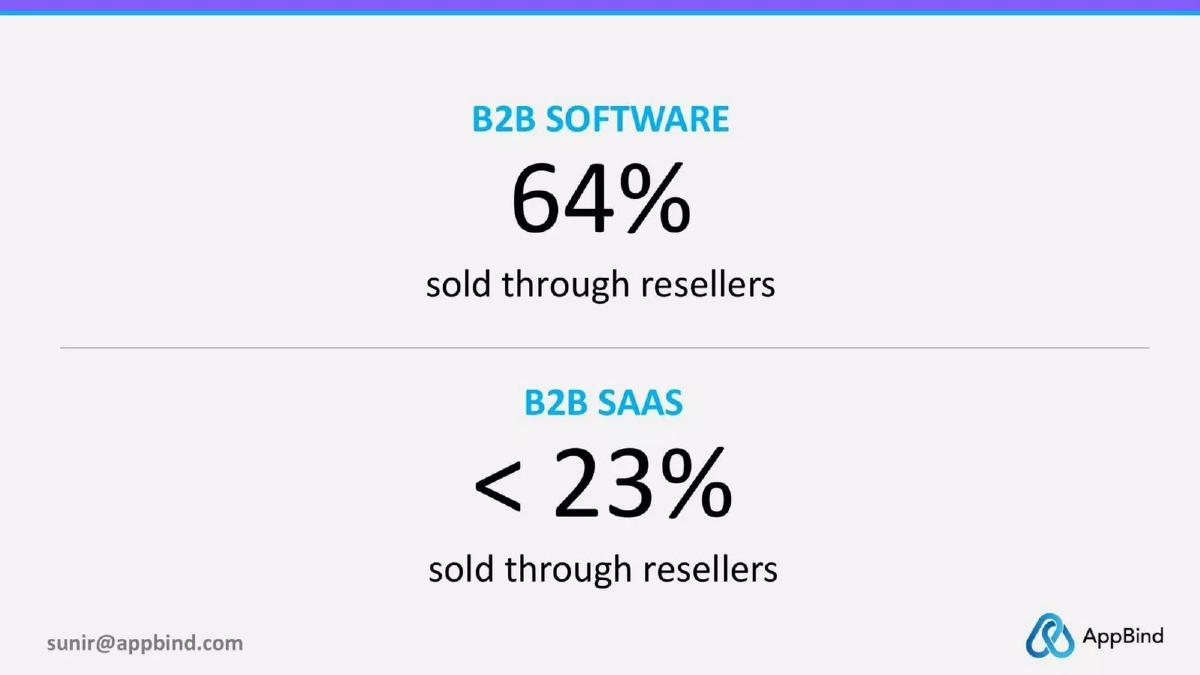
- The deck identifies a significant market opportunity by contrasting B2B software (64% sold through resellers, Slide 2) with B2B SaaS (<23% sold through resellers, Slide 2).
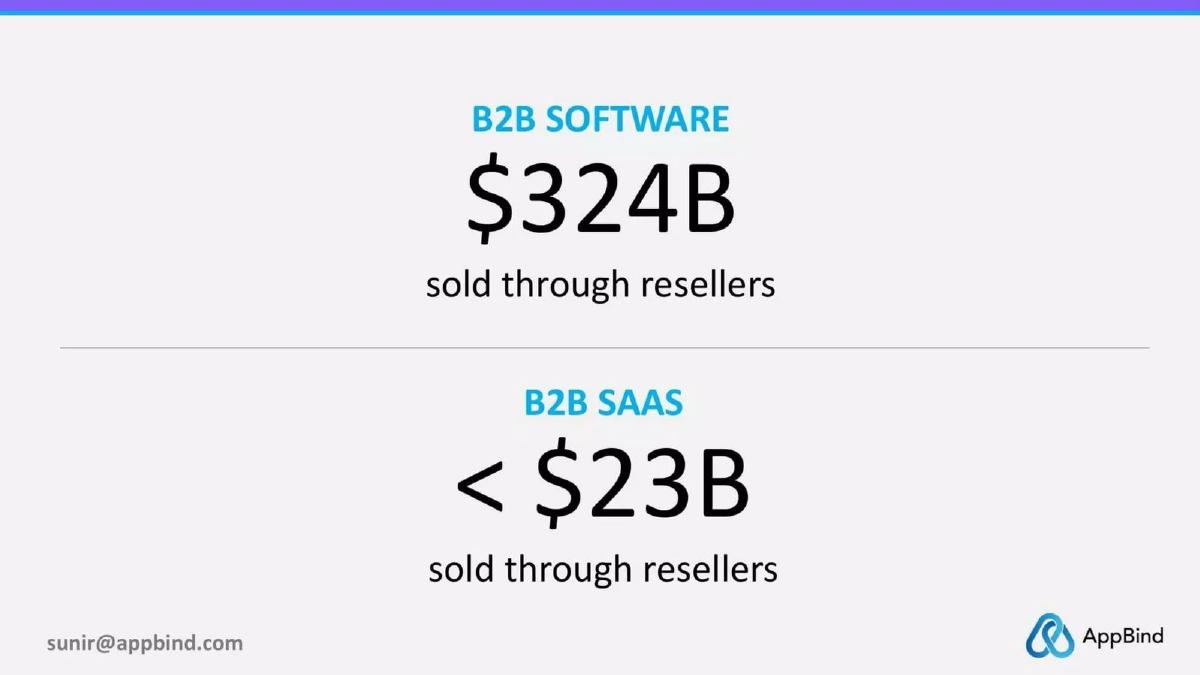
- It quantifies this market discrepancy in monetary terms: $324B for B2B software vs. <$23B for B2B SaaS sold through resellers (Slide 3).
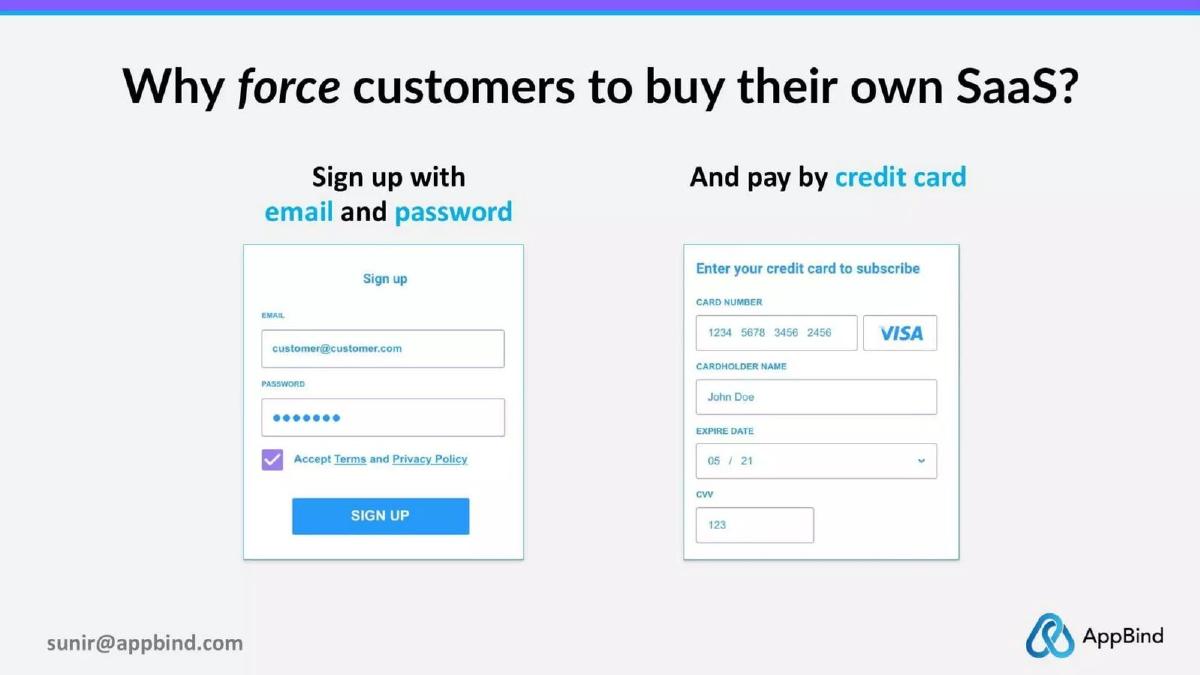
- The problem statement highlights the manual effort and customer friction involved in agencies managing client SaaS subscriptions (Slide 5).
- AppBind's solution involves creating virtual emails, shared passwords, and virtual credit cards that automatically expense clients and allow for markups (Slide 7, Slide 8).
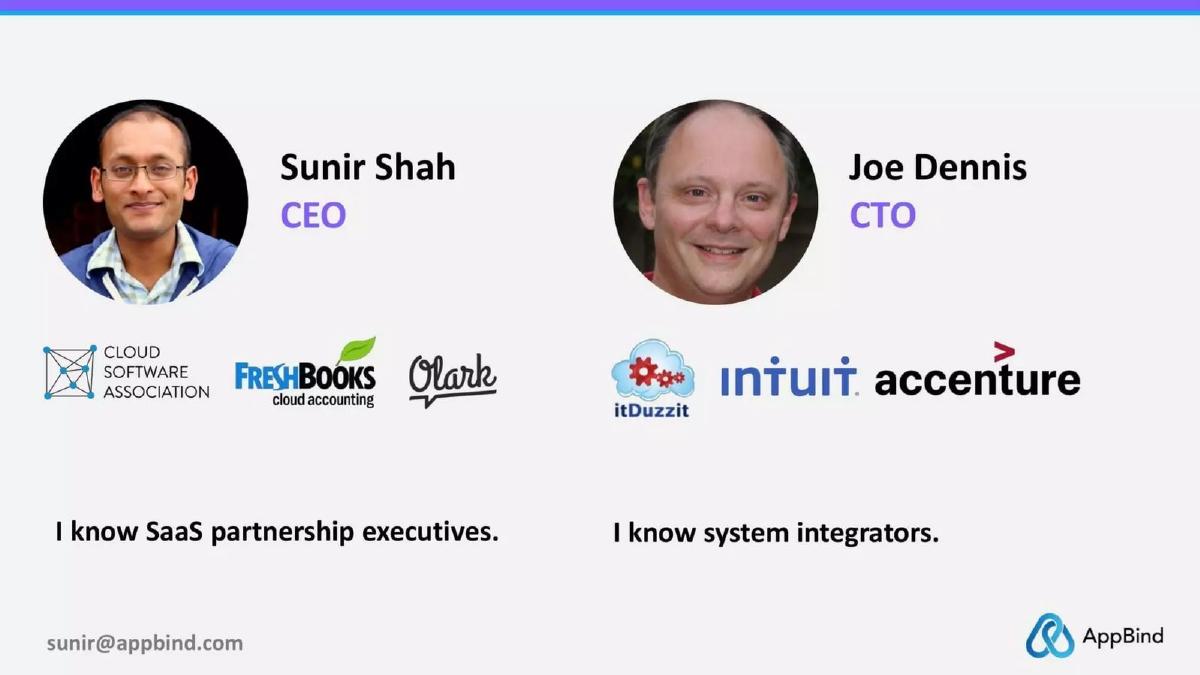
- The team slide introduces the CEO, Sunir Shah, and CTO, Joe Dennis, showcasing relevant experience in SaaS partnerships and system integration (Slide 4).
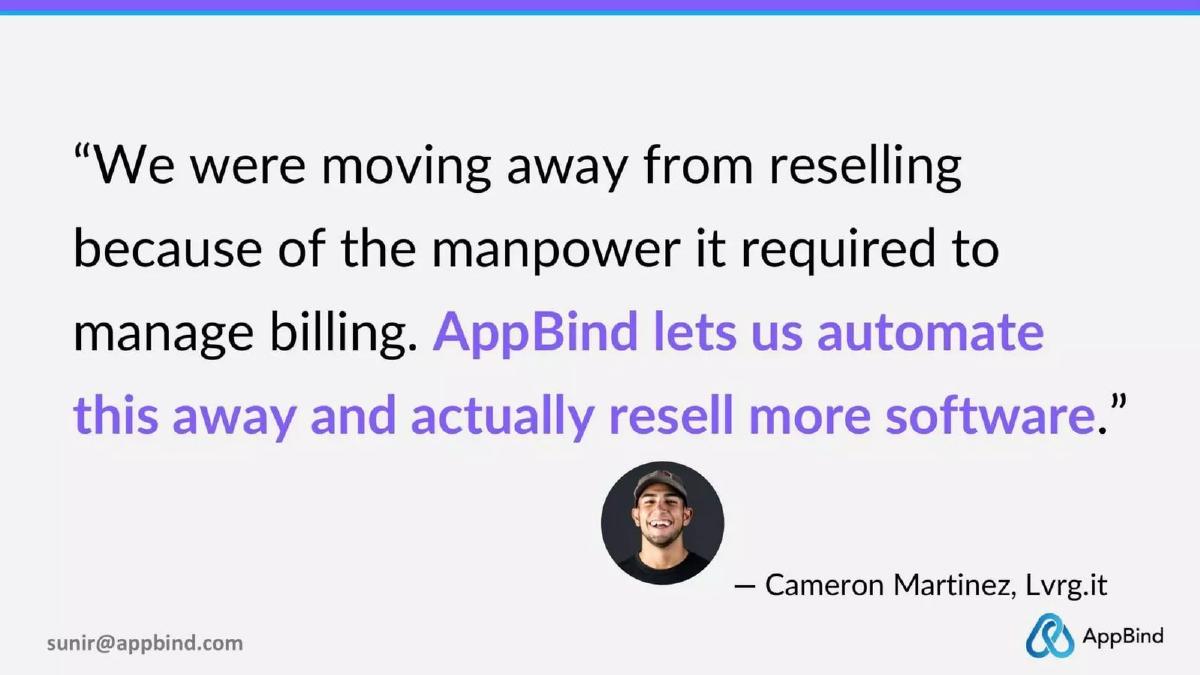
- A customer testimonial from Cameron Martinez, Lvrg.it, emphasizes the automation of billing management and increased reselling capacity (Slide 6).
- The deck does not include any financial projections, a detailed business model beyond 'markups,' or a competitive analysis.
- There is no explicit 'ask' from investors or information regarding the funding round size, use of funds, or valuation.
AppBind Pitch Deck Teardown: Unlocking SaaS Reseller Channels
This teardown analyzes the 9-slide Seed pitch deck for AppBind, a company aiming to streamline the process for agencies and consultants to manage client SaaS subscriptions. The deck, dated March 2020, focuses on identifying a significant market gap in SaaS reselling and presenting a technological solution to address it. It highlights the manual inefficiencies currently faced by resellers and proposes an automated system for procurement and expense management. While concise, the deck effectively introduces the problem and solution, supported by market data and team credentials. However, it notably omits several elements typically expected in a Seed-stage pitch, such as financial projections, a detailed business model, and a clear funding ask.
What is this deck?
This is a Seed-stage pitch deck for AppBind, dated March 2020, as indicated on Slide 1. The company's self-description from the catalogue listing states that AppBind is 'opening the cloud software reseller channel by empowering agencies and consultants to procure cloud subscriptions on behalf of clients and automatically manage to expense. It creates credit cards that automatically expenses clients when users buy SaaS, ads, and digital assets on their behalf.' The deck's primary purpose is to introduce this problem and solution to potential investors, demonstrating the market opportunity and the team's capability to execute.
Slide-by-Slide Walkthrough
1. Title Slide: AppBind - Bringing SaaS into the software reseller market
The first slide serves as the title slide, featuring the AppBind logo prominently at the top. The main title, 'Bringing SaaS into the software reseller market,' clearly states the company's core mission. Below this, the date 'March 2020' is provided, indicating the deck's recency at the time of presentation. The company's website, 'www.appbind.com,' is also listed, offering an immediate point of reference for further information. The design is clean, utilizing a purple background with white text and logo.
2. Market Opportunity: B2B Software vs. B2B SaaS Reselling Percentage
This slide presents a key market insight by comparing the percentage of B2B software sold through resellers with that of B2B SaaS. It states that '64%' of 'B2B SOFTWARE' is 'sold through resellers.' In contrast, for 'B2B SAAS,' less than ' Building on the previous slide, Slide 3 quantifies the market opportunity in monetary terms. It shows that '$324B' of 'B2B SOFTWARE' is 'sold through resellers.' For 'B2B SAAS,' the figure is ' The team slide introduces the two primary figures behind AppBind: Sunir Shah, CEO, and Joe Dennis, CTO. Each individual is presented with a headshot and their title. Sunir Shah's experience is highlighted with logos for Cloud Software Association, FreshBooks, and Olark, accompanied by the statement, 'I know SaaS partnership executives.' Joe Dennis's background includes logos for itDuzzit, Intuit, and Accenture, with the statement, 'I know system integrators.' This slide aims to establish credibility and demonstrate relevant expertise within the founding team for the problem domain.
5. Problem Statement: Why force customers to buy their own SaaS?
This slide articulates the problem AppBind aims to solve. It poses the question, 'Why force customers to buy their own SaaS?' Below this, two common scenarios are depicted with mock-up user interfaces. The left side shows a 'Sign up with email and password' form, illustrating a typical SaaS registration process. The right side displays an 'And pay by credit card' form, showing a standard credit card entry screen. These visuals effectively convey the manual, repetitive, and fragmented process that agencies and their clients currently endure when managing multiple SaaS subscriptions, implying inefficiency and friction.
6. Customer Testimonial: Automation for Resellers
Slide 6 features a direct quote from a customer, providing social proof and validating the problem and potential solution. The quote reads: '“We were moving away from reselling because of the manpower it required to manage billing. AppBind lets us automate this away and actually resell more software.”' This statement is attributed to '– Cameron Martinez, Lvrg.it,' and includes a small headshot of Cameron Martinez. The testimonial directly addresses the pain point of billing management and highlights AppBind's ability to enable more reselling, reinforcing the value proposition.
7. Solution: Virtual Emails and Virtual Credit Cards
This slide visually presents AppBind's core solution. It mirrors the layout of the problem slide (Slide 5) but shows how AppBind streamlines the process. On the left, it shows a sign-up form with 'customer.saasy@shared.appbind.com' as the email, stating 'AppBind creates a new virtual email and password shared with the customer.' On the right, it displays a mock-up of a credit card entry form alongside a virtual credit card, explaining 'AppBind creates a virtual credit card that expenses the customer automatically.' This slide clearly illustrates the technical mechanisms AppBind uses to automate subscription management.
8. Solution: Centralized Management and Automated Expensing
Continuing the explanation of the solution, Slide 8 demonstrates the benefits of AppBind's system. On the left, a screenshot titled 'Client's subscriptions' shows a list of various SaaS subscriptions (AWS, Zapier, LinkedIn Ads, Clearbit, Microsoft Office 365, Docusign) with their respective costs and dates. The caption reads, 'All customer’s subscriptions managed in one place.' On the right, a sample 'Invoice' dated 'JULY 17, 2019' is displayed, showing an 'AGENT' (John's Agency), a 'CLIENT' (Jane's Yoga), an AWS service charge, and a '+ Management fee (20%)' leading to a total. The accompanying text states, 'Subscriptions are automatically expensed—plus markups!' This slide effectively showcases the centralized management and automated billing, including the ability for agencies to add markups.
9. Call to Action: Let's talk!
The final slide is a straightforward call to action. It features the AppBind logo and the phrase 'Let's talk!' Below this, the contact information for Sunir Shah, CEO, is provided: 'Sunir Shah, CEO' and 'sunir@appbind.com.' The company's website, 'www.appbind.com,' is also reiterated. This slide serves as the concluding point of the presentation, inviting potential investors to engage further with the team.
What Works Well
Clear Problem and Market Opportunity (Slides 2, 3, 5): The deck excels at identifying a significant market gap. By contrasting B2B software and B2B SaaS reseller percentages and values, AppBind clearly articulates an untapped opportunity. The visual representation of the manual sign-up and payment process on Slide 5 effectively highlights the pain point for agencies and their clients. · Concise Solution Explanation (Slides 7, 8): The solution is presented clearly and visually. The mock-ups of virtual emails, shared passwords, virtual credit cards, and the centralized subscription dashboard, along with the automated invoice, make it easy to understand how AppBind works and its immediate benefits. The concept of 'markups' is also clearly integrated into the solution. · Credible Team (Slide 4): The team slide introduces the CEO and CTO with relevant prior experience and specific statements about their expertise ('I know SaaS partnership executives,' 'I know system integrators'). This helps build confidence in the founders' ability to tackle the problem. · Customer Validation (Slide 6): Including a direct customer testimonial provides valuable social proof. The quote directly addresses the pain point of billing management and highlights the positive impact of AppBind, lending credibility to the solution. · Minimalist Design: The deck uses a clean, consistent design with ample white space and clear typography. This makes the slides easy to read and digest, focusing attention on the key data points and visuals.
What is Missing
Financial Projections: There are no slides detailing revenue forecasts, growth projections, or key financial metrics. This is a critical omission for a Seed-stage deck, as investors need to understand the potential return on their investment. · Business Model Details: While 'markups' are mentioned, a comprehensive explanation of AppBind's business model (e.g., percentage of transaction, subscription fees, tiered pricing) is absent. How does AppBind make money beyond the reseller's markup? · Competitive Landscape: The deck does not mention any competitors or how AppBind differentiates itself from existing solutions or alternatives. Understanding the competitive environment is crucial for investors. · Go-to-Market Strategy: There is no information on how AppBind plans to acquire customers (agencies, consultants) or how it will scale its operations. · Ask and Use of Funds: The deck lacks a clear 'ask' from investors, including the amount of funding sought, the valuation, and how the raised capital will be utilized (e.g., hiring, product development, marketing). This is a fundamental component of any pitch deck. · Unit Economics: Details on customer acquisition cost (CAC), lifetime value (LTV), churn rates, or gross margins are not provided. These metrics are vital for assessing the scalability and profitability of the business. · Roadmap/Milestones: There is no indication of future product development, key milestones, or a timeline for achieving them. · Market Size (TAM/SAM/SOM): While the deck highlights a market discrepancy, it doesn't explicitly define the Total Addressable Market (TAM), Serviceable Available Market (SAM), or Serviceable Obtainable Market (SOM) for AppBind. · Traction/Metrics: Given the 2018 Seed stage, some early traction metrics (e.g., number of agencies, number of subscriptions managed, total value processed) would strengthen the pitch, even if small. The deck is dated March 2020, so two years of potential traction could have been included.
What a Founder Should Copy
Clear Problem Identification with Data (Slides 2, 3, 5): Founders should emulate AppBind's approach to clearly defining a problem and substantiating it with compelling market data. The comparison between B2B software and SaaS reselling is a strong way to highlight a unique opportunity. · Visual Problem & Solution Explanation (Slides 5, 7, 8): Using mock-ups and visual aids to explain complex processes (like sign-ups, payments, and automated invoicing) is highly effective. This makes the problem relatable and the solution understandable, even for non-technical investors. · Concise Team Slide with Relevant Experience (Slide 4): Presenting key team members with their titles, relevant past companies, and a brief statement of their specific expertise for the venture is an efficient way to establish credibility. · Inclusion of a Customer Testimonial (Slide 6): A well-placed, impactful customer testimonial can provide strong social proof and validate the problem and the proposed solution from an end-user perspective. · Minimalist and Focused Design: The clean, uncluttered design of the deck, which prioritizes readability and focuses on one key message or data point per slide, is an excellent practice. Avoid overwhelming investors with too much information on a single slide.
Frequently asked questions
- What problem does AppBind aim to solve for agencies and consultants?
- AppBind aims to solve the problem of manual and labor-intensive billing management for agencies and consultants who procure SaaS subscriptions for their clients. The deck suggests that the current process forces customers to buy their own SaaS, involving separate sign-ups and credit card entries, which is inefficient and hinders reselling efforts, as highlighted on Slide 5 and Slide 6.
- How does AppBind's solution work according to the deck?
- AppBind's solution involves creating virtual email addresses and shared passwords for client SaaS accounts, along with virtual credit cards. These virtual cards automatically expense the client for subscriptions and allow agencies to apply markups. This system centralizes subscription management and automates billing, as illustrated on Slide 7 and Slide 8.
- What is the market opportunity identified by AppBind?
- AppBind identifies a significant market opportunity by highlighting the discrepancy between B2B software and B2B SaaS sold through resellers. While 64% of B2B software ($324B) is sold this way, less than 23% of B2B SaaS (less than $23B) is. This suggests a large untapped potential for SaaS reselling, as shown on Slide 2 and Slide 3.
- Who are the key team members presented in the pitch deck?
- The pitch deck presents two key team members on Slide 4: Sunir Shah, CEO, and Joe Dennis, CTO. Sunir Shah is noted for knowing SaaS partnership executives, with experience at Cloud Software Association, FreshBooks, and Olark. Joe Dennis is noted for knowing system integrators, with experience at itDuzzit, Intuit, and Accenture.
- What critical information is missing from this pitch deck?
- Several critical pieces of information are missing from this pitch deck. There are no financial projections, a detailed business model beyond 'markups,' or a competitive analysis. The deck also omits a clear 'ask' from investors, details on the funding round size, use of funds, or valuation. Furthermore, unit economics, customer acquisition strategy, and a go-to-market plan are not included.