Apheros, a Swiss hardware startup, uses a concise 10-slide deck to pitch its patented metal foam technology designed for high-performance cooling. The deck focuses heavily on the technical superiority of its material—boasting a 100x to 1000x surface area increase over industry standards—and the massive energy crisis facing data centers. By positioning liquid cooling as a market growing at a 24.4% CAGR, Apheros creates a compelling case for its role in the future of AI and high-performance computing. While the deck lacks a specific financial 'Ask' slide or detailed unit economics, it successfu…
Key takeaways
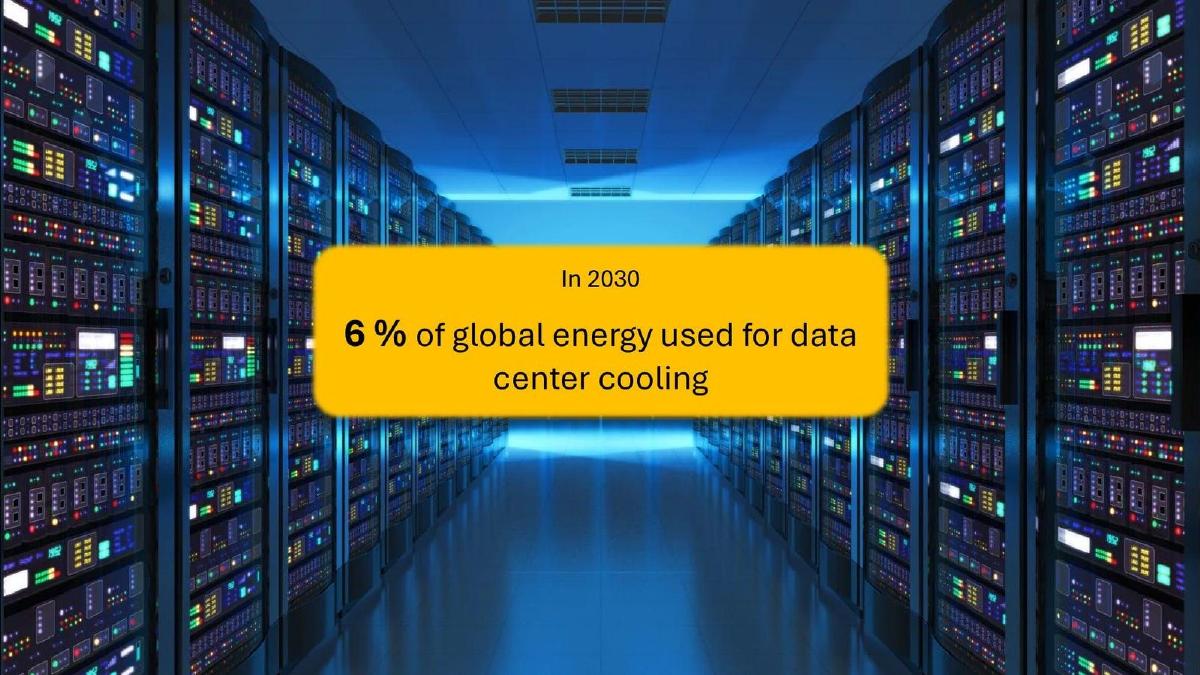
- The deck identifies a massive macro problem: data center cooling is projected to consume 6% of global energy by 2030 (Slide 2).
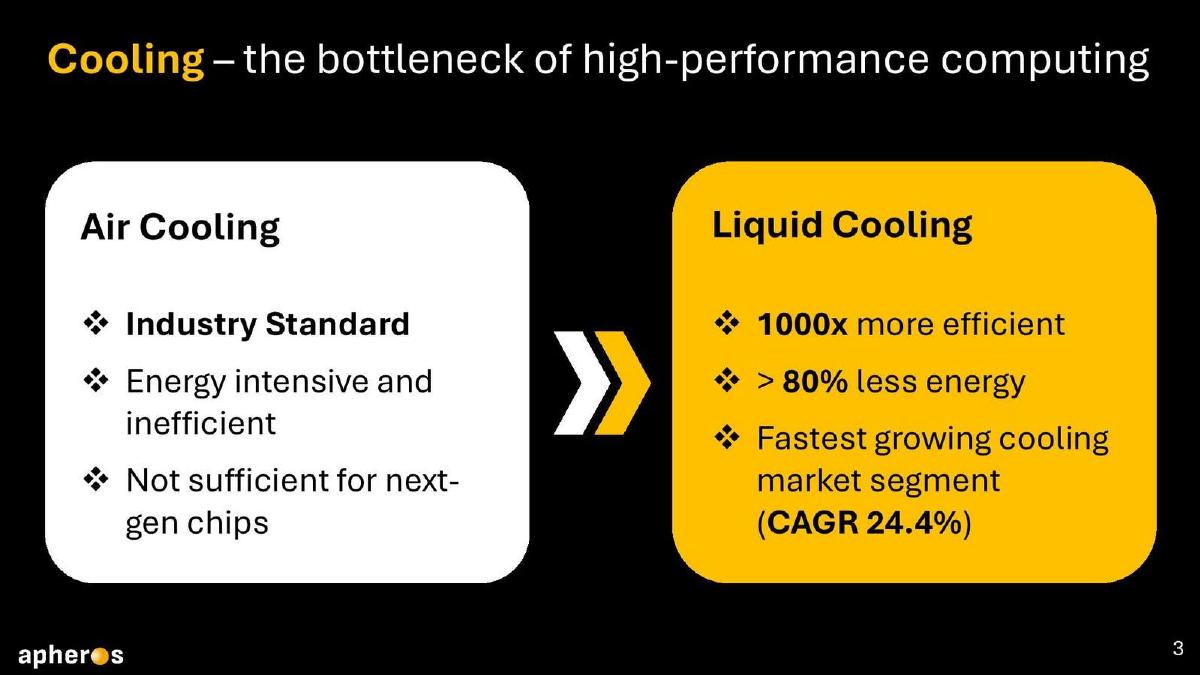
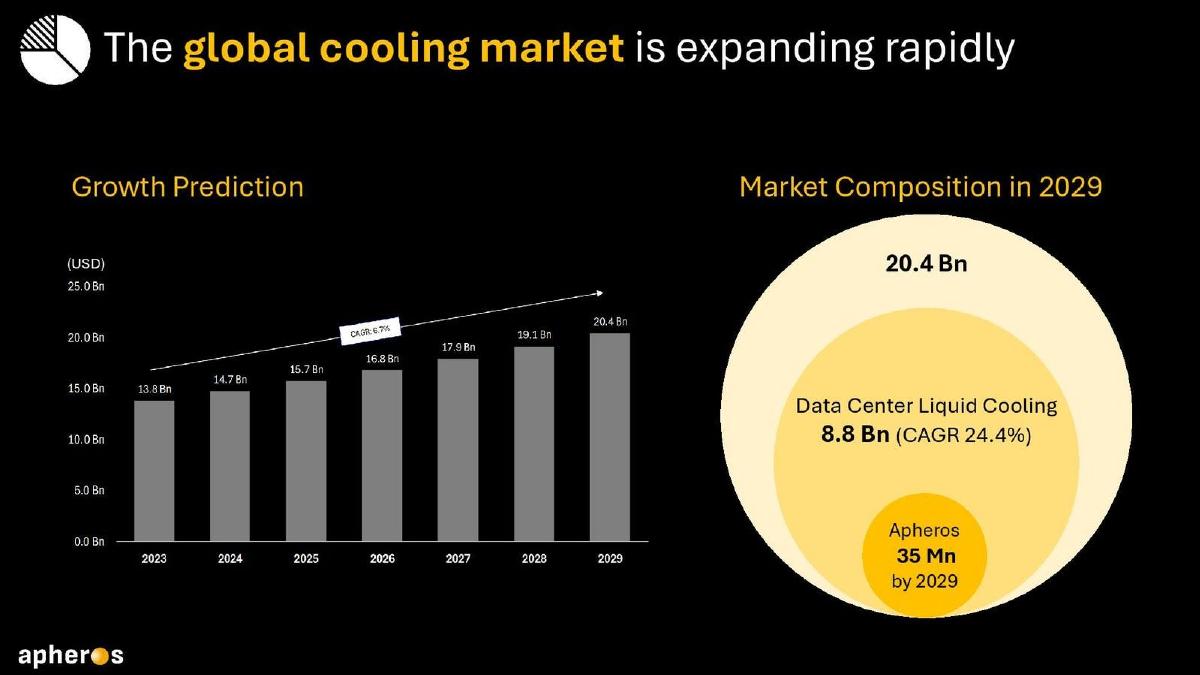
- Apheros positions its technology within the liquid cooling segment, which is growing at a 24.4% CAGR (Slide 3).
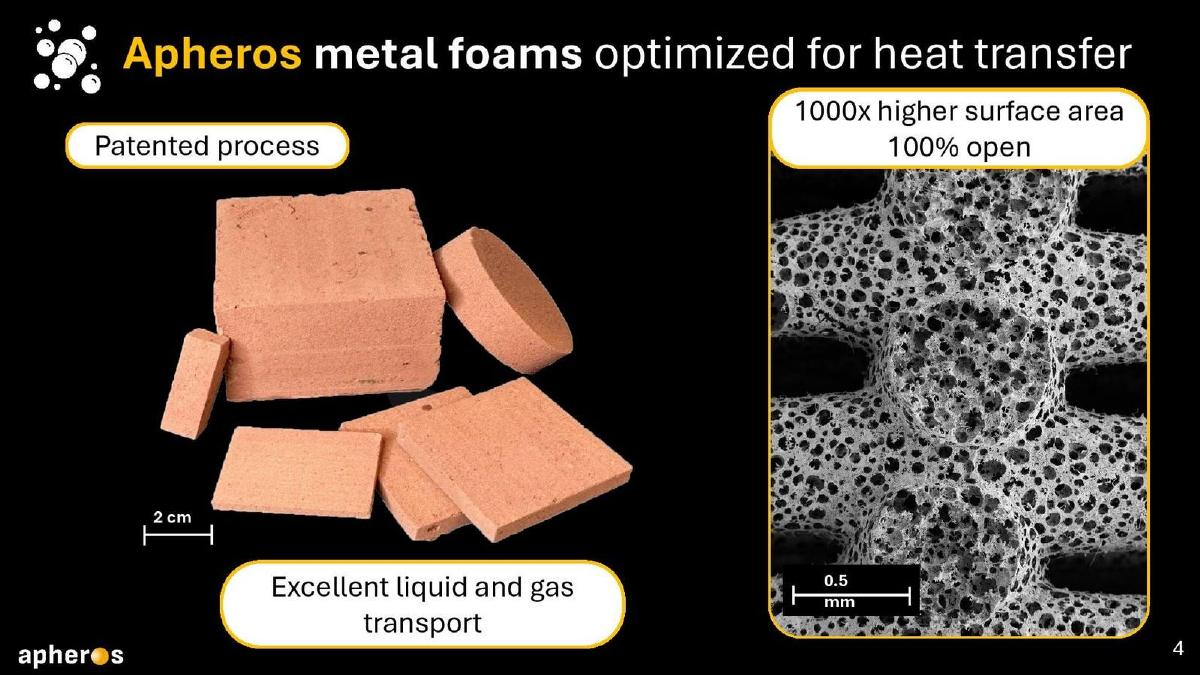
- The core value proposition is a patented metal foam that offers 1000x higher surface area and is 100% open-cell (Slide 4).
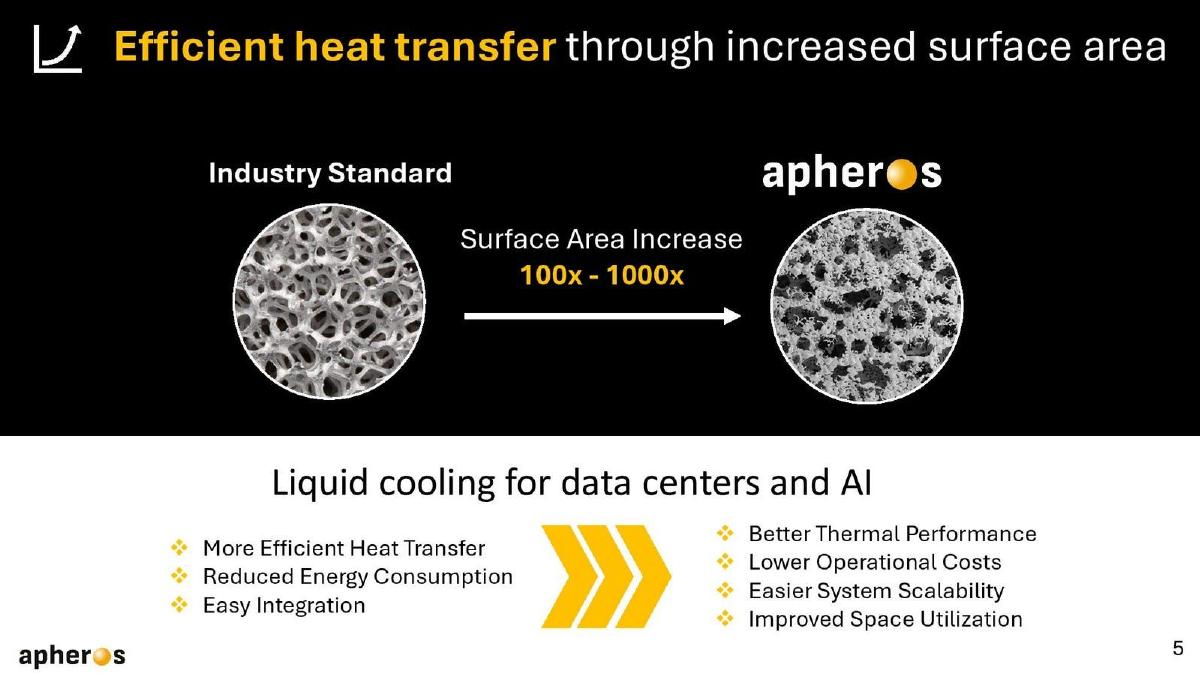
- A direct technical comparison claims a 100x to 1000x surface area increase over the 'Industry Standard' (Slide 5).
- The company targets a $35 million revenue goal by 2029 within a projected $20.4 billion total cooling market (Slide 6).
- A detailed competitive matrix places Apheros in a 'sweet spot' of high efficiency and mid-range pricing ($50 - $500) compared to 3D printed options costing over $5000 (Slide 7).
- The roadmap extends beyond data centers into hydrogen production ($3.8B market) and battery electrodes ($57.8B market) by 2029 (Slide 8).
- The team slide emphasizes deep technical expertise, featuring a CEO who is the inventor of the patented technology and a CTO with a PhD in Chemistry (Slide 9).
The Hardware Cooling Crisis: A 10-Slide Deep Dive
Apheros enters the market at a critical juncture for the technology industry. As AI models grow in complexity, the hardware required to run them generates immense heat, making traditional air cooling obsolete. This teardown analyzes the deck used by the Swiss startup to secure $1.9M in pre-seed funding. The deck is lean, technical, and focused on a single breakthrough: a patented metal foam that redefines heat transfer efficiency.
Slide 1: Title and Institutional Credibility
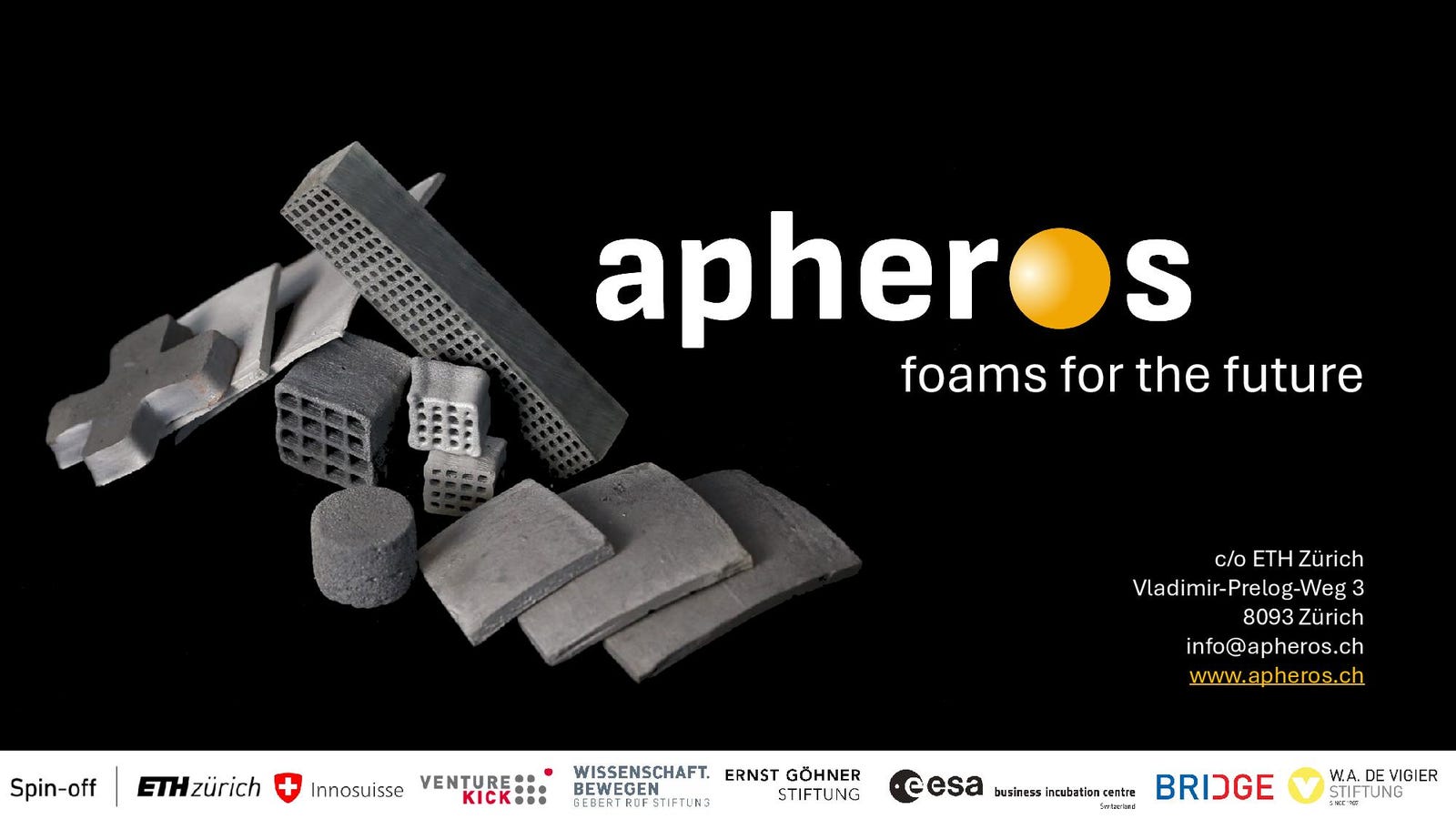
The cover slide is minimalist but heavy on 'trust signals.' By featuring the logos of ETH Zürich, Innosuisse, Venture Kick, and the European Space Agency (ESA) business incubation centre, Apheros immediately establishes its pedigree. For a pre-seed hardware company, these affiliations are often more important than early revenue, as they suggest the technology has been vetted by rigorous academic and governmental bodies. The visual of the metal foams in various shapes (crosses, blocks, cylinders) demonstrates the versatility of the manufacturing process right out of the gate.
Slide 2: The Macro Problem
Slide 2 uses a high-impact visual of a data center with a single, bold statistic: 'In 2030, 6% of global energy used for data center cooling.' This is a classic 'hair on fire' problem. It frames the startup not just as a hardware play, but as a sustainability and energy-efficiency play. By projecting to 2030, they align their growth trajectory with the global push for greener infrastructure.
Slide 3: The Technology Shift
This slide sets up the transition from Air Cooling to Liquid Cooling. It labels cooling as the 'bottleneck of high-performance computing.' The slide provides three key data points for Liquid Cooling: 1000x more efficiency, >80% less energy, and a CAGR of 24.4%. This slide is crucial because it justifies why Apheros is focusing on this specific niche—it is the fastest-growing segment of a massive market.
Slide 4: The Patented Solution
Slide 4 introduces the 'Apheros metal foams.' It highlights the 'Patented process' and uses a scanning electron microscope (SEM) image to show the material's structure. The key technical claims are '1000x higher surface area' and '100% open.' For investors, the '100% open' claim is vital as it implies that liquids and gases can flow through the material with minimal resistance, which is the primary failure point of many conventional foams.
Slide 5: Technical Comparison
Slide 5 reinforces the surface area claim with a direct visual comparison between the 'Industry Standard' and 'Apheros.' It quantifies the 'Surface Area Increase' at '100x - 1000x.' The bottom of the slide lists the business benefits: better thermal performance, lower operational costs, easier system scalability, and improved space utilization. This slide bridges the gap between 'cool science' and 'business value.'
Slide 6: Market Size and Revenue Goals
The market slide provides a growth prediction from 2023 to 2029, showing the global cooling market reaching $20.4 Billion . Within that, they isolate the 'Data Center Liquid Cooling' segment at $8.8 Billion . Most interestingly, they include a specific target: 'Apheros 35 Mn by 2029.' While $35M is a relatively conservative target for a $20B market, it suggests a realistic, bottom-up approach to market share rather than the typical 'we will capture 1% of everything' trope.
Slide 7: The Competitive Matrix
This is perhaps the strongest slide in the deck. It compares Apheros to five competitors: Tube and finned heat exchangers, Microfluidic channels, Textured Pipes, 3D Printed, and Conventional metal foams. Apheros claims '+++' (top marks) in cooling efficiency, thermal interface, and wetting. The 'Price Range' row is the clincher: Apheros is listed at $50 - $500 , while the only other high-efficiency option (3D Printed) is listed at >>$5000 . This clearly defines their competitive advantage: high-end performance at a mid-market price point.
Slide 8: Future Verticals
Slide 8 shows that Apheros is not a one-trick pony. They outline a roadmap for 'Sustained growth verticals.' This includes Grease Reservoirs (2025), H2 Production (2027), and Battery Electrodes (2029). By including the battery electrode market—valued at $57.8 Billion —they show investors a path to a much larger exit or IPO-scale business beyond just data center cooling.
Slide 9: The Team
The team slide emphasizes technical leadership. Dr. Julia Carpenter (CEO) is identified as the 'Inventor of Apheros patented technology,' and Dr. Gaëlle Andreatta (CTO) holds a PhD in Chemistry and an EMBA-X. The presence of five other team members (including R&D and production interns) suggests that the $1.9M raise will likely be used to transition these roles into full-time positions and scale the manufacturing team.
Slide 10: Mission and Vision
The final slide ties the company to the UN Sustainable Development Goals (SDGs), specifically Gender Equality, Affordable and Clean Energy, and Responsible Consumption. While these are 'feel-good' metrics, they are increasingly important for European VCs who have strict ESG (Environmental, Social, and Governance) mandates.
What Works in This Deck
Technical Clarity: For a deep-tech company, there is a high risk of getting bogged down in equations. Apheros avoids this by using SEM imagery and simple '+++' vs '--' comparisons. They make the physics of surface area feel like an obvious business advantage.
Market Segmentation: Instead of just claiming a $20B market, they break it down into the specific sub-segment (Liquid Cooling) that is relevant to their technology. This shows a sophisticated understanding of their industry.
Price Positioning: By including specific dollar amounts for their competitors ($5000 for 3D printing vs $500 for Apheros), they provide a clear 'Reason to Buy' for procurement departments at major data center operators.
What Is Missing
The Ask: The most glaring omission is a slide detailing the funding round. There is no mention of the $1.9M target, the valuation, or how the funds will be allocated between R&D, manufacturing, and sales. This information may have been moved to a separate document or discussed verbally, but its absence in the core deck is notable.
Unit Economics: While they provide a price range ($50-$500), they do not provide the cost of goods sold (COGS). Investors want to know if the 'patented process' is actually cheap to run at scale, or if the margins are thin.
Traction and Pilots: There is no mention of current customers, letters of intent (LOIs), or pilot programs. For a hardware company, showing that a major player like NVIDIA, Intel, or a hyperscaler (AWS/Google) is testing the material is the ultimate validation. The deck relies entirely on academic pedigree and technical specs rather than commercial momentum.
Founder's Playbook: What to Copy
Use the 'Bottleneck' Narrative: Apheros doesn't just say they have a better foam; they say that cooling is the bottleneck for the entire AI industry. If you can position your product as the one thing holding back a trillion-dollar trend, your valuation goes up instantly.
Visual Proof: If you have a physical product, show it. The SEM images on Slide 4 and Slide 5 are more convincing than any paragraph of text could ever be. They prove the '1000x surface area' claim visually.
Vertical Expansion: Even if you are focused on one market today, show the 'adjacent' markets you can conquer later. Slide 8 is a masterclass in showing how a single core competency (making metal foam) can be applied to three different multi-billion dollar industries.
Institutional Branding: If you are a spin-off or have won grants, put those logos on the front page. In the early stages of fundraising, you are selling trust as much as you are selling technology. Use the reputation of your university or research lab to bridge the 'credibility gap.'
Frequently asked questions
- What is the primary technology Apheros is pitching?
- Apheros is pitching a patented metal foam manufacturing process. These foams are designed for high-performance cooling, specifically for data centers and AI hardware. The material is '100% open,' allowing for excellent liquid and gas transport, and provides a surface area increase of 100x to 1000x compared to standard cooling solutions, which significantly improves heat transfer efficiency.
- How does Apheros compare to existing cooling competitors?
- On slide 7, Apheros compares itself to five other technologies. It claims superior cooling efficiency, wetting, and thermal interface compared to tube heat exchangers and microfluidic channels. Crucially, it positions itself as a cost-effective alternative to 3D printed foams (which cost >$5000) by offering a price range of $50 to $500 while maintaining similar or better performance metrics.
- What markets is Apheros targeting beyond data centers?
- While data center liquid cooling is the immediate focus, slide 8 outlines a multi-vertical strategy. This includes grease reservoirs (2025), hydrogen (H2) production (2027), and battery electrodes (2029). The latter is the largest projected market at $57.8 billion. The company argues that its high-surface-area foams are applicable anywhere that requires extreme heat exchange or high-purity material transport.
- Is there a clear financial 'Ask' in the deck?
- No. The provided 10-slide deck does not include a slide detailing how much capital the company is seeking, the valuation, or the specific milestones they intend to reach with the funding. While publisher reports indicate they raised $1.9M, the deck itself focuses entirely on the problem, technology, market, and team.
- What is the significance of the ETH Zürich branding?
- Apheros is a spin-off from ETH Zürich, one of the world's leading technical universities. This branding, featured prominently on the title slide and team slide, provides immediate institutional credibility. For a hardware and material science startup, this academic pedigree serves as a 'trust signal' for investors regarding the validity of the underlying patents and technical claims.