Castor raised $45M in 2021 for their Series B, positioning themselves as the primary infrastructure for Decentralized Clinical Trials (DCT). The deck is notably concise at just 9 slides, relying heavily on massive scale metrics rather than granular feature lists. They lead with a 'Successful Track Record' that includes 7,500+ supported studies and 250,000,000+ data points. The core narrative centers on the inefficiency of traditional clinical research—citing that 80% of non-Covid studies were delayed during the pandemic—and presents a unified platform that reduces time to first patient by 60%…
Key takeaways
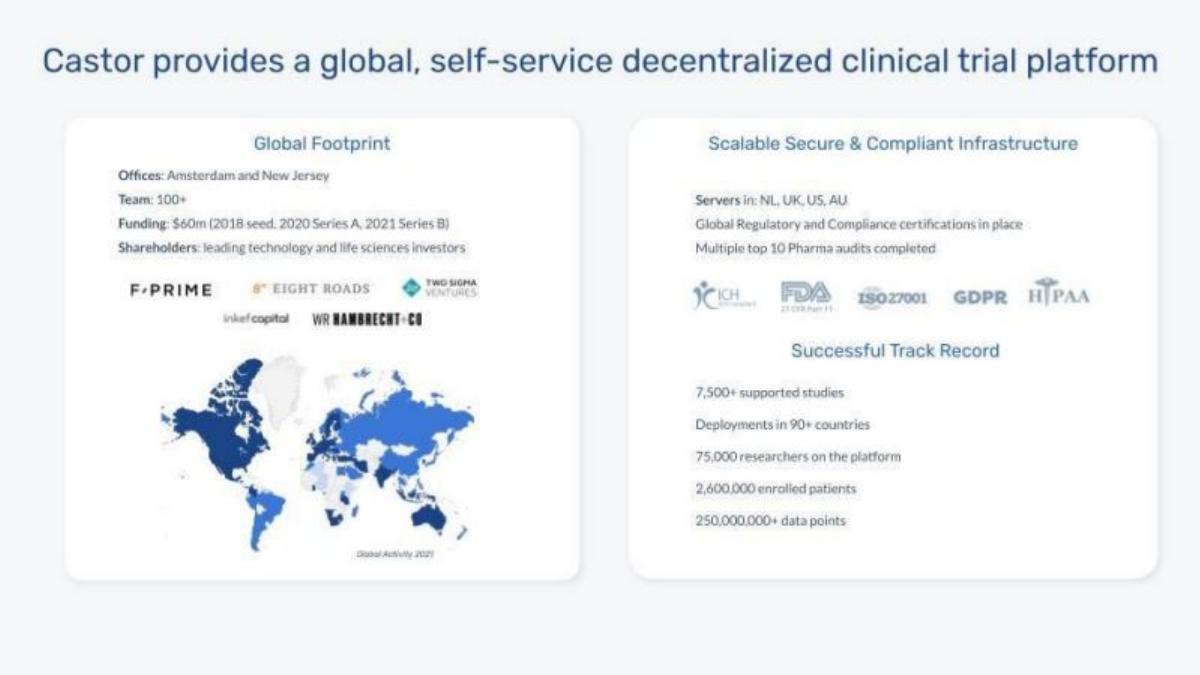
- The deck highlights a massive data scale with over 250,000,000 data points and 2,600,000 enrolled patients on Slide 2.
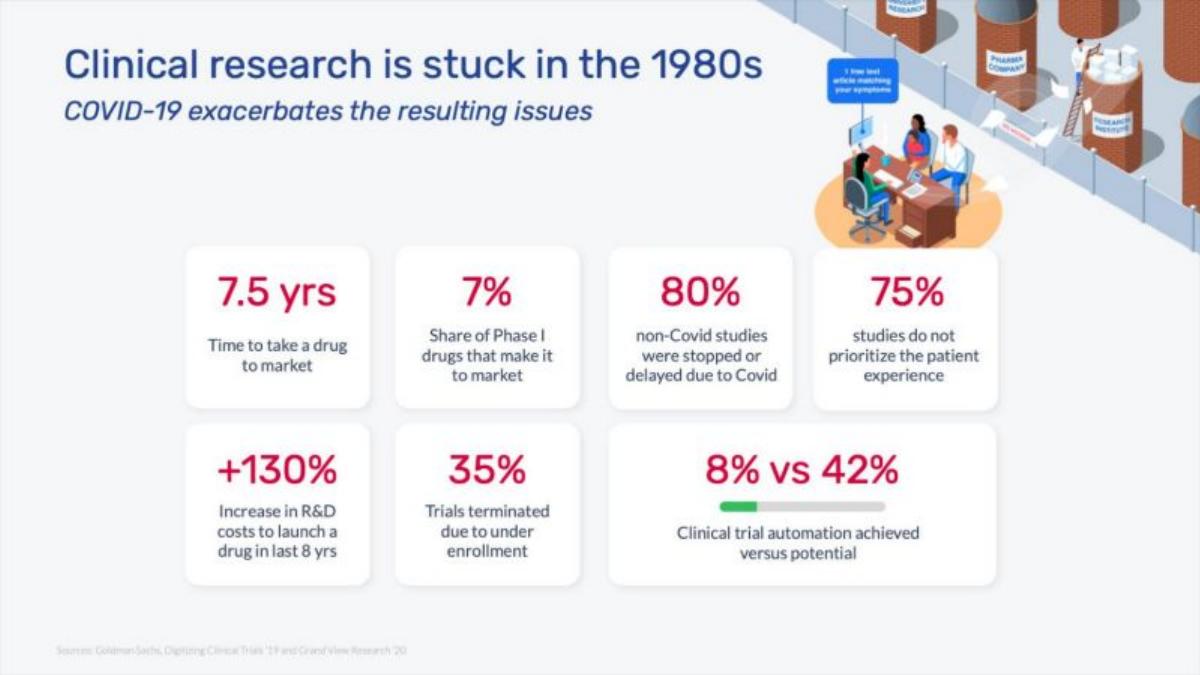
- Castor defines the problem as clinical research being 'stuck in the 1980s,' noting that R&D costs to launch a drug have increased by 130% in the last 8 years on Slide 3.
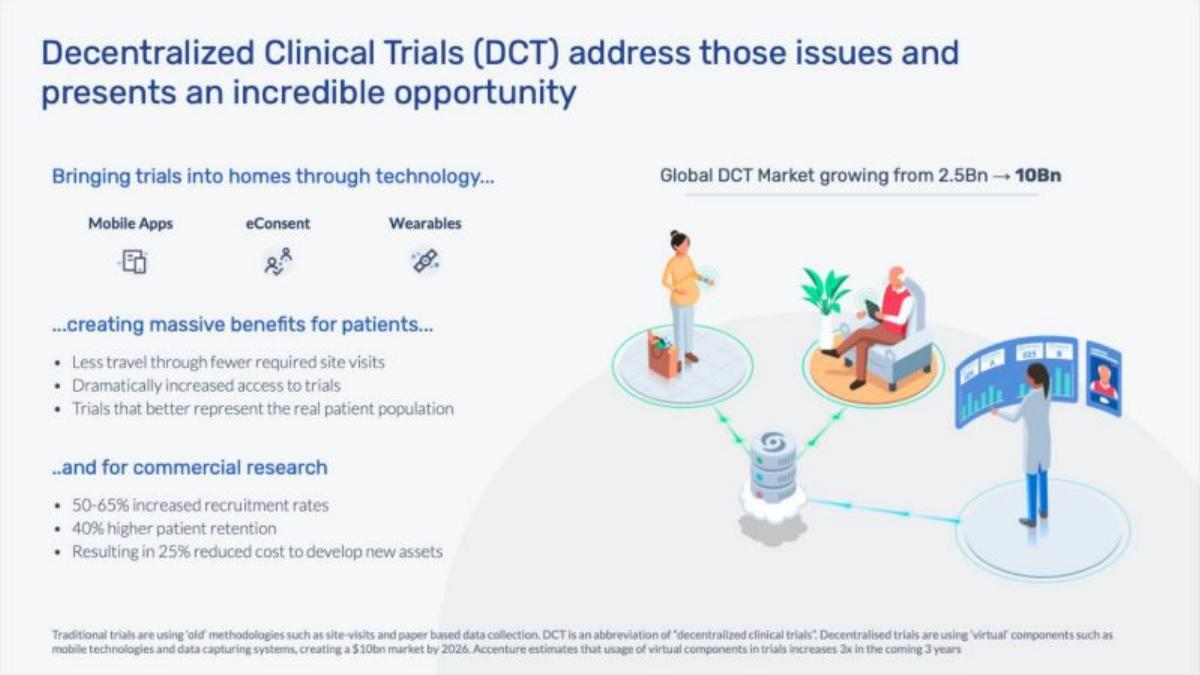
- Market opportunity is quantified by the growth of the Global DCT Market from $2.5Bn to $10Bn on Slide 4.
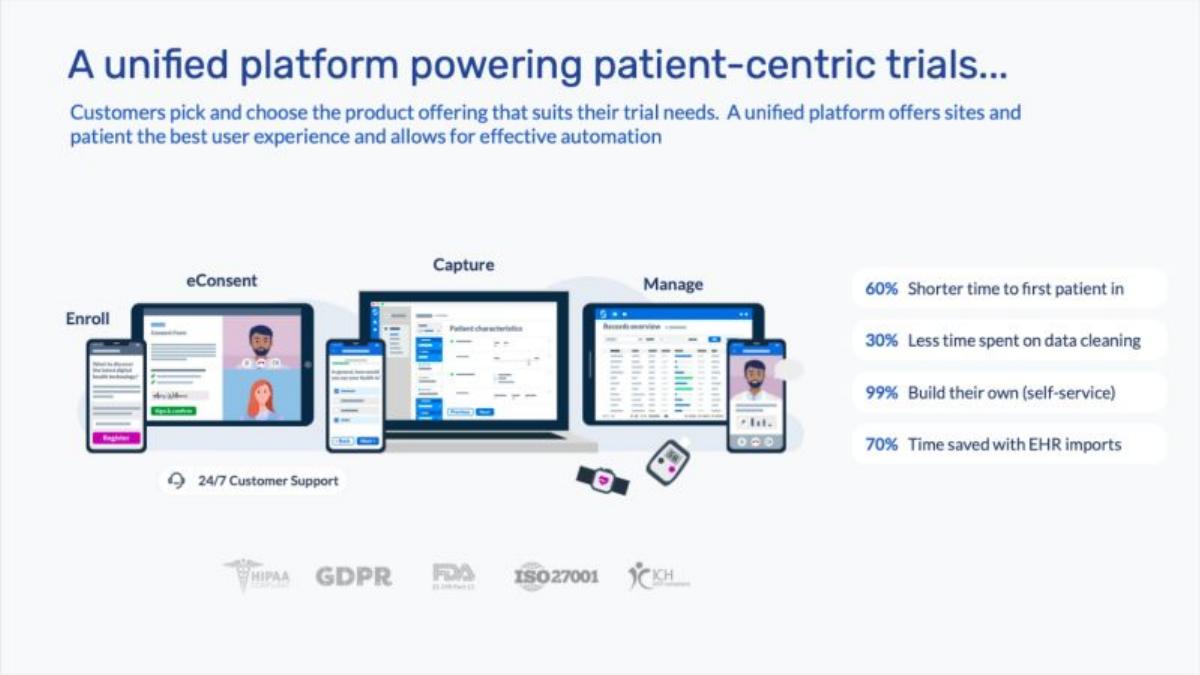
- Product efficiency is demonstrated through a 60% shorter time to first patient and 30% less time spent on data cleaning on Slide 5.
- The platform claims a 99% self-service build rate, emphasizing ease of use for researchers on Slide 5.
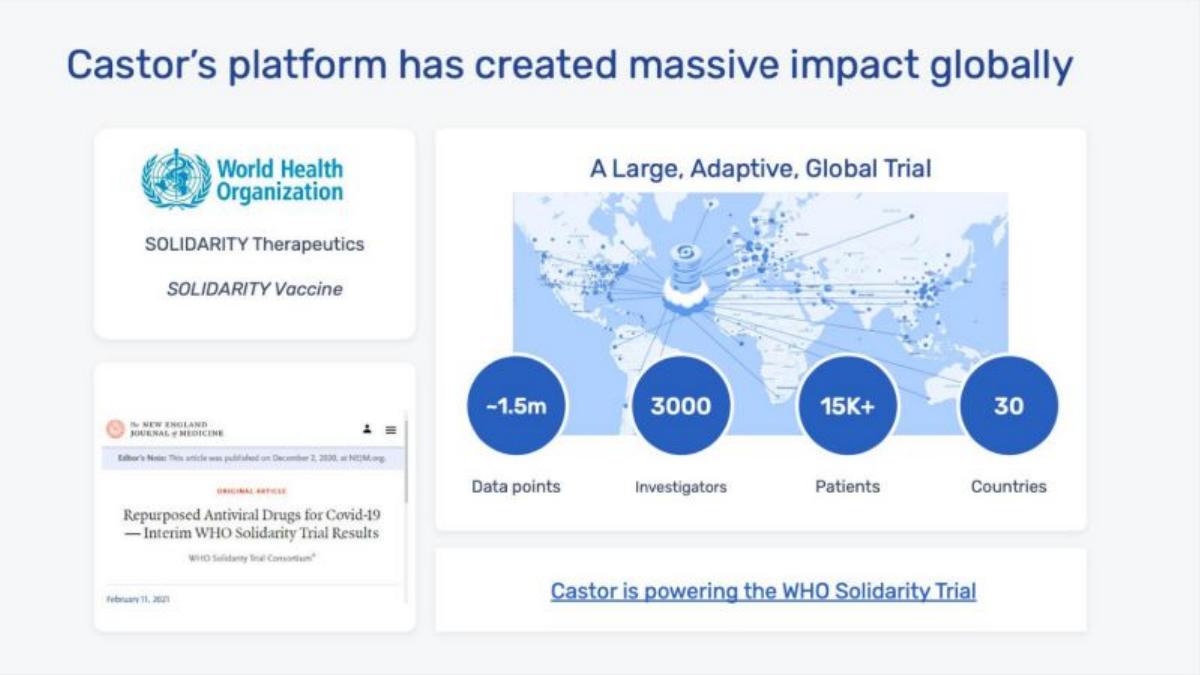
- High-level validation is achieved by showcasing their role in the WHO Solidarity Trial across 30 countries on Slide 6.
- The deck omits a traditional team slide, financial projections, and a specific use-of-funds breakdown.
- The vision slide projects a shift toward 'Computational Trials' by 2035, moving beyond standard SaaS into AI-driven research on Slide 7.
The 9-Slide Series B Strategy
Castor’s Series B deck is an exercise in restraint. Raising $45M usually involves a 20-slide deep dive into unit economics, cohort analysis, and multi-year projections. Instead, Castor relies on the sheer weight of their existing footprint. By 2021, the company wasn't just a startup; it was a critical piece of global health infrastructure. This deck is designed to prove that the 'experiment' phase is over and the 'scaling' phase is in full swing.
Slide 1: Title and Vision
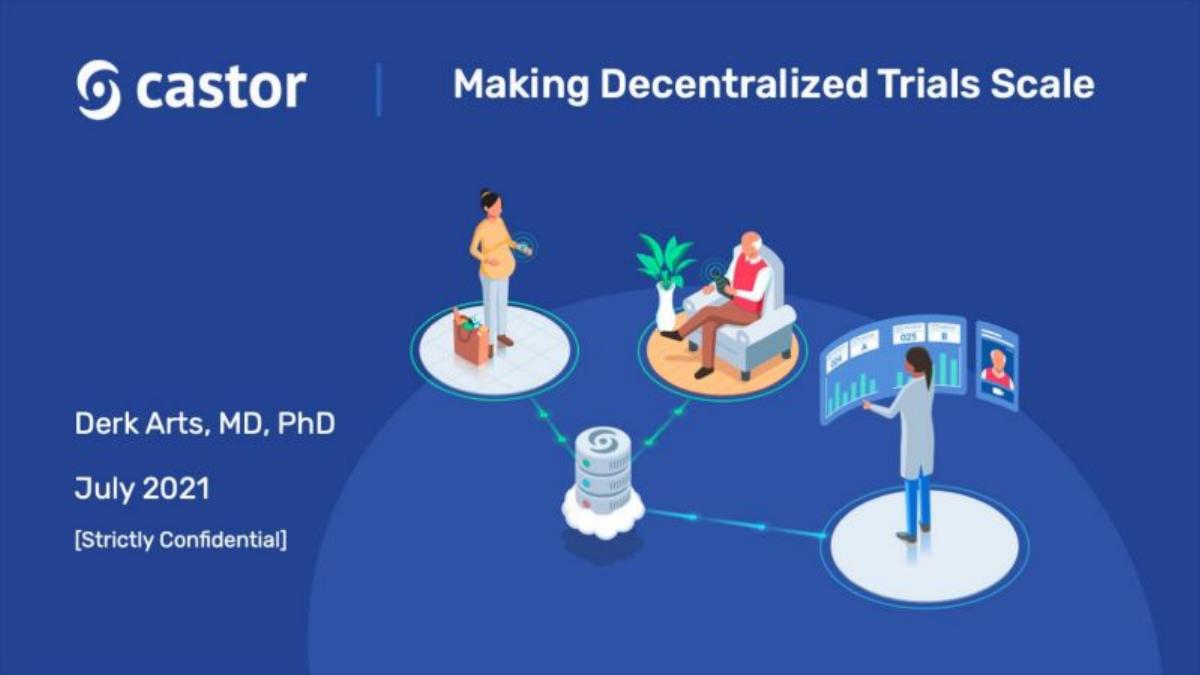
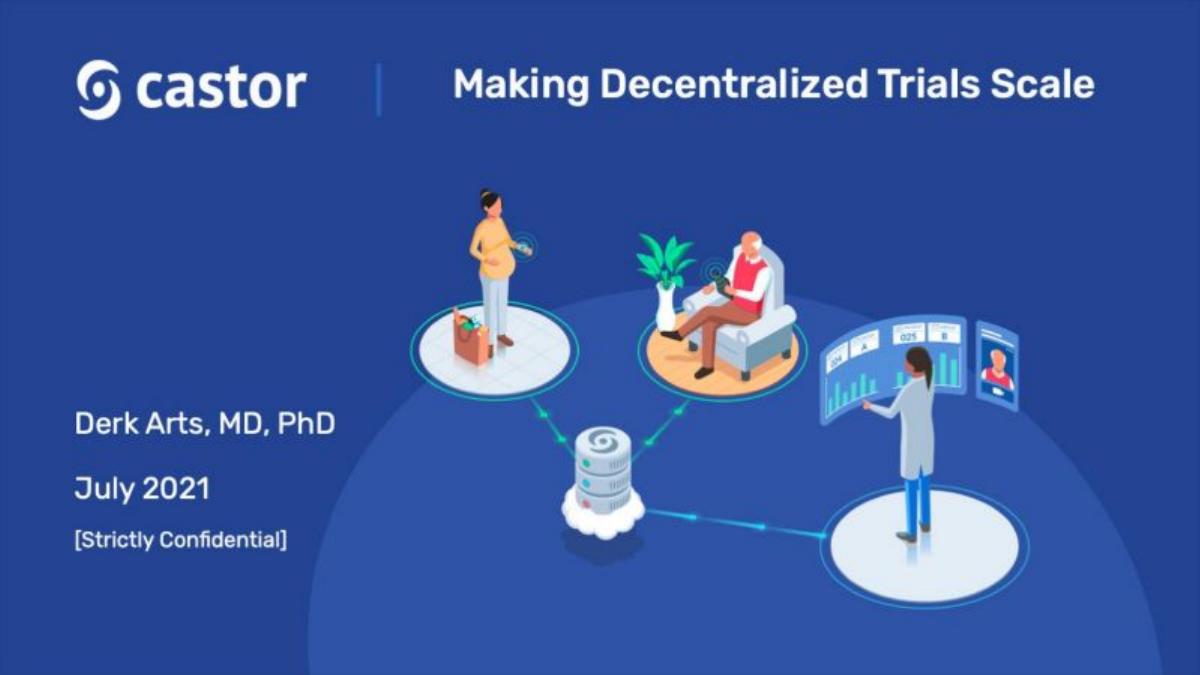
The cover slide introduces the company name and the primary value proposition: Making Decentralized Trials Scale . It features the name of the founder, Derk Arts, MD, PhD, which immediately establishes clinical and academic credibility. The date is July 2021, and the slide is marked as strictly confidential. The imagery depicts a connected ecosystem: a patient at home, a researcher in a lab, and a central cloud server, visually explaining the 'decentralized' concept without words.
Slide 2: The Global Footprint
This is the 'Credibility Slide.' Castor does not wait until the end to show their pedigree. They list offices in Amsterdam and New Jersey and a team of 100+. Crucially, they disclose their funding history: $60m total including the 2018 Seed, 2020 Series A, and 2021 Series B. The slide features logos for F-Prime, Eight Roads, and Two Sigma Ventures. The 'Successful Track Record' section is the highlight, citing 7,500+ supported studies , 2,600,000 enrolled patients , and 250,000,000+ data points . This scale is intended to make the investment feel low-risk.
Slide 3: The Industry Crisis
Slide 3 frames the problem. The headline states, Clinical research is stuck in the 1980s . It uses eight data blocks to quantify the pain: 7.5 years to take a drug to market, a 130% increase in R&D costs over the last 8 years, and the fact that 80% of non-Covid studies were delayed due to the pandemic. The most damning stat is that clinical trial automation has only achieved 8% of its potential versus a 42% target. This slide justifies why a new platform is a necessity, not a luxury.
Slide 4: The DCT Opportunity
This slide transitions from the problem to the market solution. It defines Decentralized Clinical Trials (DCT) and claims the market is growing from $2.5Bn to $10Bn . It lists benefits for two stakeholders: patients (less travel, increased access) and commercial research (50-65% increased recruitment rates, 40% higher retention). By citing a 25% reduced cost to develop new assets, Castor pitches itself as a margin-expansion tool for big pharma.
Slide 5: The Unified Platform
Slide 5 focuses on the product. It shows a 'unified platform' across mobile, tablet, and desktop, covering Enrollment, eConsent, Capture, and Management. The slide lists four specific efficiency gains: 60% shorter time to first patient , 30% less time spent on data cleaning , 99% self-service , and 70% time saved with EHR imports . The inclusion of compliance logos (HIPAA, GDPR, FDA 21 CFR Part 11) at the bottom addresses the primary barrier to entry in healthtech: security and regulation.
Slide 6: The WHO Solidarity Trial
This is the deck's 'mic drop' moment. Castor highlights its role in the World Health Organization (WHO) Solidarity Trial . They provide metrics for this specific project: ~1.5m data points, 3,000 investigators, 15,000+ patients, and 30 countries. They even include a screenshot of a New England Journal of Medicine article. For a Series B investor, this proves the platform can handle the highest possible stakes in global medicine.
Slide 7: The Future Roadmap
Slide 7 provides a historical timeline of clinical research, starting from 200 BC to a projected 2035. Castor positions itself at the '2010-2020' mark of 'Connected Trials' and looks toward Computational Trials in 2035. The text mentions that their vision goes beyond SaaS, aiming to dominate the future through 'machine readable data and AI.' This slide is meant to show that while they are winning today, their ultimate ceiling is much higher.
Slide 8: Press and Context
The final content slide provides links to recent press releases and background reading from investors like Two Sigma and Bessemer. This serves as a 'further reading' list for analysts performing due diligence, reinforcing the narrative that the industry is moving toward a 'virtual world.'
Slide 9: Appendix/Call to Action
The final slide is a promotional graphic for the platform hosting the deck, not part of the original Castor presentation. The original deck effectively ends on the press links.
What Castor Does Well
Massive Social Proof: Leading with the WHO Solidarity Trial is a brilliant move. In enterprise software, especially in life sciences, the biggest fear is 'will this work at scale?' Castor answers this by showing they are already powering one of the most important global trials in history.
Metric-Driven Value: Every slide contains hard numbers. Whether it is the 250 million data points or the 60% reduction in time to first patient, the deck avoids vague marketing speak in favor of quantifiable outcomes.
Regulatory Reassurance: By placing compliance certifications (ISO27001, GDPR, HIPAA) on multiple slides, they proactively answer the first ten questions any institutional investor would ask about data privacy.
What is Missing from the Deck
No Team Slide: While the founder is mentioned on the cover, there is no slide detailing the executive team, their backgrounds, or the board of directors. For a Series B, investors usually want to see the 'bench strength' behind the founder.
No Financials: The deck is entirely silent on revenue, ARR growth, burn rate, or customer acquisition costs (CAC). While these were likely in a separate data room, their absence in the pitch deck makes it a 'vision and validation' deck rather than a 'business model' deck.
No Competitive Landscape: The deck mentions that the industry is 'stuck in the 1980s,' but it doesn't name or compare Castor to other modern DCT players like Medable or Science 37. It assumes the investor already knows the competitive set.
No Use of Funds: There is no 'The Ask' slide. It is unclear how the $45M will be spent—whether on R&D, international sales expansion, or acquisitions.
Founder's Playbook: What to Copy
The 'Credibility First' Approach: If you have a massive, recognizable customer or a staggering data metric, do not hide it on slide 12. Castor puts their best numbers on Slide 2. This sets a tone of authority for the rest of the presentation.
Visualizing the 'Old Way' vs. 'New Way': Slide 3 and 4 do a great job of contrasting the 1980s-style paper trials with the modern, decentralized approach. Using icons and clear percentages makes the 'opportunity' feel inevitable rather than speculative.
Focus on Stakeholder Benefits: Castor doesn't just say the software is good; they explain why it's good for the patient (less travel) and the sponsor (25% reduced cost). Always map your features to the specific financial or emotional benefits of the person paying the bill.
Conclusion: Castor’s deck is a high-signal, low-noise presentation. It operates on the assumption that the Series B investor is already sold on the category (DCT) and only needs to be convinced that Castor is the most proven, compliant, and scalable player in that category. By leaning on the WHO partnership and their 250 million data points, they make that case successfully.
Frequently asked questions
- How much did Castor raise with this deck?
- According to the catalogue facts, Castor raised $45M in a Series B round in 2021. The deck itself notes on Slide 2 that they had raised a total of $60M across their Seed, Series A, and Series B rounds up to that point.
- What is the primary problem Castor is solving?
- Castor targets the inefficiency of traditional clinical trials. Slide 3 points out that it takes 7.5 years to take a drug to market and that 35% of trials are terminated due to under-enrollment. They argue that the industry is 'stuck in the 1980s' and lacks automation.
- Who are Castor's existing investors?
- Slide 2 lists several prominent technology and life sciences investors, including F-Prime, Eight Roads, Two Sigma Ventures, Inkef Capital, and WR Hambrecht + Co.
- What specific metrics prove the platform's efficacy?
- Slide 5 provides four key performance indicators: 60% shorter time to first patient, 30% less time spent on data cleaning, 99% of users building their own trials (self-service), and 70% time saved with EHR (Electronic Health Record) imports.
- Is there a team slide in the Castor deck?
- No. The 9-slide deck provided does not include a team slide with biographies or photos. It only mentions the founder's name, Derk Arts, MD, PhD, on the title slide and notes a total team size of 100+ on Slide 2.