Cazza presents a high-stakes hardware play in the construction technology sector, seeking an $80 million Series A round to scale its autonomous 3D-printing robotics. The deck centers on two primary hardware products: the X1 (starting at $480,000) and the X1 CORE (starting at $620,000), which are designed to print concrete foundations and structures. The company leverages significant external validation, citing a Deloitte study and its selection for the Dubai Future Accelerator. While the deck provides specific pricing and technical specifications for its robots, it lacks detailed financial pr…
Key takeaways
- The company is seeking a Series A round of $80 million, a significantly high figure for an early-stage hardware startup (Slide 17).
- Cazza offers two main hardware products: the X1 starting at $480,000 and the X1 CORE starting at $620,000 (Slides 10, 12).
- The technology claims to make construction processes up to 40% more efficient by minimizing human labor (Slide 10).
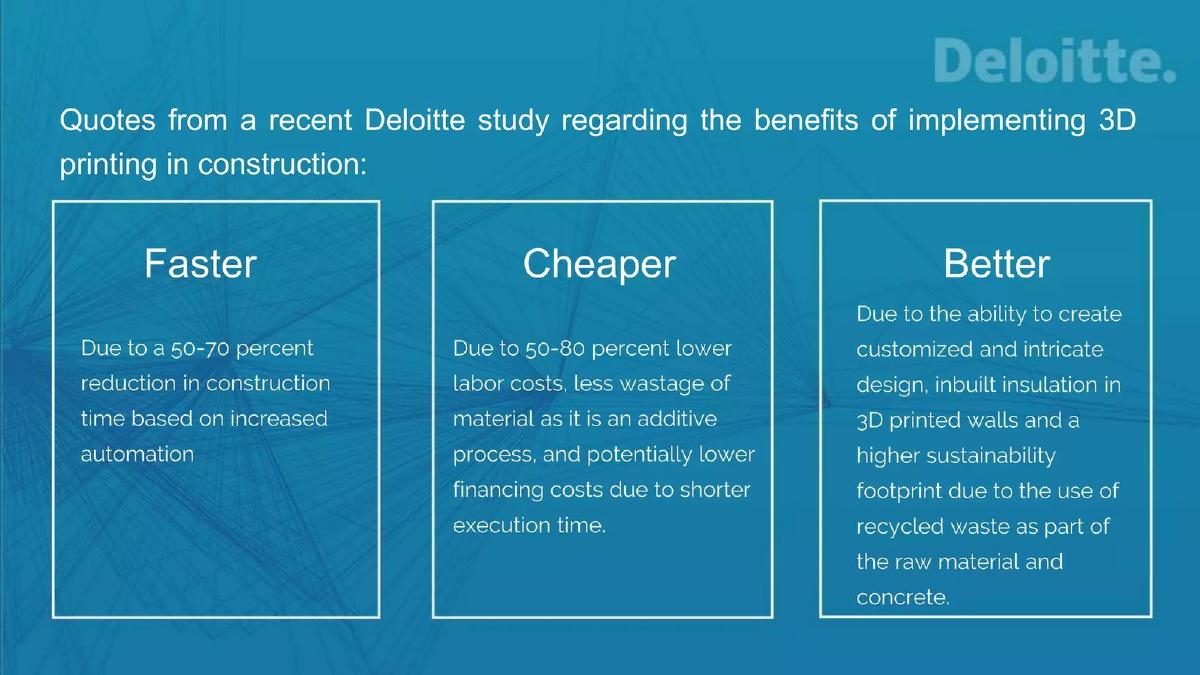
- External validation is a core pillar of the deck, citing Deloitte's findings of 50-70% reduction in construction time and 50-80% lower labor costs (Slide 6).
- The business model is diversified across hardware sales, proprietary 'ink' (concrete) sales, and consulting services (Slide 16).
- Cazza highlights its participation in the Dubai Future Accelerator and collaborations with the Dubai government to establish 3D printing building codes (Slide 21).
- The R&D team is positioned as a key asset, led by a PhD in Robotics Engineering and a Postdoctoral fellow in Materials Engineering (Slide 20).
- The deck identifies Win Sun and Apis Cor as primary competitors but claims Cazza is the only one selling the actual technology (Slide 22).
Cazza Pitch Deck Analysis
The Cazza pitch deck from 2017 is a study in high-concept hardware fundraising. It attempts to bridge the gap between a futuristic vision of automated cities and the practicalities of industrial robotics. The deck is structured to move from macro-environmental needs to specific product specifications, concluding with a massive capital request.
The Vision and The Problem (Slides 1-3)
The deck opens with a clean title slide (Slide 1) featuring a modern, glass-heavy architectural render, immediately setting the tone for a high-end construction play. Slide 2 defines the vision: a future where construction is completely automated by AI-driven machines. This is a classic 'North Star' statement intended to align investors with a long-term transformative goal.
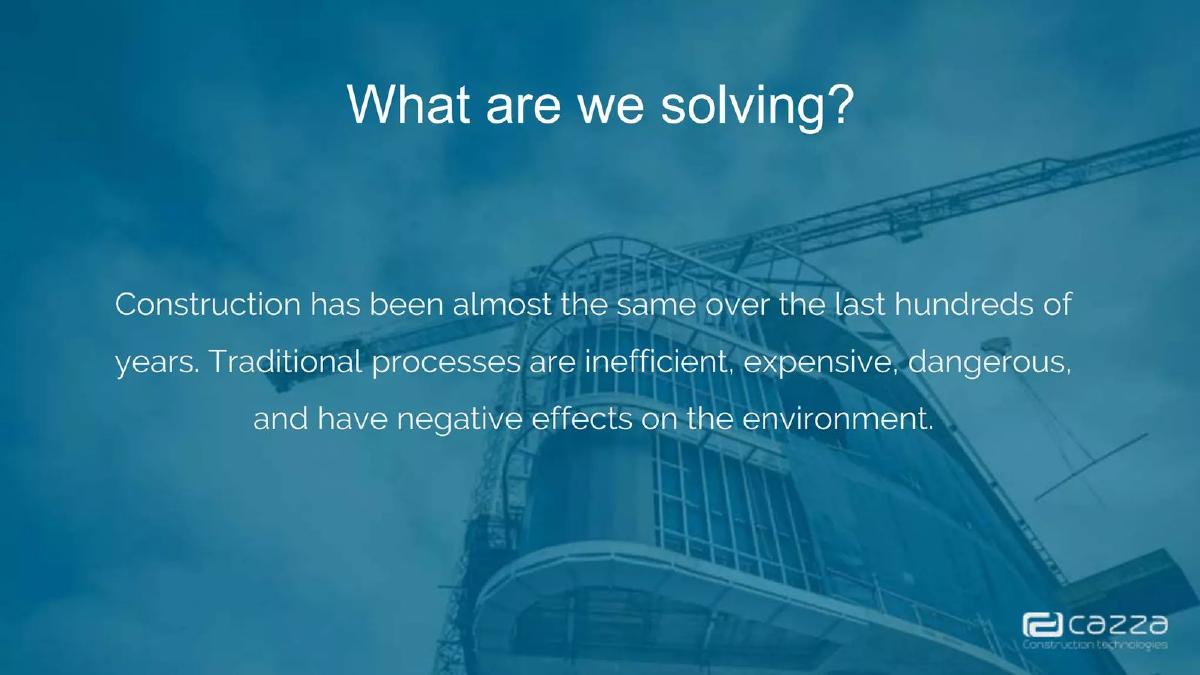
Slide 3 addresses the problem, stating that construction has remained largely unchanged for hundreds of years. It characterizes traditional processes as 'inefficient, expensive, dangerous, and have negative effects on the environment.' By framing the problem as an industry-wide stagnation, Cazza positions its technology not just as an improvement, but as a necessary evolution.
Market Validation and Macro Trends (Slides 4-6)
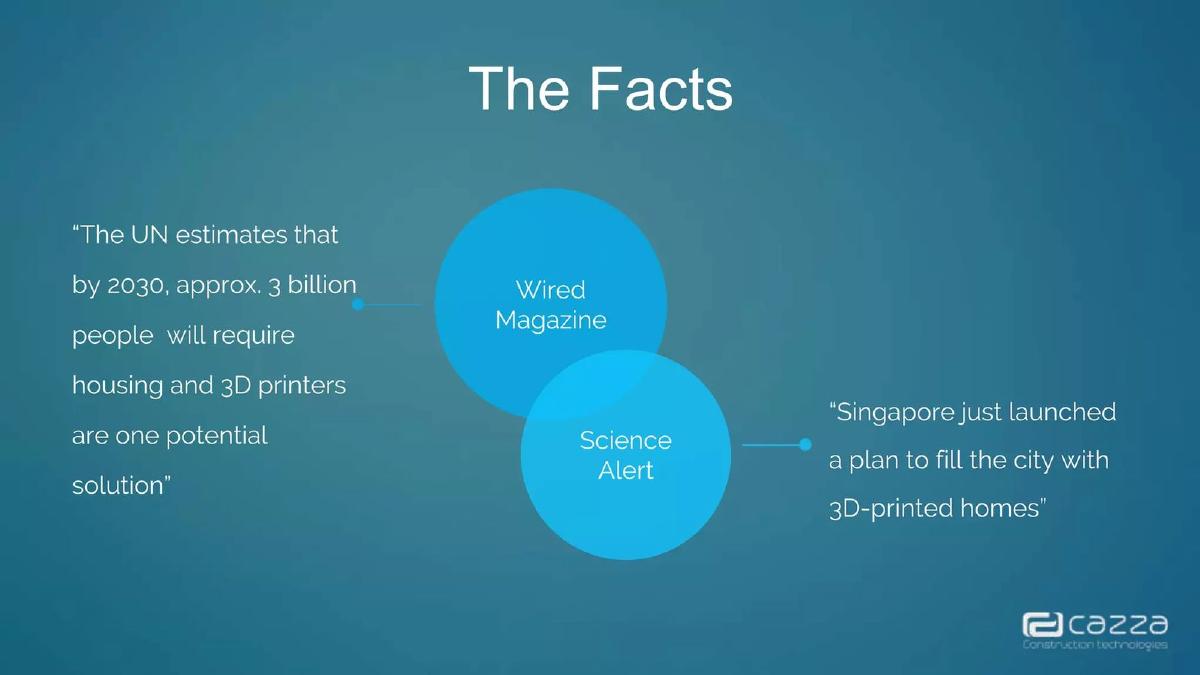
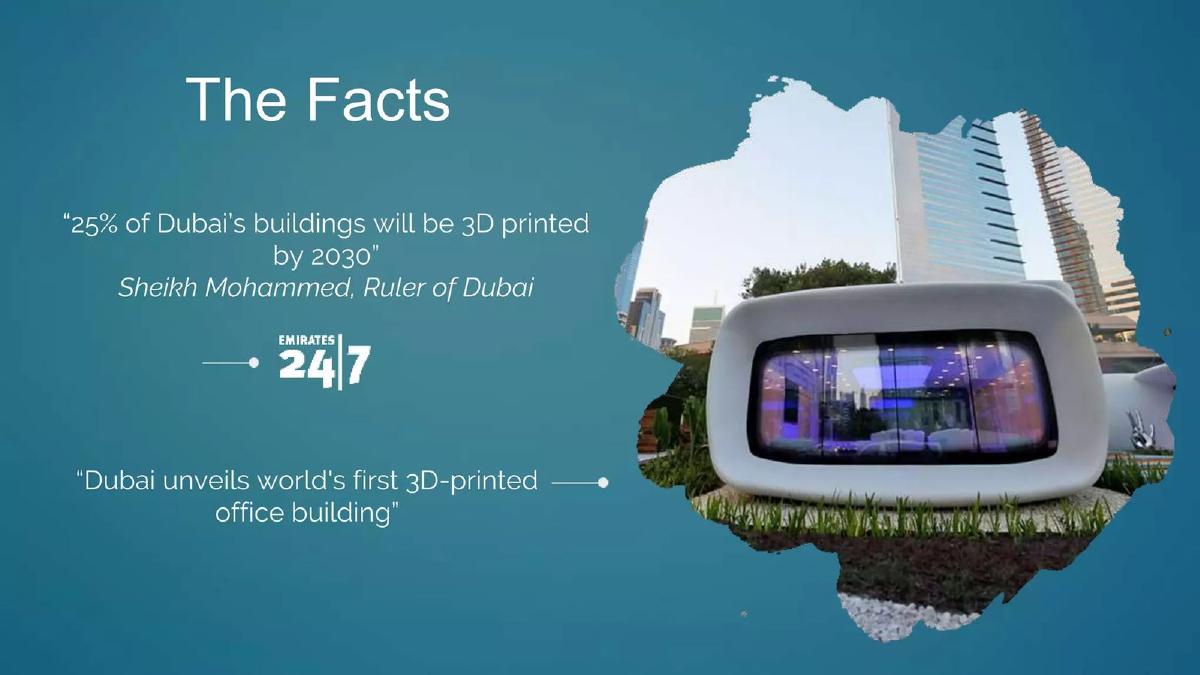
Cazza relies heavily on third-party authority to validate the market. Slide 4 quotes the UN, stating that 3 billion people will require housing by 2030, and cites Wired and Science Alert regarding Singapore's plans for 3D-printed homes. Slide 5 focuses on Dubai, quoting Sheikh Mohammed on the goal of having 25% of Dubai's buildings 3D printed by 2030.
Slide 6 is perhaps the most critical for financial validation. It uses a Deloitte study to quantify the benefits of 3D printing in construction: a 50-70% reduction in construction time , 50-80% lower labor costs , and better sustainability through recycled waste. Using a 'Big Four' accounting firm's data adds significant institutional weight to Cazza's claims, moving the deck from 'science fiction' to 'business case.'
The Solution and Product Deep Dive (Slides 7-15)
Slide 7 introduces the solution: a system for architecture, engineering, and materials that includes large-scale 3D printing. The deck then spends several slides (8-14) detailing the hardware. This is a 'show, don't just tell' section.
The Cazza X1 (Slides 8-10) is presented as an autonomous robot for foundations and structures up to 5m high. Key specs include:
Price: Starts from USD $480,000 · Efficiency: Up to 40% more efficient than human labor · Safety: Equipped with a sensor network to detect people · Reach: 4.7m frontal reach and a 3.6 x 3.4 x 0.8m tracked platform
The Cazza X1 CORE (Slides 11-13) is the premium version, starting at USD $620,000 . It adds carbon fiber covers for durability and 'Field autopilot navigation' to minimize positional mistakes. It also increases the height reach to 6m. Slide 14 provides a high-quality render of the X1 CORE in a warehouse setting, emphasizing its industrial scale.
Slide 15 explains the workflow: design in any software, export to Cazza's software for detection, and then onsite printing. This three-step process is intended to show that the technology integrates easily into existing architectural workflows.
Business Model and Financial Ask (Slides 16-17)
Slide 16 answers 'How do we make money?' The revenue streams are:
Sale of construction robots · Sale of proprietary 'ink' (concrete mixes) · Design, engineering, and consulting services
This 'razor and blade' model (selling the expensive hardware and the recurring material) is a standard and effective strategy for industrial equipment companies.
Slide 17 is the 'Ask.' It is remarkably sparse, stating only: 'Series A round size USD$80m.' In the context of 2017, an $80 million Series A was exceptionally large, especially for a company that had not yet demonstrated a massive fleet of active robots. The lack of a 'Use of Funds' breakdown here is a significant omission.
Team and R&D (Slides 18-20)
The founders, Chris Kelsey (20) and Fernando De Los Rios (27), are introduced on Slide 18. Their previous experience at Appsitude, an app development company, is noted on Slide 19. Given their youth and lack of a construction background, Slide 20 is vital. It lists the 'Research and Development Centre,' highlighting that the engineering team is led by a PhD in Robotics and the materials team by a Postdoctoral fellow. It also lists various Masters-level engineers in mechatronics, automation, and civil engineering. This slide is clearly designed to reassure investors that the technical heavy lifting is being handled by seasoned experts.
Traction and Competition (Slides 21-22)
Slide 21 details 'Activity in Dubai.' Being part of the Dubai Future Accelerator and collaborating on building codes is strong evidence of product-market fit in a specific, high-growth region. The mention of a '5k housing project' provides a sense of the scale Cazza is targeting.
Slide 22 addresses competition, naming Win Sun and Apis Cor. Cazza claims its edge is being the 'only 3D printing company who sells the technology' rather than just acting as a contractor. They also highlight their safety sensors and mobility as unique features.
What Works in the Cazza Deck
Strong External Validation: Citing Deloitte and the UN provides a level of credibility that a startup's own internal projections rarely carry. · Clear Product Differentiation: By explicitly stating they sell the hardware while others don't, they define their place in the value chain. · Detailed Technical Specs: Providing exact dimensions, reach, and pricing for the robots makes the technology feel real and ready for market. · Regional Focus: The focus on Dubai shows a clear path to early adoption in a market that is actively seeking this specific technology.
What is Missing from the Cazza Deck
Use of Funds: An $80 million ask requires a detailed breakdown of where that money is going (e.g., manufacturing setup, international expansion, specific R&D milestones). · Financial Projections: There are no slides showing expected revenue, unit economics, or a path to profitability. · Case Studies/Pilot Results: While they mention projects 'expected to start,' the deck lacks data from a completed pilot or a prototype demonstration to prove the 40% efficiency claim. · Go-to-Market Strategy: Beyond Dubai, there is no mention of how they plan to enter other markets or handle international logistics and maintenance for $600k machines.
Founder Takeaways: What to Copy
The 'Facts' Slides: Using a dedicated slide to aggregate industry trends and quotes from reputable sources (Slides 4-6) is an excellent way to build a 'why now' case. · Visualizing the Workflow: Slide 15's simple 01-02-03 breakdown of how the software interacts with the hardware is a great way to demystify complex technology for non-technical investors. · Team Balancing: If you are a young founder, follow Cazza's lead on Slide 20. Don't just list names; list the specific degrees and expertise of your R&D team to build institutional trust. · Transparent Pricing: Including the 'Starts from' price for hardware (Slides 10, 12) shows confidence in the product's value and helps qualify the right type of investor immediately.
Frequently asked questions
- What is the primary product Cazza is selling?
- Cazza sells autonomous 3D-printing robots, specifically the X1 and X1 CORE models. These machines are designed to automatically print concrete frameworks, foundations, and structures up to 6 meters in height. Unlike some competitors who operate as service providers, Cazza emphasizes that they sell the hardware directly to construction companies, alongside proprietary concrete 'ink' and consulting services.
- How does Cazza justify its $80 million Series A ask?
- The deck does not explicitly provide a 'Use of Funds' slide to justify the $80 million figure. However, it implies high capital requirements for hardware manufacturing, R&D, and large-scale projects, such as a 5,000-housing project mentioned in the Dubai section. The high price point of their machines ($480k-$620k) suggests a capital-intensive business model requiring significant upfront investment.
- What is Cazza's competitive advantage in the 3D printing space?
- According to Slide 22, Cazza distinguishes itself by being the only company that sells the technology rather than just providing printing services. They also claim technological superiorities such as 'Self Automated' site analysis, human-detecting safety sensors to prevent on-site hazards, and the ability to operate the mobile tracked platform remotely via software.
- What traction has the company achieved so far?
- Cazza's primary traction is centered in the Middle East. They were selected for the Dubai Future Accelerator (1 of 30 participants) and collaborated with the Dubai government on building codes. The deck mentions they are working with several large construction companies in Dubai on housing projects expected to start in Fall 2017, including a planned 5,000-unit project.
- Who are the people behind Cazza?
- The company was founded by Chris Kelsey (CEO, age 20) and Fernando De Los Rios (COO, age 27). Both previously held leadership roles at Appsitude, an app development company. To balance the founders' youth, the deck highlights a highly credentialed R&D team composed of PhDs and Masters-level engineers in robotics, materials, and mechatronics.