Caura’s 11-slide deck is a masterclass in identifying a highly fragmented, high-friction market and proposing a clean, verticalized solution. The deck highlights the 'expensive mistakes' motorists face, citing a £1bn cost in fines and statutory charges. It leverages a strong analogy—'Citymapper for your car'—to immediately communicate its value proposition to investors. With a focus on the UK’s £12bn motor premium market, the deck emphasizes regulatory readiness (FCA license) and existing partnerships (7 insurance partners) rather than just theoretical features. The presentation successfully…
Key takeaways
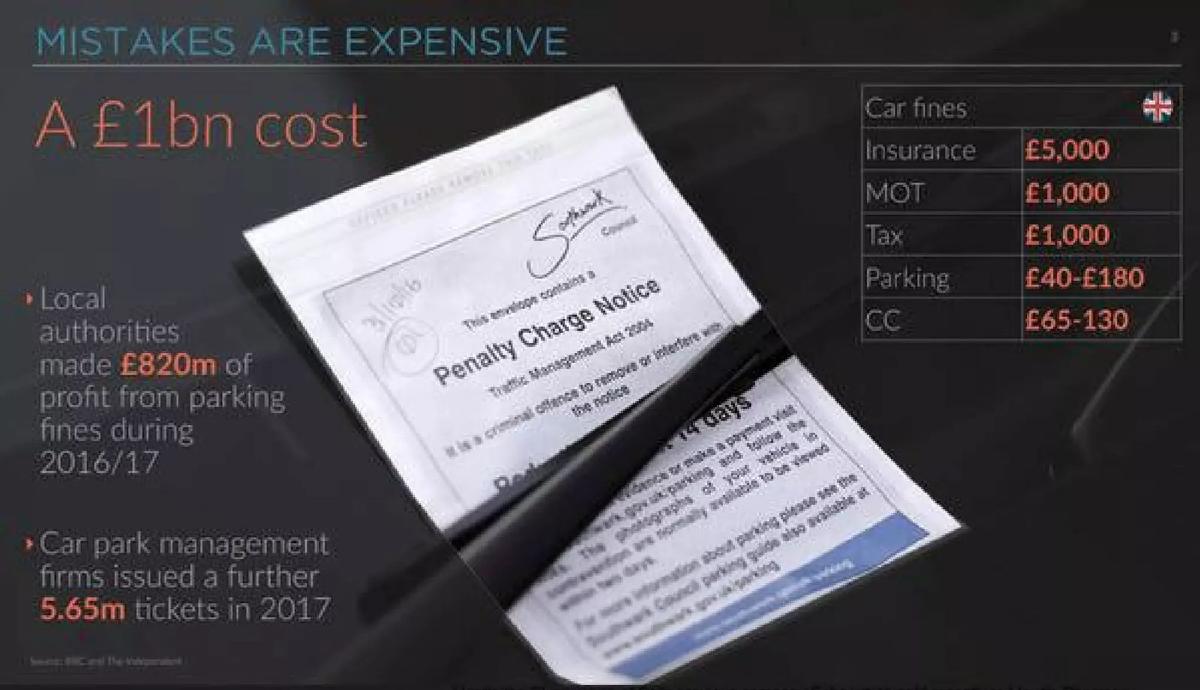
- The deck identifies a £1bn cost to UK motorists from car-related fines and statutory charges on slide 3.
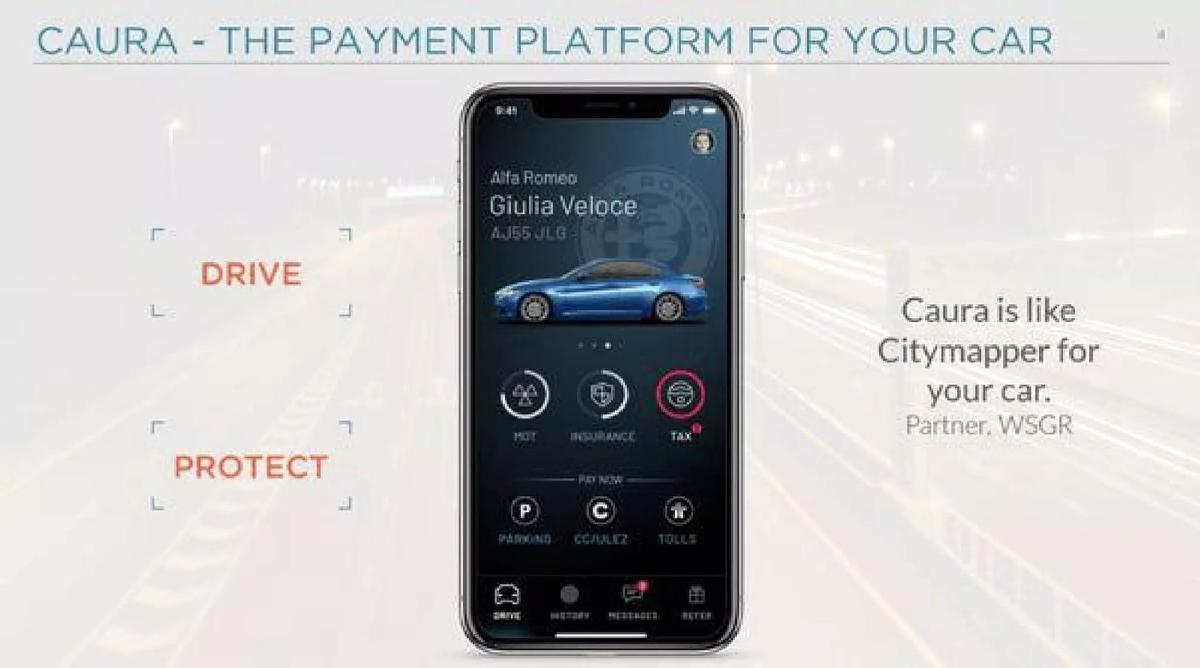
- Caura uses a powerful 'X for Y' analogy, calling itself 'Citymapper for your car' on slide 4.
- The company highlights its regulatory moat by confirming it has already secured an FCA license on slide 9.
- Market sizing focuses on the £12bn UK motor premium market and £1.2bn aggregator revenue on slide 8.
- The product strategy moves from low-friction 'Drive' payments (parking/tolls) to high-value 'Protect' services (insurance) as shown on slide 4.
- The deck demonstrates technical readiness with Apple CarPlay and Android Auto integrations featured on slide 7.
- The team slide (slide 10) emphasizes deep industry experience with logos from Jaguar, McLaren, and Apple.
- Caura notes an 'over-subscribed round' for its initial £1.3M raise on slide 9, creating FOMO for the current bridge round.
Introduction: The Vertical Fintech Play for Car Owners
Caura’s September 2020 investment presentation arrived at a pivotal moment for the automotive industry. While the world was grappling with the early stages of the pandemic, Caura was pitching a solution to a perennial problem: the extreme fragmentation of car management. This 11-slide deck focuses on the UK market, where motorists are burdened by a 'congested landscape' of apps and websites for parking, tolls, and insurance. By positioning the car as a fintech asset rather than just a vehicle, Caura successfully navigated a $6M Seed round.
Slides 1-3: The Problem of Fragmentation and Expensive Mistakes
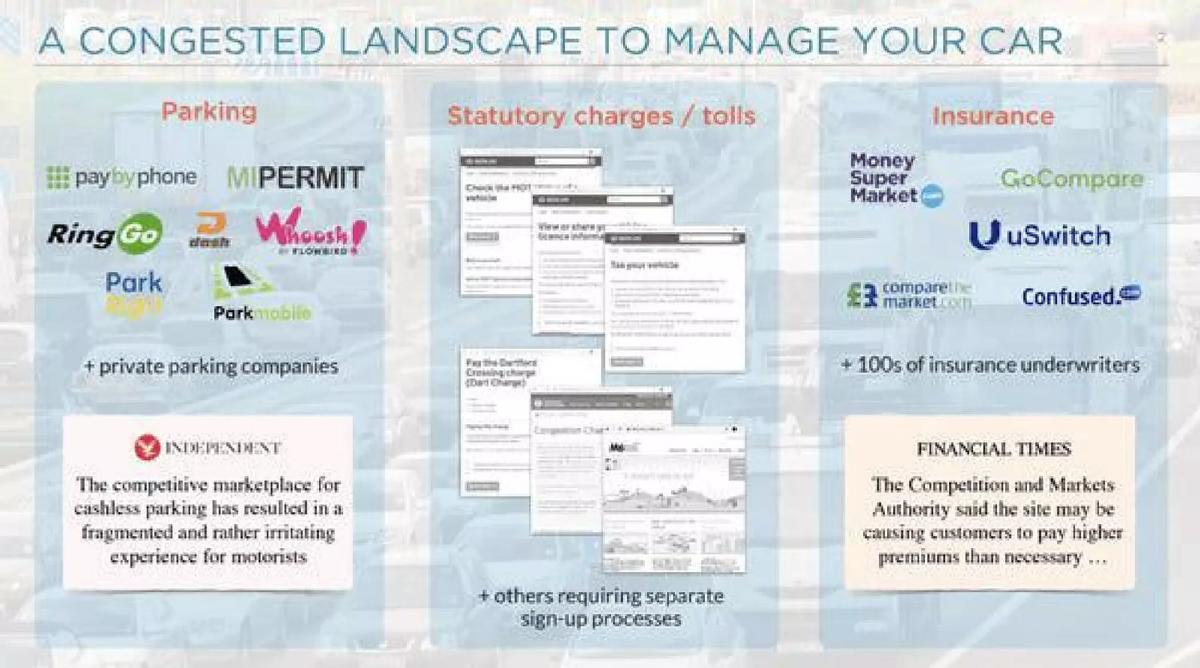
The deck opens with a clean, high-resolution title slide (Slide 1) that establishes a premium brand identity. It immediately moves into the 'Problem' on Slide 2, titled 'A Congested Landscape to Manage Your Car.' This slide is visually dense, intentionally mimicking the frustration of a user. It categorizes the chaos into three buckets: Parking (featuring logos like RingGo and PayByPhone), Statutory charges/tolls (showing various government web portals), and Insurance (listing aggregators like GoCompare and uSwitch). A quote from the Financial Times on this slide highlights that current aggregators may cause customers to 'pay higher premiums than necessary,' setting Caura up as the consumer-friendly alternative.
Slide 3, 'Mistakes are Expensive,' quantifies the pain point. It cites a '£1bn cost' to motorists, noting that local authorities made '£820m of profit from parking fines' in 2016/17. The slide includes a table of car fines: Insurance (£5,000), MOT (£1,000), Tax (£1,000), and Parking (£40-£180). By framing the problem as a financial loss for the consumer, Caura shifts the narrative from 'convenience' to 'financial necessity.'
Slides 4-5: The Solution and User Experience
Slide 4 introduces the platform with a bold claim: 'Caura is like Citymapper for your car.' This analogy is credited to a partner at WSGR, providing third-party validation. The slide divides the product into two pillars: 'Drive' (Parking, CC/ULEZ, Tolls) and 'Protect' (MOT, Insurance, Tax). This is a classic 'hook and harvest' strategy—use low-friction utility (parking) to acquire the user, then upsell high-margin financial products (insurance).
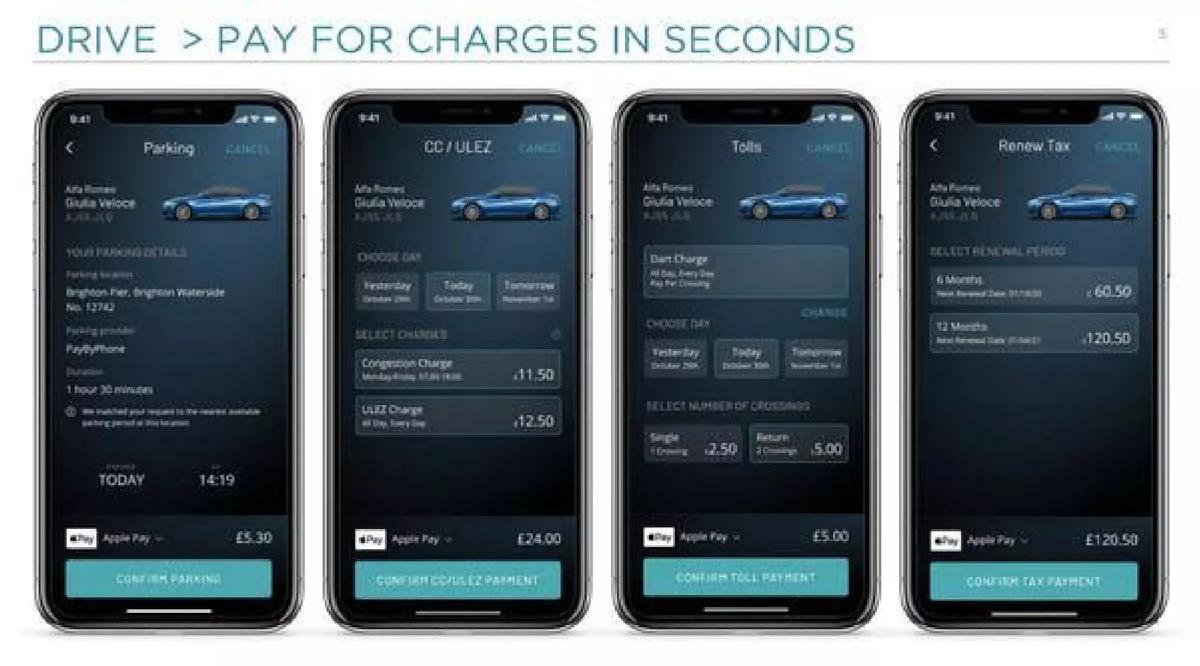
Slide 5 provides a 'Drive > Pay for Charges in Seconds' walkthrough. It shows four iOS mockups demonstrating how a user can pay for parking, CC/ULEZ, tolls, and tax renewals using Apple Pay. The UI is dark, modern, and minimalist, emphasizing speed. Each screen shows a 'Confirm' button at the bottom, reinforcing the 'seconds' claim in the header. This slide proves the product isn't just a concept; it has a defined, functional interface.
Slides 6-7: Future Roadmap and Ecosystem Integration
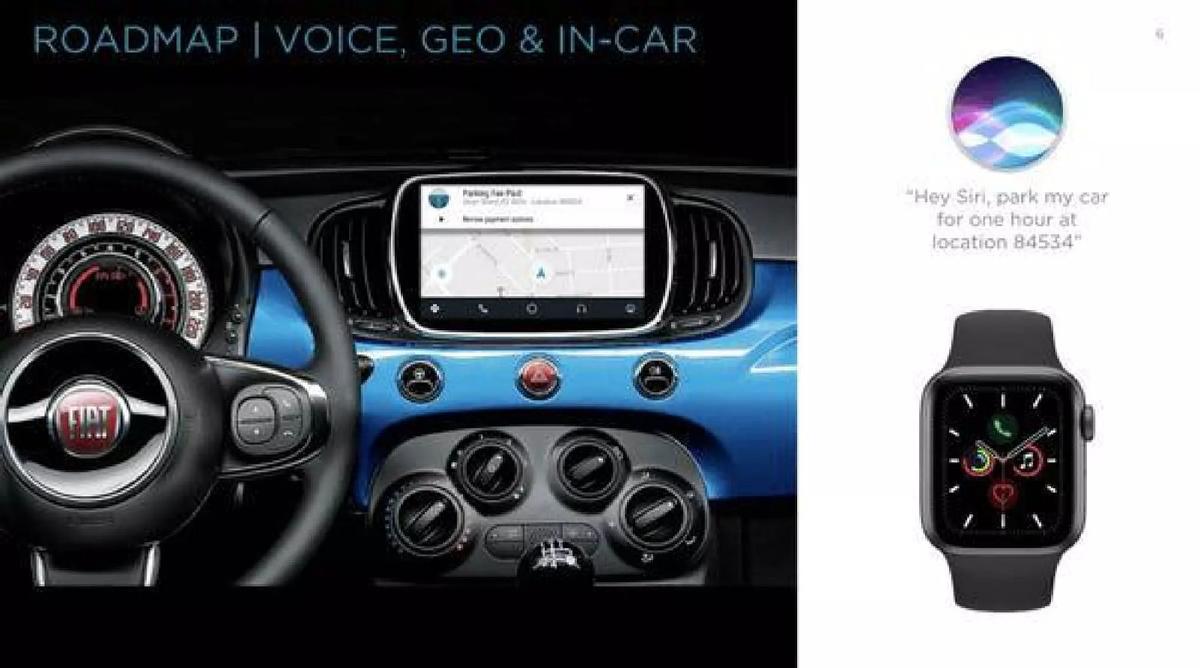
Slide 6, 'Roadmap | Voice, Geo & In-Car,' looks toward the future of the 'connected car.' It features a Siri integration mockup ('Hey Siri, park my car...') and an Apple Watch interface. This suggests that Caura intends to be platform-agnostic within the Apple/Android ecosystems, moving beyond the smartphone screen.
Slide 7 reinforces this by showing the Caura app icon on an in-car dashboard via Apple CarPlay and Android Auto . The slide lists four integration points: Geography, Insurance, Charges/tolls, and Parking. By showing the app in the context of high-end vehicle interiors (with logos of Porsche, Jaguar, and McLaren at the top), Caura signals that it is targeting a high-value demographic of car owners.
Slide 8: Market Opportunity and Aggregator Revenue
The 'Market' slide (Slide 8) provides a macro view of the opportunity across Europe, but focuses heavily on the UK. It shows the 'Size of aggregator/PCW markets' in Germany, Italy, France, Spain, and the Netherlands, all showing positive year-on-year growth (e.g., +17% p.a. in the UK). The right side of the slide highlights three massive figures for the UK: 'Motor Premiums £12BN,' 'Policies Underwritten 31.1M,' and 'Aggregator Revenue £1.2BN.' This slide tells investors that even a small slice of the insurance aggregator market represents a significant venture-scale outcome.
Slides 9-11: State of Play, Team, and Use of Funds
Slide 9, 'State of Play | Use of Funds,' is the most data-rich slide regarding the company's progress. It uses a checklist to show completed milestones: 'Minimum Viable Product (iOS),' 'Secure 7 insurance partners,' and 'FCA licence.' The inclusion of the FCA license is a critical 'de-risking' signal for a fintech startup. The slide also mentions a 'Raised £1.3M' over-subscribed round and a current 'Bridge round' to 'Ride out Covid-19.' The use of funds is broken down into Product & Eng (60%), Marketing (20%), Brand & website (10%), Legal (8%), and Contingency (2%).
Slide 10 presents the Team . It is a 'logo-heavy' slide, which is effective for a Seed round. CEO Sai Lakshmi is highlighted for his previous venture, Echo (acquired by McKesson). Other team members bring experience from Apple, Jaguar Land Rover, McLaren, Goldman Sachs, and PwC . This level of institutional pedigree is likely a major reason for the $6M raise, as it suggests the team has the technical and industry expertise to handle complex insurance and automotive integrations. Slide 11 is a simple closing slide with the company logo.
What Works in the Caura Pitch Deck
The Analogy: 'Citymapper for your car' is a perfect shorthand. It explains the utility, the platform nature, and the user experience in four words. · Regulatory De-risking: Explicitly stating they have an FCA license (Slide 9) removes a massive hurdle for fintech investors who fear regulatory delays. · Visual Hierarchy: The deck is beautiful. It uses high-quality automotive imagery and clean UI mockups that reflect a 'premium' service, which aligns with the high-cost insurance products they want to sell. · The 'Pain' Quantification: Slide 3 doesn't just say parking is annoying; it says it's a £1bn problem. Quantifying the cost of 'mistakes' creates a sense of urgency for the solution.
What is Missing from the Caura Pitch Deck
User Metrics: There is no mention of how many users have downloaded the MVP or what the transaction volume looks like for parking and tolls. · Unit Economics: The deck doesn't explain how much Caura makes per insurance policy or per parking transaction. While it's a Seed deck, a hint at the take-rate would be beneficial. · The 'Ask': While Slide 9 mentions a bridge round, it doesn't state the specific amount they are looking to raise in this September 2020 window, nor the valuation. · Retention Data: For a utility app, retention is everything. There is no data showing that users who pay for parking once come back to use the app again.
What a Founder Should Copy
The Milestone Checklist: Use a checklist like the one on Slide 9 to show 'Product-Market-Regulatory' fit. It’s a quick way to show you’ve done the hard work. · The Competitive Landscape Slide: Slide 2 is excellent because it doesn't just list names; it groups them by the 'friction' they cause. It makes the 'Solution' slide feel like a relief. · Pedigree Logos: If your team has worked at world-class companies, don't just list the names—use the logos. Slide 10 does this effectively to build instant credibility. · The 'Hook and Harvest' Narrative: Structure your deck to show how a simple, free, or low-cost utility leads to a high-value financial transaction. Caura makes the transition from 'paying a toll' to 'buying insurance' feel like a natural progression.
Frequently asked questions
- How much did Caura raise with this deck?
- According to the catalogue facts, Caura raised $6,000,000 in a Seed round. Slide 9 of the deck specifically mentions a previously raised £1.3M 'over-subscribed round' and a subsequent 'Bridge round' to ride out Covid-19, though the total $6M figure likely includes the cumulative funding from this period.
- What is Caura's core business model according to the slides?
- Caura acts as a centralized payment platform for vehicle-related expenses. Slide 4 and 5 show it handles parking, tolls (CC/ULEZ), and vehicle tax. Slide 8 suggests a significant revenue opportunity in the insurance aggregator market, where UK aggregator revenue is valued at £1.2bn.
- Does the deck show any traction or user numbers?
- The deck is notably light on specific user growth metrics or transaction volumes. Instead, it focuses on 'State of Play' milestones on slide 9, such as having a functional iOS MVP, securing 7 insurance partners, and obtaining an FCA license.
- What is the 'Citymapper for your car' analogy meant to convey?
- On slide 4, this analogy suggests that just as Citymapper simplified complex public transport data and payments into one app, Caura does the same for the fragmented world of car ownership (parking, tolls, insurance, and maintenance).
- Who are the key competitors mentioned in the deck?
- Slide 2 lists several competitors across three categories: Parking (PayByPhone, RingGo), Statutory Charges (Government portals), and Insurance (MoneySuperMarket, GoCompare, Confused.com). Caura positions itself as the aggregator that replaces these fragmented services.