Castle’s pre-seed pitch deck is a textbook example of how to frame a traditional, service-heavy industry as a scalable tech opportunity. The company successfully raised $270k by identifying a clear gap between DIY landlording and expensive, opaque property management firms. The deck relies heavily on a simple value proposition—saving owners 40% through a $79/month flat fee—and backs it up with impressive early traction in a single geographic market (Detroit). While the company eventually closed its doors, the deck remains a strong reference for early-stage founders on how to communicate a bus…
Key takeaways
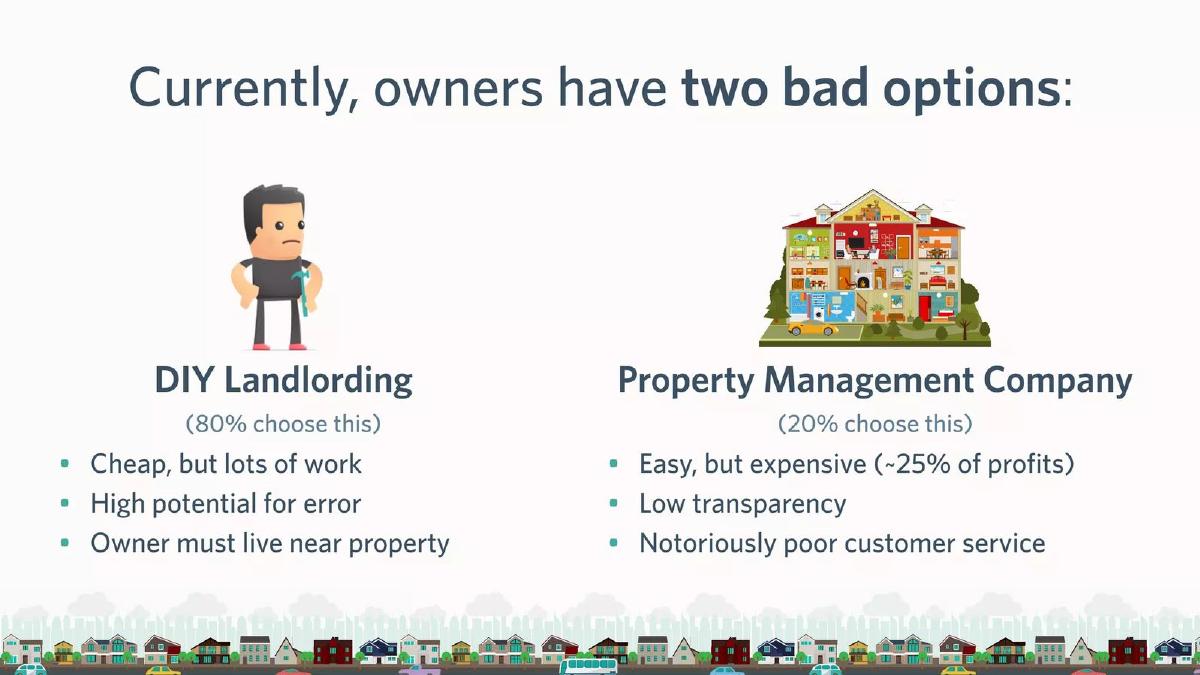
- The deck identifies a binary market failure: 80% of owners DIY while 20% use expensive managers (Slide 3).
- Castle positions itself as a hybrid solution using 'software and on-demand labor' to automate landlording (Slide 4).
- The pricing model is a disruptive $79/month flat fee, compared to the industry standard of 10% of rental income (Slide 7).
- Early traction is demonstrated by a jump from 4 units on January 1 to 49 units by the time of the pitch (Slide 8).
- The growth strategy includes unconventional methods like scraping 'Registered Rental Lists' from city governments (Slide 9).
- The competitive landscape notes that only 4 traditional property management companies have a national presence (Slide 10).
- The team slide emphasizes founder chemistry, noting they previously turned an abandoned mansion into a 'hacker house' (Slide 11).
- The financial ask is specific: $250,000 in convertible debt with a $2 million cap and 20% discount (Slide 12).
The Castle Pitch Deck Teardown
Castle was a Detroit-based proptech startup that sought to modernize the property management industry. While the company eventually ceased operations, the deck they used to raise $270,000 is a lean, 13-slide presentation that effectively communicates a complex operational business through a simple tech-first lens. This teardown examines how they framed their solution, their aggressive pricing, and their localized traction.
The Hook and the Problem
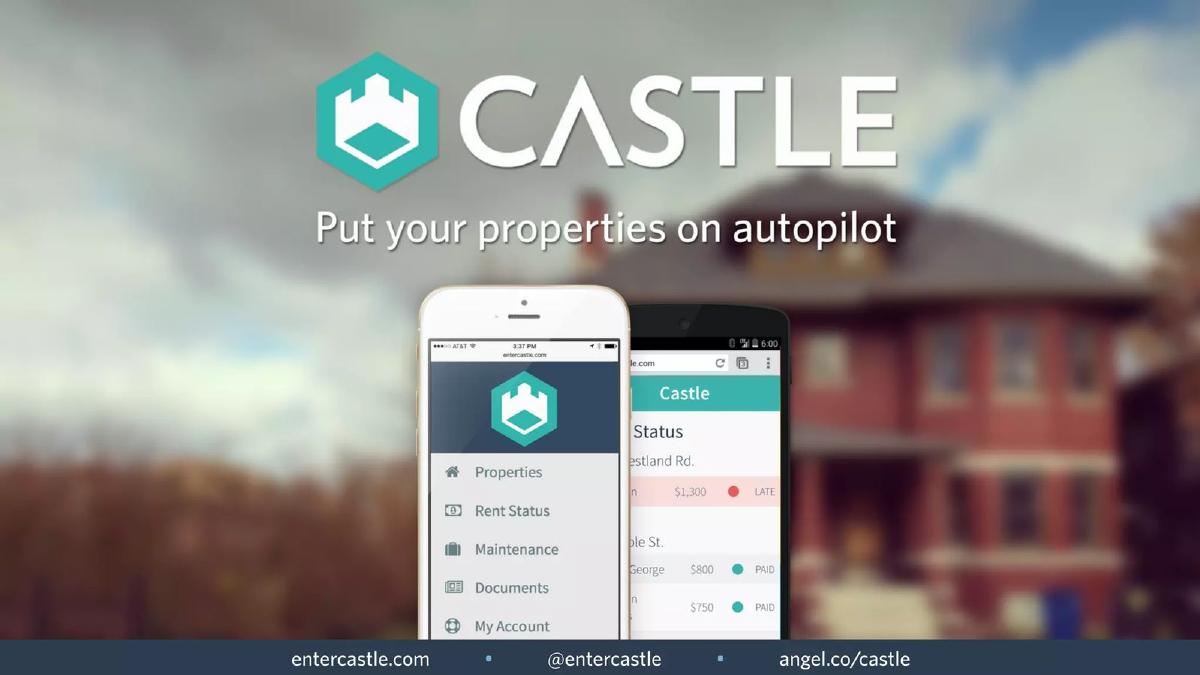
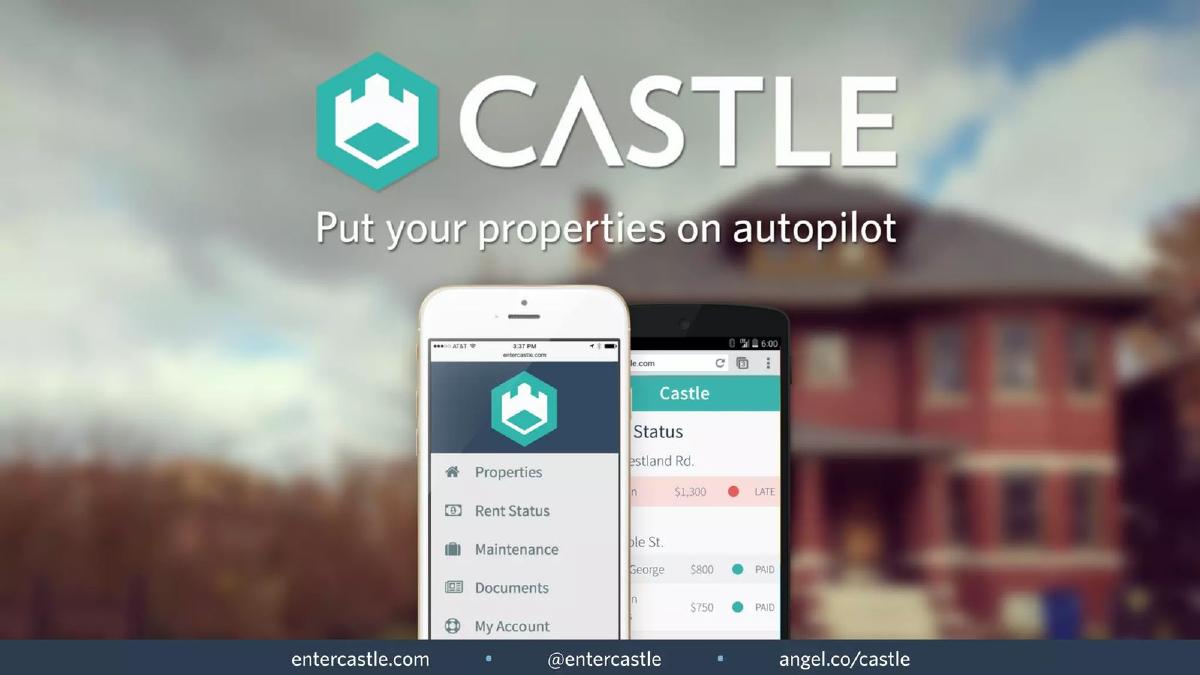
Slide 1: Title The deck opens with a clear tagline: "Put your properties on autopilot." The imagery features a mobile app interface over a blurred photo of a residential home, immediately signaling that this is a technology solution for real estate owners. The slide includes contact info and an AngelList link, which was standard for the era.
Slide 2: The Core Desire "Rental property owners want to make money without the work of being a landlord." This slide establishes the fundamental motivation of the target customer. It is a simple, high-level statement that sets the stage for the conflict to follow.
Slide 3: The Two Bad Options Castle frames the market as a failure of existing choices. They claim 80% of owners choose "DIY Landlording," which is cheap but labor-intensive and error-prone. The remaining 20% choose "Property Management Companies," which they describe as expensive (~25% of profits), opaque, and plagued by poor customer service. By presenting these as the only current options, Castle creates a vacuum for their solution to fill.
The Solution and Product
Slide 4: The Solution The solution is defined as: "Automate landlording through software and on-demand labor." This is a critical distinction. Castle isn't claiming to be a pure SaaS company; they are honest about the need for "on-demand labor," which is the reality of physical property management (repairs, inspections, etc.).
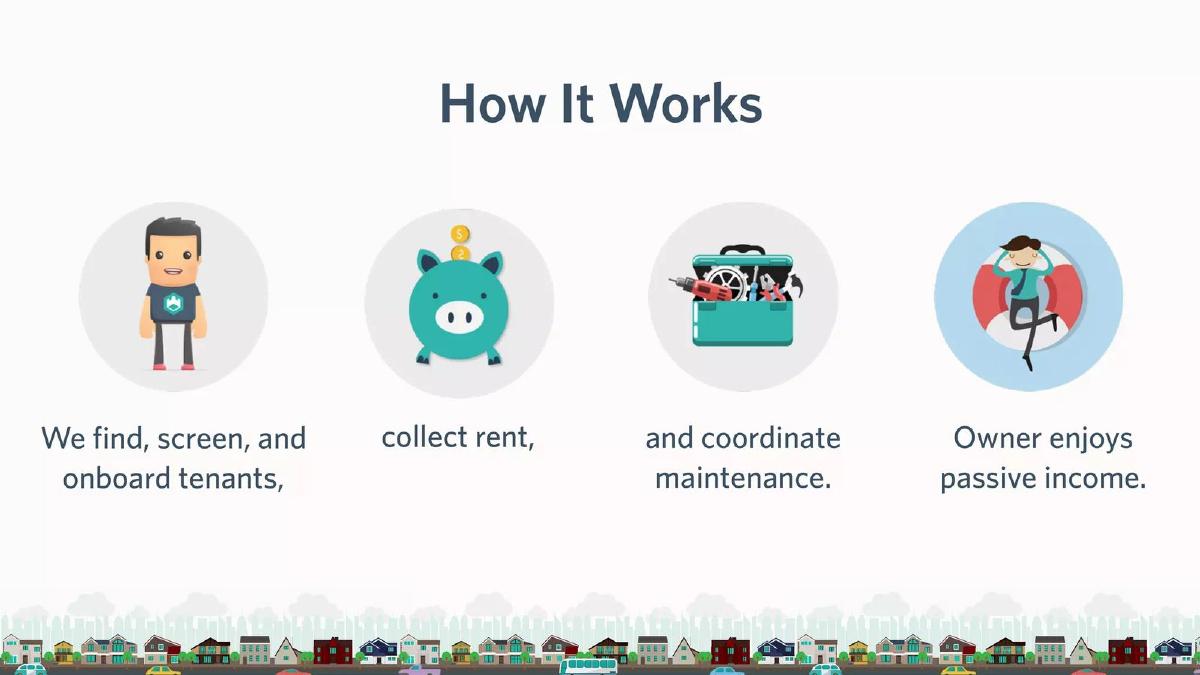
Slide 5: How It Works This slide breaks the service down into four steps: finding/screening tenants, collecting rent, coordinating maintenance, and the owner enjoying passive income. It uses simple iconography to make a logistically heavy business look streamlined and effortless.
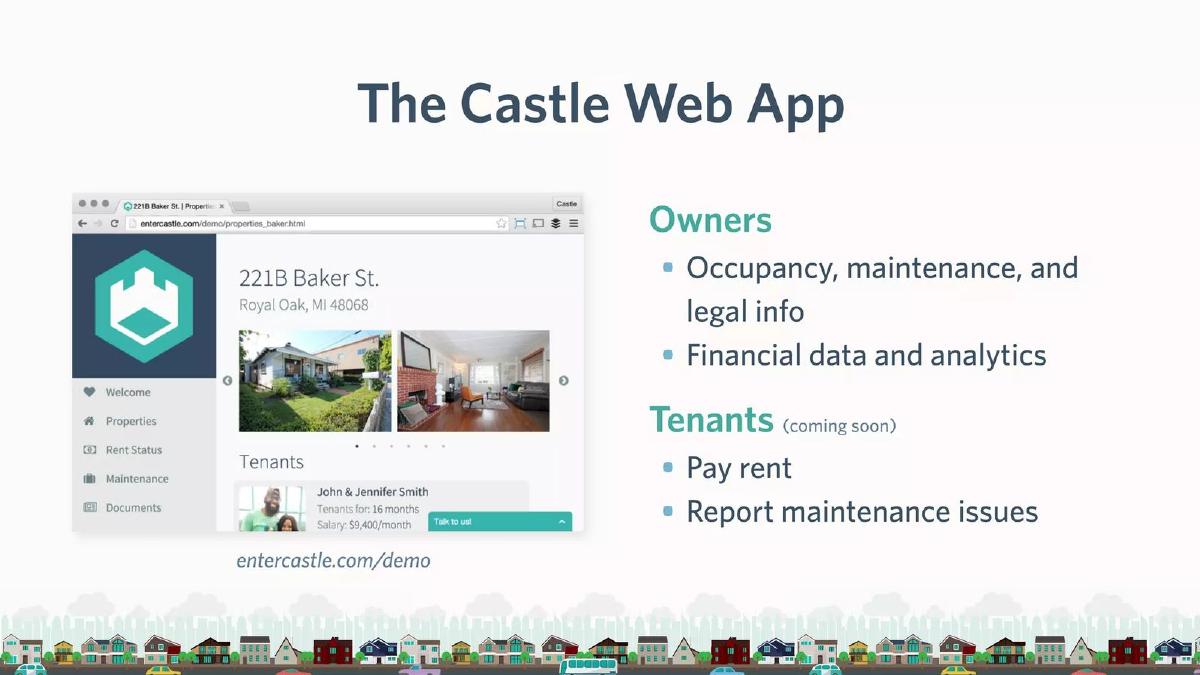
Slide 6: The Castle Web App This slide provides a glimpse into the product. For owners, it offers occupancy, maintenance, and legal info alongside financial analytics. For tenants, it promises rent payment and maintenance reporting (noting these features are "coming soon"). The inclusion of a demo URL (entercastle.com/demo) adds credibility to the product's existence.
The Business Model and Traction
Slide 7: Pricing Comparison This is the "money slide." Castle compares their $79/month flat fee against the traditional $130/month (based on 10% of rental income + fees). They claim this saves owners 40% and increases their profit margin by 10%. This clear, numerical advantage is a powerful tool for convincing investors of the product's marketability.
Slide 8: Early Traction Castle shows a bar chart of their growth in Metro Detroit. They started with 4 units on January 1, grew to 20 units by February 1, and reached 49 units by the time of the pitch. This 10x growth in a few months proves that their $79/month offer has immediate resonance with landlords.
Slide 9: Growth Strategy The deck outlines four ways to scale: 1) Marketing to "Registered Rental Lists" from city governments, 2) "Auto-Responders" to find landlords on forums, 3) A "Freemium Tier" for their software, and 4) Using tenants to refer their landlords. This shows a mix of grit (scraping lists) and product-led growth (freemium).
Market Context and Team
Slide 10: Competition Castle categorizes competitors into "traditional" (200k companies in the U.S., most with fewer than 5 employees) and "future" (Pillow for Airbnb and Cozy for landlord software). They highlight that only 4 traditional companies have a national presence, suggesting the market is highly fragmented and ripe for a tech-enabled consolidator.
Slide 11: The Team The team slide focuses on the founders' history as Venture for America Fellows. Rather than a list of corporate titles, they use a photo of themselves in work clothes and mention their 2013 project: turning an abandoned Detroit mansion into a "hacker house." This narrative emphasizes their hands-on experience in the Detroit real estate market and their ability to generate press (Fast Company, Time, Re/code).
The Ask and Future Roadmap
Slide 12: The Ask Castle asks for $250,000 in convertible debt. They provide specific terms: a $2 million cap and a 20% discount, with a closing date of April 1. This level of specificity is helpful for investors to quickly gauge if the deal fits their mandate.
Slide 13: Milestones The final slide is a roadmap. It sets ambitious targets: 300 units ($23k MRR) by January 2016 and 2,000 units ($158k MRR) by January 2017. It also notes the plan to launch in "market 2" and eventually "markets 3, 4, and beyond." This shows a clear path from a local Detroit pilot to a national scale-up.
What Works in This Deck
The Pricing Disruption: Slide 7 is the strongest part of the deck. By moving from a percentage-based fee to a flat fee, Castle creates a clear, quantifiable reason for customers to switch. · Localized Proof of Concept: Instead of trying to prove they can win the whole country at once, they show they are winning Detroit. The jump from 4 to 49 units (Slide 8) is a small sample size but a strong growth rate. · The "Two Bad Options" Framework: Slide 3 effectively buckets the entire market into two categories that the customer is already unhappy with, making the "third way" (Castle) feel inevitable.
What is Missing
Unit Economics: While they show the price ($79/mo), they don't show the cost to serve. Managing physical properties involves significant labor. Investors would want to know if that $79 covers the "on-demand labor" mentioned on Slide 4 while leaving a margin. · The "On-Demand Labor" Network: The deck mentions labor but doesn't explain how it's sourced, vetted, or managed. In a proptech business, the quality of the service providers is often the biggest bottleneck to scaling. · Churn and Retention: With 49 units, it might be too early for deep churn data, but any indication of tenant or owner satisfaction would have strengthened the traction section.
What a Founder Should Copy
The Traction Bar Chart: Use specific dates and unit counts (Slide 8). It's much more convincing than a vague "up and to the right" arrow without numbers. · The Growth Channels: Don't just say "marketing." List specific, actionable ways you are getting customers (Slide 9), especially the ones that involve "unscalable" grit like city government lists. · The Narrative Team Slide: If you don't have a background at Google or Facebook, tell a story about why you are the right person for this specific problem. The "hacker house" story on Slide 11 proves the founders understand the grit of Detroit real estate.
Frequently asked questions
- What was Castle's core value proposition to property owners?
- Castle's core value proposition was cost reduction and automation. According to Slide 7, they offered a flat fee of $79 per month, which they claimed saved owners 40% compared to traditional property management companies that typically charge 10% of rental income plus fees. This shifted the cost from approximately 25% of an owner's profits down to roughly 15%.
- How did Castle plan to acquire new customers?
- Slide 9 outlines four distinct growth channels: obtaining 'Registered Rental Lists' from city governments to market directly to owners, using 'Auto-Responders' to reach landlords on forums like BiggerPockets, offering a 'Freemium Tier' of their software, and a 'Tenants' strategy where renters sign up first and bring their landlords onto the platform.
- What was the state of Castle's traction at the time of the raise?
- Castle showed rapid early growth in the Detroit area. Slide 8 indicates they had a 'soft launch' on January 1 with 4 units. By February 1, they had grown to 20 units, and by the date of the pitch ('Today'), they had reached 49 units. Slide 13 clarifies that at this stage, the service was only 'partially automated'.
- Who were the founders and what was their background?
- The founders were Venture for America Fellows. Slide 11 highlights their history of working together, specifically mentioning that in 2013, they bought an abandoned mansion in Detroit and converted it into a 'hacker house' for entrepreneurs. This experience earned them media coverage in Fast Company, Time, and Re/code.
- What were the specific terms of the fundraising round?
- As shown on Slide 12, Castle sought to raise $250,000 in convertible debt. The terms included a $2 million valuation cap and a 20% discount for investors. They set a closing date of April 1 for the round.