Carta Healthcare’s 2022 Series B deck successfully raised $25M by addressing a specific, high-friction bottleneck in hospital operations: manual data abstraction for clinical registries. The deck highlights a 'human-in-the-loop' AI model where technology handles routine data extraction while human experts (nurse abstractors) manage complex interpretations. With 16 subscription health systems and 3.0x ARR growth, the company demonstrated significant market traction. The narrative focuses on time-to-value, claiming to reduce three-year projects to three months. While the deck is light on specif…
Key takeaways
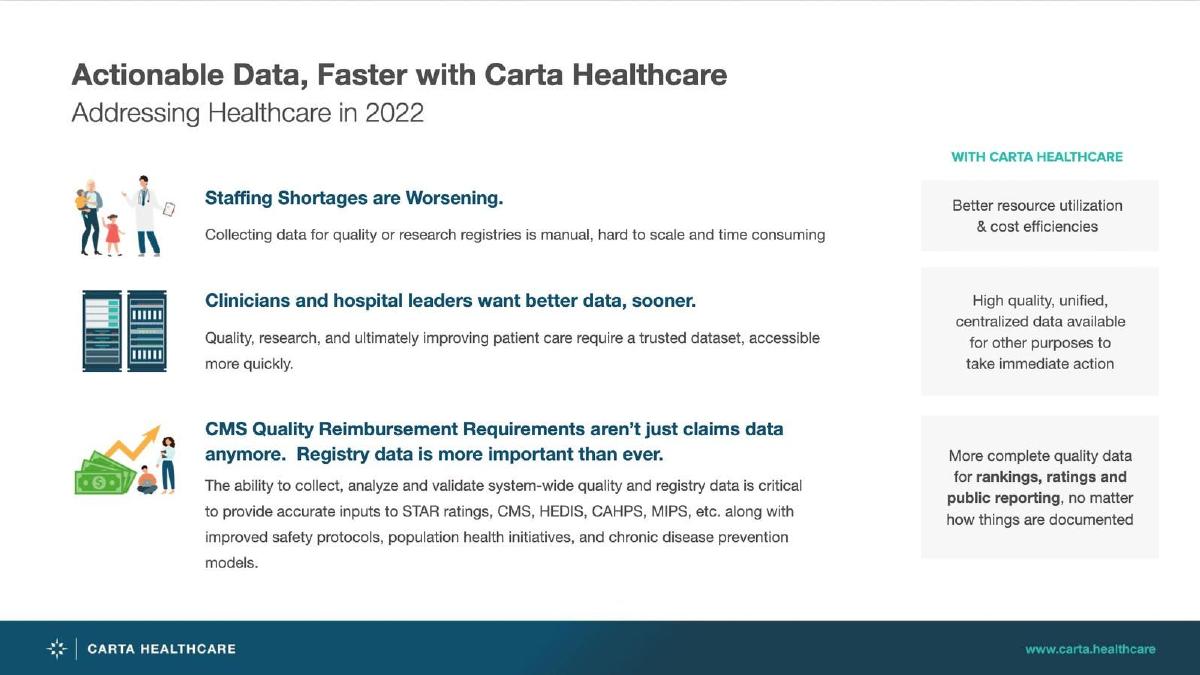
- The company positions its value proposition around solving 'staffing shortages' by automating manual data collection for research registries (Slide 3).
- Carta Healthcare claims a significant ROI for hospitals, citing a potential 20% savings or $3.48M per 250 beds (Slide 4).
- The platform aims to compress the timeline for data-driven healthcare improvements from three years down to three months (Slide 5).
- The product ecosystem is built on a core platform called 'Cartographer,' supporting specific apps like Atlas (abstraction), Semaphore (analysis), and Navigator (optimization) (Slide 6).
- A 'Human-Computer Team' approach is utilized, where AI flags fields for human verification rather than attempting 100% autonomous abstraction (Slide 7).
- Traction is evidenced by 16 subscription health systems and 3.0x ARR growth as of the 2022 deck (Slide 9).
- The startup has achieved significant market penetration, serving 4 of the top 8 hospitals in the country (Slide 9).
- The team is substantial for a Series B, reporting 151 total team members at the time of the raise (Slide 9).
Carta Healthcare: Automating the Backbone of Hospital Data
Carta Healthcare’s 2022 pitch deck is a masterclass in identifying a specific, painful administrative bottleneck and presenting a scalable solution. While many AI healthcare startups focus on diagnostic tools or patient-facing apps, Carta targets the 'plumbing' of hospital operations: clinical data abstraction. This teardown examines the 18-slide deck used to secure a $25M Series B, focusing on how they balanced technical AI claims with the practical reality of clinical workflows.
Slide 1: Title and Branding
The deck opens with a clean, professional title slide featuring the company logo and the year 2022. The background image depicts healthcare professionals in a clinical setting, immediately grounding the presentation in the industry. There is no tagline on this slide, relying instead on the brand name and the visual context of the imagery.
Slide 2: The Personal Connection
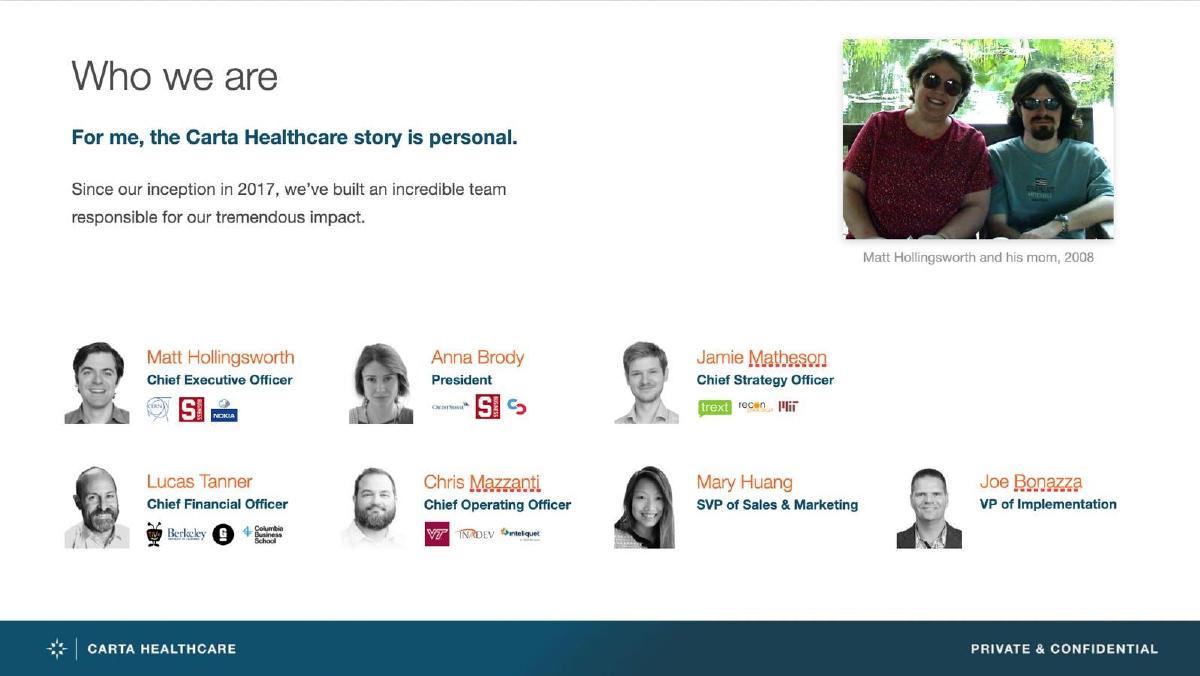
Slide 2, titled 'Who we are,' takes an unusual but effective approach for a Series B deck by leading with a personal story. It features a photo of CEO Matt Hollingsworth and his mother from 2008, stating that the 'Carta Healthcare story is personal.' This establishes founder-market fit and emotional stakes before diving into the professional credentials of the leadership team. The slide lists eight key executives, including the CEO, President, CSO, CFO, COO, and VPs of Sales, Marketing, and Implementation. Notable logos under the team members include CERN, Nokia, Credit Suisse, and Columbia Business School, signaling a mix of high-level technical and business backgrounds.
Slide 3: The Macro Problem
Slide 3 outlines the industry pressures of 2022. It identifies three core issues: worsening staffing shortages, the demand for better data from hospital leaders, and evolving CMS Quality Reimbursement Requirements. The slide argues that manual data collection is 'hard to scale and time consuming.' By framing the problem around reimbursement and staffing—two of a hospital CEO's biggest headaches—Carta positions itself as a 'must-have' rather than a 'nice-to-have' tool.
Slide 4: The Economic Impact
This slide quantifies the value proposition. It shows a simple equation: EHR Data + AI Technology = Huge Impact. The impact is defined as '20% Savings or $3.48M / 250 Bed.' This is a critical slide for a Series B, as it moves beyond theoretical benefits to specific financial outcomes. It also references a published study in the Journal of the American Medical Informatics Association to provide academic validation for their preference card optimization algorithm, which they claim 'started it all.'
Slide 5: Time-to-Value Compression
Slide 5 uses a Gantt-style chart to compare traditional data-driven healthcare improvements against the Carta platform. The visual shows that what traditionally takes three years (spanning data collection, AI/data science, and adoption) can be compressed into just three months with Carta. This '12x' improvement in speed is a powerful selling point for health systems that are often bogged down by multi-year implementation cycles.
Slide 6: The Product Ecosystem
The 'Go to market' slide introduces the product architecture. At the center is 'Cartographer,' the core data science platform. Branching off are three specific applications: 'Atlas' (abstraction), 'Semaphore' (analysis), and 'Navigator' (optimization). There is also a 'Build your own application' box, suggesting that the platform is extensible. This slide demonstrates that Carta isn't just a single-feature tool but a platform capable of supporting multiple revenue-generating SKUs (later cited as 26 SKUs on Slide 9).
Slide 7: The Human-Computer Team
One of the most honest slides in the deck, Slide 7 explains the 'Human-in-the-Loop' model. It acknowledges that AI isn't perfect for all clinical data tasks. The AI handles the heavy lifting—finding mentions and making recommendations—while human 'data abstractors' handle complex interpretations and verify flagged discrepancies. This approach builds trust with clinical stakeholders who are often skeptical of 'black box' AI solutions.
Slide 8: Atlas in Action
Slide 8 focuses specifically on the 'Atlas' product. It details how the AI searches clinical data from all sources (unstructured data, ICD-10, ADT, etc.) to prepare data for nurse abstractors. The slide includes a visual representation of the software interface, showing how it highlights specific conditions (like 'acute kidney injury') and procedures within a progress note to populate a patient registry form. This 'show, don't just tell' approach helps investors visualize the product's utility.
Slide 9: Traction and Social Proof
The 'Where we are' slide is the 'money slide' for the Series B. It lists five impressive metrics: 16 subscription health systems, 3.0x ARR growth, a successful $20M Series A in 2021, 151 team members, and 26 SKUs. Most importantly, it claims that '4 of the top 8 hospitals in the country' trust Carta for data abstraction. A quote from a Quality RN at a top 3 hospital provides qualitative support to the quantitative data. This slide proves that the company has moved past the pilot phase and is successfully selling into the most prestigious (and difficult) accounts in the U.S.
What Works in This Deck
Specific ROI: By citing a $3.48M saving per 250 beds, Carta gives hospital administrators a clear reason to buy and investors a clear reason to fund. Platform Play: The transition from a single tool to a platform (Cartographer) with 26 SKUs suggests a high ceiling for expansion revenue within existing accounts. Validation: The combination of peer-reviewed research and 'top 8' hospital logos provides a level of credibility that is rare in the crowded 'AI for healthcare' space. Pragmatism: The 'Human-Computer Team' slide addresses the biggest technical hurdle in healthcare AI—accuracy—by showing exactly how humans remain in the loop.
What is Missing
Competitive Landscape: The deck does not mention competitors. While Carta’s traction is strong, investors would want to know how they defend against incumbents like Optum or other AI startups in the clinical intelligence space. Unit Economics: While ARR growth is mentioned, there is no data on Customer Acquisition Cost (CAC), Lifetime Value (LTV), or gross margins, which are critical for evaluating the long-term sustainability of a 151-person team. The Ask: The deck ends without a specific slide detailing how the $25M will be spent. While we know the outcome from publisher reports, a standard pitch deck usually outlines the roadmap for the next 18-24 months of capital usage.
Founder Takeaways
Use Social Proof Early: If you have 'top 8' customers, don't bury them. Carta uses these logos to validate every other claim in the deck. Quantify the 'Un-quantifiable': Administrative time is hard to track, but Carta turned it into a '3 years vs. 3 months' visual that is impossible to ignore. Embrace the Human Element: In industries where 100% automation is impossible or dangerous (like medicine), showing how your AI assists humans rather than replacing them is a more credible and effective sales strategy. Structure for Scale: Showing a platform architecture early (Slide 6) helps investors see the path to a multi-billion dollar valuation, even if you are currently only generating revenue from one or two specific use cases.
Frequently asked questions
- What specific problem does Carta Healthcare solve?
- Carta Healthcare addresses the inefficiency of manual data abstraction. Hospitals must collect and validate system-wide quality and registry data for STAR ratings, CMS, and HEDIS requirements. Traditionally, this is a manual, slow, and hard-to-scale process. Carta uses AI to automate the extraction of this data from Electronic Health Records (EHRs), freeing up clinicians and providing faster access to actionable insights.
- How does their 'Human-in-the-Loop' AI model work?
- As shown on Slide 7, the AI technology completes fields it is qualified for, finds mentions of registry information, and provides traceable recommendations. However, it flags fields with conflicting values for human verification. Carta Healthcare data abstractors (often nurses) then complete fields requiring high levels of clinical interpretation, ensuring the dataset remains high-quality while benefiting from machine speed.
- What are the core products in the Carta Healthcare suite?
- The ecosystem is anchored by 'Cartographer,' a data science and developer platform. On top of this, they offer 'Atlas' for clinical data abstraction, 'Semaphore' for AI analysis of patient data, and 'Navigator' for hospital optimization in areas like anesthesia, nursing, and pharmacy (Slide 6).
- What metrics did Carta Healthcare use to prove traction for their Series B?
- On Slide 9, the company highlights five key metrics: 16 subscription health systems, 3.0x ARR growth, their previous $20M Series A (March 2021), a team size of 151, and a catalog of 26 SKUs. They also emphasize that 4 of the top 8 hospitals in the U.S. use their services.
- Does the deck include a financial forecast or exit strategy?
- No. The provided slides focus on the problem, the technical solution, and current traction metrics. There are no detailed financial projections, P&L statements, or discussions regarding potential acquirers or an IPO timeline within the 18-slide sequence.