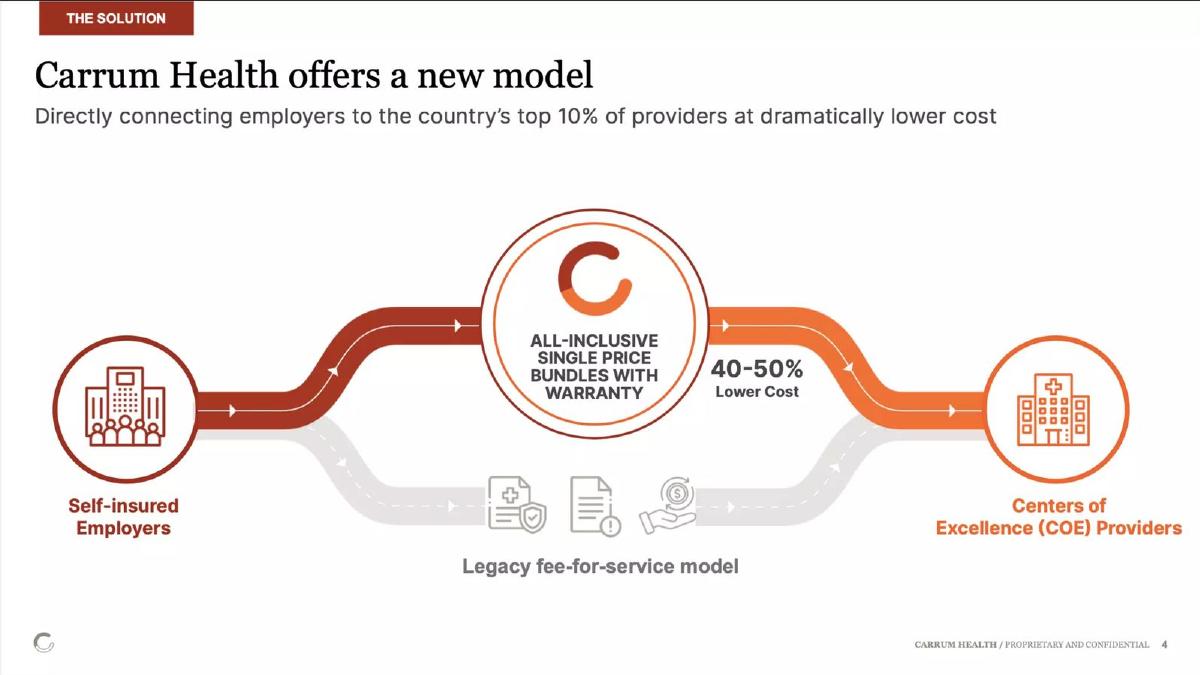
Carrum Health’s Series B deck is a masterclass in identifying a high-spend, low-innovation vertical within the healthcare sector. By focusing on surgical and complex care—which accounts for 50% of employer spend ($400B) despite representing only 10% of members—the company positions itself as a necessary efficiency layer. The deck moves from a clear problem statement to a solution based on all-inclusive bundles that align incentives for patients, employers, and providers. The narrative pivot to oncology as a secondary growth engine is backed by 2023 survey data showing cancer as the top condit…
Key takeaways
- Surgical and complex care represents a $400B market opportunity, accounting for 50% of total employer spend (Slide 3).
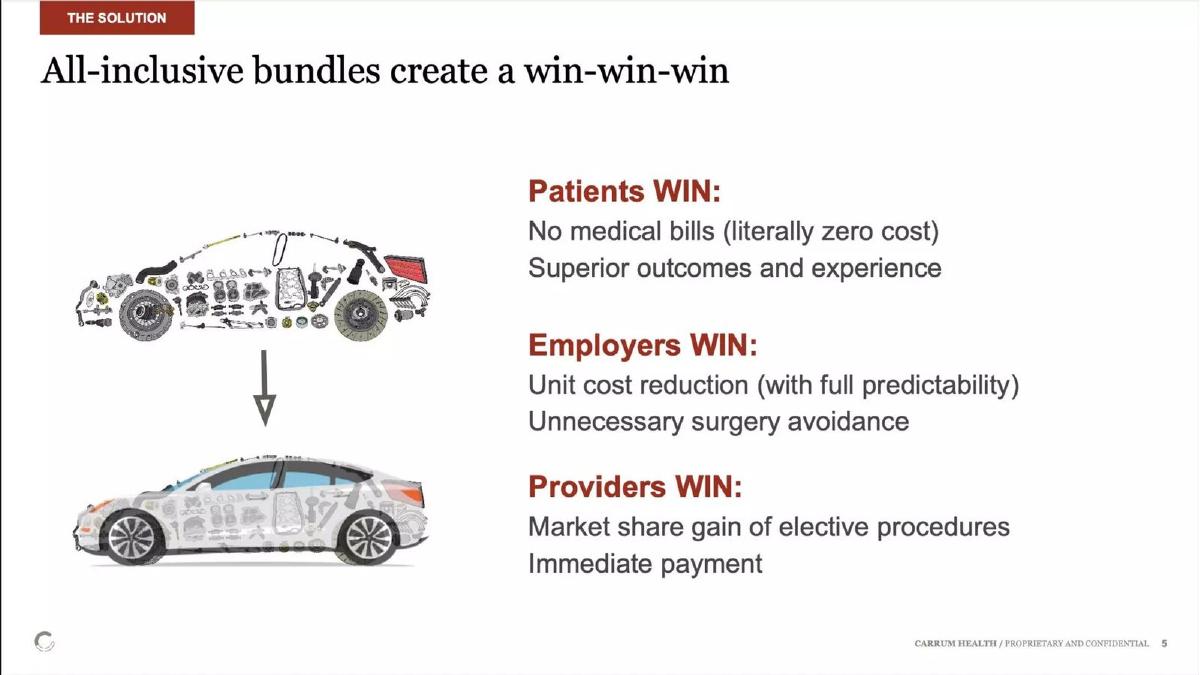
- The platform utilizes a 'win-win-win' model where patients pay zero cost and providers receive immediate payment (Slide 5).
- The technology is positioned as a plug-and-play, AI-driven platform designed for member-focused care digitization (Slide 7).
- Strategic partnerships with companies like Accolade, Hinge Health, and Virgin Pulse are used to simplify procurement and fuel growth (Slide 9).
- Cancer has overtaken MSK as the top condition driving employer costs at 83%, according to a 2023 BGH Survey (Slide 13).
- Less than 1% of employees receive a cancer diagnosis, yet they account for 12-15% of total medical spend (Slide 13).
- The company is expanding its value-based model to include a one-stop oncology offering covering screening, guidance, and a COE network (Slide 15).
- The deck emphasizes 'unnecessary surgery avoidance' as a primary value proposition for employers (Slide 5).
The Value-Based Care Narrative
Carrum Health’s Series B deck is built on the premise of radical simplification in a notoriously complex industry. The deck uses a clean, professional aesthetic to argue that the current surgical care model is fragmented and inefficient. By positioning themselves as a 'marketplace platform,' they signal to investors that they are an asset-light technology layer capable of capturing a percentage of a massive $400 billion spend.
Slide 1: Title and Positioning
The cover slide establishes the company as 'A New Model for Surgical & Cancer Care.' It explicitly defines the business as a 'true Value-Based Care marketplace platform.' The use of the term '21st century' suggests that the existing competition is antiquated. The branding is minimalist, focusing on the core value proposition rather than flashy graphics.
Slide 3: The Problem Statement
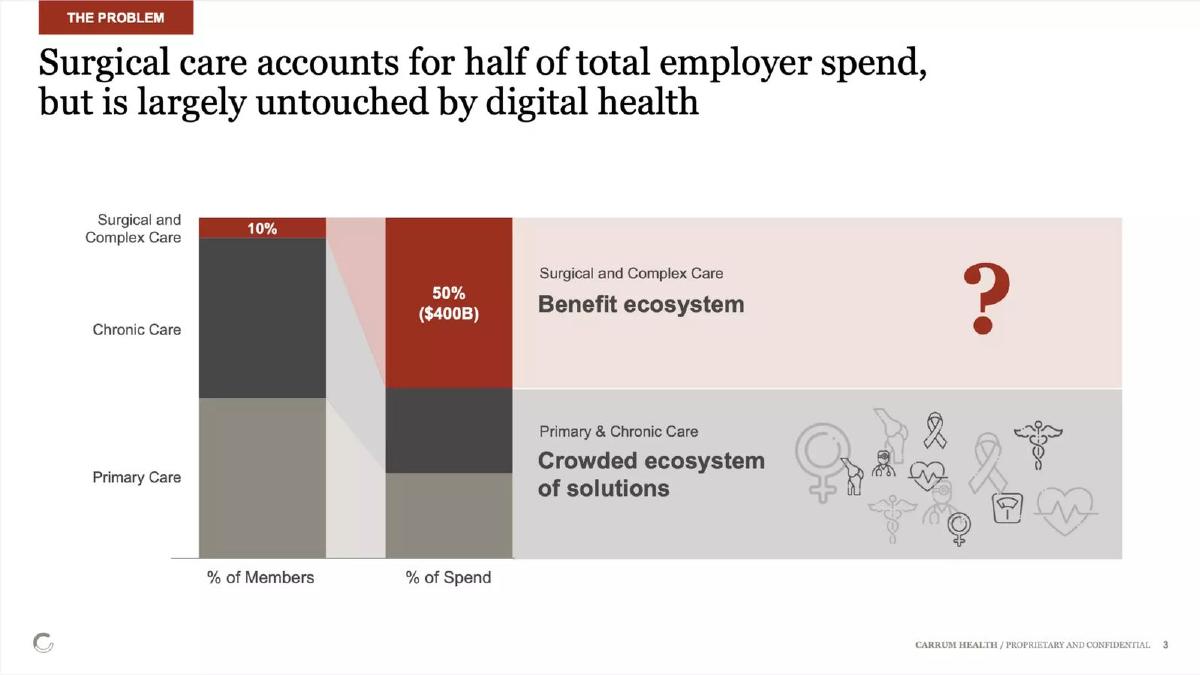
This is the 'anchor' slide of the deck. It uses a split bar chart to show a massive market inefficiency. On the left, it shows that 10% of members drive the need for surgical and complex care. On the right, it shows that this small group accounts for 50% ($400B) of total employer spend. The slide points out that while primary and chronic care have a 'crowded ecosystem of solutions,' surgical care is represented by a large red question mark. This creates a sense of urgency and highlights a clear 'blue ocean' opportunity.
Slide 5: The Solution - The Win-Win-Win
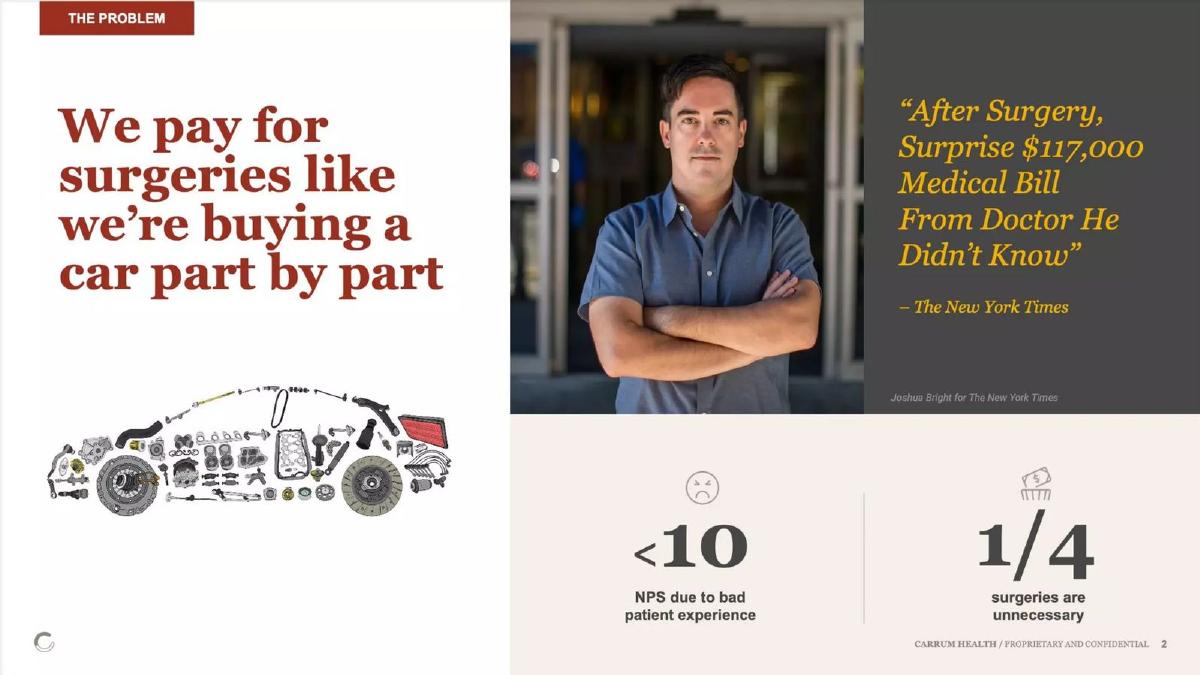
Carrum explains its solution using a car metaphor—taking fragmented parts and assembling them into a functional vehicle. The 'All-inclusive bundles' are the core product. The slide breaks down the benefits for three stakeholders: Patients (zero cost, superior experience), Employers (cost reduction, predictability, surgery avoidance), and Providers (market share, immediate payment). This alignment of incentives is a hallmark of successful marketplace businesses.
Slide 7: Enterprise Platform and Technology
This slide moves from the business model to the underlying infrastructure. It features a four-quadrant circle connecting Patients, Providers, Carrum Care Specialists, and Purchasers. The right side of the slide lists four tech-heavy bullet points: Plug-and-play, data foundation, AI-driven, and care digitization. While it lacks technical specifics, it reassures investors that the business is built to scale through automation rather than just manual care coordination.
Slide 9: Strategic Partnerships
To prove market validation and distribution, Slide 9 displays a 'who's who' of the HR-tech and digital health world. Logos for Accolade , Virgin Pulse , and Hinge Health are prominent. The slide claims these partnerships 'simplify procurement' and 'fuel growth.' For a Series B company, showing that you are already integrated into the workflows of the industry's biggest players is a significant de-risking factor.
Slides 11-13: The Oncology Pivot
Slide 11 introduces 'The Oncology Opportunity' with high-quality lifestyle photography, signaling a shift in focus. Slide 13 provides the data to back this expansion. It cites a 2023 BGH Survey showing Cancer as the top condition driving employer cost at 83%, surpassing MSK (Musculoskeletal) at 76%. The most striking stat is that less than 1% of employees receive a cancer diagnosis, yet they account for 12-15% of medical spend. This justifies why Carrum is moving beyond standard surgeries into complex oncology.
Slide 15: The Oncology Offering
This slide outlines the three pillars of their cancer care strategy: Screening & Detection , Guidance , and a Value-based Oncology COE (Center of Excellence) Network . By replicating their surgical COE model in oncology, they demonstrate a repeatable playbook for entering new high-cost medical verticals.
Slide 18: The Close
The deck concludes with a simple 'Thank you' and the company URL. Notably, in the provided slides, there is no 'Ask' slide detailing how the $45M will be spent, nor is there a 'Team' slide highlighting the founders' backgrounds. These were likely in the 9 slides not included in this set, or presented in a separate document.
What Works in This Deck
The 'Question Mark' Strategy: Slide 3 is exceptionally effective. By visually showing that the most expensive part of healthcare is the least served by digital innovation, they make their existence seem like a logical necessity rather than a luxury.
Stakeholder Alignment: The 'Win-Win-Win' slide (Slide 5) addresses the biggest hurdle in healthcare: someone usually loses when costs are cut. By showing how providers actually benefit (market share and cash flow), they overcome the objection that hospitals will resist their model.
Data-Driven Expansion: The transition to oncology isn't presented as a whim. Using the 2023 BGH Survey data makes the expansion feel like a calculated response to market demand from their existing employer customers.
What Is Missing
Unit Economics: There is no mention of the take-rate, the cost of a bundle, or the margin Carrum retains. For a Series B, investors usually require a deep dive into the LTV/CAC and the profitability of individual bundles.
The 'Ask': The deck identifies the opportunity but doesn't explicitly state what the $45M will be used for. Is it for R&D in the AI platform, sales team expansion, or building out the oncology provider network?
Competitive Landscape: While they mention the 'crowded ecosystem' of primary care, they don't address other surgical bundle competitors or how they differ from traditional PPO networks that are trying to implement similar value-based models.
Founder Takeaways
Focus on the 'Spend vs. Members' Gap: If you are in B2B or Fintech, find the segment where a tiny percentage of users drives a massive percentage of cost or pain. Visualizing that gap is the fastest way to prove market need.
Use a 'Win-Win-Win' Framework: In multi-sided marketplaces, you must explicitly state why every participant stays on the platform. If the provider doesn't get paid faster or get more business, the marketplace fails. Carrum addresses this head-on.
Leverage Ecosystem Logos: Don't just list customers; list partners. Showing that you are a 'plug-and-play' addition to a larger platform (like Virgin Pulse) tells investors that your customer acquisition cost will be lower because you are riding the rails of established giants.
Frequently asked questions
- What is Carrum Health's core business model?
- Carrum Health operates a value-based care marketplace platform that uses all-inclusive bundled payments for surgical and cancer care. By bundling costs, they provide price predictability for employers and eliminate out-of-pocket medical bills for patients. This model incentivizes providers by offering them increased market share for elective procedures and immediate payment, rather than the traditional, fragmented fee-for-service billing cycle.
- How does Carrum Health justify its focus on surgical care?
- The deck highlights a significant imbalance in healthcare spending. According to Slide 3, while only 10% of an employer's members require surgical or complex care, these cases account for 50% of the total spend, or approximately $400 billion. Carrum argues that while primary and chronic care have 'crowded ecosystems' of digital solutions, surgical care has remained largely untouched by digital health innovation.
- What is the 'Oncology Opportunity' mentioned in the deck?
- Carrum Health is expanding its bundled payment model into cancer care. They cite a 2023 BGH Survey showing cancer is now the #1 cost driver for employers (83%). The strategy involves a 'one-stop' offering that includes screening and detection, guidance, and a Value-based Oncology Center of Excellence (COE) network. This allows them to capture a segment that represents 12-15% of medical spend from less than 1% of the population.
- Who are Carrum Health's strategic partners?
- Slide 9 lists several high-profile digital health and benefits partners, including Accolade, Virgin Pulse, Hinge Health, Sword, Included Health, Rightway, Apree Health, Access Hope, and Grail. These partnerships are designed to simplify procurement for employers and improve the utilization of Carrum's platform by integrating it into the broader employee benefits ecosystem.
- What specific technology advantages does Carrum claim?
- On Slide 7, the company describes its platform as 'industry-leading technology' that is 'truly plug-and-play.' Key technical pillars include an 'unparalleled, growing data foundation,' an 'AI-driven platform,' and 'member-focused care digitization.' The goal of this tech stack is to enable the marketplace to scale efficiently across various complex care categories.