Carlson Wireless Technologies utilizes TV White Space (TVWS) to provide broadband to underserved rural areas where traditional infrastructure is cost-prohibitive. The deck, dated around 2016, emphasizes the 'physics' of the UHF spectrum, which allows for 10km+ reach through terrain and foliage. With 34 million U.S. homes lacking broadband and a global market of billions earning under $2,000 annually, Carlson positions its Gen3 hardware as the affordable alternative. The presentation leans heavily on regulatory wins, citing FCC certification and approval in markets like Canada, the UK, and Sin…
Key takeaways
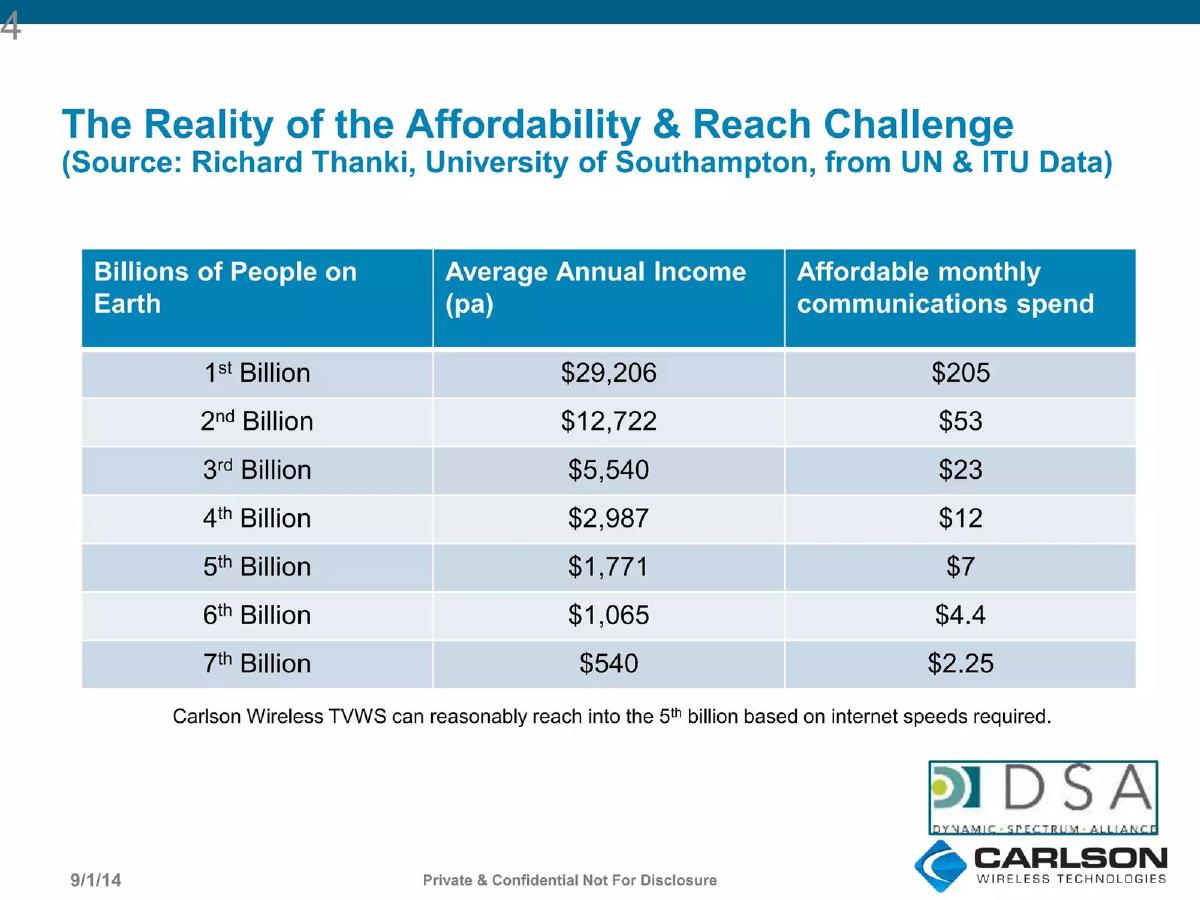
- The company targets the 'Next Billion' users, specifically those in the 5th billion income bracket who can afford roughly $7 per month for communications (Slide 4).
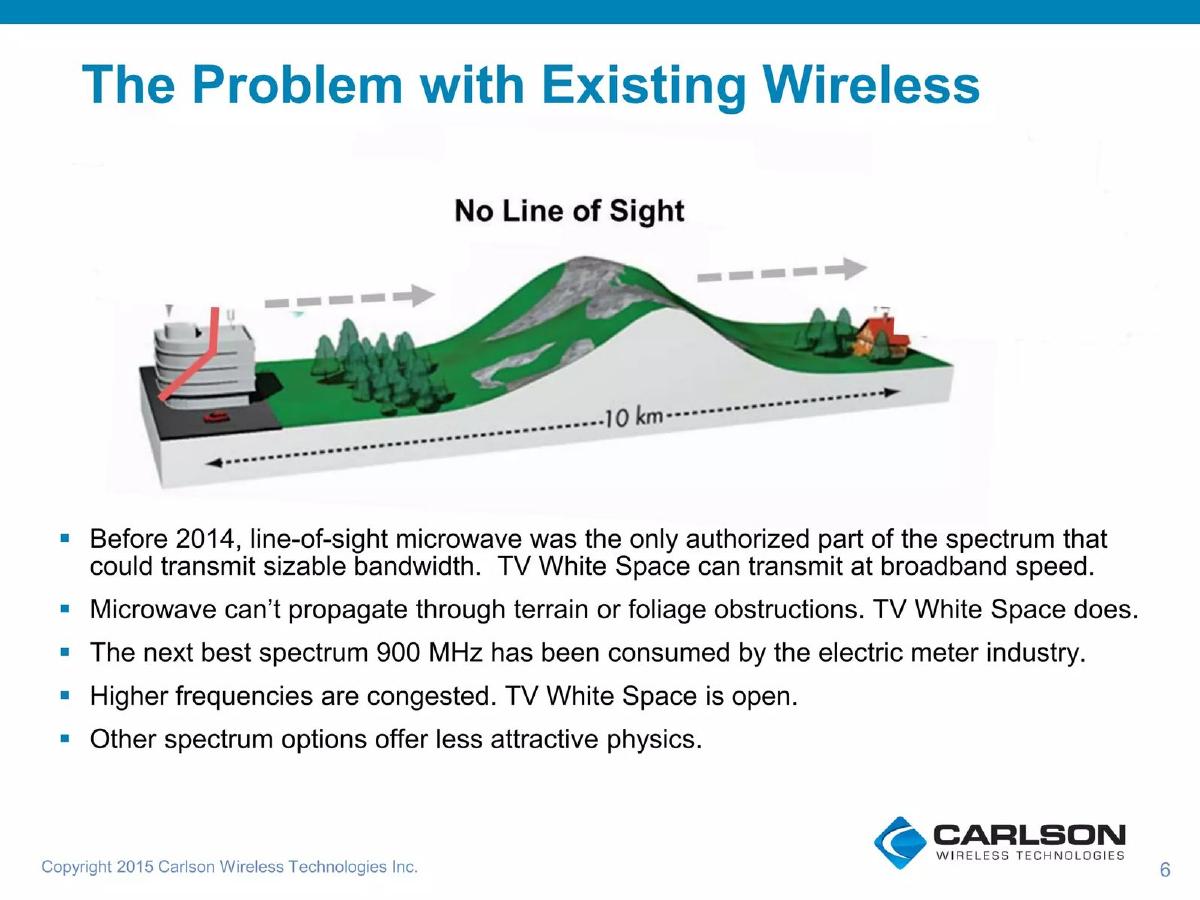
- TV White Space technology is marketed as superior for 'greenfield' installations due to its ability to travel 10km and penetrate obstacles like hills and trees (Slide 7).
- The deck identifies the UHF .3-1GHz range as the 'Sweet Spot' for wireless connectivity due to low relative complexity and cost (Slide 10).
- Regulatory tailwinds are a core part of the thesis, with Slide 13 listing over 20 countries currently authorizing or piloting TVWS deployments.
- Domestic opportunity is quantified at 34 million U.S. homes that lack access to fixed broadband due to low density and difficult terrain (Slide 16).
- Traction is evidenced by 100+ unsolicited requests for Gen 3 deployments and a project with Microsoft to build 500,000 TVWS networks in India (Slide 19).
- The company set a specific milestone to reach 50,000 unit sales by the third quarter of 2017 (Slide 22).
- Strategic partnerships are high-profile, including selection by Google for a South Africa wireless project and FCC certification achieved in 4Q13 (Slide 22).
Executive Summary: Connecting the Unconnected
Carlson Wireless Technologies addresses a fundamental infrastructure gap: the inability of traditional fiber and high-frequency wireless to cost-effectively reach rural populations. The deck, titled 'Connecting the Next Billion,' frames the problem through both a humanitarian and a commercial lens. By leveraging TV White Space (TVWS), Carlson claims to offer a solution where the 'physics are better,' allowing for long-range, non-line-of-sight connectivity. The presentation is heavily weighted toward technical validation and regulatory progress, which are the two largest hurdles for any spectrum-dependent hardware company.
Slide 1: Title Slide
The deck opens with the company logo and the tagline 'Connecting the Next Billion.' The background features a simplified world map, signaling that while the company is U.S.-based, its primary market opportunity is global. A copyright notice at the bottom dates the intellectual property to 2015, though the source listing suggests the deck was used in early 2016.
Slide 4: The Affordability and Reach Challenge
This slide provides a sophisticated market segmentation based on global income levels. Citing data from Richard Thanki (University of Southampton) and the UN/ITU, it breaks down the world's population into seven 'billions.' Carlson identifies its target as the 5th billion—people with an average annual income of $1,771 and an affordable monthly communications spend of just $7. The slide explicitly states that Carlson Wireless TVWS can 'reasonably reach' this demographic based on the internet speeds required. This is a crucial slide because it acknowledges that the 'Next Billion' cannot be served by $100/month satellite or fiber plans; the hardware and operational costs must be low enough to sustain a sub-$10 ARPU (Average Revenue Per User).
Slide 7: The TV White Space Solution
Slide 7 serves as the primary product visualization. It uses a 3D diagram to show a basestation transmitting a signal over a 10km distance, arching over a hill and trees to reach a terminal at a residential house. The slide lists four key value propositions: performance over greater distance (due to better physics), suitability for greenfield installations, database-managed co-existence with existing TV channels, and access to additional spectrum without cost. The mention of '25 Mbps broadband' at the terminal end sets a specific performance benchmark that was competitive for rural areas in 2016.
Slide 10: Spectrum Impairments Comparison
This is a highly technical slide intended to satisfy engineering-minded investors. It features a complex graph comparing frequency (GHz) against relative complexity and cost. A large red circle highlights the 'Sweet Spot' in the UHF TV band (0.3 to 1 GHz). The graph illustrates that while antenna aperture and ionospheric reflection are high at lower frequencies, and foliage absorption and rain fade spike at higher frequencies, the UHF band offers a trough of low interference and low cost. The slide credits the Canadian government for this data, adding third-party technical validation to Carlson's choice of spectrum.
Slide 13: Global Spectrum Sharing Update
Regulatory risk is the 'death knell' for wireless startups. Slide 13 mitigates this by listing the global status of TVWS. It highlights that the U.S. FCC has launched proceedings to increase flexibility and power for TVWS. It also notes that the UK (Ofcom), Canada, and Singapore have authorized or implemented regulations. Most impressively, it lists over 20 countries—including Brazil, India, Japan, and Kenya—where pilots or deployments are authorized. This slide proves that the market is not just a theoretical possibility but a regulated reality.
Slide 16: The Domestic Opportunity
While previous slides focused on the global 'Next Billion,' Slide 16 pivots to the United States. It features a map of the U.S. where green areas represent coverage and white areas represent a lack of fixed broadband access. The headline states that 34 million U.S. homes lack access due to costs, terrain, and low density. This slide serves to remind investors that there is a significant, high-value 'Tier 1' market opportunity in the company's backyard, not just in developing nations.
Slide 19: International Demand and Traction
This slide moves from 'market potential' to 'actual demand.' It lists several high-profile indicators: Microsoft plans to build 500,000 TVWS networks in India; Carlson has received 100+ unsolicited requests for Gen 3 deployments; and active discussions are underway for projects in Ethiopia, Kenya, South Africa, Brazil, India (20,000 villages), China (600,000 units), and Myanmar. The mention of 'Gen2 POC sales' proves that the company has moved past the pure R&D phase and is already generating revenue from earlier iterations of its hardware.
Slide 22: Timeline, Milestones, and Projections
The final slide in this set is a comprehensive timeline from 2012 to 2017. Key historical milestones include:
2012: VHF Prototype deployed in U.S. trials. · 2013: 1,500 units of RuralConnect run; selection by Google for South Africa project; FCC Certification in 4Q. · 2014: Gen2 demo trials in 25 countries; TVWS rules approved in Singapore and Canada. · 2015: Use of 10W EIRP for 40km links in Africa; FCC finalizes $9Bn subsidies for rural broadband. · 2016: Patent filings for dual-polarity flat panel antenna; Gen 3 trials (first IEEE 802.11af). · 2017: Projection to reach 50,000 unit sales by 3Q.
This timeline is effective because it blends technical achievements (patents, certifications) with commercial ones (unit runs, sales targets) and regulatory wins ($9Bn FCC subsidies).
What Carlson Wireless Does Well
The deck excels at technical and regulatory validation. For a hardware company operating in licensed or semi-licensed spectrum, the biggest question is always 'Will the government let you do this?' and 'Does the physics actually work?' Carlson answers both definitively. By citing the UN, ITU, FCC, Ofcom, and the Canadian government, they move the conversation away from 'if' the technology is viable to 'how fast' they can scale. The use of a 'Sweet Spot' graph (Slide 10) is a brilliant way to simplify a complex engineering argument for a generalist investor.
Furthermore, the traction slide (Slide 19) is exceptionally strong. Naming Microsoft and Google as partners or project leads provides immense social proof. The mention of '100+ unsolicited requests' suggests a strong product-market fit and a 'pull' from the market rather than a difficult 'push' sale.
What is Missing from the Deck
Despite the technical depth, the provided slides are missing several critical components for a complete investment case: 1. Management Team: There is no slide detailing the founders or the engineering team. In a hardware play, the pedigree of the RF (Radio Frequency) engineers is paramount. 2. Unit Economics: While Slide 4 mentions that the target market can afford $7/month, the deck does not explain the Bill of Materials (BOM) for the Gen 3 units or the expected margins. Investors need to know if a 50,000-unit sale (Slide 22) leads to profitability. 3. The Ask: The provided slides do not state how much capital is being raised or how those funds will be allocated (e.g., manufacturing scale-up, R&D, or sales). 4. Competition: The deck assumes TVWS is the only solution. It fails to address competition from low-earth orbit (LEO) satellites (like Starlink, which was in early development at the time) or the expansion of 4G/5G small cells.
Founder Takeaways: Lessons from Carlson
Use Third-Party Data for Market Sizing: Carlson didn't just say 'lots of people need internet.' They used the 'Billions of People' chart (Slide 4) to show exactly which economic bracket they are targeting. This makes the TAM (Total Addressable Market) feel calculated rather than guessed.
Address Regulatory Hurdles Head-On: If your startup operates in a regulated space, make a 'Regulatory Status' slide (like Slide 13) a priority. Listing specific government agencies and the status of their legislation removes a massive layer of perceived risk for the investor.
Visualize the 'Why': Slide 7 is a perfect example of a 'How it Works' slide. It doesn't just show the box; it shows the box solving a problem (going over a hill) that its competitors (standard Wi-Fi) cannot solve. Always visualize the specific edge case where your product wins.
Leverage 'Unsolicited' Interest: If you are in the early stages, mentioning 'unsolicited requests' is one of the strongest signals of demand. It tells investors that the market is searching for you, which implies a lower Customer Acquisition Cost (CAC) in the future.
Frequently asked questions
- What is the core technology behind Carlson Wireless?
- Carlson Wireless utilizes TV White Space (TVWS), which refers to the unused frequencies in the wireless spectrum between television channels. By using the UHF band (.3-1GHz), the technology can transmit data over long distances (10km+) and through physical obstructions like foliage and terrain that typically block higher-frequency Wi-Fi or cellular signals.
- Who is the target customer for this technology?
- The deck identifies two primary segments: international broadband providers looking to connect the 'Next Billion' (specifically those with an average annual income of $1,771) and U.S. rural markets where 34 million homes lack broadband. Customers include governments, service providers, and major tech firms like Microsoft and Google.
- What is the regulatory status of TV White Space?
- As of the 2016 deck, TVWS is permitted in the U.S. (FCC), Canada (Industry Canada), and the UK (Ofcom). The deck also notes that Singapore and Finland have authorized legislation, while dozens of other countries like Brazil, India, and Japan are in the pilot or pre-regulation phase.
- What kind of traction does Carlson Wireless demonstrate?
- The company shows significant momentum, including 1,500 units of their RuralConnect radio run in 2013, Gen2 trials in 25 countries, and a selection by Google for a project in South Africa. They also mention receiving over 100 unsolicited requests for their Gen 3 hardware and a massive 500,000-network initiative with Microsoft in India.
- What are the projected sales goals mentioned in the deck?
- The timeline slide (Slide 22) explicitly targets reaching 50,000 unit sales by the third quarter of 2017. This follows the filing of patents for a dual-polarity flat panel antenna and the trial of their Gen 3 solution, which is the first to be IEEE 802.11af compliant.