Agave Games, an Istanbul-based mobile gaming startup, raised a $7M Seed round in 2024 using a concise 8-slide deck. The presentation is a masterclass in 'betting on the jockey,' as it leans heavily on the founding team's previous success at major gaming studios like Good Job Games and Fugo. Rather than showcasing a finished product, the deck outlines a strategic approach to 'Casual Puzzle 2.0,' focusing on high-retention mechanics and a dual-monetization model (in-app advertising and in-app purchases). The deck successfully secured backing from top-tier investors like Balderton Capital and Fe…
Key takeaways
- The deck highlights a founding team with direct experience managing 7 titles and leading growth at established studios like Good Job Games (Slide 2).
- Agave Games positions itself as a 'long-term greedy company' aiming for multiple high-retention titles across puzzle sub-genres (Slide 3).
- The strategy relies on a 'Dual Monetization' model, balancing in-app advertising with in-app purchases to widen the target audience (Slide 5).
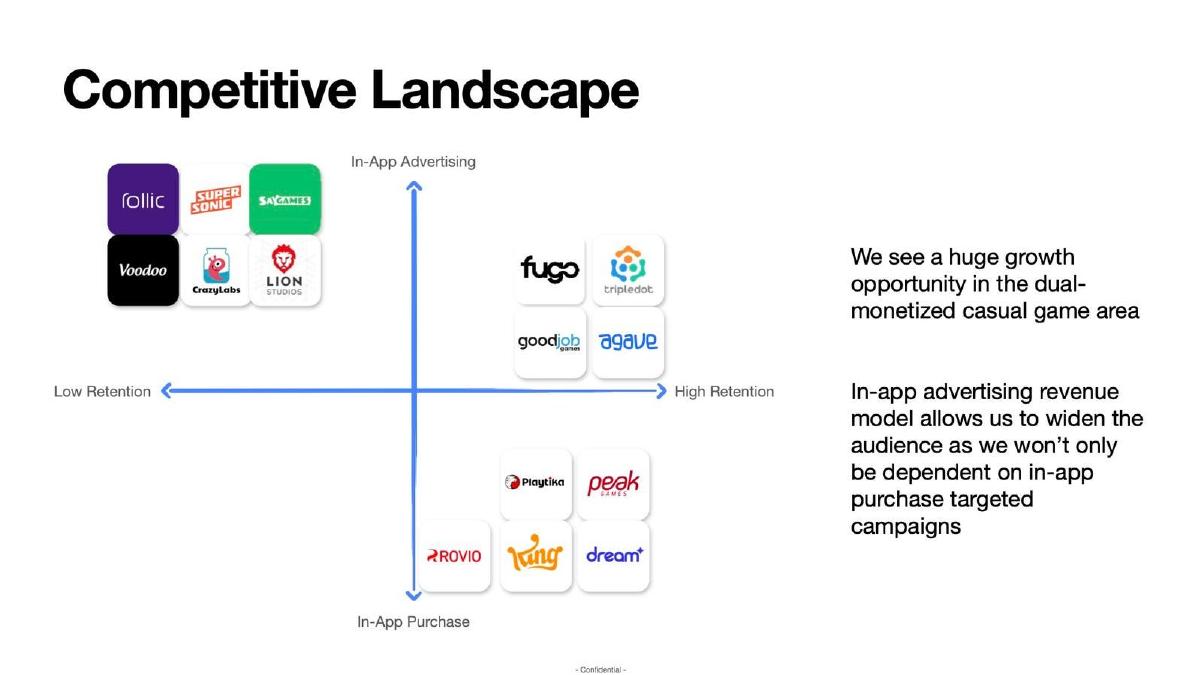
- The competitive landscape slide identifies a gap in the market for high-retention games that utilize in-app advertising (Slide 5).
- The startup plans a rapid development cycle, aiming for a Beta release within 6-8 months of funding (Slide 7).
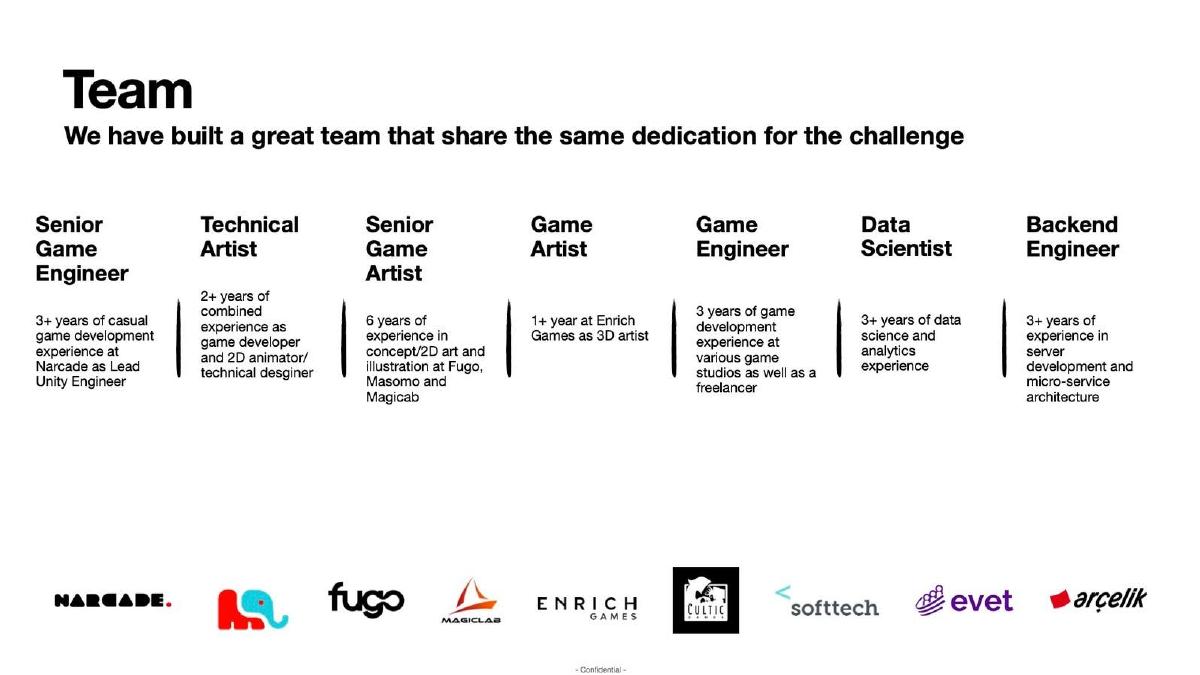
- The deck lists a complete technical team including Data Scientists and Backend Engineers with experience from Narcade and MagicLab (Slide 6).
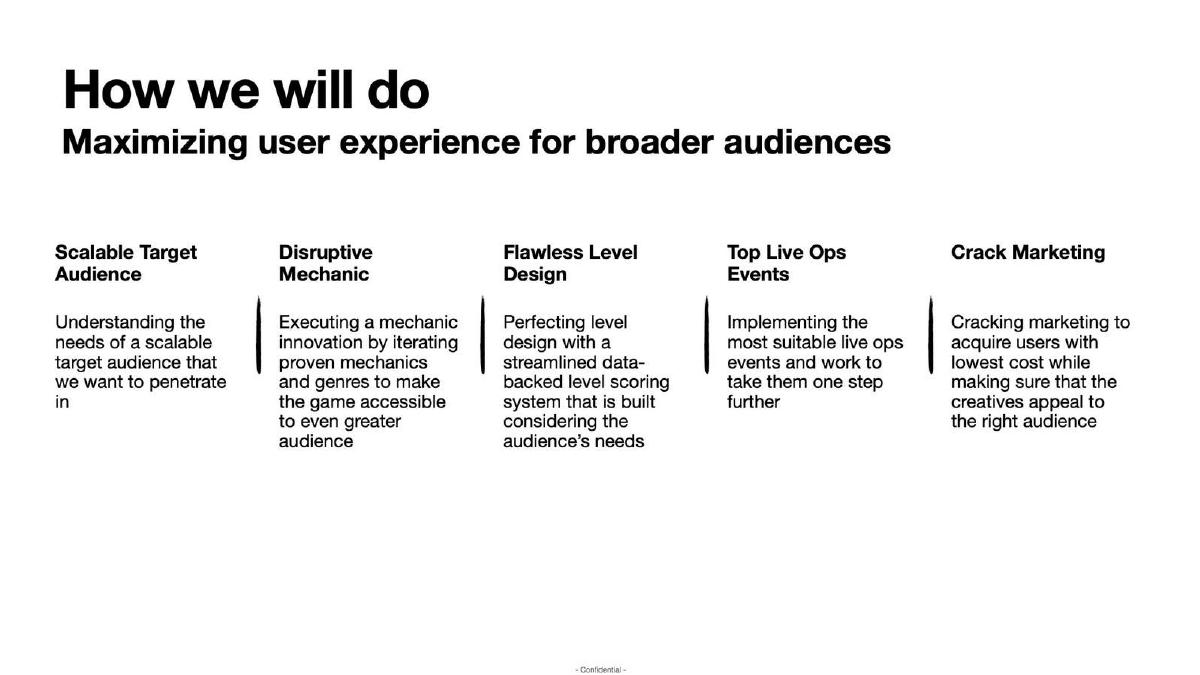
- Marketing is treated as a core competency, with a specific focus on 'cracking marketing' to acquire users at the lowest possible cost (Slide 4).
- The $7M Seed round was led by Balderton Capital, Felix Capital, and 500 Istanbul (Slide 7).
The Pedigree Play: How Agave Games Raised $7M Pre-Launch
In the world of mobile gaming, where the cost of user acquisition is skyrocketing and the market is saturated with clones, investors are increasingly looking for teams that have already 'been there and done that.' The Agave Games pitch deck is a textbook example of how to leverage professional history to secure a massive Seed round. Based in Istanbul—a rising global hub for mobile gaming—the team used just 8 slides to convince Balderton and Felix Capital that they were the right group to tackle the 'Casual Puzzle 2.0' market.
Slide 1: Brand Identity
The deck opens with a minimalist title slide featuring the Agave logo. There is no tagline or mission statement here. In a high-velocity fundraising environment, this simplicity suggests a focus on the brand and the team behind it, rather than a specific gimmick.
Slide 2: The Founding Team
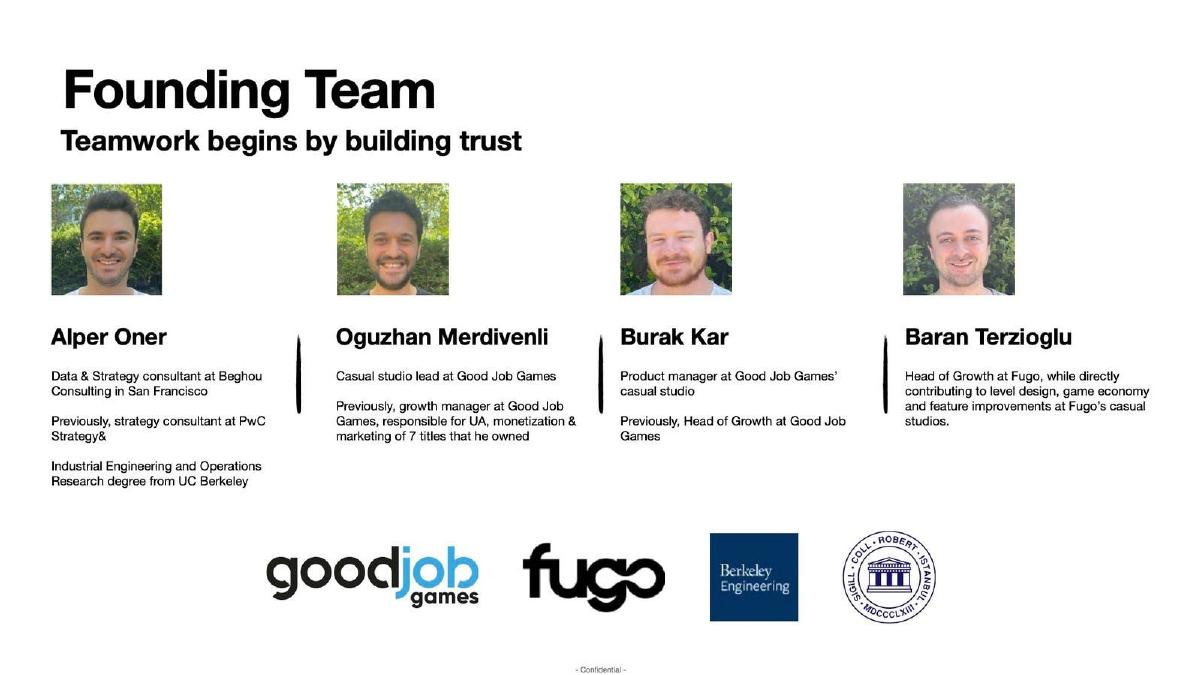
This is arguably the most important slide in the deck. It introduces the four founders: Alper Oner, Oguzhan Merdivenli, Burak Kar, and Baran Terzioglu. The text highlights specific, quantifiable achievements. For instance, Merdivenli is credited with the marketing of 7 titles at Good Job Games. Terzioglu is noted for his role as Head of Growth at Fugo. By including logos for Good Job Games, Fugo, and UC Berkeley, the slide establishes immediate credibility. The subtitle, 'Teamwork begins by building trust,' reinforces the idea that this is a cohesive unit with a shared history of success.
Slide 3: What We Will Do
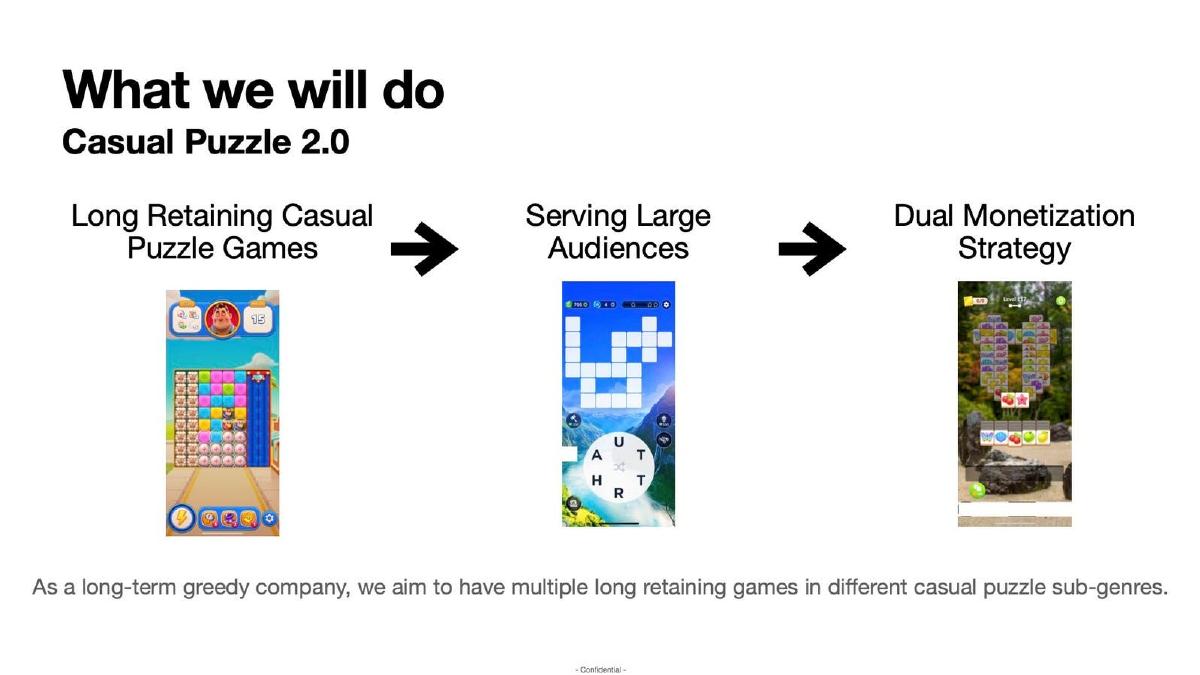
Slide 3 defines the company's vision: 'Casual Puzzle 2.0.' The slide uses a simple three-step flow: Long Retaining Casual Puzzle Games -> Serving Large Audiences -> Dual Monetization Strategy. The footer contains a notable phrase: 'As a long-term greedy company, we aim to have multiple long retaining games.' This indicates a portfolio approach rather than a 'one-hit-wonder' strategy, which is more attractive to VCs looking for sustainable growth.
Slide 4: How We Will Do It
This slide breaks down the execution strategy into five pillars: Scalable Target Audience, Disruptive Mechanic, Flawless Level Design, Top Live Ops Events, and Crack Marketing. The 'Crack Marketing' section is particularly vital, as it mentions acquiring users at the 'lowest cost.' In the current IDFA-impacted mobile landscape, proving you can acquire users efficiently is a prerequisite for funding. The mention of 'data-backed level scoring' also signals a technical, analytical approach to game design.
Slide 5: Competitive Landscape
Agave uses a standard 2x2 matrix to position itself. The axes are 'Retention' (Low to High) and 'Monetization' (In-App Purchase to In-App Advertising). They place themselves in the top-right quadrant: High Retention and In-App Advertising. By positioning themselves against giants like King, Playtika, and Dream Games (who are placed in the IAP/High Retention quadrant), Agave argues that their dual-monetization model allows them to 'widen the audience' and avoid being 'dependent on in-app purchase targeted campaigns.'
Slide 6: The Extended Team
While Slide 2 focused on the founders, Slide 6 showcases the technical depth of the broader team. It lists roles such as Senior Game Engineer, Technical Artist, Data Scientist, and Backend Engineer. Each role includes years of experience and previous employers like Narcade, MagicLab, and Softtech. This slide proves that the $7M isn't just going to the founders; it's funding a fully-staffed production house capable of building complex micro-service architectures and data pipelines.
Slide 7: Funding and Roadmap
Slide 7 explicitly states the $7M raise and names the investors: Balderton Capital, Felix Capital, and 500 Istanbul. It also provides a clear timeline: Beta in 6-8 months, followed by a 3-6 month soft launch. The mention of 'building the second studio' during the soft launch phase indicates an aggressive scaling plan that justifies the $7M price tag.
Slide 8: Conclusion
The deck ends with a simple 'Thank You!' slide. It maintains the clean, blue-and-white aesthetic found throughout the presentation.
What Works in This Deck
Clarity of Pedigree: The deck does not hide behind vague promises. It puts the founders' specific track records front and center. For a Seed round, where there is often no product to show, the team's history is the primary asset. The mention of specific titles and growth roles at market leaders like Fugo and Good Job Games provides the 'social proof' necessary to de-risk the investment.
Strategic Positioning: The competitive landscape slide is excellent. It doesn't just say 'we are better'; it explains why their monetization model is a strategic advantage in the current market. By targeting the gap between hyper-casual (high ads, low retention) and hardcore casual (high IAP, high retention), they carve out a specific 'blue ocean' for their products.
Operational Readiness: Slide 6 is a powerful addition. Many seed decks focus only on the founders. By showing they have already recruited senior engineers and data scientists from competing studios, Agave proves they are 'ready to build' the moment the funds hit the bank.
What is Missing
Product Specifics: There are no screenshots of an actual game in development. While Slide 3 shows generic puzzle game imagery, there is no 'Agave Original' shown. This is common for very early-stage gaming rounds, but it puts the entire weight of the pitch on the team's ability to find 'fun' later.
Unit Economics Projections: While the deck mentions 'lowest cost' marketing and 'dual monetization,' it lacks specific targets for LTV (Lifetime Value) or CAC (Customer Acquisition Cost). Investors in this space usually want to see what kind of ROAS (Return on Ad Spend) the team expects to achieve based on their previous experience.
Market Size: The deck assumes the investor already knows the mobile gaming market is massive. It omits the standard 'TAM/SAM/SOM' slide. While this works for specialized gaming VCs, a generalist firm might have wanted to see the specific dollar opportunity in the 'Casual Puzzle 2.0' sub-genre.
Founder Lessons
Sell the 'Why' of the Team: If you have worked at industry leaders, make that the centerpiece of your deck. Agave didn't just list their names; they listed their specific contributions to successful titles. If you are a founder, don't just say you were a 'Manager'; say you 'managed the marketing for 7 titles.'
Define Your 'Version 2.0': Agave didn't just say they were making puzzle games. They branded their approach as 'Casual Puzzle 2.0.' This creates the perception of an evolution in the market, making the startup seem like a forward-thinking disruptor rather than a copycat.
Keep it Lean: 8 slides is remarkably short for a $7M raise. This suggests that the founders spent their time on high-signal information (Team, Strategy, Roadmap) rather than filler. If your team is strong enough, you don't need 20 slides to prove it.
Frequently asked questions
- How much did Agave Games raise and who were the investors?
- As stated on Slide 7, Agave Games raised $7M. The round was backed by prominent venture capital firms Balderton Capital, Felix Capital, and 500 Istanbul. This significant seed amount for a pre-product company reflects the high level of investor confidence in the founding team's ability to execute in the competitive mobile gaming sector.
- What is Agave Games' specific product strategy?
- According to Slide 3, the company is pursuing a 'Casual Puzzle 2.0' strategy. This involves creating 'Long Retaining Casual Puzzle Games' that serve large audiences. Their goal is to build a portfolio of multiple games across different sub-genres rather than relying on a single hit, which they describe as being a 'long-term greedy company.'
- What makes the Agave Games team unique?
- The team is composed of industry veterans. Slide 2 notes that Oguzhan Merdivenli was responsible for the marketing of 7 titles at Good Job Games, while Baran Terzioglu was Head of Growth at Fugo. Slide 6 further shows a deep bench of talent with 3+ years of experience at studios like Narcade and Enrich Games.
- How does Agave Games plan to monetize its users?
- Slide 5 details a 'Dual Monetization' strategy. By combining in-app advertising (IAA) and in-app purchases (IAP), they aim to achieve high retention while widening their audience. They argue that IAA allows them to be less dependent on expensive IAP-targeted marketing campaigns, providing a competitive advantage over 'IAP-only' giants like King or Dream Games.
- What is the timeline for their first game launch?
- Slide 7 outlines a clear roadmap: the company plans to have its first game ready for Beta testing within 6 to 8 months. Following that, they intend to conduct a soft launch for an additional 3 to 6 months while simultaneously beginning the build-out of a second development studio.