The 2004 deck for 'thefacebook.com' is technically a media kit rather than a traditional venture capital pitch deck, though it served a similar purpose in establishing the company's value proposition. The deck focuses heavily on the 'addictive' nature of the product, citing a 65% daily unique user rate and 3 million daily pageviews among just 70,000 students (Slide 9). It emphasizes a controlled, high-growth expansion strategy, listing specific launch dates for universities like Stanford, MIT, and NYU (Slide 6). Rather than focusing on a broad social mission, the deck pitches a highly efficie…
Key takeaways
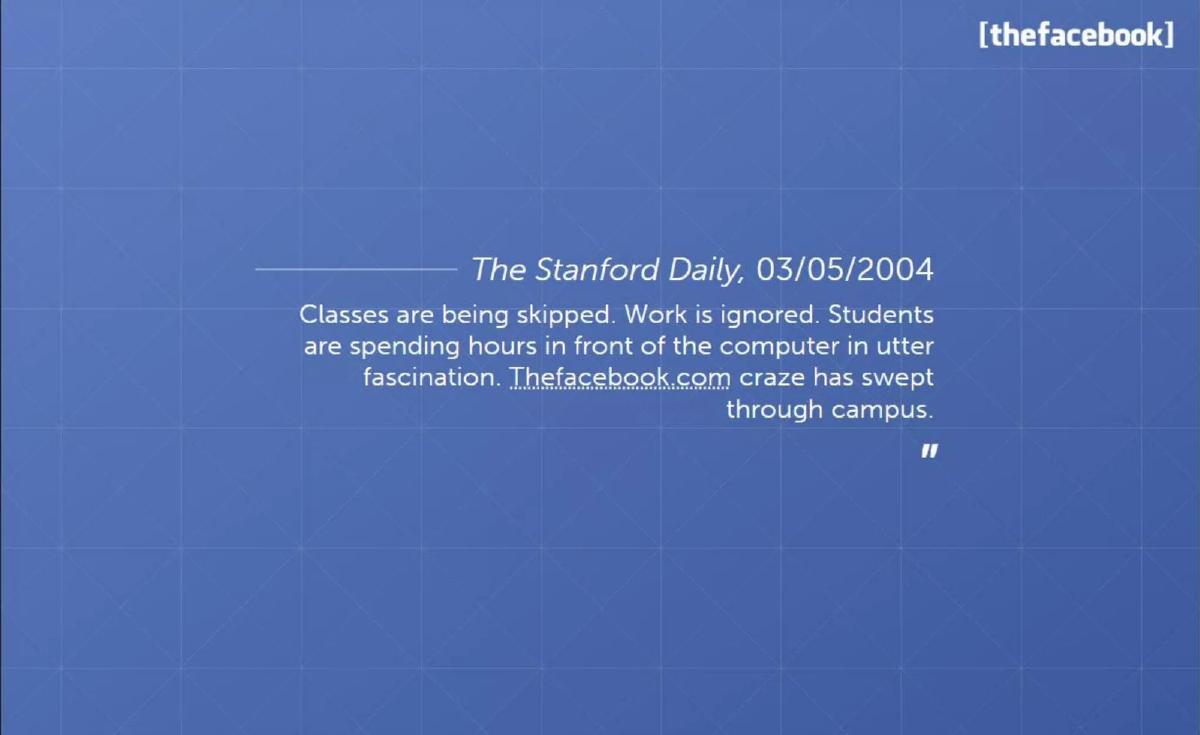
- The deck leads with social proof, quoting The Stanford Daily on students skipping classes to use the site (Slide 2).
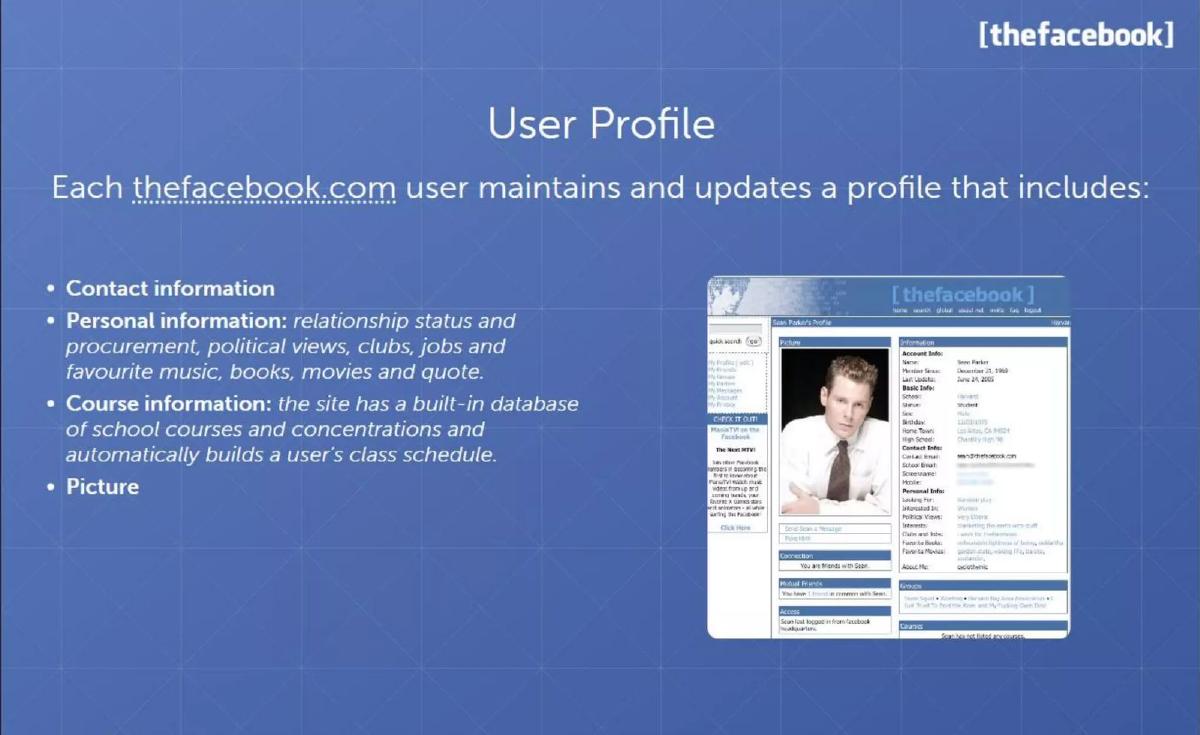
- Product features are described as tools for 'Intra-School Networking,' including a built-in database of school courses (Slide 3, 4).
- Growth is presented as a chronological rollout, showing expansion from Harvard to 14 other universities between February and April 2004 (Slide 6).
- The total addressable market is defined as 15 million US college students with $85 billion in purchasing power (Slide 7).
- Engagement metrics are exceptionally high, with 95% of the user base being monthly unique users (Slide 9).
- The business model is explicitly targeted advertising, leveraging 16 specific user parameters for ad placement (Slide 12).
- The deck lacks a traditional 'Team' slide, featuring only CFO Eduardo Saverin on the final contact page (Slide 13).
- There is no mention of a funding 'ask' or financial projections in the provided slides, as the deck is framed as a Media Kit (Slide 1).
Introduction: The Media Kit That Built an Empire
The 2004 deck for Thefacebook.com is a legendary artifact in the startup world. Unlike modern decks that often lead with a 'Vision' or 'Problem' slide, this document is a 'Media Kit' (Slide 1). It was designed to sell the platform's utility to advertisers and partners during its first few months of existence. At this stage, the company was not yet 'Facebook'; it was a closed network for elite universities, and the deck reflects that exclusivity and rapid growth. The aesthetic is simple, using a blue grid background that mirrors the early site's design, and the language is surprisingly aggressive regarding user behavior, frequently using the word 'addiction' to describe its market fit.
The Hook: Social Proof and Product Utility
Slide 2 sets the tone immediately. Instead of a mission statement, it uses a quote from The Stanford Daily dated March 5, 2004. The quote claims that 'Classes are being skipped. Work is ignored.' This is a bold way to start a pitch, framing the product not just as a tool, but as a cultural phenomenon that commands total attention. It validates the product's value through the eyes of its users before a single metric is shown.
Slide 3 and 4 detail the 'User Profile' and 'Social Networking' features. The product at this time was a digital directory. Slide 3 highlights that the site automatically builds a user's class schedule based on a database of school courses. Slide 4 introduces 'Intra-School Networking,' which allowed users to browse their school's network through 'Course Roasters' and an 'Advanced Search Engine.' These slides show that the early value proposition was strictly utility-based: finding and identifying people within a specific, trusted community.
The Growth Engine: Controlled Expansion
Slide 5 and 6 focus on the rollout strategy. Slide 5 notes the launch date of February 4, 2004, at Harvard University. Slide 6 provides a chronological table of expansion. It shows a rapid-fire launch schedule: Stanford on February 26, MIT on March 14, and a cluster of schools like NYU, Duke, and Georgetown throughout March and April. By April 19, 2004, they had expanded to 15 schools. This table is crucial because it demonstrates execution. It proves the founders could replicate the Harvard success across different campuses in a matter of weeks, suggesting a scalable model.
The Market: The $85 Billion Opportunity
Slide 7 , titled 'Our audience - The College Addiction,' defines the target market. It identifies 15 million college students in the U.S. with a purchasing power exceeding $85 billion. The slide breaks down spending into specific categories: $21 billion on restaurants, $9 billion on automobiles, and $5 billion on clothes. This is a classic 'TAM' (Total Addressable Market) slide, but it is tailored specifically for advertisers. It tells a potential partner exactly how much money the users have and what they are likely to spend it on.
The Metrics: Unprecedented Engagement
Slide 8 and 9 provide the hard data. Slide 8 shows a pie chart of the user base demographics as of March 2004. With 70,000 total students, 87% were active students, 11% alumni, and 2% faculty/staff. This reinforces the 'walled garden' nature of the site.
Slide 9 is perhaps the most important slide for any investor or advertiser. It lists 'Site Usage' metrics that are almost unheard of in modern SaaS or social media: 65% Daily Unique Users and 95% Monthly Unique Users. The slide also boasts 3 million daily pageviews. For a platform with only 70,000 users, 3 million pageviews indicates that the average user was refreshing the site dozens of times a day. This data backs up the 'addiction' claim made earlier in the deck.
The Business Model: Hyper-Targeted Advertising
Slide 10 returns to social proof with another quote, this time from The Daily Pennsylvanian: 'I have a new addiction. It is powerful. It is disturbing.' The repetition of this theme is intentional; it frames the site as an unavoidable part of student life.
Slide 11 and 12 move into the 'Services' offered. Slide 11 is a transition slide for 'Online Marketing Services.' Slide 12, 'Targeted Advertisement,' is the core of the business pitch. It lists 16 parameters that advertisers can use to target users. This list includes 'Sexual Orientation,' 'Political Bent,' 'Relationship/Dating Interests,' and 'House/Dormitory.' In 2004, this level of granular targeting was revolutionary. While Google targeted intent through search, Thefacebook.com was targeting identity and social circles.
The Team and Contact
Slide 13 is the final slide, titled 'Contact Us.' It features a photo and contact information for Eduardo Saverin, listed as the CFO. The text invites interested parties to reach out for marketing services to 'expose your product... to thousands of college students.' Notably, Mark Zuckerberg is absent from this slide, and there is no 'Team' slide showcasing the engineering talent or the broader founding group. This reinforces that this specific version of the deck was a sales tool for the business side of the operation.
What Works in This Deck
Extreme Engagement Metrics: The 65% daily active user rate (Slide 9) is the strongest part of the deck. It proves product-market fit more effectively than any narrative could. · Specific Growth Timeline: The list of schools and launch dates (Slide 6) shows a clear, repeatable expansion playbook. It removes the mystery of how the company intends to grow. · Granular Targeting: For an advertising-based business, Slide 12 is a masterclass in value proposition. It shows exactly how the data collected from users translates into a superior product for advertisers. · Social Proof: Using student newspaper quotes (Slide 2, 10) provides an authentic 'on-the-ground' perspective that makes the growth feel organic and unstoppable.
What is Missing from This Deck
The 'Ask': There is no slide detailing how much money the company is looking to raise or what the valuation is. As a media kit, this is expected, but as a fundraising tool, it is a major omission. · Competitive Landscape: In 2004, Friendster and MySpace were active. This deck completely ignores the competition, choosing instead to focus on its own 'addictive' metrics within a closed ecosystem. · Technical Infrastructure: There is no mention of how the site is built or how it will handle the massive traffic (3 million pageviews) as it scales beyond the first 15 schools. · The Full Founding Team: Only Eduardo Saverin is mentioned. A typical pitch deck would include the technical lead (Zuckerberg) and other key players to build confidence in the team's ability to execute.
What a Founder Should Copy
Focus on 'Usage' over 'Users': Facebook didn't just talk about how many people signed up; they talked about how often they came back (Slide 9). High retention and frequency are more valuable than raw sign-up numbers. · Define Your Niche: The deck doesn't try to be a social network for everyone. It is a network for 'The College Addiction' (Slide 7). By dominating a specific niche first, they built a defensible moat. · Use External Validation: If people are talking about your product in the press or on social media, use those quotes. The Stanford Daily quote (Slide 2) is more evocative than a founder's own description of the product. · Show the Playbook: If you have a strategy for expansion, list the dates and locations (Slide 6). It turns a vague 'we will grow' promise into a concrete track record of execution.
Frequently asked questions
- Is this a pitch for investment or for advertising?
- Slide 1 explicitly labels this as a 'MEDIA KIT,' and the final slide (Slide 13) invites readers to contact the CFO for 'online marketing services.' While it was used to explain the business to various stakeholders, its primary framing is a sales tool for advertisers to reach the college demographic. It lacks the financial asks and competitive analysis typical of a VC-focused seed deck.
- What were the key engagement metrics for Facebook in 2004?
- According to Slide 9, based on March 2004 statistics, the site had 70,000 total students. The engagement was remarkably high: 65% were Daily Unique Users, and 95% were Monthly Unique Users. The platform was generating 3 million daily pageviews, a figure used to demonstrate the 'addiction' mentioned in the slide titles.
- How did the early product differ from the modern Facebook?
- Slide 3 and 4 show the product was deeply integrated with university life. It included a 'built-in database of school courses' that automatically built class schedules for users. The networking was strictly 'Intra-School,' meaning users primarily browsed people within their own campus through 'Course Roasters' and random social net displays.
- What targeting capabilities did Facebook offer advertisers in its first year?
- Slide 12 lists 16 parameters for targeted advertisement. These include standard demographics like age and gender, but also highly specific data points like 'Sexual Orientation,' 'Political Bent,' 'House/Dormitory,' 'Relationship/Dating Interests,' and even the number of friends a user had on the site.
- Who is the primary contact listed in the deck?
- The final slide (Slide 13) lists Eduardo Saverin as the CFO of Thefacebook.com, based in Cambridge, MA. Mark Zuckerberg is not mentioned by name or pictured in the provided slides, reflecting Saverin's early role in handling the business and advertising side of the startup.