Eziban presents a 15-slide pitch deck for a food delivery service primarily targeting Accra, Ghana. The company identifies high prices and lack of convenience as the primary market friction points (Slide 3). Their unique value proposition centers on a business model of order aggregation to optimize fuel usage and a flat low service fee per item (Slide 10). While the deck showcases a functional product with released Android and iOS apps (Slide 15), it lacks critical financial data, such as unit economics, burn rate, or a specific funding ask. The competitive landscape is acknowledged, naming B…
Key takeaways
- The problem is defined simply as high prices and a lack of delivery convenience for customers (Slide 3).
- Eziban aims to be the 'iconic brand of food delivery in Africa' by focusing on speed and affordability (Slide 5).
- The business model relies on order aggregation to maximize revenue and ensure delivery within one hour (Slide 10).
- Market validation cites a $311M online food and beverage market in Africa and 16M internet users in Ghana as of 2019 (Slide 11).
- Direct competition includes major regional players: Bolt Food, Jumia Food, and Glovo (Slide 12).
- Future optimizations include a subscription model called 'EziPass' and integration with ExpressPay (Slide 14).
- Traction is limited to 5 recruited riders and partnerships with local Accra merchants like KFC and Papaye (Slide 15).
- The deck completely omits a management team slide, financial projections, and a specific investment ask.
Slide-by-Slide Analysis
Slide 1: Title Slide
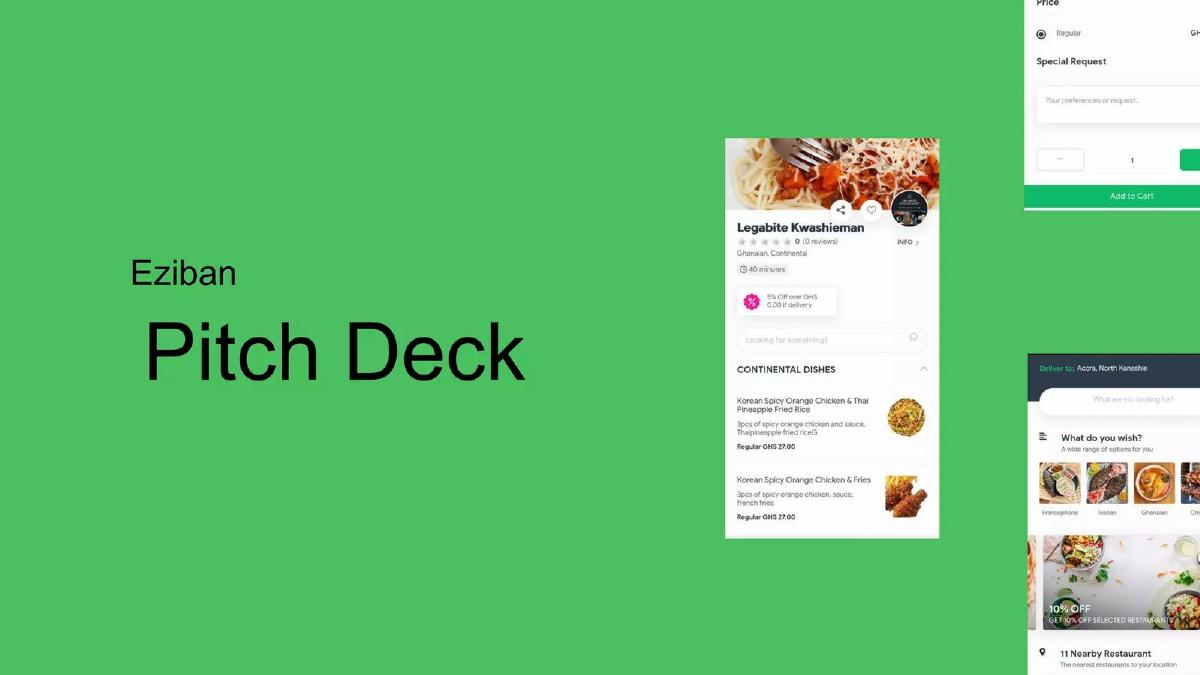
The deck opens with a minimalist green title slide featuring the company name 'Eziban' and 'Pitch Deck.' It includes mobile app screenshots showing a food menu and a restaurant listing for 'Legabite Kwashieman.' The visual identity is clean, but the slide lacks a tagline or a clear value proposition statement.
Slide 2: Introduction and Table of Contents
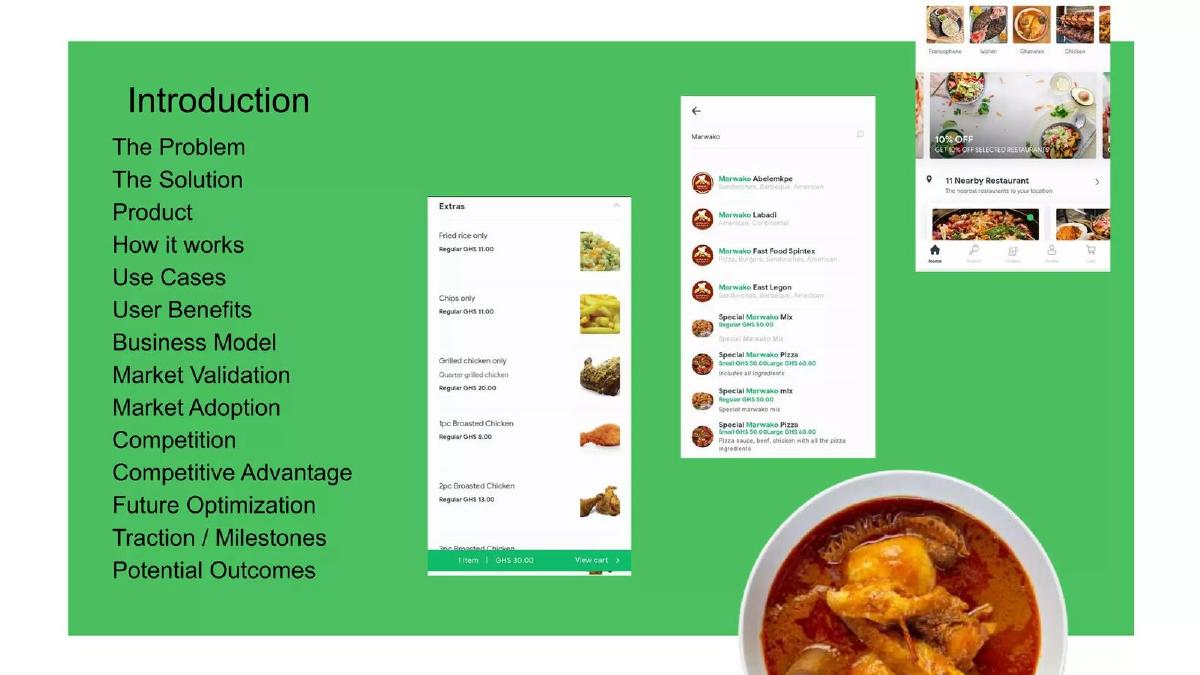
This slide provides a roadmap for the presentation, listing 15 sections ranging from 'The Problem' to 'Potential Outcomes.' It continues the use of app mockups, specifically showing a menu for 'Marwako' with prices in GHS (Ghanaian Cedi). For example, 'Fried rice only' is listed at 'Regular GHS 11.00.'
Slide 3: The Problem
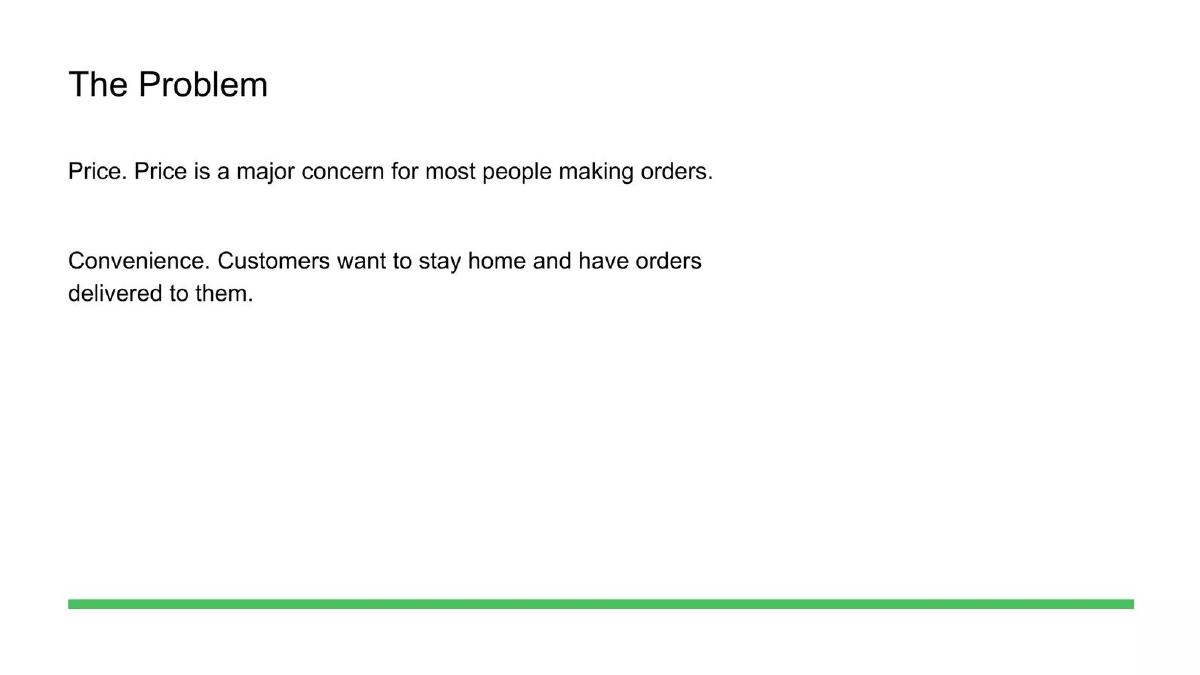
The problem is stated in two points: Price and Convenience. The slide notes that 'Price is a major concern for most people making orders' and that customers want to stay home rather than travel for food. This is a standard setup for a delivery startup, though it lacks data on current delivery costs in Ghana to quantify the 'price concern.'
Slide 4: The Solution
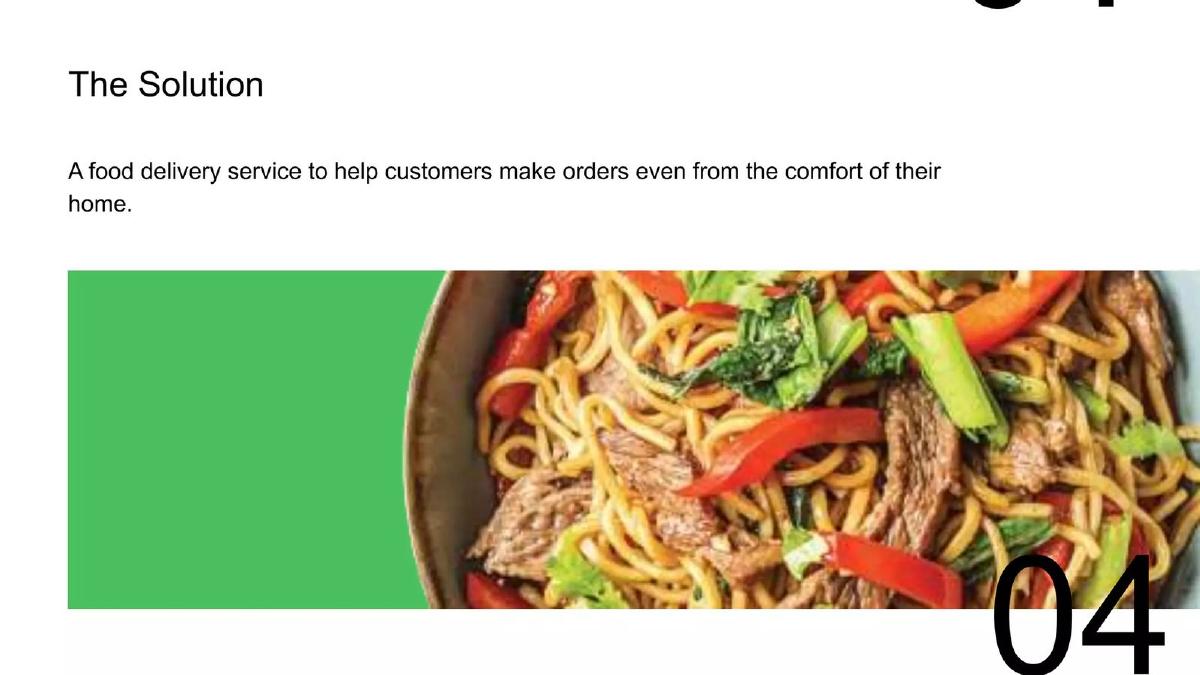
The solution is defined as 'A food delivery service to help customers make orders even from the comfort of their home.' It is accompanied by a high-resolution image of a noodle dish. This slide is functional but repetitive of the problem slide.
Slide 5: Product Vision
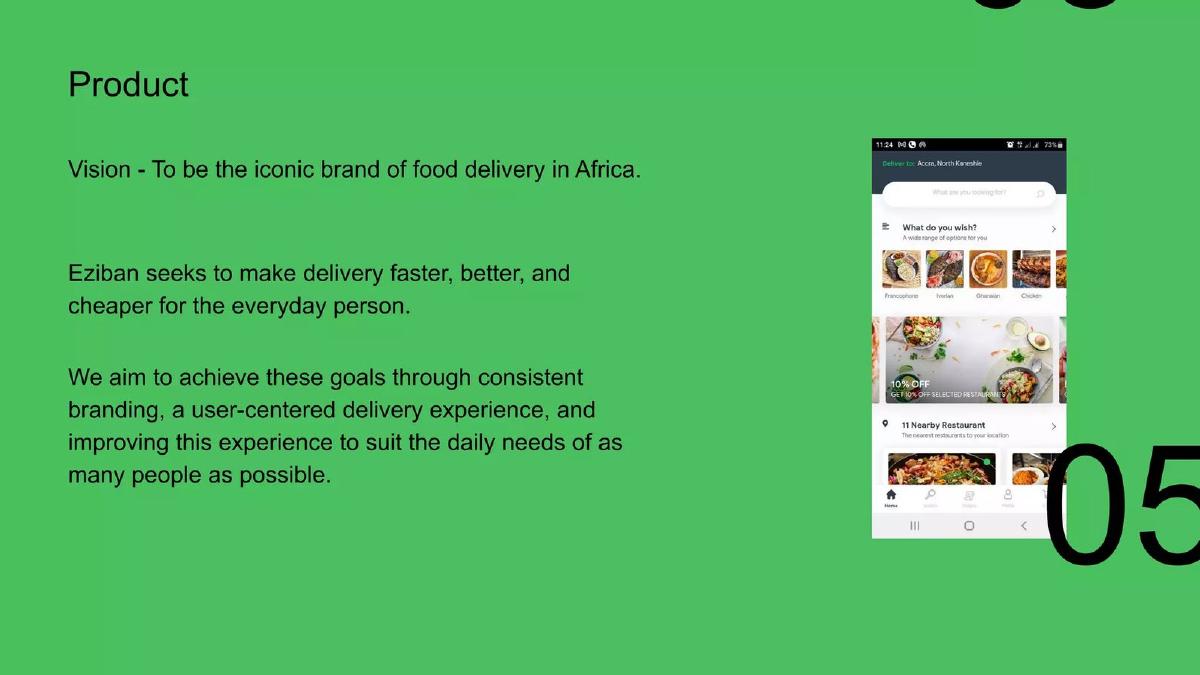
Eziban states its vision: 'To be the iconic brand of food delivery in Africa.' The slide emphasizes making delivery 'faster, better, and cheaper for the everyday person.' It mentions 'consistent branding' and a 'user-centered delivery experience' as the primary vehicles for achieving this vision.
Slide 6: Product Interface
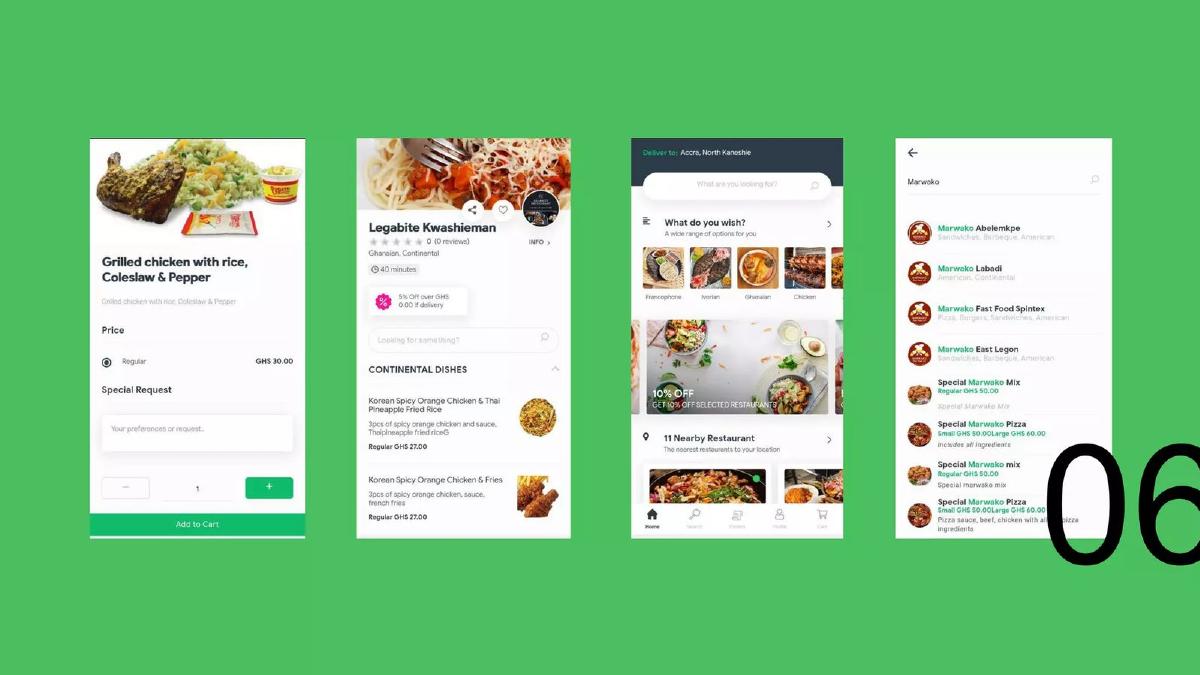
This slide displays four mobile screenshots of the Eziban app. Key details visible include a 'Grilled chicken with rice' dish for 'GHS 30.00' and a 40-minute estimated delivery time for 'Legabite Kwashieman.' The UI appears standard for the industry, featuring search bars, category icons (Francophone, Ivorian, Ghanaian), and a '10% OFF' promotional banner.
Slide 7: How it Works
The operational flow is broken down into four steps: 1. Customer orders via app, 2. Merchant prepares order, 3. Rider picks up, 4. Rider delivers. This is the standard three-sided marketplace model (Customer, Merchant, Rider) used by global delivery platforms.
Slide 8: Use Cases
The target demographics are identified as 'Busy workers,' 'Parents,' and 'Students.' No further detail is provided on how the service specifically caters to these different groups differently.
Slide 9: User Benefits
The slide lists benefits for three stakeholders: Customers (convenience, save money), Riders (earn money), and Partners (wider reach of customers). This highlights the marketplace nature of the business but lacks specific incentives or unique benefits not offered by competitors.
Slide 10: Business Model
This is a critical slide. Eziban explains they use 'order aggregation to optimize fuel usage.' By bulking orders going to specific areas, they aim to save fuel and ensure delivery within one hour. They also state they 'charge a flat low service fee for each menu item ordered.' This 'per item' fee structure is a notable departure from the 'per order' delivery fee common in the industry.
Slide 11: Market Validation
The deck provides three data points: a '$136.4' figure for the 'Global Food Industry in 2020' (the unit, likely billions, is omitted), a '$311 M' Online Food and Beverage Market in Africa, and '16 M' Internet Users in Ghana as of 2019. The jump from a global trillion-dollar market to a specific African niche is standard, though the 2019 data was slightly dated by the 2021 publication.
Slide 12: Competition
Eziban identifies three main competitors: Bolt Food, Jumia Food, and Glovo. These are all well-funded, international or pan-African entities. Acknowledging them is honest, but it sets a high bar for the 'Competitive Advantage' slide that follows.
Slide 13: Competitive Advantages
The advantages listed are 'Easy to Use' (simple experience), 'Bold Experience' (expressive design), and 'Brand Identity' (earning user trust). These are largely subjective and 'soft' advantages. There is no mention of proprietary technology, exclusive merchant contracts, or a lower cost of customer acquisition.
Slide 14: Future Optimization
The roadmap includes three items: 1. Payment Systems (integration with ExpressPay), 2. Analytic Tools for merchants, and 3. EziPass (a subscription model for exclusive offers). The subscription model suggests a move toward recurring revenue, which is a positive signal for investors.
Slide 15: Traction
The final slide lists current milestones: 5 riders recruited, partnerships with 'Top partners in Accra' (KFC, Papaye, Marwako, Eddy's, Foodien, Papa's, and Cheezzy), and the release of Android, iOS, and Courier apps. The mention of '5 riders' suggests the company is in a very early pilot phase.
What Eziban Does Well
Local Context: The deck is clearly tailored to the Ghanaian market, specifically Accra. By naming local favorites like Papaye and Marwako, the founders demonstrate they have already begun the difficult work of merchant acquisition in their target geography.
Operational Focus: The emphasis on 'order aggregation' to save fuel (Slide 10) shows an awareness of the high operational costs associated with last-mile delivery in African urban centers. This focus on efficiency is a necessary component of a low-margin business model.
Product Readiness: Unlike many early-stage decks that rely on mockups, Eziban shows a functional product suite including customer and courier apps. This reduces execution risk regarding the software development phase.
What is Missing from the Eziban Deck
The Team: There is no team slide. Investors fund people, especially at the pre-seed and seed stages. The absence of founder bios, relevant experience in logistics, or technical backgrounds is a significant omission that makes it impossible to judge the 'right to win.'
The Ask: The deck does not state how much money the company is looking to raise, what the valuation expectations are, or how the funds will be allocated (e.g., marketing vs. rider fleet expansion).
Unit Economics: In a crowded food delivery market, understanding the Contribution Margin is vital. The deck mentions a 'flat low service fee' but does not explain if this covers the cost of the rider, insurance, and customer acquisition. Without these numbers, the business model is unproven.
Growth Metrics: While they list 5 riders and several partners, there is no data on order volume, Monthly Active Users (MAU), or growth rates. Even small numbers are better than no numbers when demonstrating momentum.
What a Founder Should Copy
Clear Market Segmentation: The use of local merchant logos and specific price points in GHS makes the deck feel grounded in reality. Founders should always ensure their 'Product' slides reflect the actual market they are entering, rather than using generic stock photos.
Identifying Future Revenue Streams: Including a subscription model (EziPass) in the 'Future Optimization' slide shows that the founders are thinking about long-term customer retention and increasing Lifetime Value (LTV), which is essential for delivery platforms.
Simple Operational Flow: Slide 7 ('How it Works') is a model of clarity. It uses four simple bullet points to explain a complex three-sided interaction. Founders often over-complicate their 'How it Works' slides with technical diagrams; Eziban’s approach is much more digestible for a first-time reader.
Frequently asked questions
- What is Eziban's primary competitive advantage?
- According to Slide 13, Eziban claims a competitive advantage through a 'bold experience,' 'brand identity,' and a 'simple, non-crowded experience.' However, the deck does not provide technical or logistical data to support how these subjective advantages will overcome the massive capital and infrastructure of competitors like Glovo or Bolt Food.
- How does Eziban plan to make money?
- Slide 10 outlines a business model based on charging a 'flat low service fee for each menu item ordered.' They also plan to optimize margins by aggregating orders going to specific areas to save on fuel costs. Future revenue streams mentioned on Slide 14 include a subscription model called EziPass.
- What is the current stage of the product?
- The product is live. Slide 15 notes that Android and iOS apps have been released, a courier-specific app is functional, and a website has been deployed. They have also secured initial merchant partners in Accra, including KFC and Marwako.
- Which geographic market is Eziban targeting?
- While the vision is to be an iconic brand in Africa (Slide 5), the current operations and traction are strictly focused on Accra, Ghana. Slide 15 lists 'Top partners in Accra,' and Slide 11 uses Ghanaian internet user statistics to validate the market.
- What information is missing from the Eziban deck?
- The deck is missing several standard components required for a professional fundraise: a team slide (who is building this?), a clear financial 'Ask' (how much money do they need?), unit economics (CAC/LTV), and a detailed roadmap beyond general 'future optimizations.'