Fabric’s 2020 Seed deck is a high-signal presentation that prioritizes founder pedigree and architectural shift over granular financial data. By positioning the leadership team—veterans of Amazon, Google, and Staples—on slide 2, the company establishes immediate credibility in a complex enterprise market. The deck effectively utilizes the 'Headless Commerce' trend, contrasting modern modular APIs against the 'monolithic' legacy systems of the early 2000s. While it lacks a traditional 'Ask' slide or detailed unit economics, it compensates with strong social proof, including a customer testimon…
Key takeaways
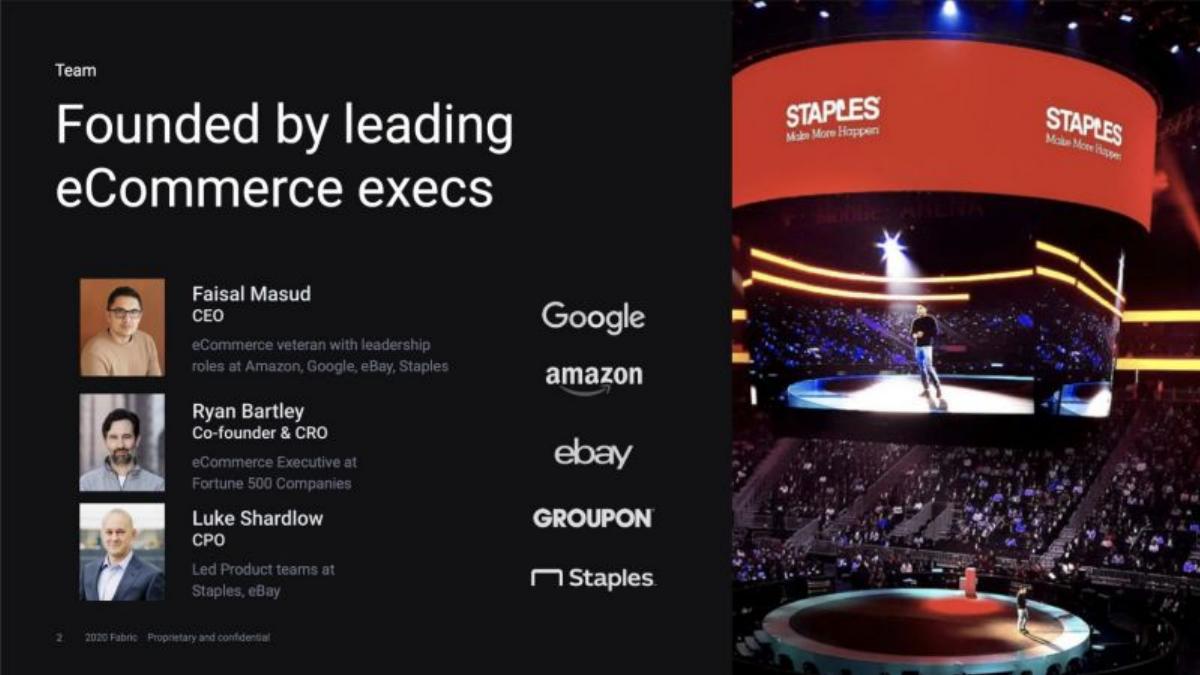
- The team slide appears immediately after the title, showcasing leadership experience at Amazon, Google, eBay, and Staples (Slide 2).
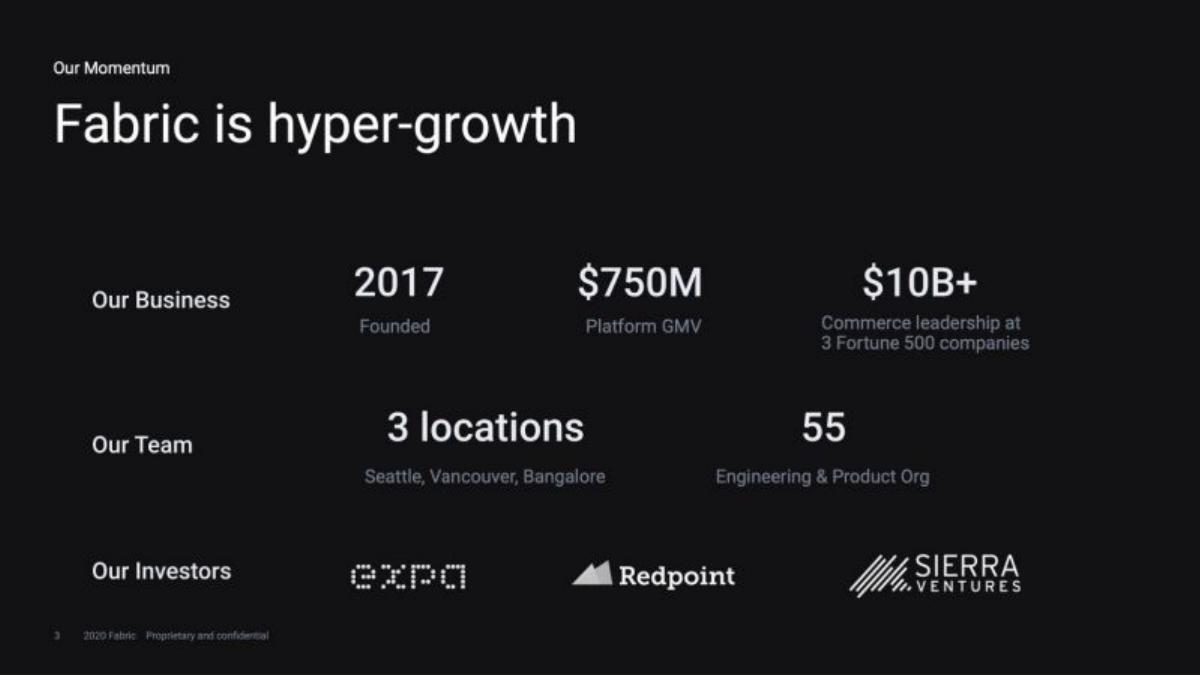
- Fabric reports a platform GMV of $750M and a team of 55 in its engineering and product organization (Slide 3).
- The product is positioned as a 'Modular Suite of Commerce APIs' including Customer, Search, Product, and Pricing modules (Slide 7).
- The deck claims a '10X' improvement in value, citing a 23% increase in growth and a 2.30% decrease in ownership cost (Slide 8).
- A featured customer testimonial from the CEO of ABC Carpet & Home claims revenue run rates increased by nearly 3x after implementation (Slide 11).
- Fabric contrasts its 'Simple monthly subscription' against legacy platforms that charge 5-7% of GMV (Slide 12).
- The implementation timeline promises a 'Go Live' phase of 8-12 weeks or less, compared to 12-16 months for legacy systems (Slides 12 and 13).
- The deck omits a specific funding 'Ask' slide and detailed financial projections or burn rate data.
The Narrative: Experience as the Primary Asset
Fabric’s 2020 pitch deck is a masterclass in establishing authority. In the crowded eCommerce infrastructure space, the founders chose to lead with their resumes. This isn't just a 'Team' slide; it is a 'Why Us' slide that serves as the foundation for the entire investment thesis. By the time an investor reaches the product details, they have already been told that the people building this platform are the same people who ran commerce at the world's largest retailers.
Slide 1: Title and Positioning
The deck opens with the tagline 'Your commerce site, your way.' It explicitly defines Fabric as a 'headless commerce platform purpose-built for growth.' The date, October 2020, places this raise in the heart of the pandemic-driven eCommerce boom, a period where retailers were desperate for digital agility.
Slide 2: The Powerhouse Team
This is the most critical slide in the deck. It features Faisal Masud (CEO), Ryan Bartley (Co-founder & CRO), and Luke Shardlow (CPO). The logos for Google, Amazon, eBay, Groupon, and Staples are displayed prominently. The text notes that Masud is an 'eCommerce veteran with leadership roles' at these giants. The right side of the slide shows a photo of a founder on a massive stage at a Staples event, reinforcing the 'leading execs' narrative through visual social proof.
Slide 3: Momentum and Scale
Fabric uses Slide 3 to prove they aren't just a 'team with an idea.' Founded in 2017, they report $750M in Platform GMV. This is a massive figure for a Seed-stage company, indicating they likely started with high-contract-value enterprise clients. They also highlight a team of 55 in engineering and product, and existing backing from Expa, Redpoint, and Sierra Ventures. This slide signals that the 'Seed' round is likely a misnomer for what is actually a very mature early-stage company.
Slide 4: Target Verticals
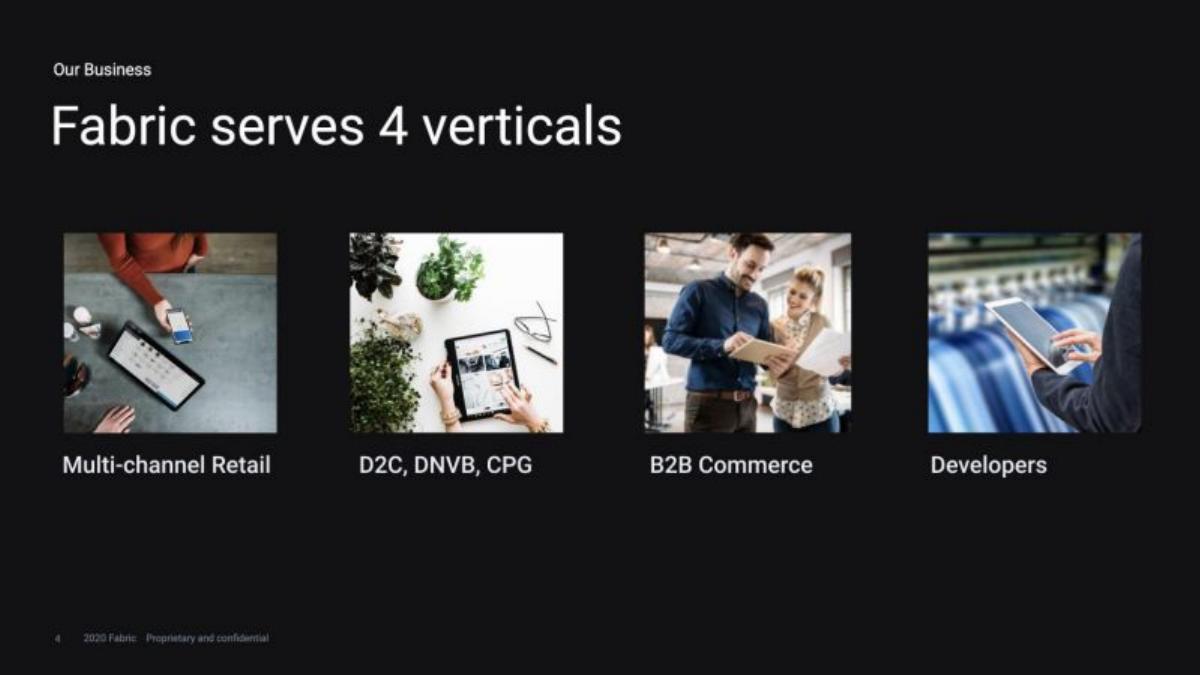
Fabric identifies its four key markets: Multi-channel Retail, D2C/DNVB/CPG, B2B Commerce, and Developers. By including 'Developers' as a vertical, Fabric acknowledges that in the 'headless' world, the person writing the code is often the primary internal champion and decision-maker.
Slide 5 & 6: The Market Shift
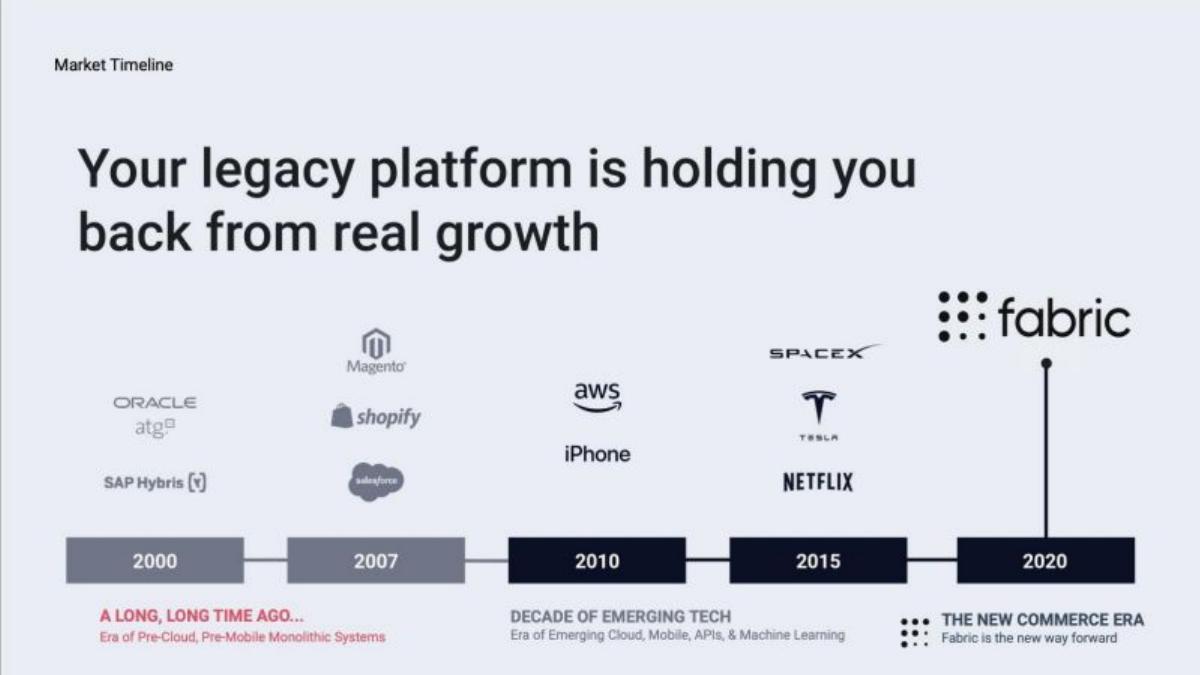
Slide 5 is a 'Fact' slide stating that shopping habits are 'changing for good.' Slide 6 provides the 'Market Timeline,' a classic strategy to show why now is the time for a new solution. It buckets the year 2000 as the 'Era of Pre-Cloud Monolithic Systems' (Oracle, SAP) and 2007-2015 as the 'Era of Emerging Tech' (Shopify, Magento, AWS). Fabric positions itself at the start of 'The New Commerce Era' in 2020.
Slide 7: Product Architecture
This slide visualizes the 'Modular Suite of Commerce APIs.' It breaks the product into three layers: the Experience Platform (Storefront + CMS), the Headless Commerce Platform (APIs for Customer, Search, Product, etc.), and CoPilot Applications (OMS, POS, PIM). This visual effectively communicates the 'Lego-block' nature of headless commerce—you take what you need and leave the rest.
Slide 8, 9 & 10: The Value Proposition
These slides focus on 'Why Fabric.' Slide 8 claims 'Crazy fast time to value,' showing a graph where growth increases by 23% and ownership costs drop by 2.30%. The '10X' callout is a bold, if somewhat abstract, claim. Slide 9 emphasizes 'Modern tools for the modern business,' and Slide 10 highlights the technical architecture: 'Extensible, single-tenant SaaS' with 30+ pre-integrated vendors. The mention of 'single-tenant' is a specific appeal to enterprise buyers who require higher security and isolation than multi-tenant SaaS typically provides.
Slide 11: Social Proof
The deck includes a featured customer testimonial from Aaron Rose, CEO of ABC Carpet & Home. The quote is high-impact: 'conversion and revenue run rates increased by nearly 3x.' For an investor, a 3x revenue increase is a much more compelling metric than any technical API description.
Slide 12: The Comparison Table
Fabric contrasts itself against 'Legacy Platforms.' Key differentiators include:
Cost: Legacy charges 5-7% of GMV; Fabric is a simple monthly subscription. · Speed: Legacy takes 12-16 months to launch; Fabric takes weeks. · Performance: Legacy has slow page loads; Fabric offers sub-1 second speed.
This slide is designed to make the legacy option look financially and operationally irresponsible.
Slide 13: Implementation Timeline
The final content slide breaks down the onboarding process: a 2-hour Exec Briefing, a 2-3 day Tech Assessment, and a 'Go Live' phase of 8-12 weeks. This addresses the primary fear of enterprise buyers: the 'replatforming hell' mentioned on the previous slide.
What Works in This Deck
Founder-Market Fit: The team slide is unassailable. In enterprise SaaS, investors are buying the team's ability to navigate complex sales cycles and understand deep-rooted industry pain points. Fabric nails this.
Clarity of Category: The deck doesn't just say they are an eCommerce platform; it defines the 'Headless' category and explains why the previous categories (Monoliths) are failing. This 'New Way vs. Old Way' narrative is very effective for high-growth fundraising.
Quantifiable Customer Success: Including a specific quote about a 3x increase in revenue run rates provides a 'reason to believe' that overrides technical skepticism.
What Is Missing
The Ask: There is no slide detailing the amount of capital being raised or how it will be deployed. While this is common in 'teaser' decks, a full pitch usually requires a clear roadmap for the funds.
Unit Economics: There is no mention of Customer Acquisition Cost (CAC), Lifetime Value (LTV), or churn rates. For a company with $750M in GMV, investors would want to see how much of that translates to Fabric's actual revenue and what the margins look like.
Competitive Landscape: While it attacks 'Legacy Platforms,' it ignores modern competitors in the headless space (like Commercetools or Contentstack). A sophisticated investor would want to know why Fabric wins against other modern API-first solutions, not just why they win against Oracle.
What Other Founders Should Copy
The Comparison Table: Slide 12 is a perfect example of how to frame a competitive advantage. It doesn't just list features; it lists outcomes (Cost, Time to Value, Velocity). Founders should focus on the business impact of their technical differences.
The Timeline Slide: Slide 13 is excellent for B2B startups. It de-risks the purchase for the customer and the investment for the VC by showing a repeatable, fast path to revenue and 'Go Live.'
Visual Hierarchy: The deck uses a clean, dark-mode aesthetic with high-contrast text. It avoids 'wall of text' slides, using icons and bold headers to make the deck skimmable in under two minutes.
Frequently asked questions
- What is the core value proposition of Fabric?
- Fabric positions itself as a 'headless commerce platform' that allows brands to move away from rigid, monolithic legacy systems. Its core value prop centers on speed and modularity, claiming that businesses can launch in weeks rather than the 12-16 months typical of traditional replatforming projects. This is achieved through a suite of APIs and 'CoPilot' applications.
- How does Fabric justify its competitive advantage?
- The company relies heavily on founder-market fit. By highlighting that the team has 'Commerce leadership at 3 Fortune 500 companies' and experience at Amazon and eBay, they signal deep domain expertise. Technically, they differentiate through a 'single-tenant SaaS' model that offers better scalability and security than older multi-tenant or on-premise solutions.
- What metrics are included in the Fabric pitch deck?
- The deck is light on traditional SaaS metrics like CAC or LTV but heavy on platform-level scale. It cites $750M in Platform GMV and a team of 55 people. It also uses a customer case study to highlight a 3x increase in revenue run rates and a 23% growth uptick for users of the platform.
- Who are the target customers for Fabric according to the deck?
- Fabric identifies four primary verticals: Multi-channel Retail, D2C/DNVB/CPG (Direct-to-Consumer/Digitally Native Vertical Brands/Consumer Packaged Goods), B2B Commerce, and Developers. This broad targeting suggests the platform is designed to be a horizontal infrastructure layer for any business selling online.
- What is missing from the Fabric pitch deck?
- The deck lacks a formal 'Ask' slide detailing how much they are raising and what the milestones for that capital will be. It also omits a detailed competitive landscape (beyond a general 'Legacy vs. Modern' comparison) and specific financial projections or historical revenue growth charts.