Eyes On Freight’s seed deck is a study in minimalist, high-level storytelling. Spanning just 11 slides, it identifies a $4 trillion global market plagued by a lack of transparency and consistency. The company positions itself as a neutral marketplace, specifically highlighting a $22 billion opportunity within the oil and heavy machinery sectors. While the deck lacks granular details on unit economics, customer acquisition costs, or a specific funding ask, it successfully demonstrates early traction. The revenue chart shows a clear upward trajectory, growing from $9,000 in 2014 to a $210,000 p…
Key takeaways
- The deck identifies a massive $4 trillion global logistics market on slide 3.
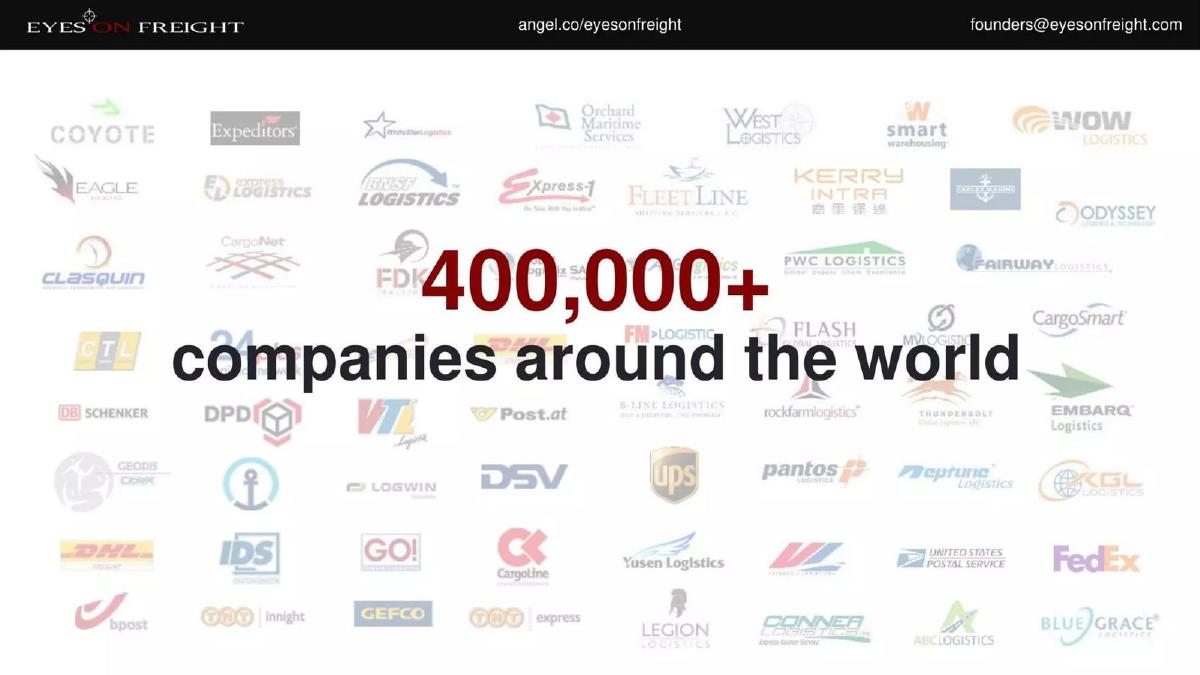
- Fragmentation is highlighted on slide 4, noting over 400,000 companies operating worldwide.
- The core problem is defined as a lack of transparency and consistency in the industry on slide 5.
- A specific niche opportunity in Oil & Heavy Machinery is valued at $22 billion on slide 7.
- Net revenue shows significant growth, moving from $9,000 in 2014 to a $210,000 pipeline in 2016 on slide 8.
- The team claims over 20 years of combined experience across five key members on slide 10.
- The deck completely omits a specific financial ask or use of funds slide.
- There is no detailed breakdown of the business model or how the 'neutral party' marketplace generates fees.
Introduction: A Lean Approach to a Trillion-Dollar Problem
The Eyes On Freight pitch deck is a concise, 11-slide presentation that focuses on the macro-inefficiencies of the global logistics industry. Founded in 2012, the company positions itself as a neutral marketplace designed to bring order to a fragmented market. The deck is characterized by high-level messaging and a reliance on large-scale market figures to establish the 'why now' of the investment opportunity.
Slides 1-2: The Vision and the Visual Context
Slide 1 serves as the title card, identifying the company as a 'Logistics & Supply Chain Marketplace.' The background features a dark world map, immediately signaling the global ambitions of the startup. The logo includes a crosshair icon over the 'O' in 'Eyes On,' reinforcing the theme of precision and oversight in a complex industry.
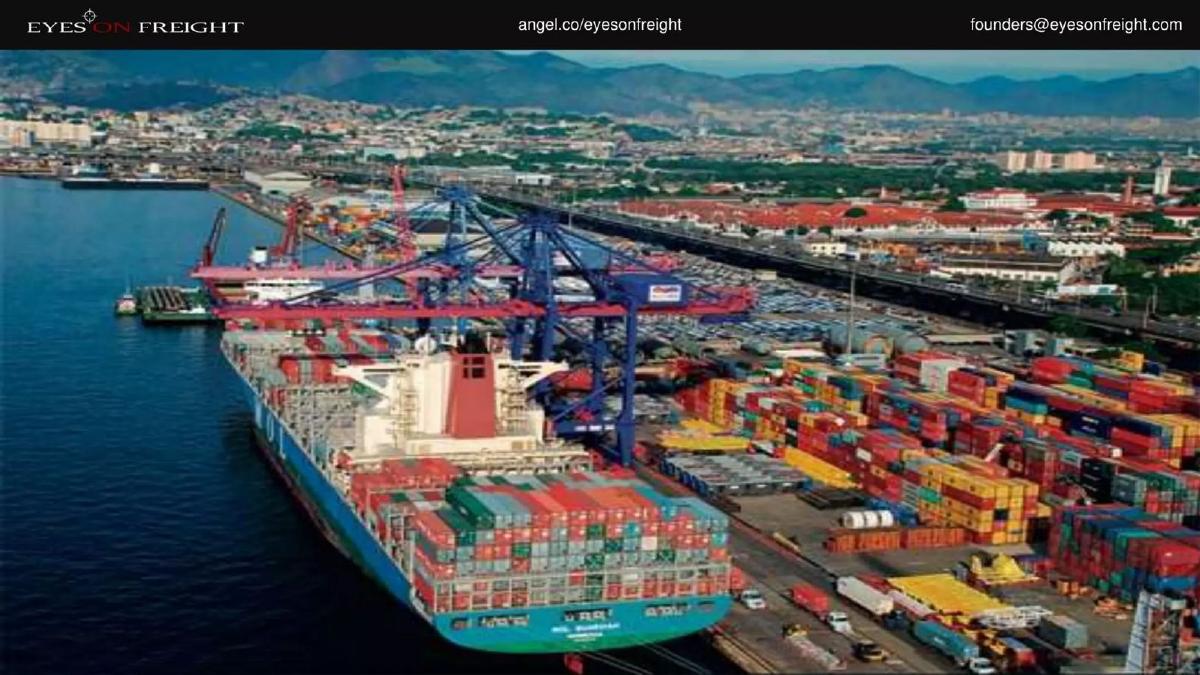
Slide 2 is a full-bleed image of a shipping port, showing a container ship being loaded. There is no text on this slide other than the header containing the company's AngelList profile and founder email. This slide is purely atmospheric, intended to ground the investor in the physical reality of the freight industry before moving into abstract data.
Slides 3-5: The Market Opportunity and Problem Statement
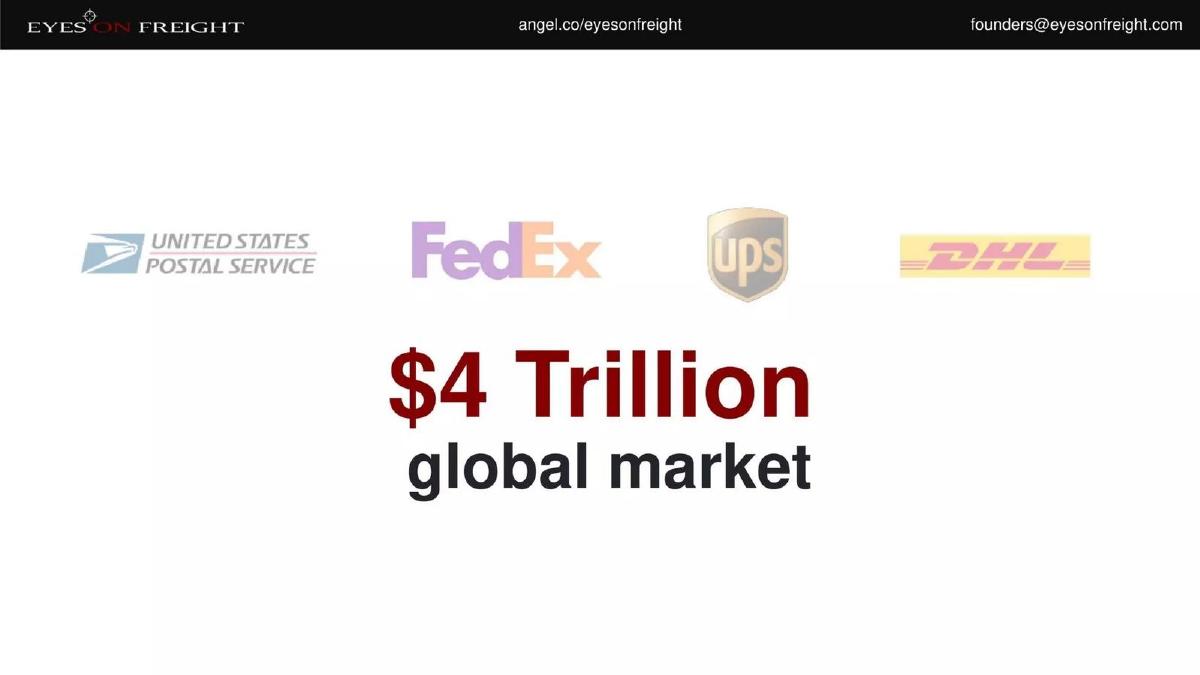
Slide 3 introduces the scale of the opportunity. It features the logos of major carriers—USPS, FedEx, UPS, and DHL—above a bold statement: '$4 Trillion global market.' By placing these household names next to the figure, the deck attempts to validate the size of the sector through association.
Slide 4 addresses industry fragmentation. It displays a dense grid of logistics company logos, stating there are '400,000+ companies around the world.' This slide is crucial for a marketplace play; it suggests that the market is too decentralized for shippers to navigate efficiently without a central platform.
Slide 5 defines the pain points. In large, red and black text, it states: 'No TRANSPARENCY, No CONSISTENCY.' This is the core problem the company aims to solve. By framing the problem so simply, the founders are betting that investors will recognize these as universal issues in legacy industries like shipping.
Slides 6-7: The Solution and Niche Focus
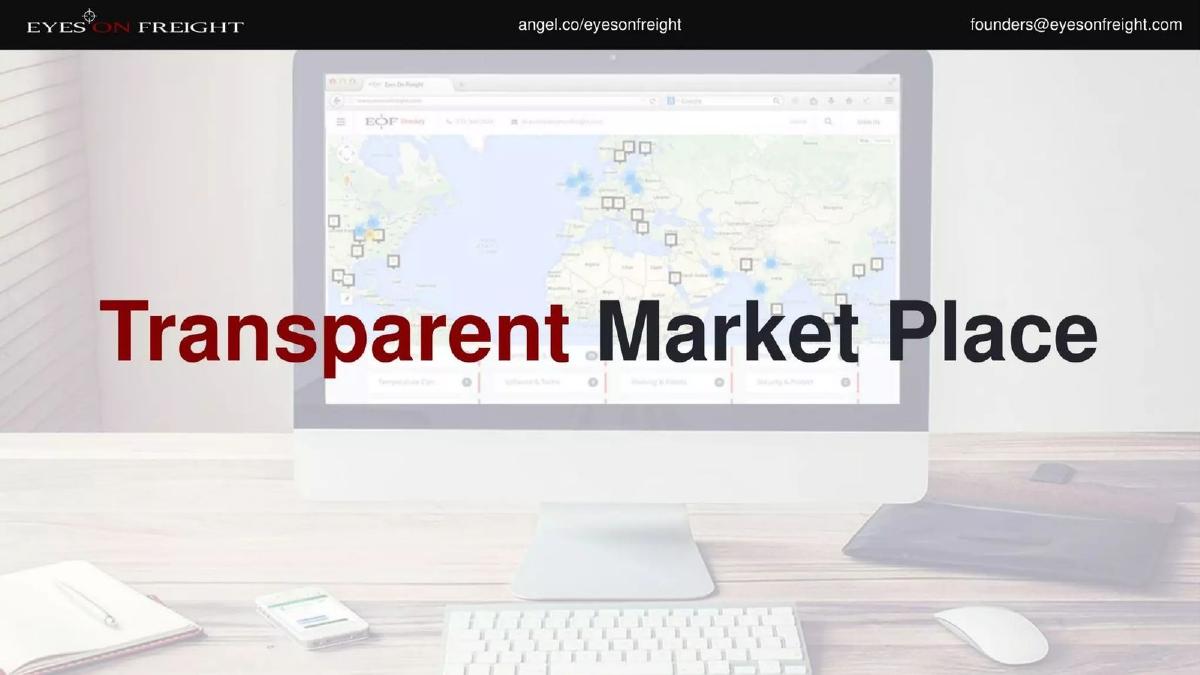
Slide 6 presents the solution: a 'Transparent Market Place.' The background shows a blurred image of a desktop computer displaying a map with various location pins, presumably a screenshot of the Eyes On Freight platform. This is the only glimpse of the actual product in the entire deck, and it remains very high-level.
Slide 7 narrows the focus to a specific vertical: 'Oil & Heavy Machinery.' It identifies this as a '$22 Billion Opportunity.' The slide uses icons of tractors and oil pumps to illustrate the types of high-value cargo the platform is optimized to handle. This is a smart inclusion, as it shows the company isn't just chasing the general market but has identified a high-margin niche.
Slides 8-9: Traction and Partnerships
Slide 8 provides the 'Net Revenue' chart, which is the most data-rich slide in the deck. It shows a clear growth trend: $9,000 in 2014, $72,000 in 2015, and a '$210,000 Pipeline' for 2016. While the 2016 figure is noted as a pipeline rather than realized revenue, the 8x growth between 2014 and 2015 provides a solid foundation for the traction narrative.
Slide 9 is titled 'Partnering Opportunities.' It features logos for Echo Global Logistics, Obi Energy, Aramex, TQL (Total Quality Logistics), and EquipmentShare. It is unclear from the slide whether these are active partners, current customers, or merely targets. In a teardown context, this ambiguity is a weakness; investors generally prefer to know the exact nature of these relationships.
Slides 10-11: Team and Contact
Slide 10 introduces the team under the headline 'Over 20 Years of Experience.' The team consists of five members: Chris Nyenhuis (CEO), Jardin Fuller (COO), Anita Nyenhuis (Marketing), Anna Swacker (Design), and Chad Haney (Architecture). The slide lacks specific bios or previous company names, relying instead on the aggregate years of experience to build credibility.
Slide 11 is the closing slide, repeating the contact information found in the headers of previous slides: the AngelList URL and the founders' email address.
What Works in the Eyes On Freight Deck
Clear Problem Identification: The deck does not bury the lead. Identifying 'Transparency' and 'Consistency' as the missing elements in a $4 trillion market is a compelling hook. · Visual Simplicity: The deck is not cluttered. Each slide has a single, clear message, which makes it easy to digest during a quick first pass. · Niche Targeting: By highlighting the $22 billion heavy machinery sector, the founders demonstrate that they understand where the most complex (and likely most profitable) problems exist within logistics. · Traction Trajectory: The revenue chart on slide 8 shows a healthy growth curve, which is essential for any seed-stage pitch.
What is Missing from the Eyes On Freight Deck
The Ask: This is the most glaring omission. There is no mention of how much money the company is looking to raise, the valuation, or the milestones they intend to hit with the new capital. · Business Model Details: The deck describes the company as a 'neutral party' and a 'marketplace,' but it never explains the take rate, subscription fees, or how it actually makes money. · Product Depth: Aside from one blurred screenshot, there is no information on the platform's features. How does it provide transparency? Is there a bidding system? Real-time tracking? Automated documentation? · Competitive Analysis: The deck mentions 400,000 competitors in a general sense but fails to address direct digital competitors who were also emerging in the 2012-2016 window. · Unit Economics: There is no mention of Customer Acquisition Cost (CAC) or Lifetime Value (LTV), which are critical for evaluating the scalability of a marketplace.
What a Founder Should Copy
The 'Logo Cloud' Strategy: Using a dense field of logos (Slide 4) is an effective way to visually demonstrate market fragmentation without using a wall of text. · Vertical Specificity: Even if your platform is horizontal, showing a deep dive into one high-value vertical (Slide 7) helps investors visualize a realistic go-to-market strategy. · Simple Revenue Visualization: The bar-and-line hybrid chart on Slide 8 is very easy to read. It clearly labels the years and the dollar amounts, making the growth story undeniable. · Consistent Branding: The use of the crosshair logo and the red/black/white color palette throughout the deck creates a professional, cohesive feel.
Frequently asked questions
- What is the primary value proposition of Eyes On Freight?
- According to slide 6, the company offers a 'Transparent Market Place' for logistics. The goal is to solve the industry's lack of consistency and transparency by providing a neutral platform where shippers and service providers can connect. The catalogue listing further clarifies that they aim to save companies time and money by finding the best solutions and resources in one centralized location.
- How does the company demonstrate market demand?
- The deck uses a combination of macro and micro data. Slide 3 cites a $4 trillion global market, while slide 4 shows a logo cloud of 400,000+ companies to illustrate fragmentation. More specifically, slide 8 displays a net revenue growth chart, showing a jump from $9,000 in 2014 to $72,000 in 2015, and a projected $210,000 pipeline for 2016.
- Who are the key members of the leadership team?
- Slide 10 introduces five team members: Chris Nyenhuis (Co-Founder | CEO), Jardin Fuller (COO | Sales), Anita Nyenhuis (Marketing & Operations), Anna Swacker (Development & Design), and Chad Haney (Development & Architecture). The slide emphasizes that the group possesses 'Over 20 Years of Experience' in the field.
- What specific industry niche is Eyes On Freight targeting?
- While the platform is broad, slide 7 explicitly identifies 'Oil & Heavy Machinery' as a primary target. It values this specific opportunity at $22 billion. This suggests a strategic focus on high-value, complex freight that requires more specialized logistics management than standard consumer goods.
- What critical fundraising information is missing from this deck?
- The deck is missing several standard components. Most notably, there is no 'Ask' slide detailing how much capital is being raised or how it will be spent. Additionally, there is no slide covering unit economics, customer acquisition strategy, or a detailed competitive analysis beyond the general mention of industry fragmentation.