EXFO’s Fall 2020 presentation serves as a corporate update for a mature player in the telecommunications testing and analytics space. The deck reports Q4 2020 revenue of $70.6M and bookings of $63.0M, while acknowledging an IFRS net loss of $3.6M. The narrative centers on the 'unseen level of complexity' introduced by 5G and virtualization, positioning EXFO’s NOVA SensAI and SA systems as the solution for real-time anomaly detection and subscriber insights. With 1,900 employees across 25+ countries, the company leverages its No.1 position in the optical test market to capture growth from fibe…
Key takeaways
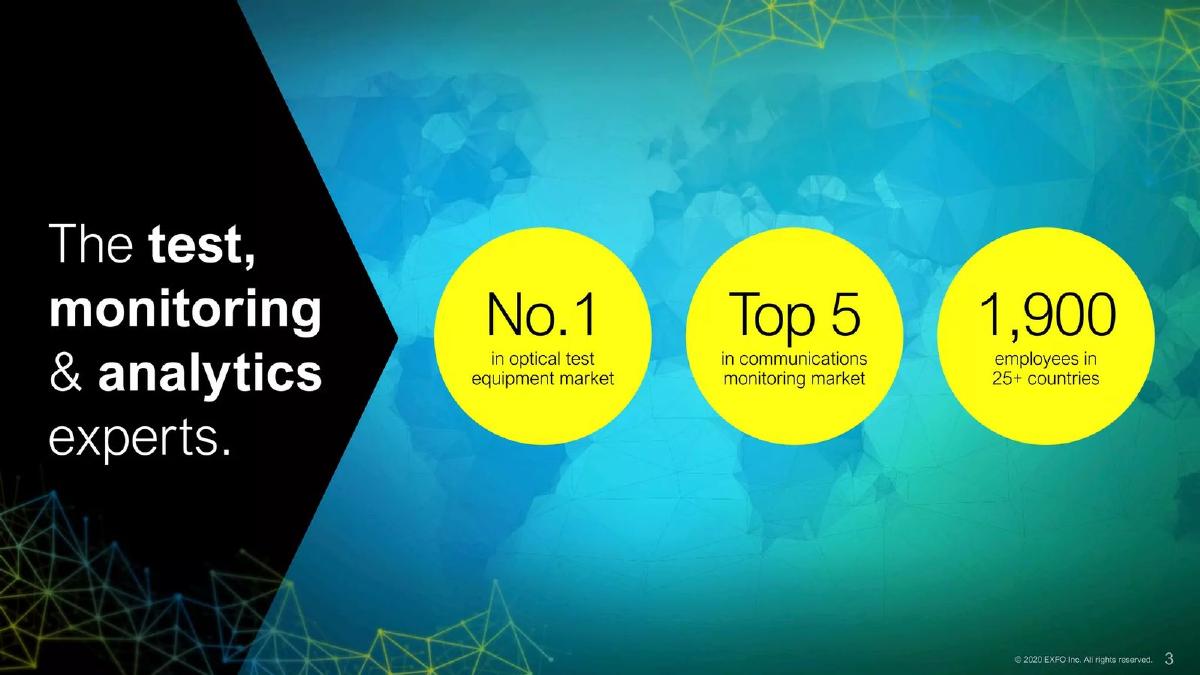
- EXFO claims the No.1 market position in optical test equipment and a Top 5 spot in communications monitoring (Slide 3).
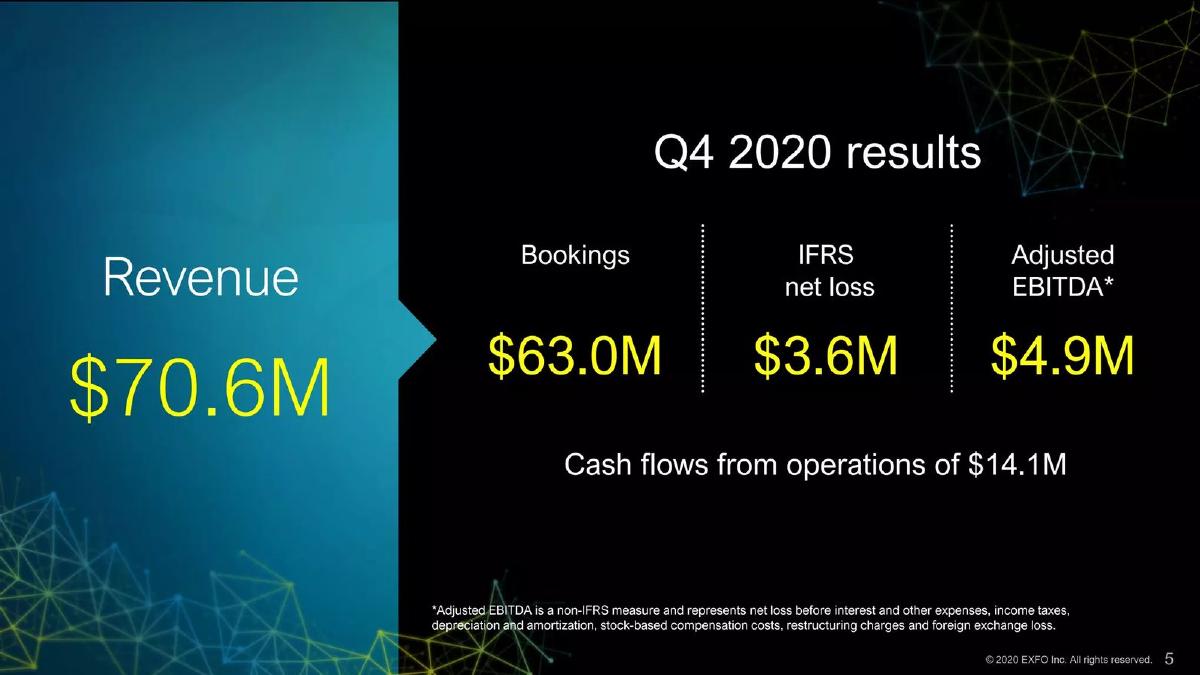
- The company reported Q4 2020 revenue of $70.6M and adjusted EBITDA of $4.9M (Slide 5).
- Operational cash flow for the quarter was stated at $14.1M, despite an IFRS net loss of $3.6M (Slide 5).
- The core customer pain point identified is the 'unseen level of complexity' caused by 5G paradigm shifts and virtualization (Slide 7).
- NOVA SensAI is presented as a real-time assurance solution focused on automated anomaly detection (Slide 9).
- Growth opportunities are explicitly tied to fiber buildouts at the network edge and 5G deployments involving network slicing (Slide 11).
- The company employs 1,900 people across more than 25 countries (Slide 3).
- Capital allocation strategy includes a specific commitment to 'no major acquisitions for the short-term' (Slide 15).
Executive Summary: A Mature Player Navigating the 5G Shift
The EXFO Fall 2020 Investor Presentation is a clinical, data-driven update from an established leader in the telecommunications infrastructure space. Unlike early-stage startup decks that sell a dream, EXFO sells market dominance and operational resilience. With a No.1 ranking in optical test equipment, the company uses this deck to demonstrate how it is translating its legacy hardware expertise into the software-defined world of 5G and AI-driven analytics.
Slide 1: Title Slide
The deck opens with a standard corporate title slide: "INVESTOR PRESENTATION Fall 2020." The branding is consistent with EXFO’s established identity, utilizing a teal and green geometric background. The presence of the logo and a clear date immediately sets the context for a quarterly or seasonal update to the public markets or institutional investors.
Slide 3: The Market Position
Slide 3 establishes the company's scale and authority. It uses three large yellow circles to highlight key metrics: No.1 in the optical test equipment market , Top 5 in the communications monitoring market , and a global workforce of 1,900 employees in 25+ countries . This slide serves as the "Why Us" and "Traction" slides combined, emphasizing that EXFO is not a challenger but an incumbent defender of a significant market share.
Slide 5: Q4 2020 Financial Results
This slide provides a snapshot of the company's financial health at the end of the 2020 fiscal year. The figures are presented clearly: Revenue of $70.6M and Bookings of $63.0M . While the company notes an IFRS net loss of $3.6M , it counterbalances this with an Adjusted EBITDA of $4.9M and significant Cash flows from operations of $14.1M . The footnote defines Adjusted EBITDA as a non-IFRS measure, excluding interest, taxes, depreciation, and stock-based compensation. This distinction is crucial for investors to understand the underlying cash-generating power of the business despite bottom-line accounting losses.
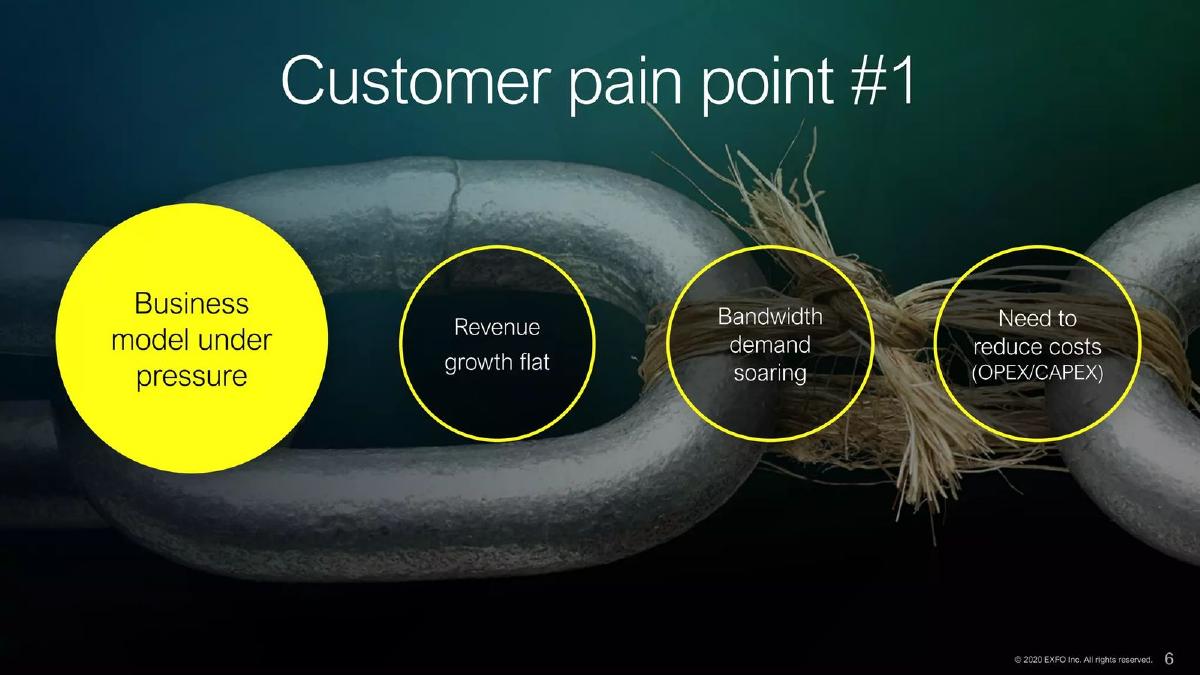
Slide 7: Customer Pain Point #2
EXFO identifies a specific hurdle for their clients: Unseen level of complexity . The slide breaks this down into three sub-points: the major paradigm shift with 5G, the increased complexity brought by virtualization, and the resulting lack of visibility into the subscriber experience. By labeling this as "Pain point #2," the deck implies a structured narrative of challenges that their technology is designed to mitigate. It frames 5G not just as a speed upgrade, but as a management crisis for service providers.
Slide 9: Product Spotlight - NOVA SensAI
To address the complexity mentioned in Slide 7, Slide 9 introduces NOVA SensAI . The slide describes it as a "Real-time assurance solution" that focuses on anomaly detection. The value proposition is automation: the system "automatically detects and predicts subscriber-impacting events." The visual uses a high-angle shot of a crowd with digital overlays, symbolizing the ability to pick out specific issues from a sea of data. This represents EXFO's move into AI and predictive analytics.
Slide 11: Industry Transformations and Opportunities
This slide maps the external market forces acting as tailwinds for the company. It identifies two main pillars: Fiber buildouts and 5G deployments . Under fiber, it lists network edge expansion, small cell connectivity, and data center interconnects. Under 5G, it notes multiple use cases and the "stringent requirements" enabled by network slicing. This slide connects EXFO’s product capabilities directly to the capital expenditure cycles of major global telcos.
Slide 13: SA, Systems and Services
Slide 13 focuses on the service layer of the business. It highlights "end-to-end network performance, service reliability and subscriber insights." The imagery of a technician monitoring multiple screens reinforces the company's role as the "eyes and ears" of the network. This slide emphasizes that EXFO is not just selling hardware tools, but a comprehensive monitoring ecosystem for both fixed and mobile networks.
Slide 15: Disciplined Capital Allocation
The final slide in this set outlines the company's financial strategy. It uses a four-quadrant flow: Invest in organic growth , Replenish balance sheet , No major acquisitions for the short-term , and Leverage normal course issuer bid (NCIB) . This is a highly conservative and transparent message to investors. By explicitly stating they will avoid major acquisitions, EXFO is signaling a focus on internal efficiency and returning value to shareholders rather than risky expansion.
What Works in This Deck
Clarity of Market Position: Slide 3 is exceptionally effective. By stating they are No.1 in their primary market, they immediately remove the need for a complex competitive landscape slide. For a mature company, this is the strongest possible opening.
Financial Transparency: Slide 5 does not hide the net loss. By placing the IFRS loss next to the positive operating cash flow, the company provides a sophisticated view of its finances that appeals to institutional investors who understand the difference between accounting net income and cash generation.
Trend Alignment: The deck successfully hitches EXFO's wagon to the 5G and fiber buildout trends. Slide 11 clearly explains why the company's products are necessary for the next decade of infrastructure spending.
What Is Missing from This Deck
The Team Slide: While the deck mentions 1,900 employees, there is no slide introducing the executive leadership or the board. In a corporate investor presentation, knowing who is steering the ship is usually a requirement.
Competitive Comparison: While they claim a Top 5 position in monitoring, they do not name the other four. A slide showing their technical advantages over specific competitors (like Viavi or Anritsu) would have strengthened the case for their No.1 status.
Detailed Unit Economics: For a company with $70M in quarterly revenue, there is very little detail on margins per product line or the split between hardware sales and recurring software/service revenue.
What a Founder Should Copy
The 'Pain Point' Framing: Slide 7 is a masterclass in framing a technical challenge. Instead of saying "5G is hard," they use the phrase "Unseen level of complexity." This creates a sense of urgency and suggests that the customer is currently flying blind without EXFO's tools.
Conservative Capital Messaging: Founders often feel pressured to promise aggressive M&A or massive spending. EXFO’s Slide 15 shows the power of promising "discipline." For later-stage companies, telling investors you will not spend money recklessly is often more attractive than promising to spend it all on growth.
Visual Consistency: The deck uses a consistent color palette and clean, high-resolution imagery. It looks like a professional corporate document, which builds trust before a single word is read.
Frequently asked questions
- What is EXFO's primary market advantage according to the deck?
- EXFO identifies itself as the No.1 player in the optical test equipment market and a Top 5 player in the communications monitoring market. This leadership position is supported by a global footprint of 1,900 employees in over 25 countries, providing the scale necessary to service large communications service providers during complex 5G transitions.
- How did EXFO perform financially in Q4 2020?
- The company generated $70.6M in revenue and $63.0M in bookings. While it recorded an IFRS net loss of $3.6M, it maintained a positive adjusted EBITDA of $4.9M and strong cash flows from operations totaling $14.1M. This suggests that despite accounting losses, the core business remained cash-generative during the period.
- What specific problems does EXFO solve for 5G providers?
- EXFO targets the 'unseen level of complexity' inherent in 5G. Specifically, they address the lack of visibility into subscriber experience caused by virtualization and the shift to small cell architecture. Their NOVA SensAI product uses automated detection to predict subscriber-impacting events, allowing providers to resolve issues before they escalate.
- What is EXFO's strategy regarding future growth and acquisitions?
- The deck outlines a 'disciplined capital allocation' strategy. Unlike many high-growth tech firms, EXFO explicitly states they will avoid major acquisitions in the short term. Instead, they are focused on investing in organic growth, replenishing their balance sheet, and leveraging normal course issuer bids (NCIB).
- What industry trends are driving EXFO's current roadmap?
- The roadmap is driven by two primary transformations: fiber buildouts and 5G deployments. This includes moving fiber closer to the network edge, connecting small cells, and managing the stringent requirements of network slicing within data centers. Their 'SA, systems and services' arm provides the end-to-end performance monitoring required for these fixed and mobile networks.