Aceiss, a North American cybersecurity startup, raised $3.3M in 2024 to tackle unauthorized access in enterprise environments. Their 8-slide pitch deck is notable for its brevity and heavy reliance on the 'Team' slide to establish immediate authority in a crowded market. The narrative focuses on the visibility gap between modern and legacy applications, positioning their patented 'adaptive technologies' as the bridge. While the deck lacks traditional metrics, a business model, or a specific financial ask, it succeeds by framing a technical problem through the lens of regulatory risk and opera…
Key takeaways
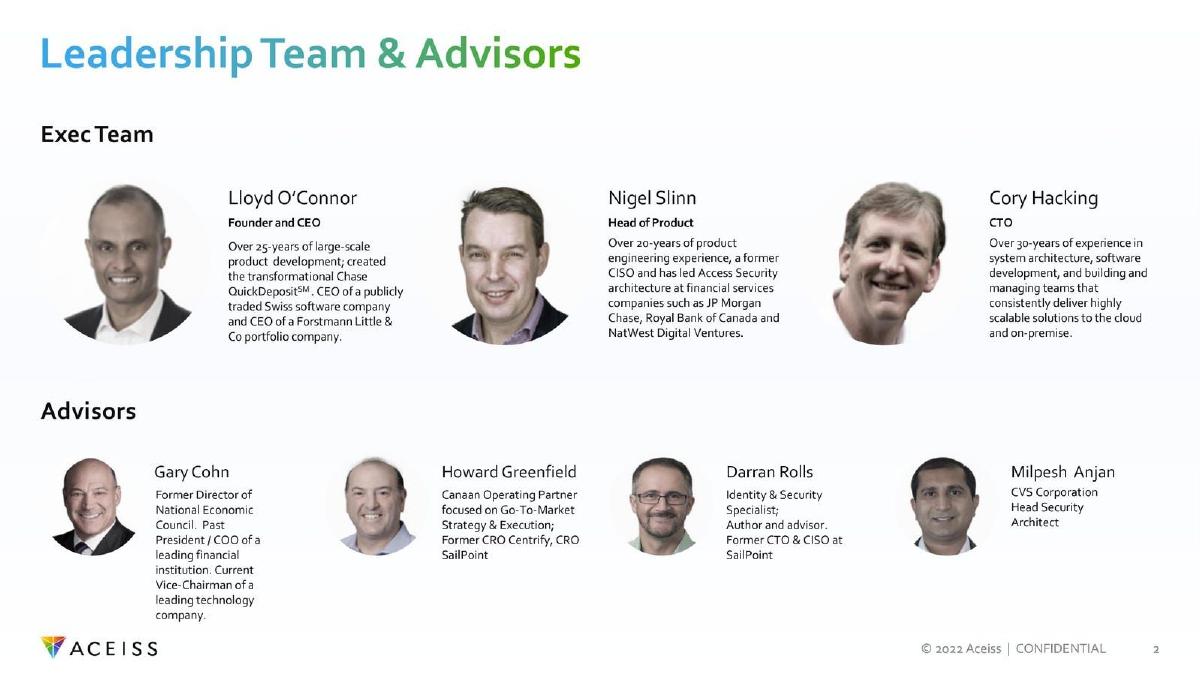
- The deck leads with a high-pedigree team, featuring executives with experience at JP Morgan Chase, Royal Bank of Canada, and CVS (Slide 2).
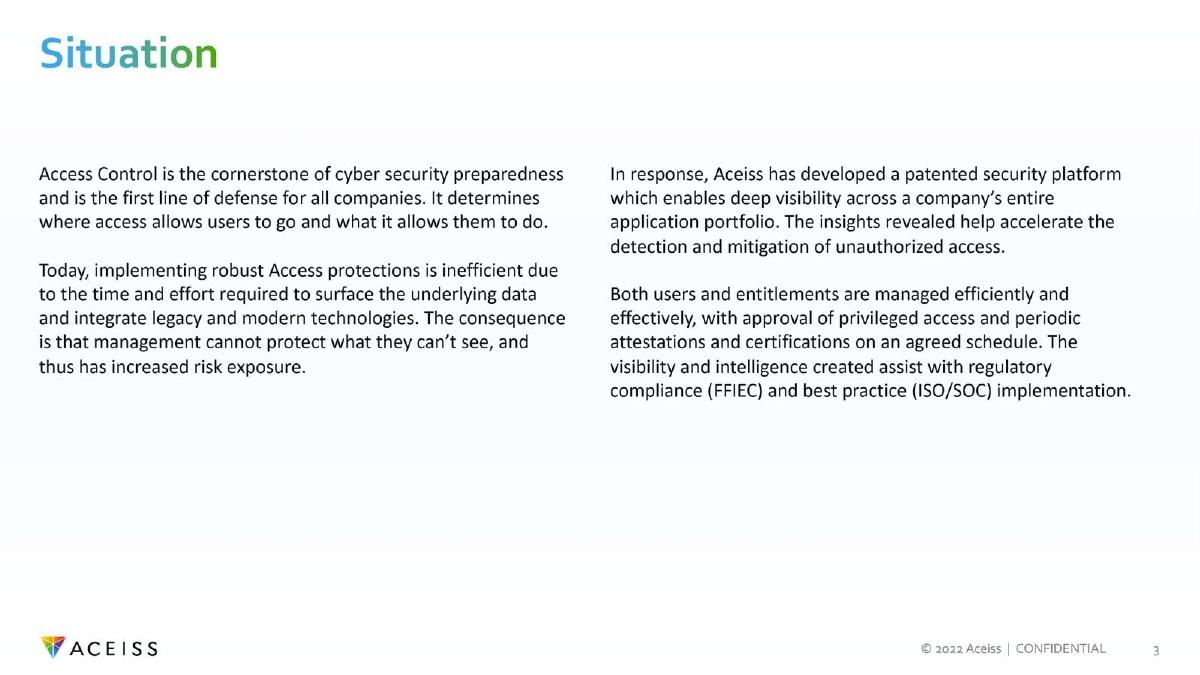
- Aceiss frames the problem as a visibility issue, stating that management cannot protect what they cannot see (Slide 3).
- The presentation highlights a specific regulatory pain point, citing FFIEC, ISO, and SOC compliance (Slide 3).
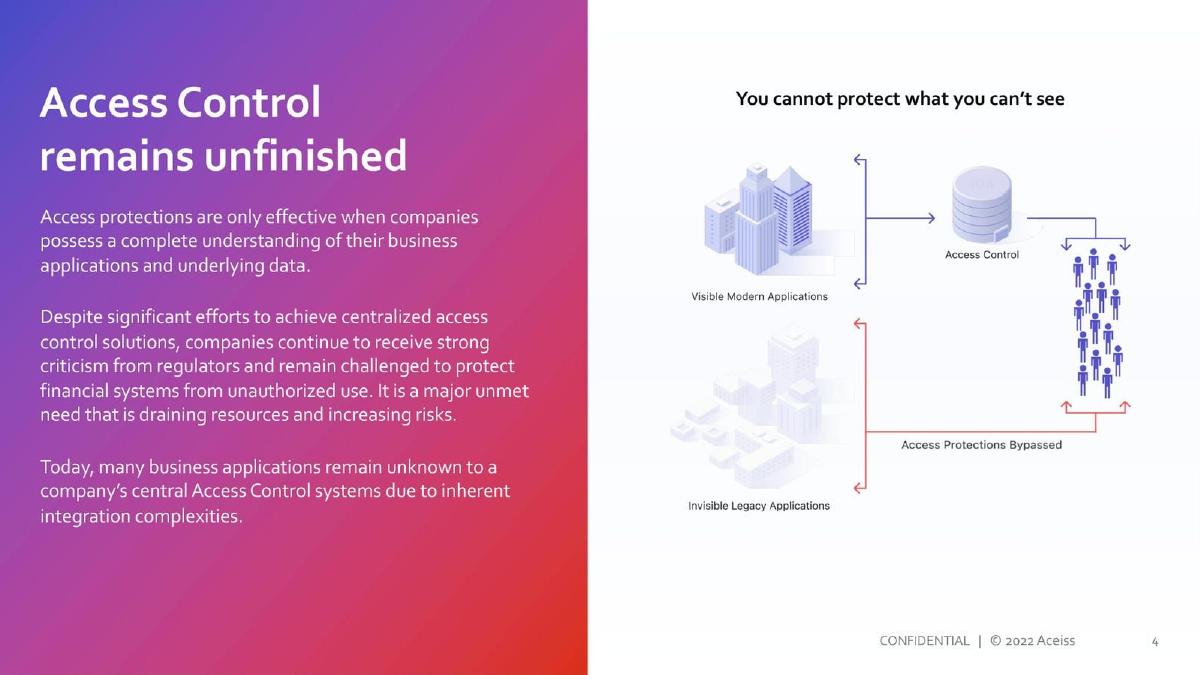
- A clear architectural contrast is drawn between 'Invisible Legacy Applications' and 'Visible Modern Applications' (Slide 4).
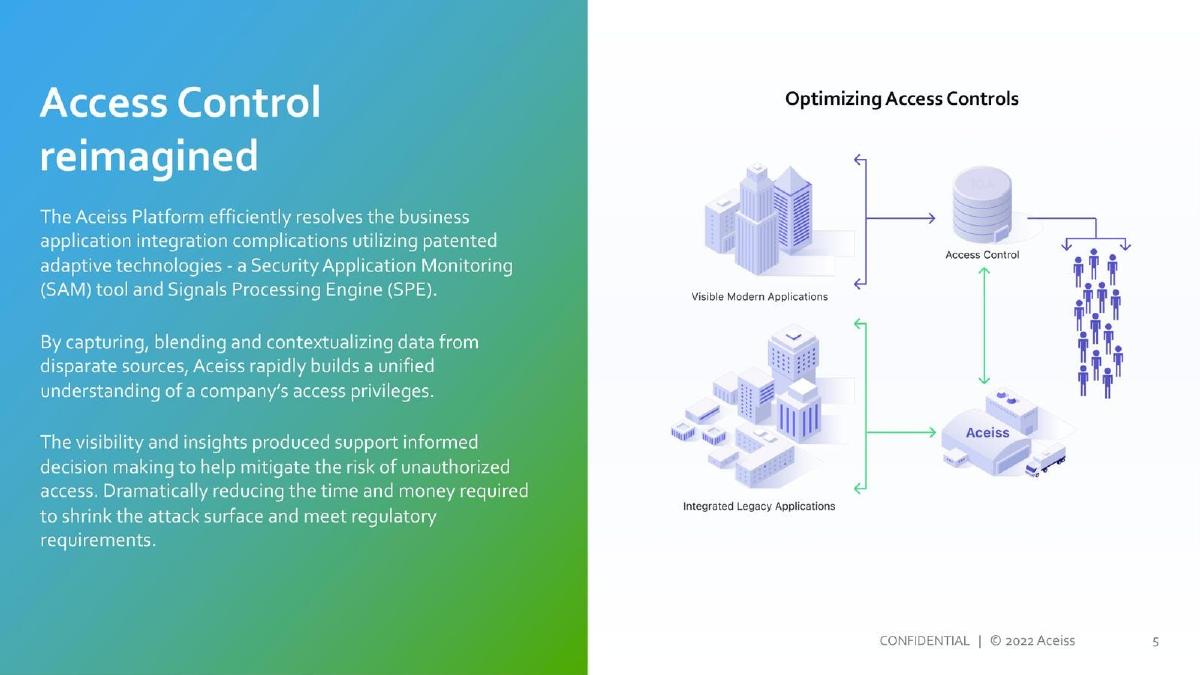
- The solution is defined by two specific technical components: a Security Application Monitoring (SAM) tool and a Signals Processing Engine (SPE) (Slide 5).
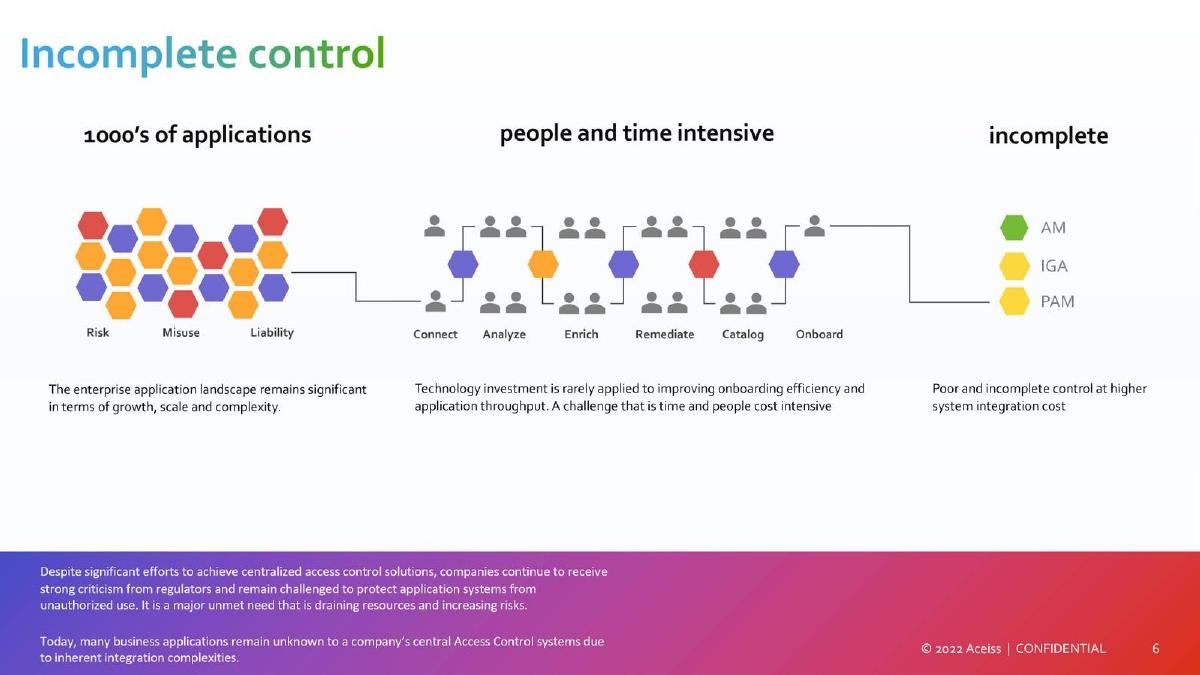
- The deck uses a 'Before vs. After' visualization to show how they replace a 6-step manual process with an automated loop (Slides 6 and 7).
- Aceiss claims to have patented security platform technology, which adds a layer of defensibility to their Seed round (Slide 3).
- The deck completely omits a competition slide, a financial ask, and any mention of current revenue or traction (Slides 1-8).
The Pedigree-First Approach to Cybersecurity Fundraising
Aceiss entered the cybersecurity market with a $3.3M Seed round in 2024, backed by a deck that is surprisingly light on slides but heavy on executive authority. In an industry where 'Access Control' is a crowded category, Aceiss chose to focus on the 'visibility gap'—the dark corners of enterprise infrastructure where legacy applications hide from modern security protocols. This teardown examines how a lean 8-slide deck can successfully secure millions by focusing on team credibility and architectural logic rather than raw metrics.
Slide 1: Title and Positioning
The cover slide introduces the company name and a clear, functional subtitle: 'Mitigating the risk of Unauthorized Access using Adaptive Technologies.' The visual language is standard for the sector—a network graph representing connectivity. It establishes the brand as a serious, enterprise-focused entity from the outset. The 'Confidential' footer and 2022 copyright date indicate this deck may have been in circulation for some time before the 2024 round was finalized.
Slide 2: Leadership Team & Advisors
Placing the team slide second is a strategic move often used by founders with significant 'exit' or 'big corporate' experience. Lloyd O’Connor (CEO) is credited with creating Chase QuickDeposit and leading a publicly traded company. Nigel Slinn (Product) brings CISO experience from JP Morgan Chase and Royal Bank of Canada. Cory Hacking (CTO) adds 30 years of systems architecture experience. The advisor row is equally heavy, featuring Gary Cohn (former Director of the National Economic Council) and Howard Greenfield (Canaan Operating Partner). For a Seed round, this level of seniority is the primary 'traction' metric.
Slide 3: The Situation
This slide serves as the executive summary. It defines Access Control as the 'cornerstone of cyber security preparedness' but notes that current implementations are 'inefficient due to the time and effort required to surface underlying data.' Crucially, it mentions that Aceiss has developed a 'patented security platform.' By linking visibility to regulatory compliance (FFIEC, ISO, SOC), the deck moves the conversation from a technical 'nice-to-have' to a business necessity.
Slide 4: Access Control Remains Unfinished
Slide 4 visualizes the problem. It uses a split diagram to show that while 'Visible Modern Applications' are covered by current Access Control systems, 'Invisible Legacy Applications' bypass these protections. The text highlights that this is a 'major unmet need that is draining resources and increasing risks.' This slide is effective because it validates the existing investments an enterprise has made (the modern stuff) while pointing out the dangerous gap they know exists (the legacy stuff).
Slide 5: Access Control Reimagined
This is the 'Solution' slide. It mirrors the diagram from Slide 4 but inserts the 'Aceiss' platform as the bridge. The deck introduces two specific technical terms: the Security Application Monitoring (SAM) tool and the Signals Processing Engine (SPE). The value proposition is stated as 'dramatically reducing the time and money required to shrink the attack surface.' It avoids feature-bloat, focusing instead on the outcome of 'informed decision making.'
Slide 6: Incomplete Control (The 'Before' State)
Slide 6 breaks down the current manual workflow. It shows a linear, 'people and time intensive' process involving six steps: Connect, Analyze, Enrich, Remediate, Catalog, and Onboard. It categorizes the landscape into AM (Access Management), IGA (Identity Governance and Administration), and PAM (Privileged Access Management). The takeaway is that current technology investment is rarely applied to onboarding efficiency, leading to 'higher system integration cost.'
Slide 7: Rapid and Complete Control (The 'After' State)
Slide 7 provides the counter-narrative. Instead of the linear manual process, Aceiss proposes a cyclical, automated loop: Activity Correlation, Control Definition, and Interactive Context. The diagram shows the Aceiss logo at the center of this loop, leading to a 'complete' stack of AM, IGA, and PAM. The text claims 'economy of scale' and 'right-sizing of access privilege.' This is the strongest 'value' slide in the deck, as it promises to solve the complexity described in the previous slide.
Slide 8: Deployment Alternatives
The final slide addresses the 'how.' It offers two paths: 'Runtime Instrumentation' for legacy remediation and 'Continuous Integration/Continuous Deployment' for DevOps pipelines. This shows versatility—the tool works for both the 'old' IT department and the 'new' engineering teams. However, as the final slide, it feels abrupt. There is no 'Ask,' no 'Roadmap,' and no 'Contact' information beyond the standard footer.
What Aceiss Does Well
The Aceiss deck is a masterclass in problem framing . By categorizing applications into 'Visible Modern' and 'Invisible Legacy,' they create a clear, urgent need that most enterprise CISOs will immediately recognize. They don't try to replace existing security stacks; they offer to 'complete' them. This 'bridge' strategy is often easier to sell than a 'rip and replace' strategy.
The Team Slide is the deck's greatest asset. In the absence of revenue figures or customer logos, the collective 75+ years of high-level experience at institutions like JP Morgan and CVS acts as a proxy for market validation. Investors are betting on the team's ability to navigate the complex sales cycles of the very institutions they used to work for.
What is Missing from the Aceiss Deck
The most glaring omission is Traction and Metrics . There is no mention of pilot programs, revenue, user growth, or even a list of target industries beyond a vague reference to 'financial systems.' While the team pedigree is strong, a Seed round usually requires some evidence of product-market fit or at least a 'proof of concept' result.
There is also no Competition Slide . The identity and access management (IAM) space is crowded with giants like Okta, SailPoint, and CyberArk. Aceiss mentions these categories (AM, IGA, PAM) but doesn't explicitly state how they coexist with or outperform the incumbents. A founder without this specific team's pedigree would likely be penalized for this omission.
Finally, the Missing Ask . The deck ends without telling the investor what the company needs. There is no dollar amount, no hiring plan, and no milestone map. This suggests this deck may have been a 'teaser' or a high-level overview used to secure a meeting rather than the final document used to close the round.
What Founders Should Copy
Founders should emulate the visual clarity of Slides 4 and 5. The use of simple isometric icons to explain a complex architectural gap is highly effective. It allows a non-technical investor to understand the 'where' and 'why' of the technology without getting lost in the code.
The process mapping on Slides 6 and 7 is also a great template. If your startup automates a manual process, showing the 'linear manual' vs. 'cyclical automated' workflow is a powerful way to demonstrate efficiency gains. It moves the conversation from 'what the product is' to 'how much time it saves.'
Lastly, the regulatory tie-in on Slide 3 is a smart move for any B2B SaaS company. By mentioning FFIEC and ISO/SOC, Aceiss isn't just selling security; they are selling 'compliance insurance,' which is often a much easier budget to tap into within large corporations.
Frequently asked questions
- How much did Aceiss raise and when?
- As reported by Business Insider, Aceiss raised a $3.3M Seed round in 2024. The deck itself is dated 2022, suggesting a long development cycle or a multi-stage fundraising process.
- What is the core technology behind Aceiss?
- According to Slide 5, the platform utilizes patented adaptive technologies consisting of a Security Application Monitoring (SAM) tool and a Signals Processing Engine (SPE) to contextualize data from disparate sources.
- Who are the key members of the Aceiss leadership team?
- The team includes CEO Lloyd O’Connor (former CEO of a publicly traded Swiss software company), Head of Product Nigel Slinn (former CISO), and CTO Cory Hacking (30+ years of experience), as detailed on Slide 2.
- What specific problem does Aceiss solve for enterprises?
- Aceiss addresses the 'unfinished' nature of access control, specifically targeting legacy applications that remain invisible to central systems due to integration complexities, as explained on Slide 4.
- Does the deck include a financial ask or valuation?
- No. The 8-slide deck omits the 'Ask' slide entirely, as well as any financial projections, use of proceeds, or valuation details.