Artisan's 17-slide Series A deck is a masterclass in narrative-driven fundraising, successfully securing $25M from top-tier investors like Glade Brook Capital and BOND. The deck moves away from traditional software metrics, instead focusing on the 'AI Employee' paradigm. By positioning their first product, Ava (an AI BDR), as the entry point into a multi-agent ecosystem, Artisan argues that the future of work isn't better tools, but the replacement of human-managed workflows with autonomous agents. While the deck is light on traditional financial disclosures—omitting revenue, burn, and specif…
Key takeaways
- The deck identifies three core problems with current software: fragmentation, the burden of human management, and uninspiring design (Slide 2).
- Artisan positions their AI agents as 'most human-like AI Employees' rather than just another SaaS tool (Slide 3).
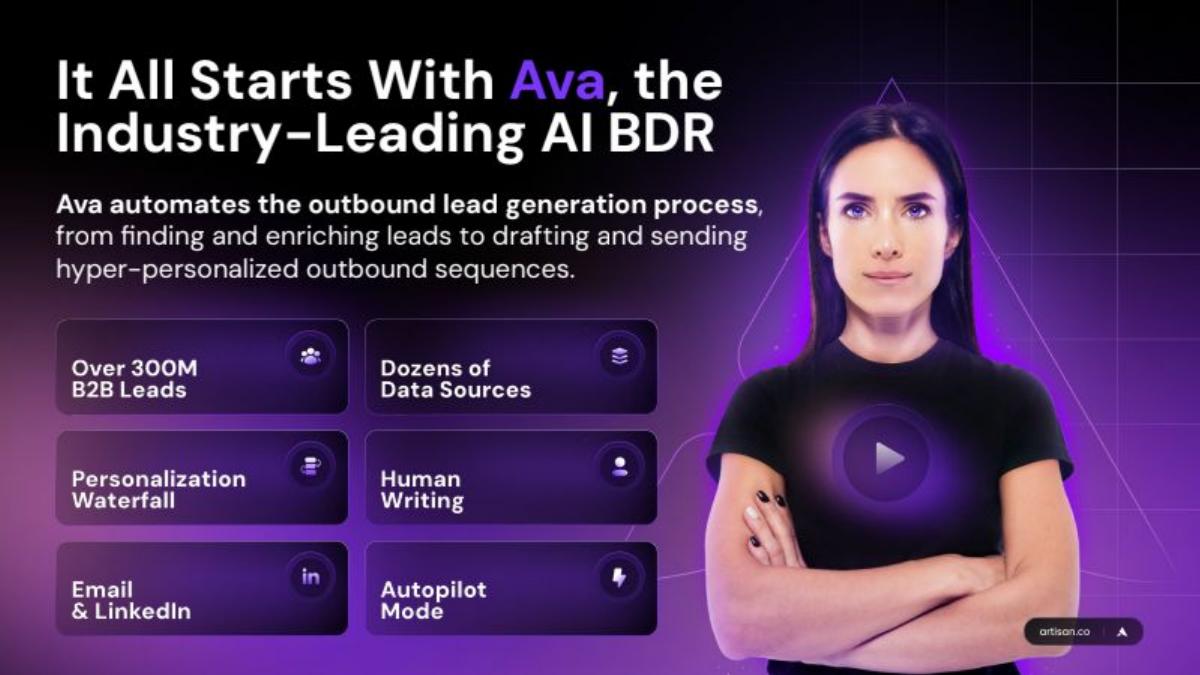
- Ava, the AI BDR, is the flagship product, claiming access to over 300M B2B leads and dozens of data sources (Slide 4).
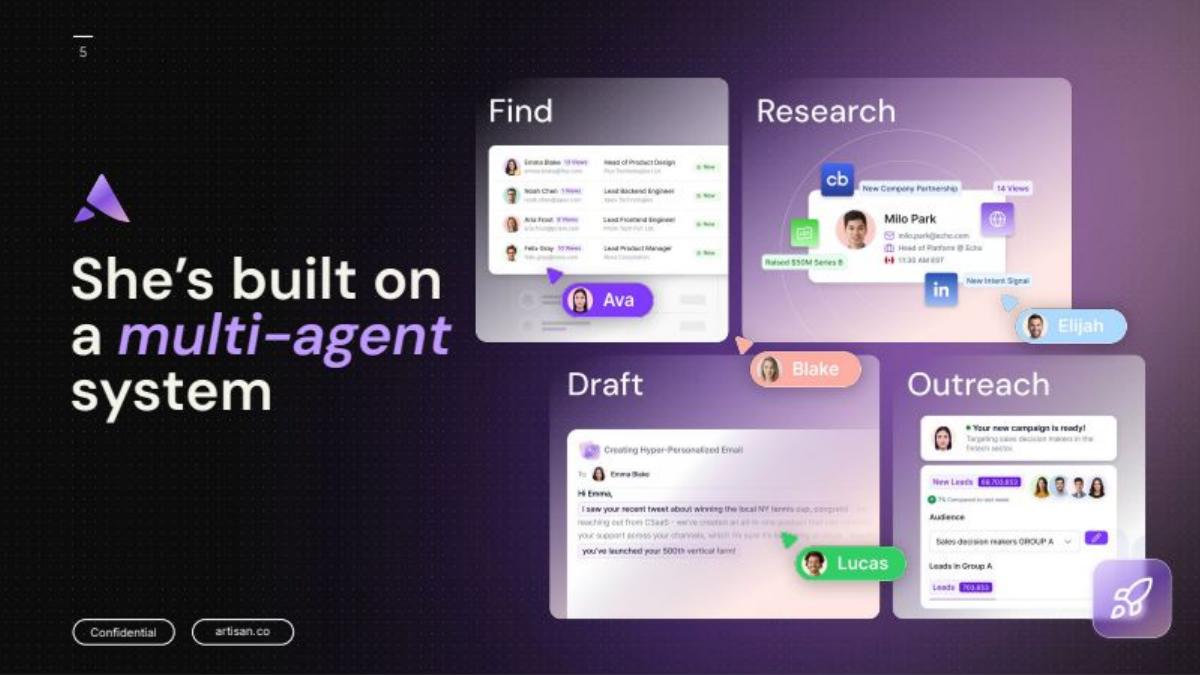
- The technical architecture is described as a 'multi-agent system' where specialized agents like Blake, Lucas, and Elijah handle specific tasks like drafting and outreach (Slide 5).
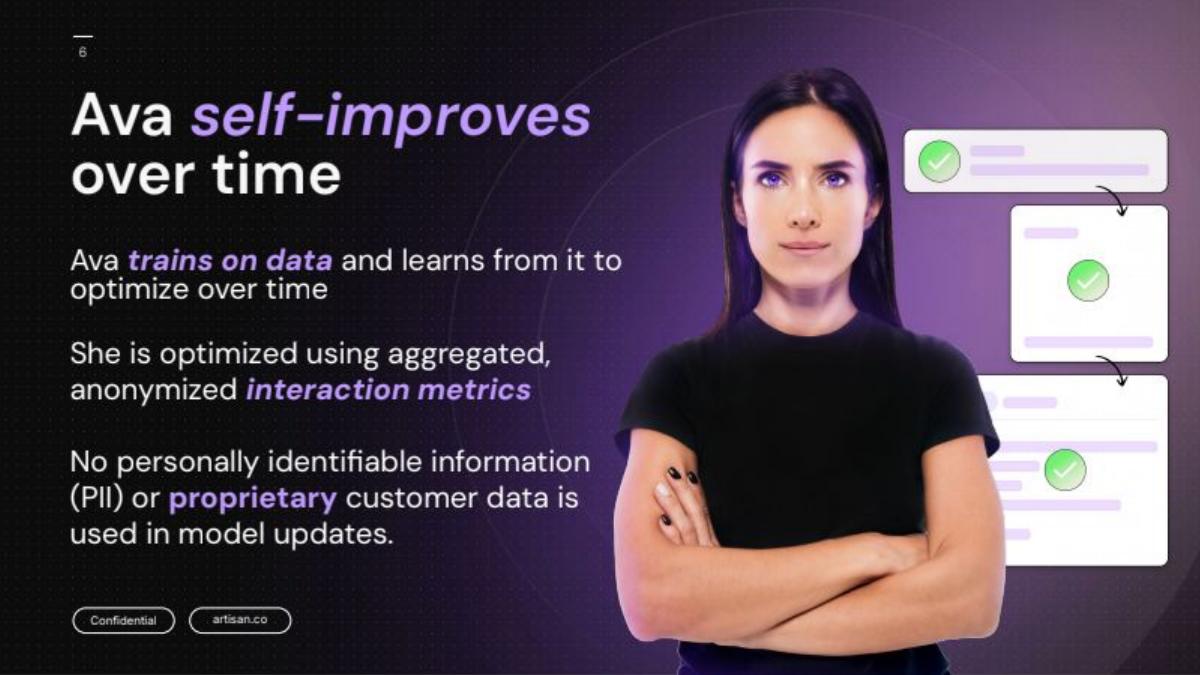
- The company emphasizes data privacy, stating that no PII or proprietary customer data is used in model updates (Slide 6).
- Artisan targets a massive Total Addressable Market by comparing $52B in annual software costs to $790B in annual labor costs (Slide 12).
- The founders highlight their Y Combinator pedigree and previous experience in GTM agencies and engineering roles at IBM (Slide 13).
- Market leadership is asserted through SEO dominance, claiming the #1 Google ranking for 'AI BDR' (Slide 14).
The Shift from SaaS to Automated Labor
Artisan’s Series A deck represents a significant shift in how AI companies are pitching investors in 2025. Rather than selling a tool that makes humans more productive, they are selling the replacement of the human workflow itself. The deck is visually polished, using a dark, high-contrast aesthetic that aligns with their claim that B2B software needs to be more 'inspiring.' By focusing on 'AI Employees' rather than 'AI Features,' Artisan positions itself to capture a share of the $790B labor market rather than just the $52B software market.
Slides 1-3: The Vision and the Problem
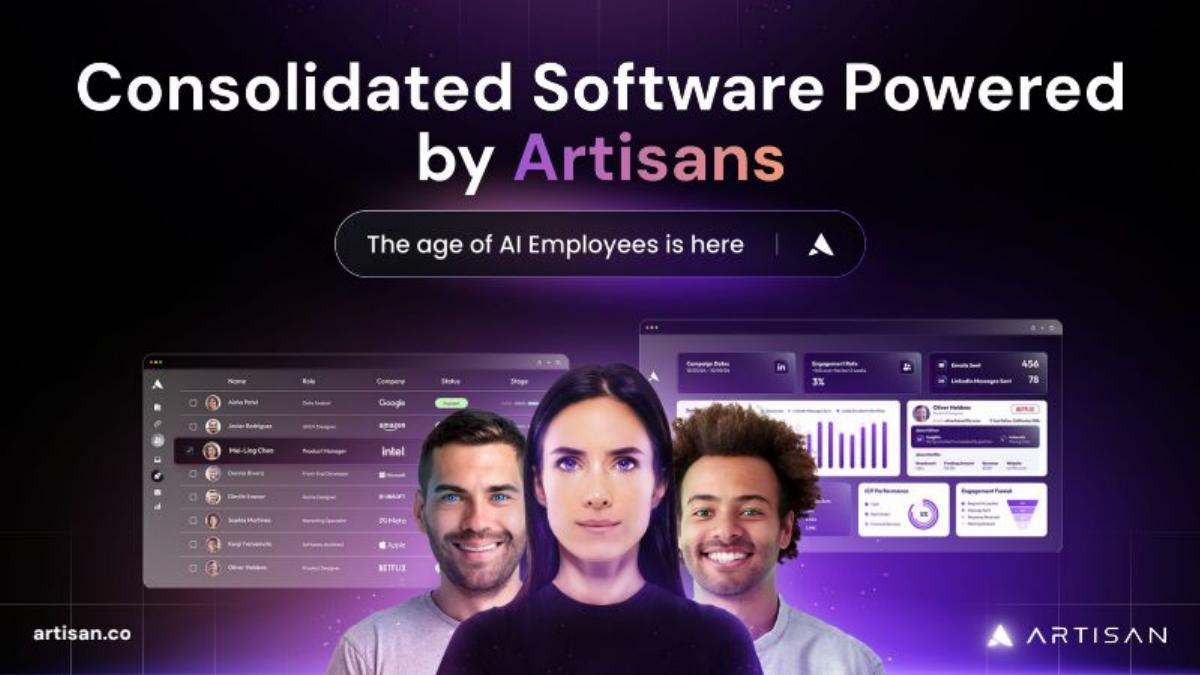
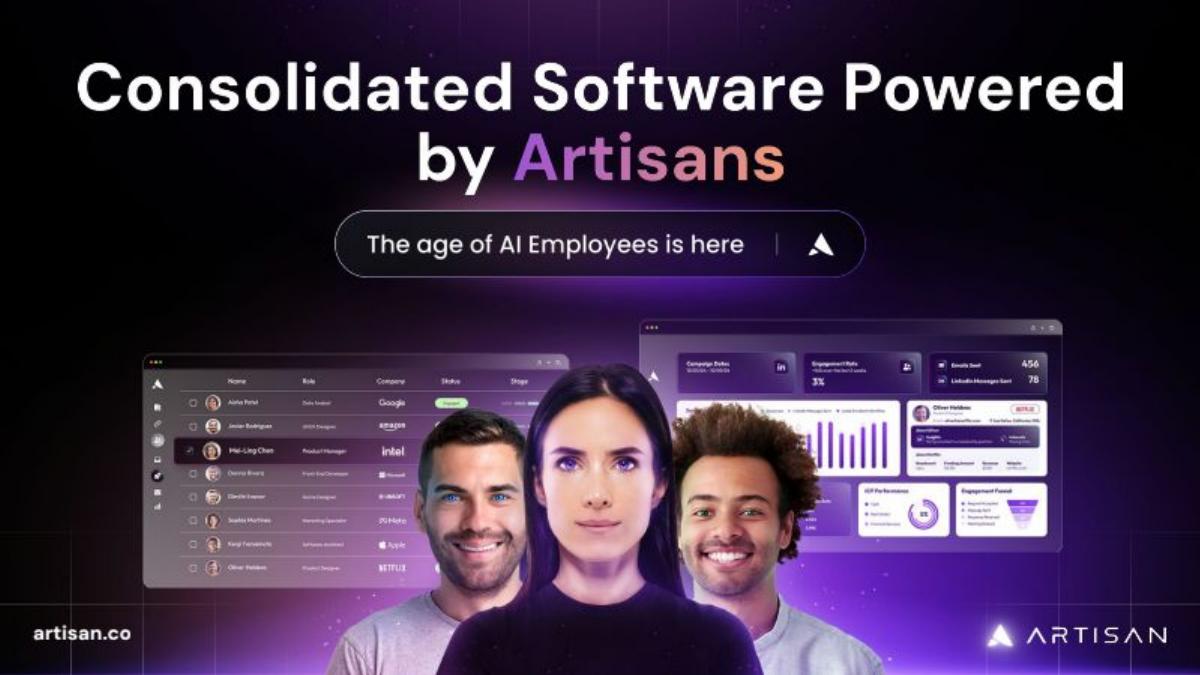
Slide 1: Title Slide The deck opens with a bold headline: 'Consolidated Software Powered by Artisans.' It introduces the tagline 'The age of AI Employees is here.' The imagery shows three diverse human faces alongside software dashboards, immediately establishing the 'human-like' quality of their AI agents.
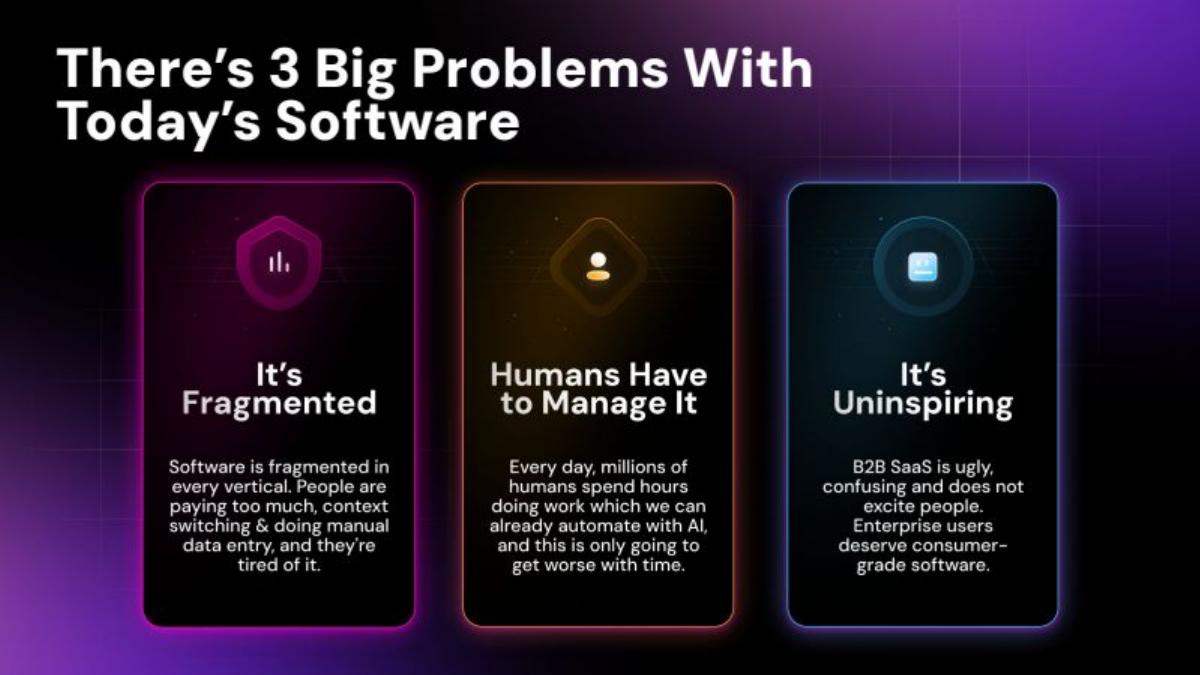
Slide 2: The 3 Big Problems Artisan identifies three pain points in the current market: fragmentation, the requirement for human management, and an 'uninspiring' user experience. They argue that B2B SaaS is 'ugly' and that users deserve 'consumer-grade software.' This sets the stage for a solution that is both automated and aesthetically superior.
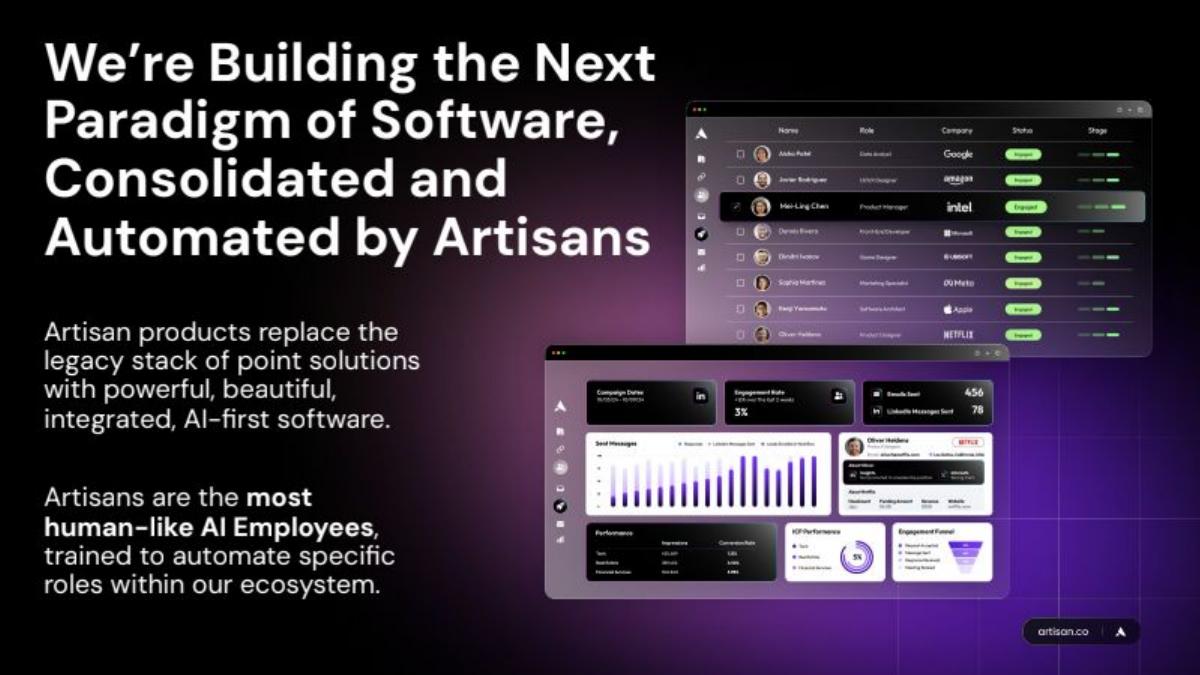
Slide 3: The Next Paradigm This slide defines 'Artisans' as the most human-like AI employees trained to automate specific roles. The core value proposition is the replacement of the 'legacy stack of point solutions' with a single, integrated, AI-first ecosystem.
Slides 4-7: Product Deep Dive - Ava
Slide 4: Ava, the AI BDR The deck introduces its first specific agent, Ava. Key metrics provided include access to over 300M B2B leads and 'dozens of data sources.' Features mentioned include a 'Personalization Waterfall,' 'Human Writing,' and an 'Autopilot Mode.' This is the 'wedge' product that gets Artisan into the enterprise.
Slide 5: Multi-Agent System This slide is crucial for technical credibility. It illustrates how Ava isn't a monolithic script but a system of agents. It names specific sub-agents: Ava (Find), Elijah (Research), Blake (Draft), and Lucas (Outreach). This visualizes the workflow of a multi-step sales process being handled autonomously.
Slide 6: Self-Improvement and Privacy Addressing common enterprise concerns, this slide notes that Ava 'trains on data' to optimize over time. Crucially, it states that no PII or proprietary customer data is used in model updates, a necessary assurance for Series A investors looking at enterprise scalability.
Slide 7: Consolidated Sales Ecosystem A 'Before vs. After' slide. The 'Before' side shows a jumble of 20+ logos (representing the fragmented sales stack). The 'After' side shows Ava at the center of a unified globe containing web scraping, email warmup, intent data, and outbound CRM. This visualizes the 'Consolidation' part of their opening pitch.
Slides 8-11: Traction and Competition
Slide 8: Customer Testimonial A single, large quote from Karlo Buik, Growth Lead at SumUp. He mentions that Artisan’s platform integrates 'valuable local business data.' Using a recognizable brand like SumUp provides social proof early in the deck.
Slide 9: Competitive Landscape The competitive matrix compares Artisan to four unnamed competitors. Artisan claims superiority in data types (B2B, E-Commerce, Local Business), interaction (Chat), and advanced features like 'Personalization Waterfall' and 'Target Audiences.' The lack of competitor names is a strategic choice to focus on their own feature set.
Slide 10: Future Roadmap A transition slide stating that Ava and Artisan Sales are going to get 'a lot more impressive' by replacing dozens of legacy tools.
Slide 11: Ecosystem Actions This slide previews the broader utility of Artisans. It shows a chat interface where a user asks to reschedule meetings, reassign accounts for an offboarding employee, and start a hiring process for engineers. This suggests that the Artisan platform will eventually move beyond sales into HR and Operations.
Slides 12-14: Market and Team
Slide 12: The Addressable Market This is the 'billion-dollar' slide. It compares Total Annual Labor Costs ($790B) to Total Annual Software Costs ($52B). By breaking down labor costs across B2B Sales ($90-100B), Customer Success ($100-120B), and Operations ($200-220B), Artisan argues that their TAM is effectively the global payroll for these functions.
Slide 13: Team The team slide features Jaspar Carmichael-Jack (CEO) and Sam Stallings (CPO). Jaspar’s background is in GTM agencies and entrepreneurship, while Sam brings engineering experience from IBM and YC-backed startups. The bios are concise, focusing on relevant domain expertise.
Slide 14: Market Leadership Artisan claims they are already dominating the sales vertical. They show a 'Google Ranking' table where they claim the #1 spot for 'AI BDR' and #2 for 'AI SDR.' They also include a snippet from TechCrunch naming them as one of the 'best-known AI SDR startups.'
Slides 15-17: Values and Closing
Slide 15: Company Values (RECIPE) The company lists six values: Reliability, Excellence, Customer, Impatience, Pioneering, and Execution. The inclusion of 'Impatience' ('This is a race') signals a high-intensity culture, which often appeals to Series A venture capitalists.
Slide 16: Closing Vision A final summary slide: 'The Future is Consolidated and Automated. And we’re building it.'
Slide 17: Appendix/BestPitchDeck Promo This is a standard promotional slide for the source library and not part of the original Artisan pitch.
What Works in This Deck
The Labor vs. Software Framing: By comparing the $790B labor market to the $52B software market, Artisan justifies a much higher ceiling for their valuation. They aren't just selling a $50/month tool; they are selling a replacement for a $60k/year employee. · Visual Consistency: The deck looks like the product they describe—modern, high-fidelity, and 'inspiring.' This reinforces their critique of 'ugly' B2B software. · Multi-Agent Visualization: Slide 5 does an excellent job of explaining a complex technical concept (multi-agent systems) through a simple, workflow-based graphic. · SEO as Traction: In a crowded AI market, claiming the #1 Google rank for a high-intent keyword like 'AI BDR' is a tangible metric of market presence that doesn't require disclosing sensitive revenue data.
What Is Missing
Financial Metrics: There is no mention of ARR, MRR, or growth rates. While the TechCrunch mention and SumUp quote imply traction, the lack of hard numbers is notable for a Series A. · Unit Economics: The deck does not explain the cost to serve these AI agents. If 'Ava' requires significant compute or manual oversight, the margins might look different than traditional SaaS. · The Ask: There is no slide detailing how much capital is being raised or how it will be allocated (e.g., hiring, R&D, marketing). · Retention Data: While they show a customer quote, there is no data on churn or net revenue retention, which are typically standard for Series A SaaS decks.
Founder Takeaways
Sell the 'Who,' not the 'What': If you are building in AI, try framing your product as an 'Employee' rather than a 'Tool.' This allows you to anchor your pricing and TAM to labor costs rather than software budgets. · Consolidation is a Winning Theme: Investors are currently wary of 'point solution fatigue.' Artisan’s message of consolidating the stack into one 'Artisan Sales' ecosystem is a timely response to this sentiment. · Use Values to Signal Culture: Including 'Impatience' as a core value (Slide 15) is a bold way to signal to investors that you are moving fast in a competitive market. · Lead with your strongest 'Wedge': Artisan has a broad vision for AI employees in every department, but they spend the majority of the deck on Ava (Sales). This shows they have a clear starting point rather than just a vague platform play.
Frequently asked questions
- How much did Artisan raise with this deck?
- According to the catalogue facts, Artisan raised $25M in their Series A round. The lead investor was Glade Brook Capital, with participation from high-profile firms including BOND Capital, Sequoia Scout, and Y Combinator. The deck itself does not state the amount raised or the valuation sought, which is common for high-momentum rounds where terms are negotiated dynamically.
- What is the core product offered by Artisan?
- The primary product featured is 'Ava,' an AI Business Development Representative (BDR). As shown on Slide 4, Ava automates the outbound lead generation process, including finding leads, enriching data, and sending personalized sequences. The broader vision is to create a suite of 'Artisans' (AI employees) that operate within a consolidated software ecosystem to replace legacy point solutions.
- How does Artisan differentiate itself from other AI sales tools?
- Artisan uses a competitive matrix on Slide 9 to claim superiority. They highlight their ability to handle multiple data types (B2B, E-commerce, Local Business), offer 'Chat' interaction with the AI employee, and provide advanced features like a 'Personalization Waterfall' and 'Coaching.' They explicitly state that competitors lack these integrated, multi-source data enrichment capabilities.
- What market size is Artisan targeting?
- Artisan frames their market opportunity by contrasting software spend with labor spend on Slide 12. They cite $52B in total annual software costs across functions like Sales, CS, and HR, but point to a much larger $790B in annual labor costs. Their thesis is that by automating roles, they are capturing a portion of the labor market rather than just the software market.
- Who are the founders of Artisan?
- As detailed on Slide 13, the company was co-founded by Jaspar Carmichael-Jack (CEO) and Sam Stallings (CPO). Jaspar previously founded an on-demand services startup and a 15-person GTM agency. Sam has over 9 years of engineering experience, including roles at two YC companies and IBM, and previously led engineering for a consumer app startup.