Artemis Strategy Group’s pitch deck outlines a service-heavy approach to digitalizing small and mid-sized enterprises (SMEs). The company identifies a specific pain point: SMEs are intimidated by technology and fear unintended consequences from implementation. To solve this, Artemis proposes a 'Small Business Suite' that enables mobile ordering and customer tracking. The deck is notable for its qualitative focus, citing interviews with 16 business owners to validate demand. However, it lacks quantitative rigor, omitting market size (TAM/SAM/SOM), financial projections, and a specific funding…
Key takeaways
- The company focuses on SMEs that lack dedicated IT departments, specifically in the service and sales industries (Slide 9).
- Customer validation is based on face-to-face interviews with 16 business owners to ensure product-market fit (Slide 6).
- The 'Small Business Suite' features include automatic ordering via credit card or PayPal and customer data tracking (Slide 8).
- Monetization is described as a 'complex process' involving asset sales, usage fees, brokerage fees, advertising, and subscriptions (Slide 11).
- The deck identifies two major barriers for SMEs: lack of knowledge about solutions and fear of implementation risks (Slide 7).
- The competitive advantage is framed around a 'Minimum Viable Product' approach and continuous deployment tailored to specific customer feedback (Slide 5).
- The team is geographically distributed across the USA, India, and Canada, though specific roles and backgrounds are not detailed (Slide 14).
- There is no mention of current revenue, user growth metrics, or a specific capital requirement in the 14-slide presentation.
Slide-by-Slide Analysis
Slide 1: Title Slide
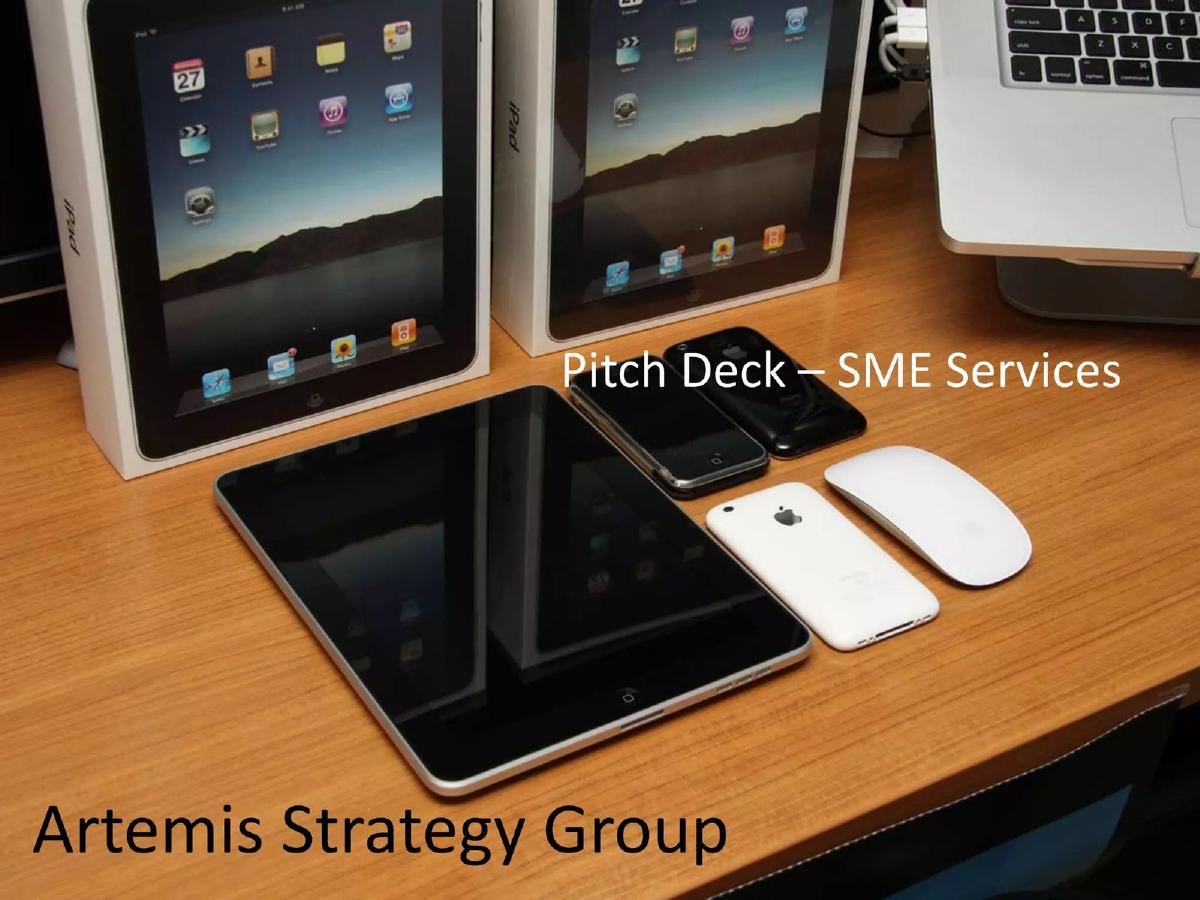
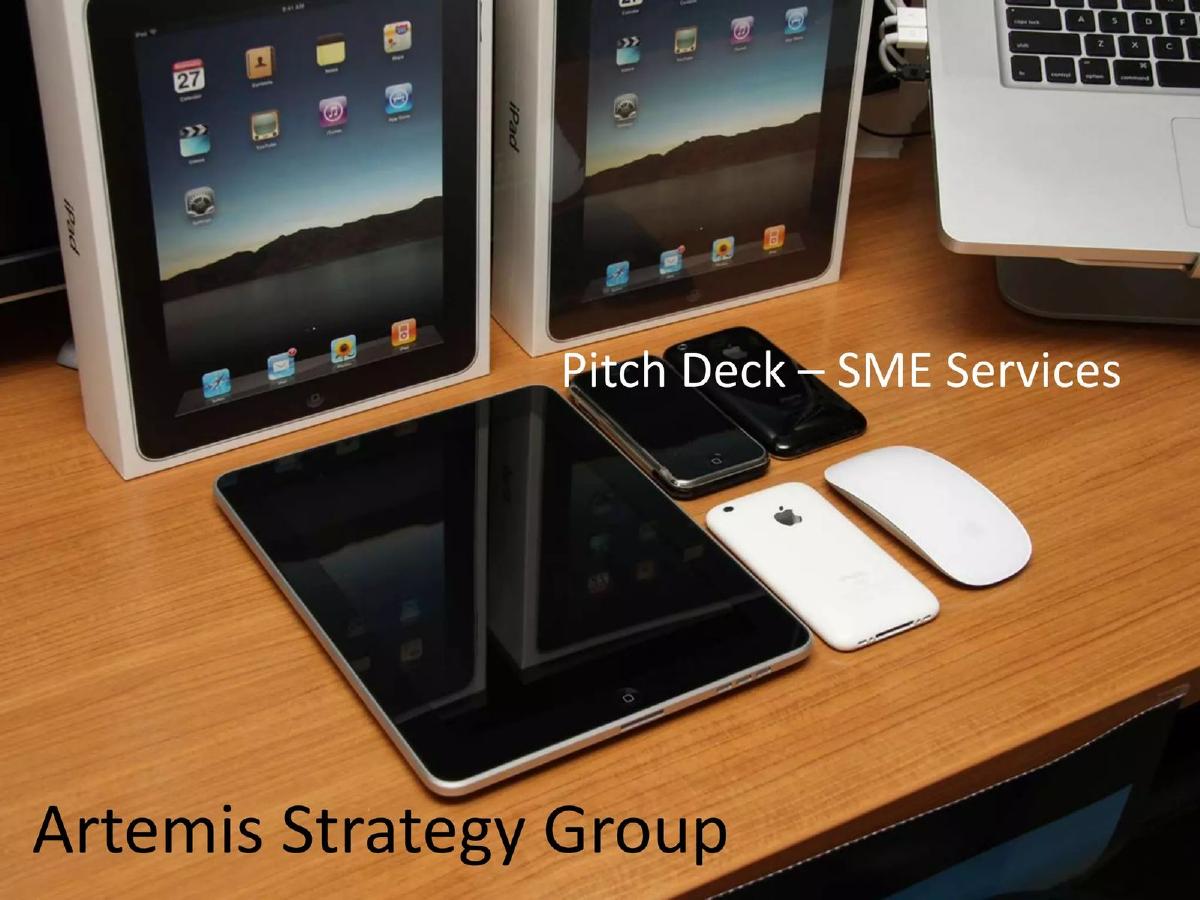
The title slide introduces Artemis Strategy Group with the subtitle 'Pitch Deck – SME Services.' The background image features a collection of Apple products (iPads, iPhones, and a MacBook), which visually aligns with the company's focus on mobile and tablet-based software solutions for businesses. It is a functional, if generic, opening.
Slide 2: Our Mission Statement
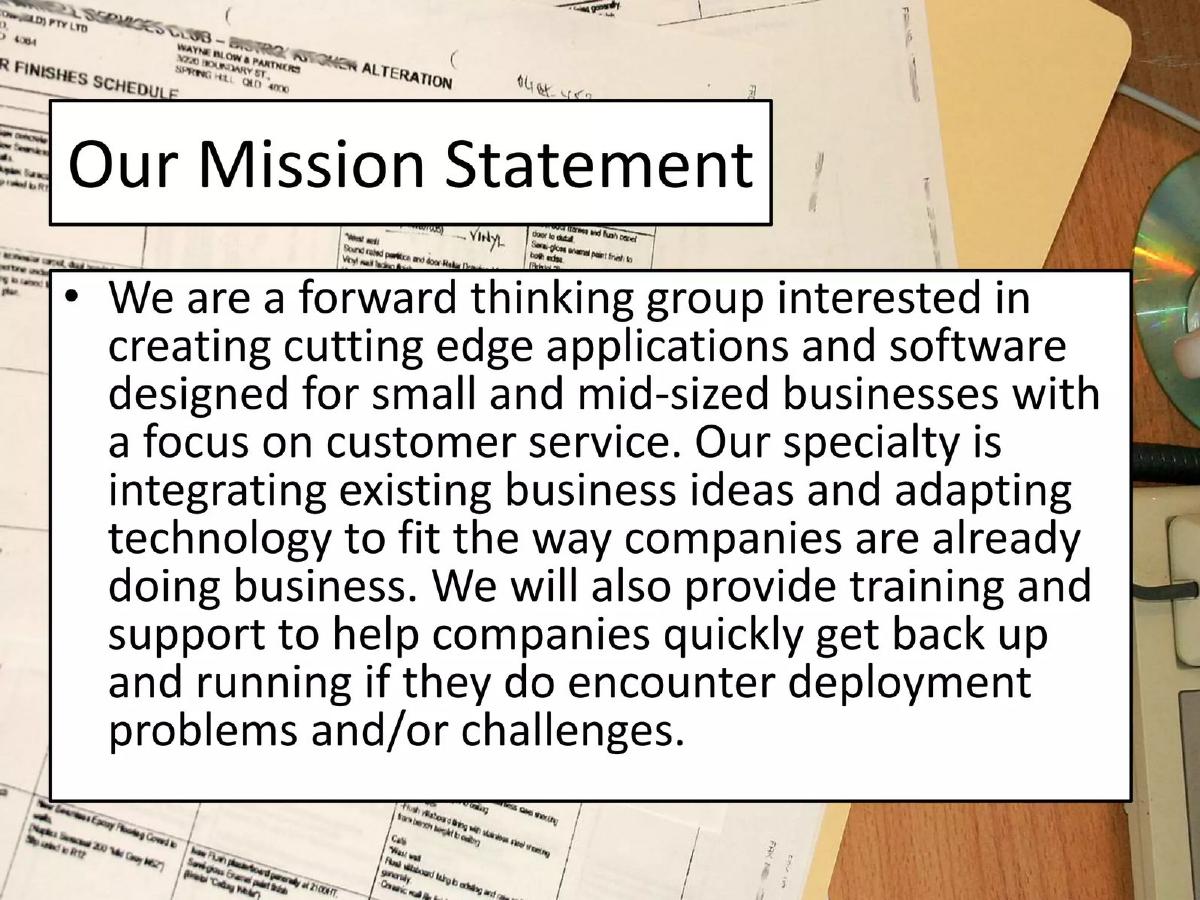
The mission statement defines the company as a 'forward thinking group' focused on 'cutting edge applications and software' for small and mid-sized businesses. A key differentiator mentioned here is the focus on customer service and 'integrating existing business ideas' rather than forcing new workflows. They also commit to providing training and support to handle deployment challenges. This slide sets a tone of high-touch service rather than pure-play SaaS.
Slide 3: The Problem
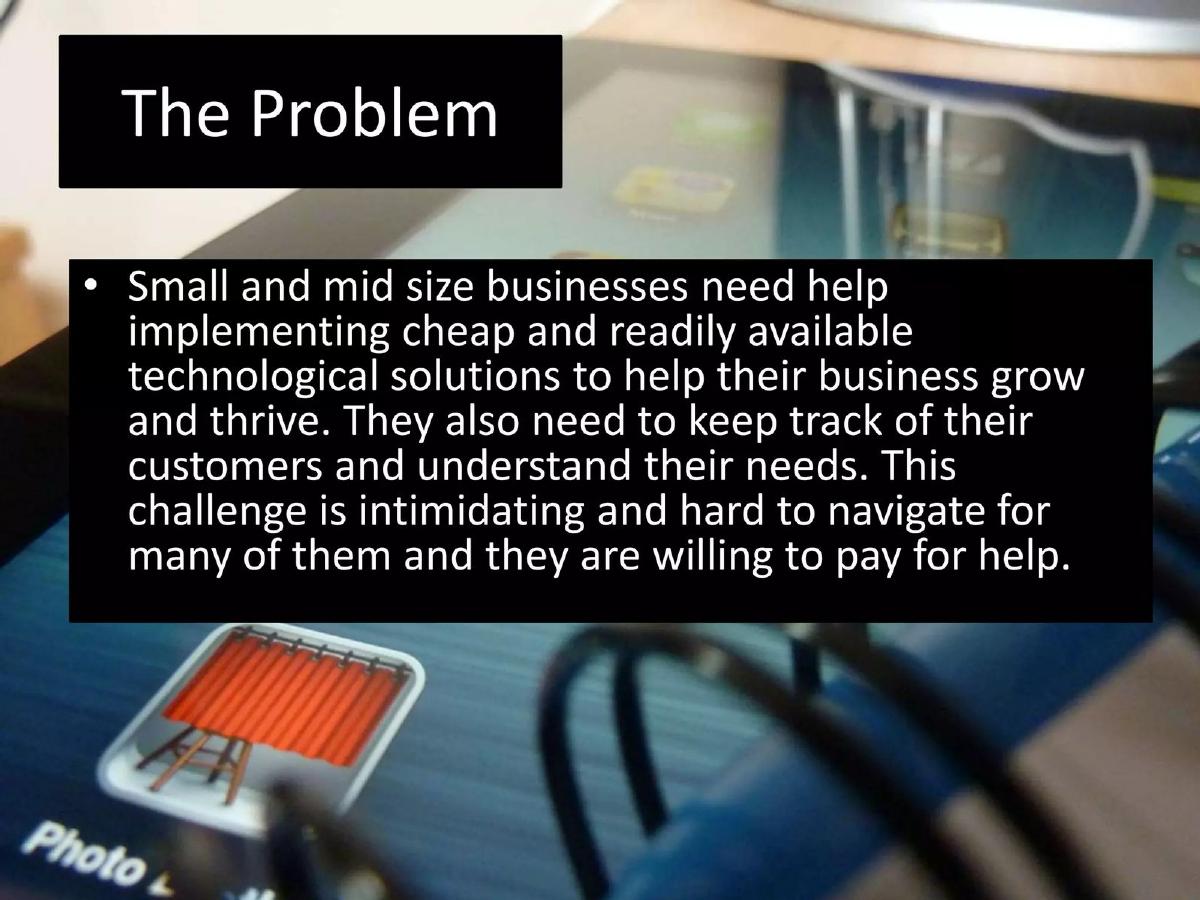
The problem slide identifies that SMEs need help implementing 'cheap and readily available technological solutions.' The core issue is that these businesses find the landscape 'intimidating and hard to navigate.' Crucially, the slide claims these businesses are 'willing to pay for help,' which attempts to establish the existence of a market, though it lacks data to support the scale of this willingness.
Slide 4: The Solution
The solution is branded as the 'Small Business Suite.' It leverages existing hardware (smartphones for customers, tablets/computers for businesses) to track orders and demographics. The slide emphasizes 'low cost' and a 'little learning curve.' It also mentions integrating advertising campaigns, suggesting the solution is intended to be an all-in-one growth platform for small shops.
Slide 5: Competitive Advantage
Artemis claims its advantage lies in 'customer convenience' and 'slow and steady growth.' This is an unusual phrasing for a pitch deck, as investors typically look for rapid scalability. The slide also highlights the use of a 'Minimum Viable Product approach' and 'continuous deployment,' suggesting an agile development methodology that responds directly to customer interest.
Slide 6: Why We are Different
This slide focuses on the company's research methodology. The founders state they 'personally interview our customers face to face.' They cite a specific figure: 16 business owners interviewed so far. This qualitative approach is presented as a way to ensure 'proven demand' before the product is fully created, contrasting their method with a 'traditional paradigm' of technology-first development.
Slide 7: What Did We Learn?
Following the interviews, the company identified two barriers: lack of knowledge and fear of 'unintended consequences' that might harm the business. The slide concludes that the market warrants further testing because customers want solutions that do not increase their 'general levels of stress' or 'financial risk.' This slide effectively bridges the gap between the problem and the specific product features.
Slide 8: SME Suite - Product Features
Automatic ordering via credit card or PayPal. · Auto-order daily unless cancelled. · Memory of previous orders with the ability to add items. · Cross-platform compatibility (iOS, Android, Mac, Windows, Tablet). · Customer data tracking. · Ease of use.
This is the most technical slide in the deck, providing a clear picture of what the software actually does.
Slide 9: Target Customers
The target market is segmented into three groups: small businesses in the service industry, small businesses in the sales industry, and mid-sized enterprises without dedicated IT departments. This is a broad categorization that would benefit from more specific examples (e.g., dry cleaners, local retail, or independent consultants).
Slide 10: Strategy
The strategy slide is brief, stating the goal is to capture underserved markets by taking advantage of 'dropping prices of some technologies.' The background image of giant chess pieces is a common metaphor for strategy but adds little to the specific narrative of how they will acquire customers or scale operations.
Slide 11: Monetization
The company lists five potential revenue streams: Asset Sales , Usage Fees , Brokerage Fees , Advertising , and Subscription Fees . The slide admits this is a 'complex process' and that they need to assess CLV and gross margins. While comprehensive, the lack of a primary chosen model can signal to investors that the company is still in the experimental phase and lacks a clear path to profitability.
Slide 12: Competition
The competition slide is remarkably vague. It does not name any competitors (such as Square, Shopify, or Clover). Instead, it states that by focusing on 'certain niche markets,' they can provide a product 'not offered by anyone else.' In a teardown, this is a significant red flag; failing to acknowledge the crowded SME software space suggests a lack of market awareness.
Slide 13: One Final Point
This slide discusses future expansion, including 'international markets' and a 'second wave of expansion.' It claims the time to market is short and requires 'small investment up front.' It frames the company as a portfolio of 'valuable assets' including IP and scalable services. It acts as a summary of the potential upside.
Slide 14: Team
The final slide lists four individuals: David Landriault (USA) , Nicholas Landriault (USA) , Arun Saxena (India) , and Manie Eagar (Canada) . It also lists 'Our Customers' as part of the team. The slide lacks titles, professional backgrounds, or headshots, making it difficult to assess the team's ability to execute the plan.
What Artemis Strategy Group Does Well
The deck excels at customer empathy . By identifying 'stress' and 'fear of unintended consequences' as primary barriers to technology adoption in SMEs, the founders show they understand the psychology of their target user. This is a nuanced take that many tech-heavy decks miss. The commitment to face-to-face interviews (Slide 6) provides a solid foundation for product-market fit, even if the sample size of 16 is small.
Furthermore, the Product Features slide (Slide 8) is clear and concise. It avoids jargon and focuses on the utility of the software, such as 'Auto Order Each Day' and 'Track Customer Data.' This clarity helps a non-technical investor understand the value proposition quickly.
What Is Missing from the Deck
The most glaring omission is quantitative data . There are no market size figures (TAM/SAM/SOM), no financial projections, and no metrics regarding the cost of customer acquisition (CAC) versus lifetime value (LTV), despite mentioning these terms on the monetization slide. Without these, the deck feels more like a business proposal for a small agency than a venture-backed startup pitch.
The Competition slide (Slide 12) is also a major weakness. By not naming competitors, the founders fail to demonstrate how they will survive in a market dominated by multi-billion dollar incumbents. A standard 2x2 competitive matrix or a feature comparison table is missing here.
Finally, there is no Ask . A pitch deck is a tool to raise capital, yet this deck never specifies how much money is needed, what the terms are, or what milestones the funding will help achieve. The Team slide (Slide 14) is also insufficient, providing names and locations but no evidence of expertise in software development, SME sales, or business operations.
Founder Takeaways: What to Copy and What to Avoid
Copy the qualitative discovery: Founders should emulate the way Artemis used direct customer interviews to define the problem. Citing specific learnings from these interviews (Slide 7) adds credibility to the 'Problem' and 'Solution' slides.
Avoid the 'Niche' trap without naming names: Never claim you have no competition or that your niche is so unique that no one else is there. Investors will assume you haven't done your homework. Always name your closest competitors and explain exactly why your approach is better.
Avoid the 'Everything' monetization model: Listing five different ways to make money (Slide 11) suggests a lack of focus. For an early-stage deck, it is better to identify one primary revenue stream that will drive the majority of growth, while perhaps mentioning others as secondary possibilities.
Include a clear 'Ask': Every pitch deck must end with a clear request. Whether you are looking for $500k for a seed round or $5M for Series A, state the number and briefly outline how you will spend it (e.g., 50% Engineering, 30% Sales, 20% Ops).
Frequently asked questions
- What is the core product offered by Artemis Strategy Group?
- The core product is the 'Small Business Suite,' a low-cost software solution designed for smartphones, tablets, and computers. According to Slide 4 and Slide 8, the suite allows SMEs to receive customer orders, track demographics, and automate recurring orders via PayPal or credit cards. It is intended to have a low learning curve to help businesses start taking orders immediately.
- How does the company plan to make money?
- Artemis Strategy Group proposes a diversified monetization strategy on Slide 11. This includes Asset Sales (software packages), Usage Fees (per-use charges for apps), Brokerage Fees (referrals to third parties), Advertising (lead generation), and Subscription Fees (ongoing advisory services). The deck notes that determining the final model requires assessing customer lifetime value and gross margins.
- Who is the target audience for this platform?
- Slide 9 explicitly defines the target customers as small businesses in the service and sales industries, as well as mid-sized enterprises that do not have a dedicated IT department. The strategy is to capture 'underserved' areas of the market where technology costs have dropped enough to be accessible to these smaller players.
- What evidence of market demand does the deck provide?
- The deck relies on qualitative research rather than quantitative metrics. Slide 6 states that the founders personally interviewed 16 business owners face-to-face to find out what they wanted before finalizing product ideas. Slide 7 further explains that these interviews revealed a willingness to pay for solutions that do not add to general stress levels or financial risk.
- What critical information is missing from the pitch deck?
- The deck lacks several standard venture components. There are no financial projections or historical performance data. It does not define the total addressable market (TAM) in dollar terms. Most importantly, there is no 'Ask' slide detailing how much capital is being raised, the valuation, or how the funds will be allocated.