ArtCorgi’s seed deck is a masterclass in brevity, utilizing just nine slides to communicate a clear value proposition: making commissioned art accessible and predictable. Raised in 2013, the $200,000 round was supported by a deck that prioritized traction over complex market theory. The presentation highlights a 100%+ month-over-month revenue growth trend from January to June and specifies a $120 average order value with a 30% platform cut. While it lacks a formal 'Ask' slide or detailed competitor analysis, it leverages strong social proof by showing high-profile tech figures using the produ…
Key takeaways
- The deck reports a 100%+ month-over-month revenue growth rate between January and June on slide 3.
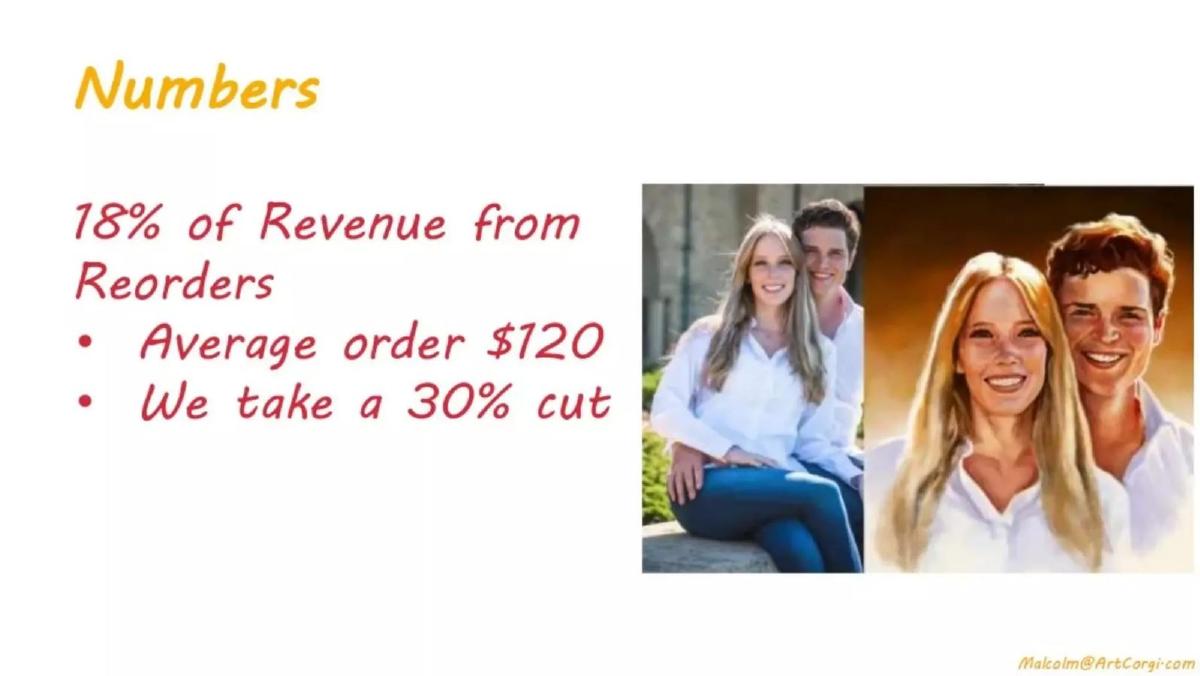
- ArtCorgi operates on a 30% take rate with an average order value of $120, as stated on slide 4.
- Retention is highlighted early, with 18% of revenue coming from reorders according to slide 4.
- The platform promises a predictable turnaround time of one week for custom commissions on slide 2.
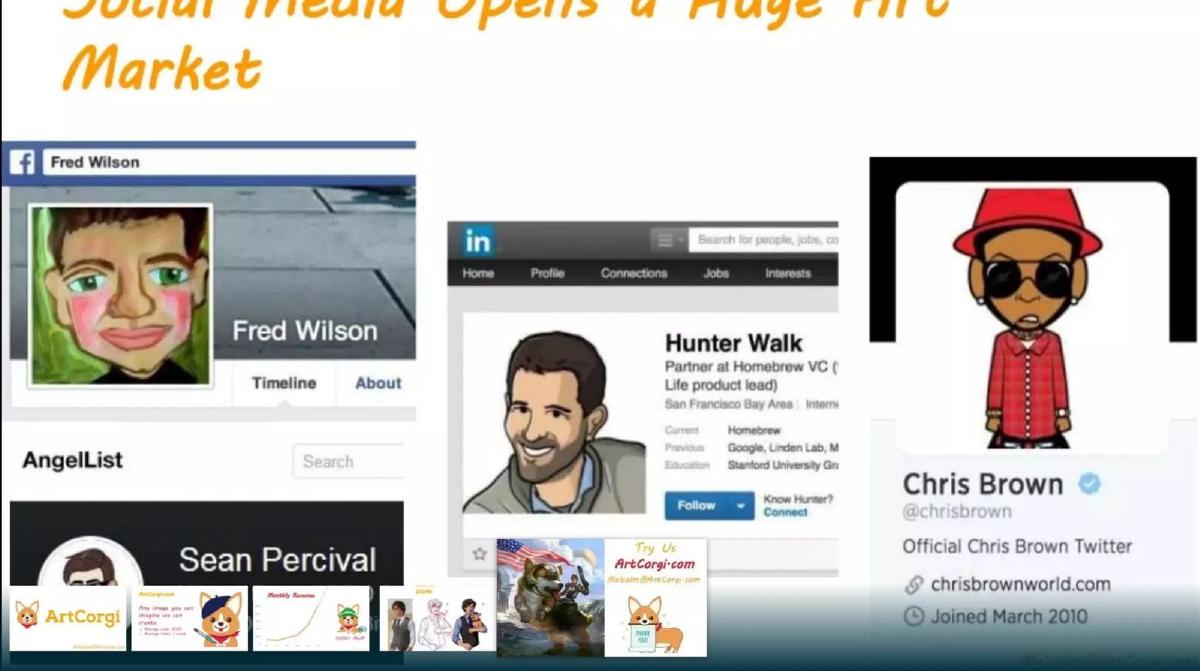
- Social proof is demonstrated on slide 6 by showing avatars used by Fred Wilson, Hunter Walk, and Chris Brown.
- The team slide (slide 8) emphasizes pedigree with two Stanford-affiliated founders and a COO from HubPages.
- The deck completely omits a formal 'Ask' slide, failing to specify the amount being raised or the intended use of funds.
- There is no slide dedicated to market size (TAM/SAM/SOM) or a competitive landscape analysis.
The ArtCorgi Seed Deck: A Study in Marketplace Traction
ArtCorgi’s 2013 seed deck is a lean, 9-slide presentation that focuses almost entirely on the 'what' and the 'how much' rather than the 'why.' At a time when the 'Uber for X' and 'Marketplace for Y' trends were reaching their peak, ArtCorgi sought to professionalize the notoriously fragmented world of custom art commissions. By standardizing prices and timelines, they aimed to turn a luxury service into a repeatable consumer product. The deck, which helped secure $200,000, relies heavily on visual evidence and rapid growth figures to tell its story.
Slides 1-2: The Hook and Value Proposition
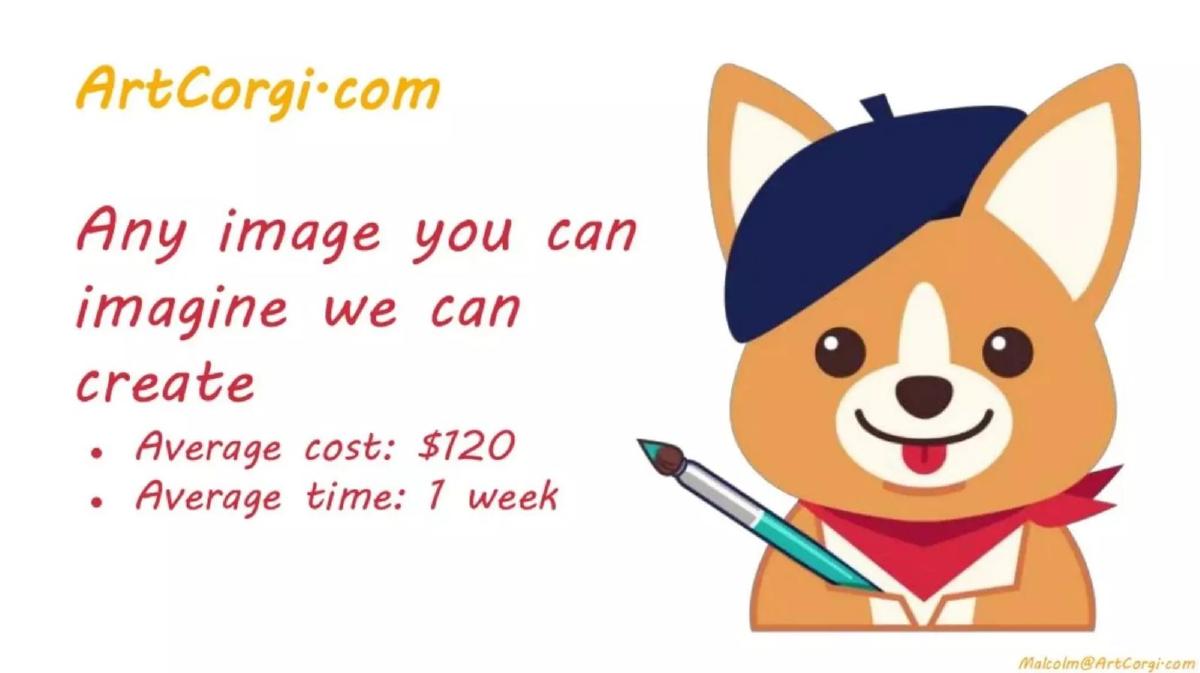
The deck opens with a simple title slide featuring the company logo—a corgi wearing a red bandana. There is no tagline here, only the CEO's email address. This minimalist approach continues into Slide 2 , which serves as the executive summary. The slide states, "Any image you can imagine we can create." It immediately addresses the two biggest pain points in the commission world: cost and time. It lists an "Average cost: $120" and an "Average time: 1 week." By putting these numbers on the second slide, ArtCorgi is positioning itself not as a high-end gallery, but as a high-velocity service provider.
Slides 3-4: The Growth and Unit Economics
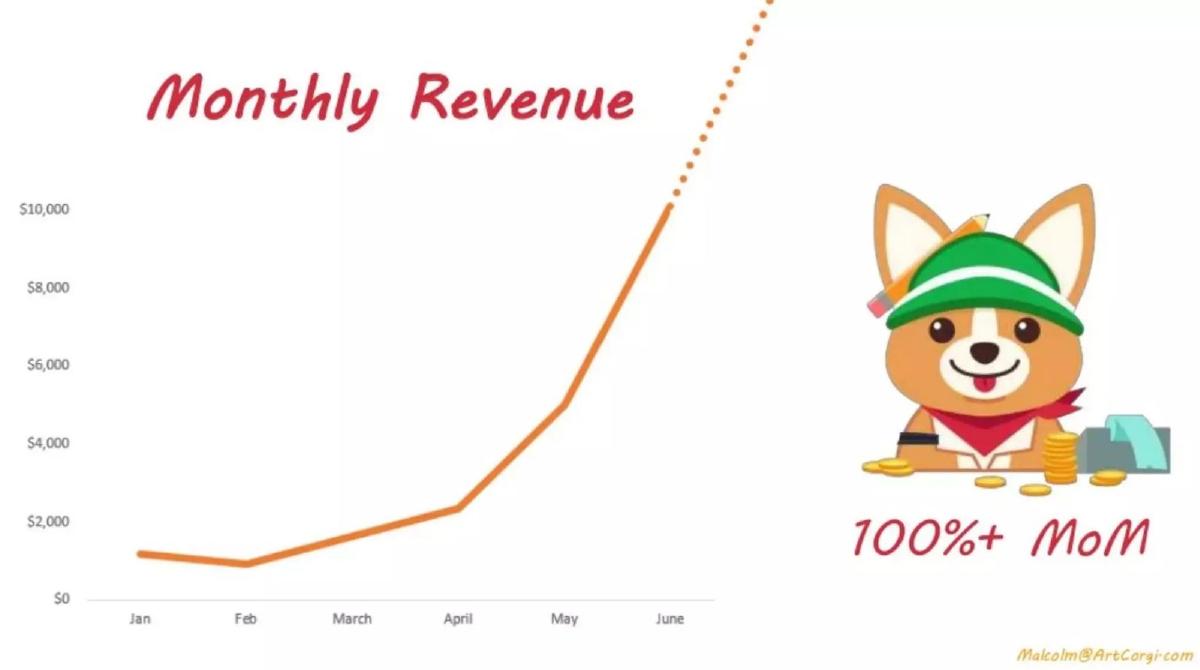
Slide 3 is the 'Traction' slide, and it is the strongest part of the deck. It features a line graph showing monthly revenue from January to June. While the Y-axis starts at $0 and peaks just above $10,000, the trajectory is nearly vertical in the final two months. The slide explicitly claims "100%+ MoM" growth. For a seed-stage company, showing that you have moved from $1,000 to $10,000 in monthly revenue in half a year is a powerful signal of early product-market fit.
Slide 4 , titled "Numbers," dives into the unit economics. It highlights that "18% of Revenue from Reorders," which suggests a level of customer loyalty and product quality that prevents the marketplace from being a 'one-and-done' experience. It reiterates the "Average order $120" and reveals the business model: "We take a 30% cut." This 30% take rate is standard for digital marketplaces (similar to the Apple App Store or Etsy at the time), signaling to investors that the margins are healthy enough to support scaling.
Slides 5-7: Product Process and Social Proof
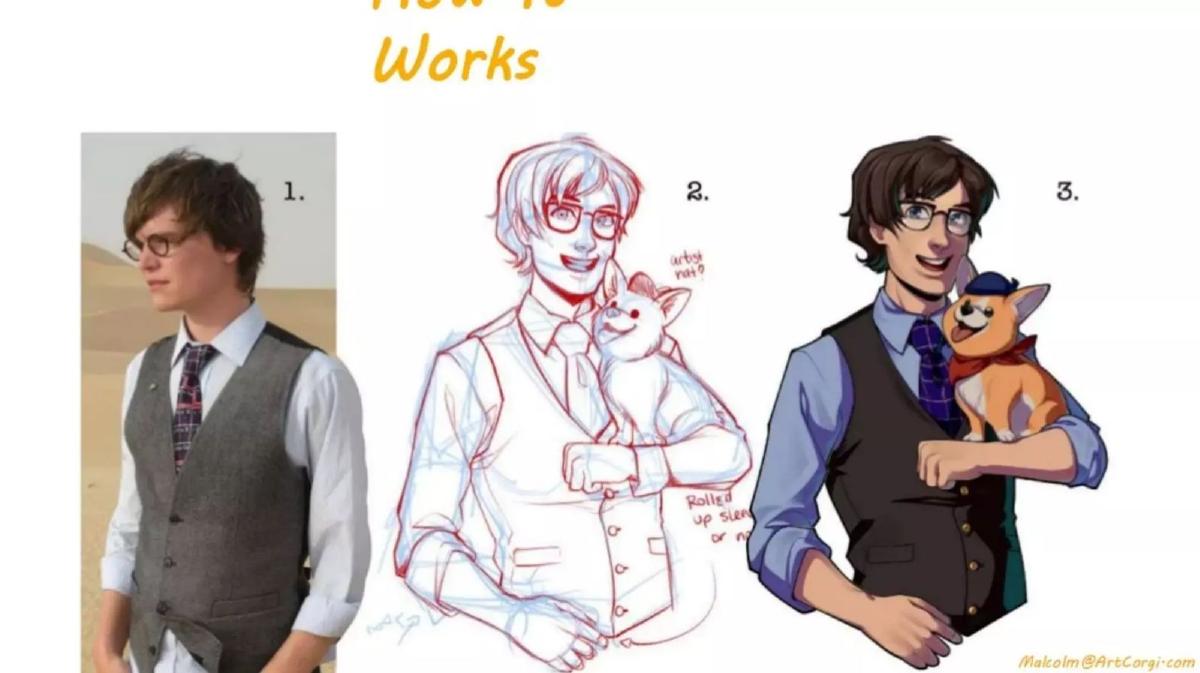
Slide 5 explains the user experience through a visual "How it Works" diagram. It shows three stages: 1. A reference photo of a person, 2. A rough sketch (with notes like "artist hat?"), and 3. The final polished illustration. This demystifies the commission process, showing that the platform manages the workflow between the client's vision and the artist's execution.
Slide 6 addresses the 'Market' through the lens of social media. Titled "Social Media Opens a Huge Art Market," it shows screenshots of profile pages for Fred Wilson (AVC), Hunter Walk (Homebrew), Sean Percival , and Chris Brown . Each of these individuals is shown using a custom-illustrated avatar. This is a clever way to demonstrate a 'use case' without needing a complex market analysis slide. It suggests that every social media user is a potential customer for a digital portrait.
Slide 7 pivots to the gifting market, claiming "Commissioned Art is the Perfect Gift." It lists three attributes: Personal, Memorable, and "They will share it." The last point is crucial for a low-CAC (Customer Acquisition Cost) strategy, as it implies built-in virality when recipients post their gifts online.
Slides 8-9: The Team and Closing
Slide 8 introduces the founders. The team has strong academic and professional credentials. CEO Malcolm Collins is noted as being from Stanford GSB and mentions a viral story about proposing to his fiancée using art commissions—a personal anecdote that explains his motivation for starting the company. COO Simone Smith brings marketing experience from HubPages , and CTO Eugenia O’Kelly provides the technical backbone with a Stanford CS degree. The slide also features logos for 500 Startups and Stanford Graduate School of Business , anchoring the company in a reputable ecosystem.
The deck concludes with Slide 9 , a "Thank You" slide that features a high-fidelity illustration of a corgi in sci-fi armor. It provides the website and contact email again but, notably, does not include a call to action or a specific funding request.
What ArtCorgi Got Right
Clarity of Economics: By stating the average order value ($120) and the take rate (30%) early, the founders removed any ambiguity about how the business makes money. · Visual Proof: The deck uses the actual product (illustrations) to decorate the slides. This serves as a constant portfolio of what the marketplace can produce, proving the quality of the artist supply. · Traction Focus: The revenue graph on slide 3 is the centerpiece. In 2013, showing $10k in monthly revenue with 100% MoM growth was often enough to secure a $200k seed check. · Social Proof: Showing that respected VCs like Fred Wilson and Hunter Walk were using the product is a high-signal way to validate the concept to other investors.
What Is Missing from the ArtCorgi Deck
The Ask: There is no slide stating how much money is being raised, the valuation cap, or what the milestones for the next 18 months look like. · Market Size (TAM): The deck assumes the investor understands the market is "huge" based on social media screenshots, but it lacks any hard data on the total addressable market for custom art or gifting. · Competition: There is no mention of Fiverr, Etsy, or DeviantArt. Investors generally want to see how a startup plans to defend its niche against larger, established horizontal marketplaces. · Artist Side Economics: While we see the consumer side, the deck doesn't explain how they recruit artists, what the artist churn looks like, or how they ensure the artists are paid fairly while the platform takes 30%.
Founder's Playbook: What to Copy
The 'How it Works' Visual: Slide 5 is a perfect example of how to explain a service-based marketplace. Don't use text; use a three-step visual progression. · Pedigree and Passion: The team slide successfully balances 'hard' credentials (Stanford) with a 'soft' origin story (the viral proposal). This makes the founders seem both capable and uniquely motivated. · Standardizing the Unstandardized: If you are building a marketplace for a fragmented service, follow ArtCorgi's lead on Slide 2. Define the price and define the timeline immediately. Predictability is a product feature. · Leveraging Influencer Users: If high-profile people use your product, even if they aren't 'official' partners, showing their profiles (as seen on Slide 6) is the most efficient way to build credibility in a short deck.
Frequently asked questions
- What was the primary growth metric used in the ArtCorgi deck?
- The primary growth metric was monthly revenue, which showed a steep upward curve from January to June. Slide 3 explicitly claims '100%+ MoM' (Month-over-Month) growth. This focus on top-line revenue growth is typical for early-stage marketplaces trying to prove that there is sufficient demand to justify a seed investment.
- How does ArtCorgi monetize its marketplace?
- According to slide 4, ArtCorgi monetizes through a transaction fee model. They take a 30% cut of every order. With an average order value of $120, the platform nets approximately $36 per transaction. This transparent take rate helps investors quickly calculate the potential margins and scalability of the business model.
- Who were the key team members at the time of the raise?
- The team consisted of CEO Malcolm Collins (Stanford GSB), COO Simone Smith (formerly Director of Marketing at HubPages), and CTO Eugenia O’Kelly (Stanford CS and D-School). The team slide also mentions support from 500 Startups and the Stanford Graduate School of Business, providing significant institutional credibility to the founding group.
- What is missing from this pitch deck that modern founders should include?
- The deck is missing several critical components: a clear 'Ask' (how much money they want), a 'Use of Funds' breakdown, a 'Market Size' slide (TAM), and a 'Competition' slide. In today's more crowded market, investors usually require a deeper dive into the competitive moat and the total addressable market beyond just social media avatars.
- How did the deck demonstrate product-market fit?
- ArtCorgi demonstrated product-market fit through two main avenues: financial data and social proof. Financially, they showed that 18% of revenue came from reorders (slide 4). Socially, they showcased that prominent venture capitalists and celebrities were already using the service to create their digital identities on platforms like Twitter and LinkedIn (slide 6).