Artisan’s 22-slide deck is a masterclass in narrative-driven fundraising, focusing on the transition from software-as-a-tool to software-as-a-worker. By positioning their AI 'Artisans' as colleagues rather than chatbots, the company successfully raised $11.5M from a heavy-hitting roster of investors including Y Combinator and HubSpot Ventures. The deck leans heavily on the 'why now' of the AI revolution, contrasting the high cost of human labor ($7,000 for 1,000 prospects) against the efficiency of their AI agents ($250 for the same task). While the deck is light on historical traction and la…
Key takeaways
- The deck positions AI agents as 'Digital Workers' that can be onboarded in 5-10 minutes via chat (Slide 11).
- Artisan claims their agents can reduce the cost of contacting 1,000 prospects from $7,000 to just $250 (Slide 15).
- The business model includes a 30% commission on agent subscriptions sold through their planned marketplace (Slide 13).
- The product roadmap outlines a transition to a custom LLM model by January 2024 (Slide 17).
- Artisan aims to replace existing SaaS giants like HubSpot, Salesforce, and Calendly by building native features into their agents' dashboards (Slide 12).
- The deck identifies the total US labor market for their target roles at over $10 trillion (Slide 19).
- The fundraising ask on Slide 20 was for a $2-4M Pre-Seed round, though the company eventually raised $11.5M for its Seed round in 2024.
- The competitive landscape slide claims Artisan is the only player offering integrated call functionality and Slack/Teams chat capabilities (Slide 16).
The Vision: From Software to Staff
Artisan’s pitch deck is a bold declaration of the end of the SaaS era as we know it. Instead of selling tools that humans use to work, Artisan sells the work itself. This 22-slide presentation, used to secure an $11.5M Seed round in 2024, focuses on the concept of "Digital Workers"—AI agents that act as autonomous employees rather than passive software interfaces.
Slides 1-4: Defining the Digital Worker
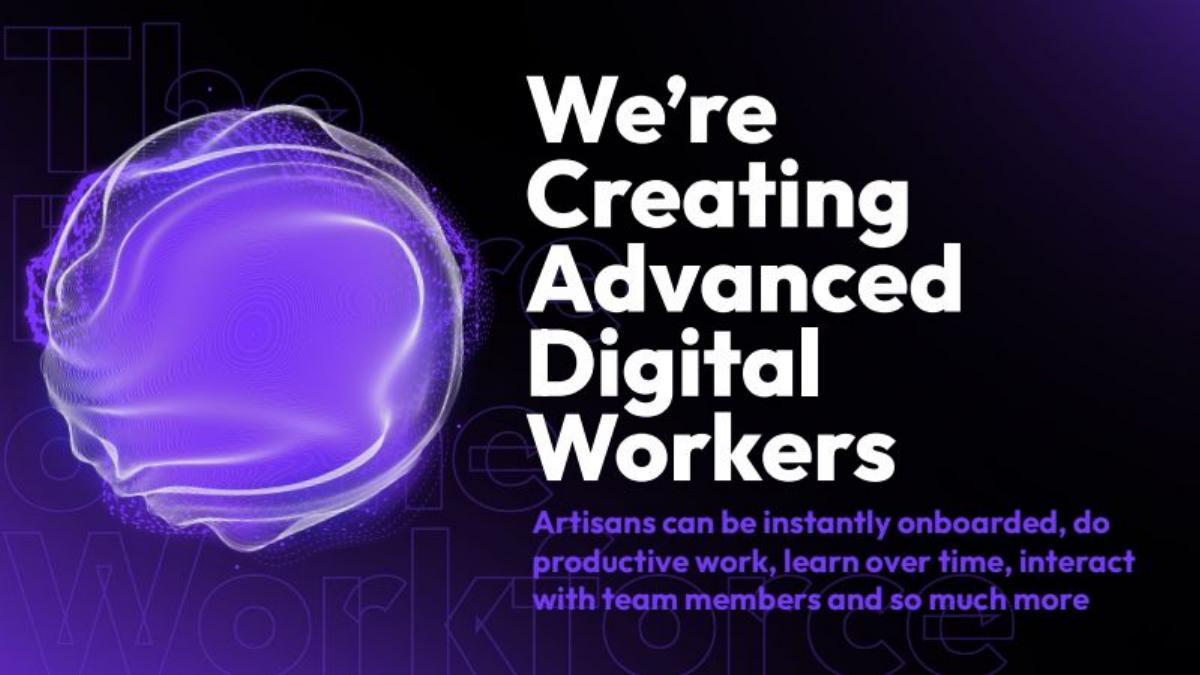
The deck opens with a high-concept visual of a glowing sphere, immediately setting a futuristic tone. Slide 2 introduces the core mission: "We’re Creating Advanced Digital Workers." The emphasis here is on the human-like qualities of the product—onboarding, productivity, and learning over time.
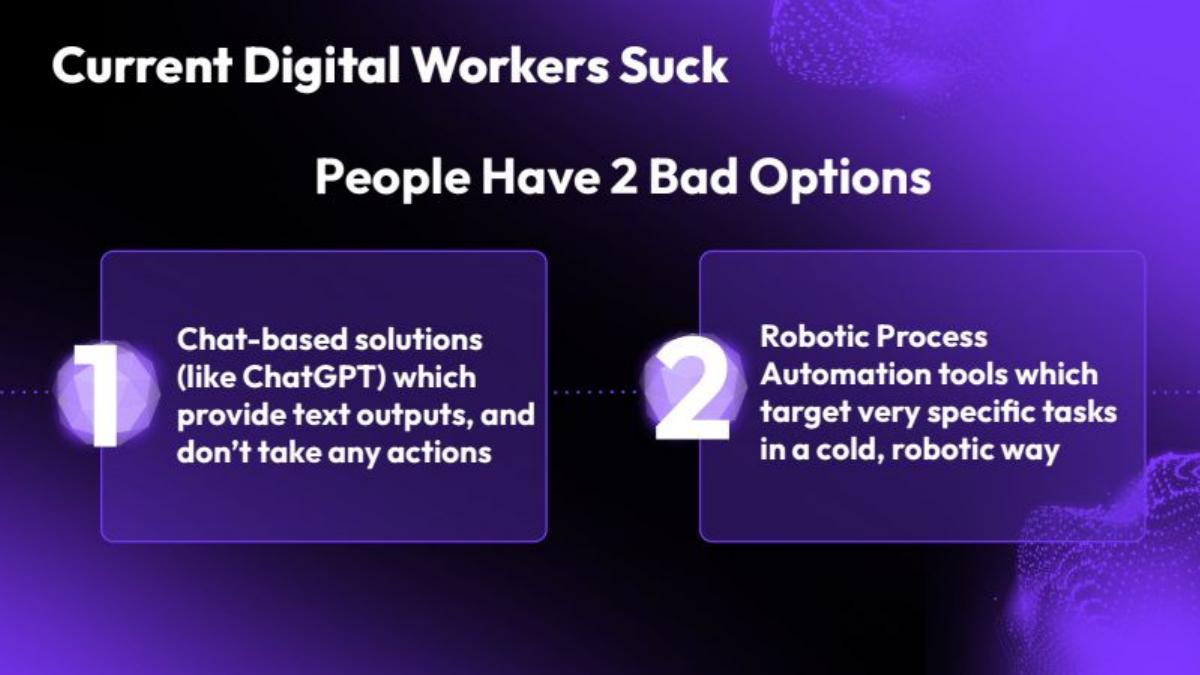
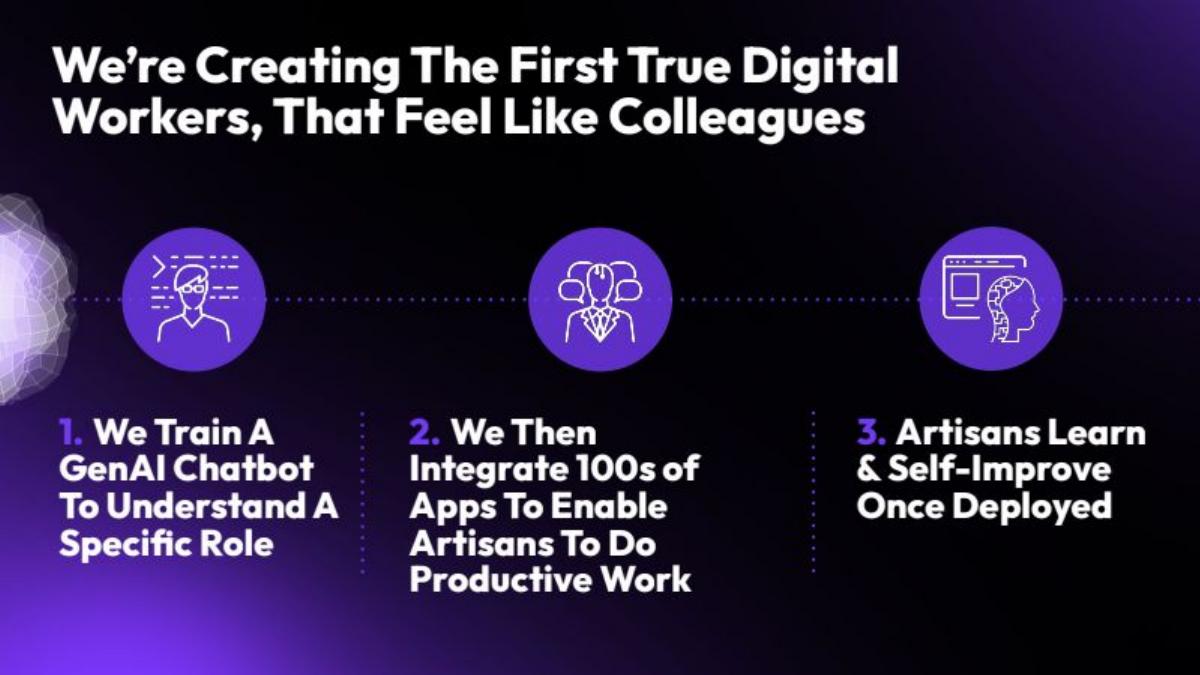
Slide 3 takes a direct shot at the current state of AI, stating that "Current Digital Workers Suck." They categorize the competition into two "bad options": chat-based solutions like ChatGPT that don't take action, and Robotic Process Automation (RPA) tools that are too rigid and "robotic." This sets the stage for Slide 4 , where Artisan claims to create the "First True Digital Workers" that "Feel Like Colleagues." The three-step process outlined involves training a GenAI chatbot for a specific role, integrating hundreds of apps, and allowing the agent to self-improve post-deployment.
Slides 5-7: The User Experience
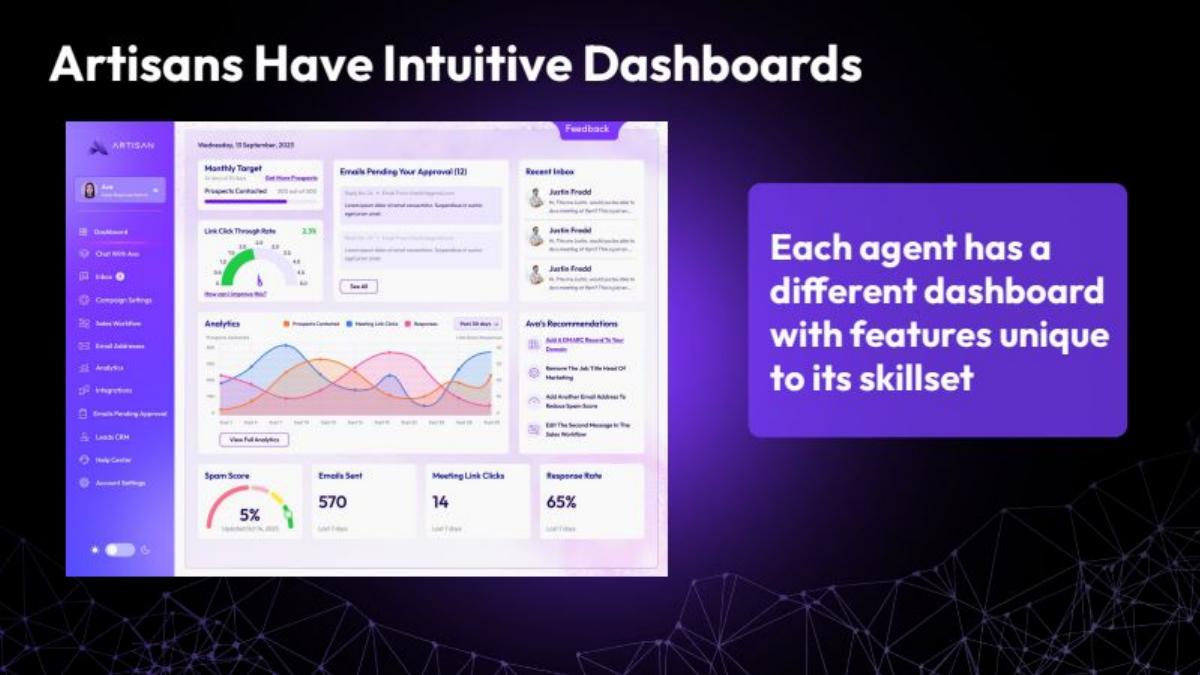
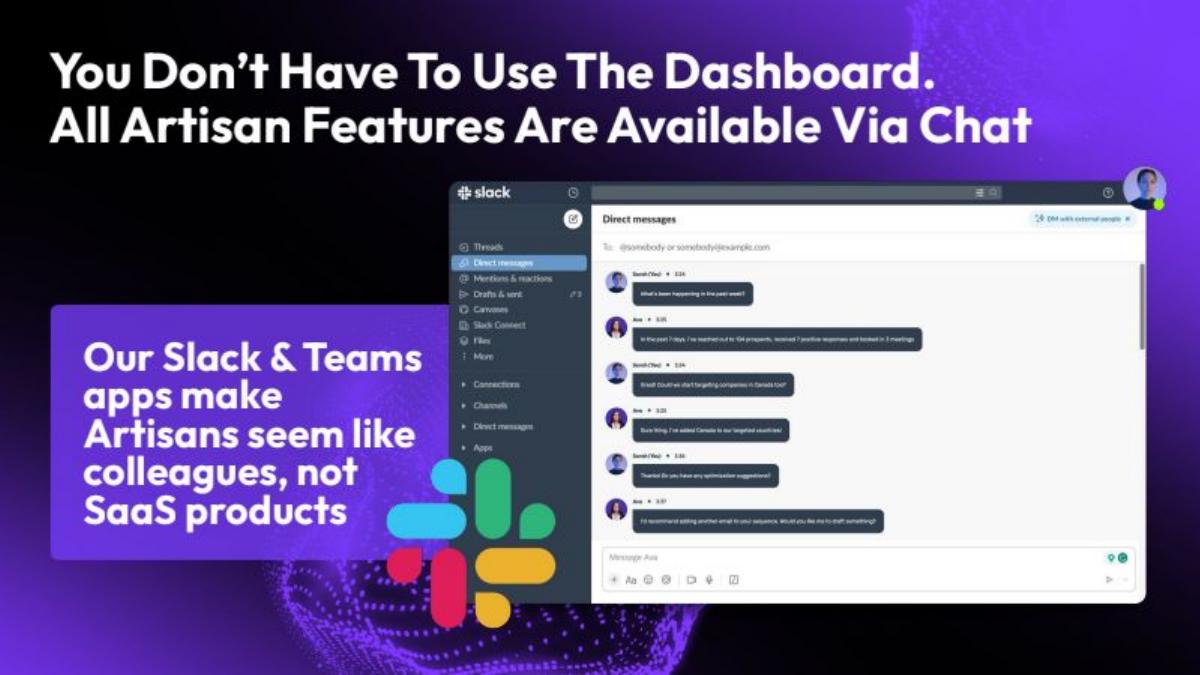
Artisan understands that for an AI to feel like a colleague, it needs a familiar interface. Slide 5 shows a comprehensive dashboard featuring metrics like "Prospects Contacted," "Email Click Through Rate," and "Response Rate." Interestingly, Slide 6 pivots to state that users don't actually have to use the dashboard. By integrating with Slack and Microsoft Teams, the agents can be managed entirely through chat, reinforcing the "colleague" metaphor.
Slide 7 pushes this further, claiming that "Artisans Seem Human." They give each agent a unique face, name, and memory. The deck suggests these agents will analyze group chats and feedback to "evolve" and understand a company's specific way of working.
Slides 8-10: Capabilities and Scalability
Slide 8 explains the two-tier improvement system: individual agent learning from user feedback and systemwide updates from Artisan’s core team. Slide 9 introduces a more speculative feature: video calling with agents. It claims the system uses sentiment detection and facial recognition to improve agent responses, though it doesn't specify if this is currently live or a future goal.
Slide 10 presents the "Product Roadmap" for agents, listing roles from Executive Assistant and Graphic Designer to Chief Financial Officer and Investment Banking Analyst. This slide is designed to show the breadth of the platform's potential beyond simple sales automation.
Slides 11-13: The Go-To-Market and Platform Play
Slide 11 introduces "Ava," the Sales Rep Artisan. This is the company's flagship product. The slide notes that Ava was set for private beta in November 2023 and can "onboard herself after a 5-10 minute chat conversation."
Slide 12 is perhaps the most aggressive in the deck. It explicitly states that Artisan is "Replacing The Need For SaaS Products," listing logos for Leadfeeder, HubSpot, Salesloft, Chili Piper, and Calendly. The strategy is to build a suite of features that makes these multi-billion dollar companies "redundant."
Slide 13 reveals the long-term business model: becoming the "App Store For AI Agents." Artisan plans to allow third-party developers to build agents on their platform, with Artisan taking a 30% commission on subscriptions. This is a classic platform play designed to appeal to VCs looking for network effects and high-margin recurring revenue.
Slides 14-16: The Economic Argument
Slide 14 lists the benefits of digital workers: 24/7 availability, lower cost, 0% churn, and no burnout. Slide 15 puts numbers to these claims, comparing the $7,000 cost of a human sales rep to the $250 cost of an Artisan agent for contacting 1,000 prospects. The speed comparison is equally stark: 2 hours for a human to send 100 emails versus 30 seconds for the AI.
Slide 16 is the competitive landscape. Artisan compares itself to ChatGPT, Adept, and UiPath. Naturally, Artisan checks every box, including "Call Functionality" and "Moulds To User," which they claim the others lack.
Slides 17-19: Roadmap and Market Size
Slide 17 provides a chronological product roadmap from November 2023 to July 2024. Key milestones include a transition to a "Custom LLM Model" in January 2024 and the launch of the "Agent App Store" beta in July 2024. Slide 18 discusses the "Moat," citing data gravity, viral loops, and the fact that agents created on the platform cannot be transferred elsewhere.
Slide 19 addresses the Total Addressable Market (TAM). Artisan frames the market as "Labor," which they value at over $10 Trillion . They break this down into specific US segments: $7bn for copywriters, $21bn for marketing managers, and $154bn for B2B sales reps.
Slides 20-22: The Ask
Slide 20 outlines the "Fundraising Roadmap." At the time of this deck, they were seeking a $2-4M Pre-Seed round to build the founding team and release three Artisans. The slide also mentions future Series A and Series B rounds with "TBC" (To Be Confirmed) amounts. The deck concludes with Slide 21 , a simple call to action: "We’re Raising Capital To Lead The Next Industrial Revolution."
What Works in This Deck
Strong Narrative: The deck doesn't just sell a tool; it sells a paradigm shift. The transition from "SaaS" to "Digital Workers" is a compelling story for investors. · Clear Comparison: The cost-benefit analysis on Slide 15 is simple, punchy, and provides a clear ROI for potential customers. · Platform Ambition: Moving from a single agent (Ava) to an App Store model shows that the founders are thinking about how to build a venture-scale ecosystem, not just a point solution. · Visual Consistency: The dark, purple-hued aesthetic feels modern and aligned with the "AI-first" branding.
What Is Missing or Weak
No Team Slide: In a Seed round, the team is often the most important factor. This deck completely omits the backgrounds of the founders, which is a significant gap. · Lack of Traction Data: While the deck mentions a private beta, there are no hard numbers on current users, waitlist size, or early pilot results. · High Execution Risk: The claim to replace HubSpot, Salesforce, and Calendly simultaneously is incredibly ambitious. The deck doesn't go into detail on how they will achieve feature parity with these deeply entrenched incumbents. · Custom LLM Justification: Slide 17 mentions a transition to a custom LLM, but doesn't explain why this is necessary or how they will fund the immense R&D costs associated with proprietary model development.
Founder Takeaways: What to Copy
The "Why Now" Slide: Artisan does a great job of explaining why previous automation (RPA) failed and why GenAI makes their vision possible today. · Role-Based Positioning: Instead of selling "AI for sales," they sell "Ava, the Sales Rep." Giving the AI a persona makes the product more tangible and easier to understand. · Aggressive Moat Building: Identifying early on that data and platform lock-in (Slide 18) are your primary defenses against big tech is a smart move for any AI startup. · The "Industrial Revolution" Framing: Using big, historical metaphors helps investors see the potential for a 100x return, which is what Seed-stage VCs are looking for.
Frequently asked questions
- What is the core value proposition of Artisan?
- Artisan moves beyond simple AI chatbots to create 'Digital Workers' that act as autonomous colleagues. These agents, such as 'Ava' the Sales Rep, are designed to integrate into existing workflows like Slack and Teams, perform complex tasks like outbound marketing at scale, and self-improve over time based on user feedback.
- How does Artisan plan to compete with established SaaS companies?
- Rather than just integrating with existing tools, Artisan intends to replace them. Slide 12 explicitly lists HubSpot, Salesloft, and Calendly as products they aim to make redundant by building equivalent features directly into the Artisan platform, creating an all-in-one ecosystem for digital labor.
- What is the 'Artisan App Store' mentioned in the deck?
- Artisan plans to move from a single-product company to a platform. Their roadmap includes a marketplace where third-party developers can build and sell their own AI agents using Artisan’s proprietary data and feature sets. Artisan intends to take a 30% cut of these subscriptions, mimicking the Apple App Store model.
- What are the key metrics used to justify the AI transition?
- The deck focuses on cost and speed efficiency. It highlights that a human sales rep takes 2 hours to send 100 emails, whereas an Artisan agent takes 30 seconds. Financially, it pits a $7,000 human labor cost against a $250 AI cost for reaching 1,000 prospects, representing a massive margin improvement for customers.
- What is missing from the Artisan pitch deck?
- The deck is notably missing a team slide, which is unusual for a Seed round. It also lacks a detailed breakdown of current traction, such as Monthly Recurring Revenue (MRR) or specific pilot customer names, focusing instead on the future roadmap and the theoretical 'superhuman' capabilities of the agents.