ArtiE is a voice development platform that aims to lower the barrier to entry for creating voice-activated enterprise software. The deck positions the company as a 'Voice development platform for Dummies,' emphasizing ease of use and cross-device deployment capabilities. The startup targets a range of customers, from marketing departments to individual software developers, with a tiered revenue model based on usage and features. While the deck provides a clear vision and specific financial terms for its $750K bridge round, it relies heavily on external links for traction data and uses generic…
Key takeaways
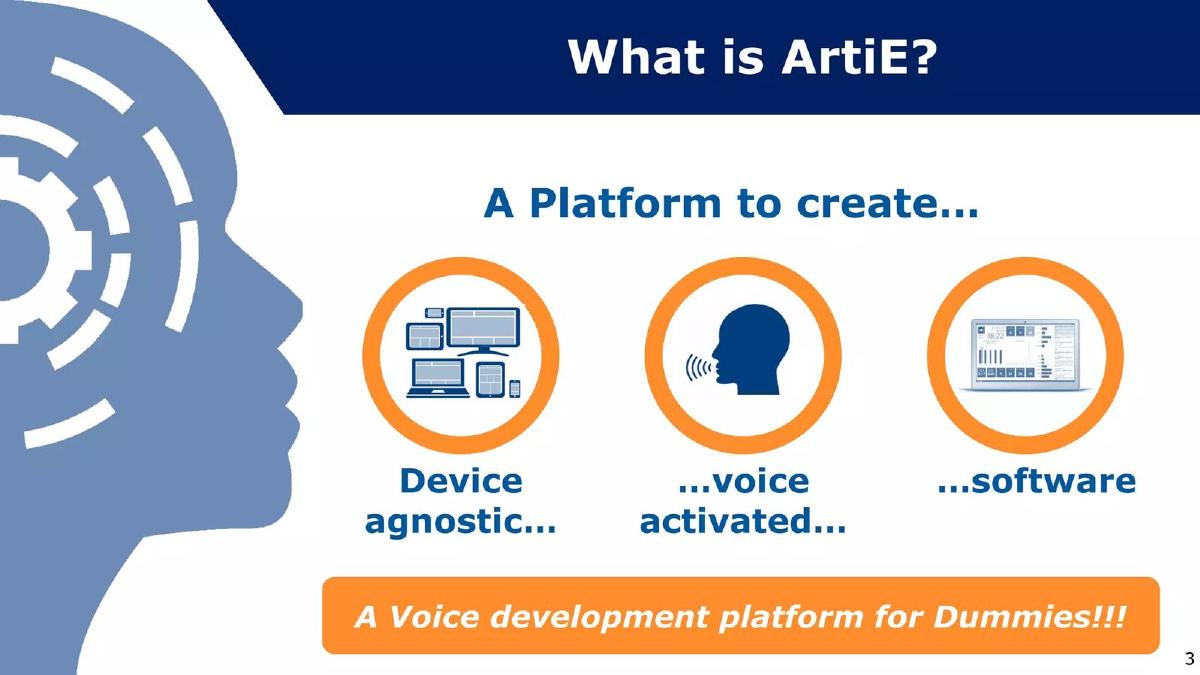
- The platform is designed to be device-agnostic and voice-activated, described as a 'Voice development platform for Dummies' on slide 3.
- ArtiE targets a $30 Billion market initially through marketing and sales products like VoiceWeb and VoiceDisplay (slide 7).
- The solution claims to be 10x more productive than existing NLU APIs by including database, UI, and middleware layers (slides 11 and 19).
- Founder Stephen Mallik brings 20 years of industry experience and a core team of 4 engineers (slide 13).
- The revenue model is tiered: $360 ARPC for website use, $2,400 for mobile apps, and $50,000 for enterprise clients (slide 25).
- Market opportunity is framed by a $6T worldwide IoT market and a $300B SaaS market (slides 27 and 29).
- The current ask is $750K via a convertible note with an 8% coupon and a 20% discount (slide 33).
- The deck omits specific traction metrics, instead directing investors to a password-protected URL (slide 31).
Deck Overview and Visual Style
The ArtiE pitch deck consists of 36 slides (18 provided for this teardown) and utilizes a high-contrast blue and orange color palette. The visual style relies heavily on clip-art style illustrations and simple diagrams. The messaging is direct, often using bold headers to define the company's purpose and market position. The deck follows a standard narrative arc: problem, solution, market size, team, and the financial ask.
Slide 1: Title Slide
The cover slide introduces 'ArtiE – Artificial Intelligence for the enterprise.' It features the CEO's name, Stephen Mallik, and logos for Tech Alpharetta, ATDC Georgia Tech, and Nearsoft DojoLIVE!, suggesting affiliation with these incubators or media platforms. The imagery of a human head with circuit patterns reinforces the AI theme.
Slide 3: What is ArtiE?
This slide defines the product as a platform to create device-agnostic, voice-activated software. The most notable element is the orange call-out box at the bottom: 'A Voice development platform for Dummies!!!' This positioning emphasizes ease of use as the primary differentiator, targeting non-specialist developers or business units.
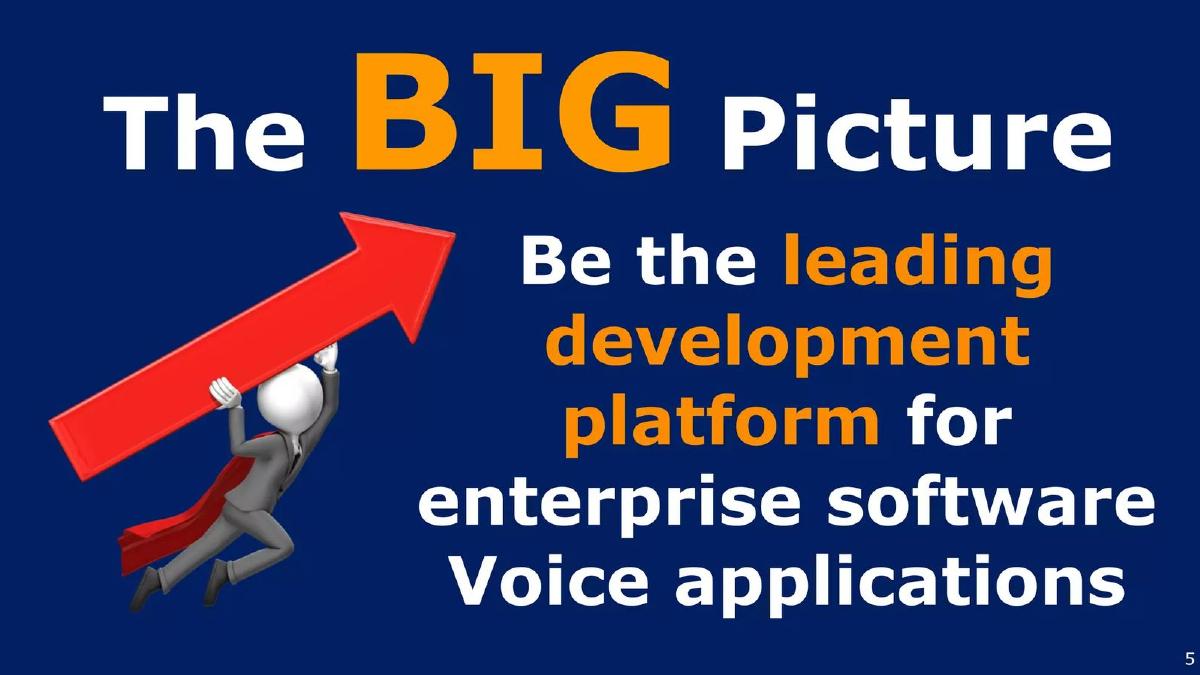
Slide 5: The BIG Picture
A high-level vision slide stating the goal: 'Be the leading development platform for enterprise software Voice applications.' The slide uses a generic 3D character graphic to illustrate growth, focusing on the long-term ambition rather than immediate technical milestones.
Slide 7: The Opportunity & Great Timing - Initial Target
ArtiE identifies three initial segments: Marketing/Sales departments (via products named VoiceWeb, VoiceDisplay, and VoiceSlides), software consulting companies, and Cloud/SaaS companies. It mentions a '$30 Billion market' for the marketing segment but does not provide a source or specific breakdown for this figure.
Slide 9: The Opportunity & Great Timing - Final Target
The long-term strategy involves targeting IT departments that are beginning to allocate funds for AI projects. It also positions ArtiE as a career-advancement tool for 'Millions of software developers wanting to become AI developers,' suggesting that having ArtiE on a resume will be a value-add for engineers.
Slide 11: Our Solution
This slide lists the core technical benefits of the platform. Key claims include: 'Develop once and deploy natively on all devices,' 'Code using English,' and being '10x productive' compared to other solutions. It emphasizes that the platform is cloud-based and reduces the learning curve for professional enterprise applications.
Slide 13: Team - Stephen Mallik
The team slide focuses exclusively on the Founder & CEO. It highlights 20 years of industry experience, previous startup success, and the fact that the company is currently self-funded. It mentions a 'strong core team following of 4 engineers' but does not name them or provide their backgrounds.
Slide 15: Advisors
Two advisors are listed: Oneal Bhambani (Cabbage Board, Investor, Entrepreneur) and Lalit Joshi (Ex President NIIT Technologies). The use of generic icons for the advisors instead of photos is a notable stylistic choice.
Slide 17: Partners
This slide lists four partners categorized by their role: AnalyticsWise (Business development/co-marketing), Convergent (JV partner – Signage), Tech Alpharetta (Branding), and Nearsoft (Outsourcing partner). This provides context on how the company handles its go-to-market and technical execution.
Slide 19: Current Available Solutions
ArtiE critiques existing NLU (Natural Language Understanding) APIs. The slide argues that these APIs are incomplete because they do not include the database, UI, or middleware. It claims that existing solutions require 'high end engineers' and are 'too much R&D required,' setting the stage for ArtiE’s simplified approach.
Slide 21: Our Winning Solution
This is a purely conceptual slide using illustrations to represent success. It lacks text but serves as a visual transition between the problem/competitor analysis and the company's internal metrics.
Slide 23: Competitive Analysis
A standard 2x2 matrix places ArtiE in the top right quadrant. The Y-axis is 'Turnkey / user experience / ease of use' and the X-axis is 'Enterprise focus versatility Better, faster, cheaper.' Competitors are grouped into categories like 'Mobile App tools,' 'Website tools,' 'SaaS tools,' and 'NLU APIs,' rather than named individual companies.
Slide 25: Revenue Model
The deck provides specific Assumed Revenue Per Customer (ARPC) figures:
Website: $360 ARPC (1 user, 3 features) · Mobile app: $2,400 ARPC (20 users, 3 features) · Enterprise: $50,000 ARPC (Unlimited users/features)
This tiered approach shows a clear path from low-touch self-service to high-touch enterprise contracts.
Slide 27: Available Markets - IoT
The company cites a '$6T worldwide market for iot' with 20% expected yearly growth. It identifies a '$200B relevant market' via voice/mobile apps. These are very large, top-down figures that lack specific attribution or a bottom-up calculation of ArtiE's actual addressable portion.
Slide 29: Available Markets - SaaS
Similar to the IoT slide, this cites a '$300B worldwide market for SaaS' with 18.5% growth. It claims a '$110B relevant market' via cloud/mobile apps. Again, these figures represent the entire industry rather than the specific niche ArtiE occupies.
Slide 31: Traction
This slide is a placeholder. It directs investors to a website (artie.ai/traction) with a passcode (0101) to see 'upto date traction details' straight from their CRM. While this implies real-time data, it leaves the pitch deck itself devoid of proof of concept, user growth, or revenue milestones.
Slide 33: The Ask
The financial request is explicit: $750,000 via a convertible note. The terms include an 8% coupon and a 20% discount. It sets a valuation cap range between $4.25M and $20M. It also looks ahead to a $10M Series A at a $20M pre-money valuation.
Slide 35: Conclusion
The final slide summarizes the investment thesis: high exit multiple, unicorn possibility, cashflow positive potential, and a 'future proof' business model. It provides the CEO's contact information (Gmail address and phone number).
What Works
Clear Product Definition: The deck successfully explains what the product does in simple terms, avoiding overly dense technical jargon in the early slides. · Specific Financial Terms: Unlike many early-stage decks that remain vague about the 'Ask,' ArtiE provides exact figures for the note, including the coupon rate and discount. · Tiered Revenue Model: The breakdown on slide 25 shows that the founders have thought through different customer segments and how to monetize them at various scales. · Competitive Positioning: Slide 19 does a good job of explaining why a developer might choose a platform over a raw API, focusing on the 'missing pieces' like middleware and UI.
What is Missing
Internal Traction Data: By moving traction to an external link, the deck fails to build immediate credibility. Investors want to see at least a summary of growth or pilot programs within the slides. · Detailed Team Bios: Only the CEO is profiled. For a technical platform, the backgrounds of the '4 engineers' mentioned on slide 13 are critical to proving the team can actually build what they are promising. · Bottom-Up Market Analysis: The use of $6 trillion and $300 billion figures is too broad. The deck would be stronger if it calculated a Serviceable Obtainable Market (SOM) based on their specific ARPC and target customer count. · Case Studies or Demos: While the deck mentions products like 'VoiceWeb,' there are no screenshots or descriptions of actual use cases or successful deployments.
Founder Takeaways
Don't hide your traction. While a 'live' link to a CRM sounds innovative, it creates friction. A pitch deck should stand on its own. Include a summary slide with your key KPIs (users, revenue, growth rate) and use the external link for the deep-dive due diligence phase. Name your technical talent. If your value prop is a '10x productivity' engine, the pedigree of your engineering team is your most valuable asset. Listing '4 engineers' without names or previous accomplishments makes the technical claim harder to believe. Refine your market sizing. Investors are generally skeptical of 'trillion-dollar market' slides. Focus on the specific segment of the voice-AI market you can realistically capture in the next 3-5 years. Show, don't just tell. The deck uses many generic illustrations. Replacing some of these with actual product screenshots or a diagram of the 'English-based coding' interface would make the 'winning solution' feel more tangible.
Frequently asked questions
- What is the core value proposition of ArtiE?
- ArtiE positions itself as a fully integrated, cloud-based voice platform that allows developers to 'code using English.' According to slide 11, the platform enables users to develop once and deploy natively across browsers, mobile devices, Alexa, and Google Home. The primary goal is to make enterprise-class voice application development faster and cheaper, claiming a 10x productivity increase over traditional methods.
- Who are the primary target customers for this platform?
- The deck outlines a two-stage targeting strategy. The 'Initial Target' (slide 7) includes marketing and sales departments, software consulting firms, and Cloud/SaaS companies. The 'Final Target' (slide 9) expands to internal IT departments allocating budget for AI projects and the millions of software developers looking to add AI capabilities to their professional resumes.
- How does ArtiE differentiate itself from existing NLU APIs?
- Slide 19 argues that current Natural Language Understanding (NLU) APIs only address part of the problem, requiring high-end engineers and significant R&D. ArtiE claims to provide a 'winning solution' by including the database, UI, and middleware layers that APIs lack, thereby reducing the time and technical skill required to build a functional application.
- What are the financial terms of the current investment round?
- As stated on slide 33, ArtiE is seeking $750,000 to prepare for a future Series A. The investment is structured as a convertible note with an 8% coupon and a 20% discount. The note includes a minimum pre-money valuation cap of $4.25M and a maximum cap of $20M. The company also signals an intent to raise a $10M Series A at a $20M pre-money valuation later.
- What information is missing from the traction slide?
- Slide 31, titled 'Traction,' contains no actual data. Instead, it provides a URL (artie.ai/traction) and a passcode (0101) for investors to view live details from the company's CRM. While this suggests transparency, it prevents the deck from standing alone as a persuasive document and forces the investor to take an extra step to see growth metrics, churn, or user numbers.