Doido is a Munich-based service marketplace designed to help busy professionals and expatriates delegate domestic and professional tasks. The deck positions the company as a localized alternative to TaskRabbit and Elance, specifically targeting the 22.1 billion Euro German online temporary labor market. With early validation from the Wayra accelerator and a reported 1,792 Euro in tasks delegated with zero marketing spend, the company emphasizes its 'intelligent matching algorithm' and verified user base. While the deck excels at defining the user persona and the friction of existing search me…
Key takeaways
- The company targets the 160 billion Euro European temporary labor market, with a specific focus on the 22.1 billion Euro German online segment (Slide 15).
- Doido differentiates itself from competitors like TaskRabbit and eBay Kleinanzeigen through a combination of local transactions, review checks, and an intelligent matching algorithm (Slide 16).
- Early traction includes 1,792 Euro in tasks delegated by November 2014 with 0 Euro spent on marketing (Slide 17).
- The platform identifies 'Expatriates/Immigrants' and 'Tech-savvy people' as verified delegator segments (Slide 18).
- The product workflow focuses on a natural language input where users describe a task and receive an instant estimated price, such as 35-65 Euro for flat cleaning (Slide 13).
- The company has secured institutional validation through the Wayra accelerator program (Slide 17).
- The deck identifies a specific pain point in the 'fragmented' search process, showing the difficulty of finding movers via Google, Gelbe Seiten, and eBay (Slides 6-7).
- Doido is expanding beyond domestic tasks into B2B services, evidenced by a Telefonica-branded personal assistant mockup for customer interviews (Slide 14).
Slide-by-Slide Analysis
The Hook and the Persona (Slides 1-5)
Slide 1: The title slide introduces the brand 'doido' with the tagline 'Delegate. EVERYTHING.' The minimalist design uses a high-contrast red background, signaling a consumer-facing brand.
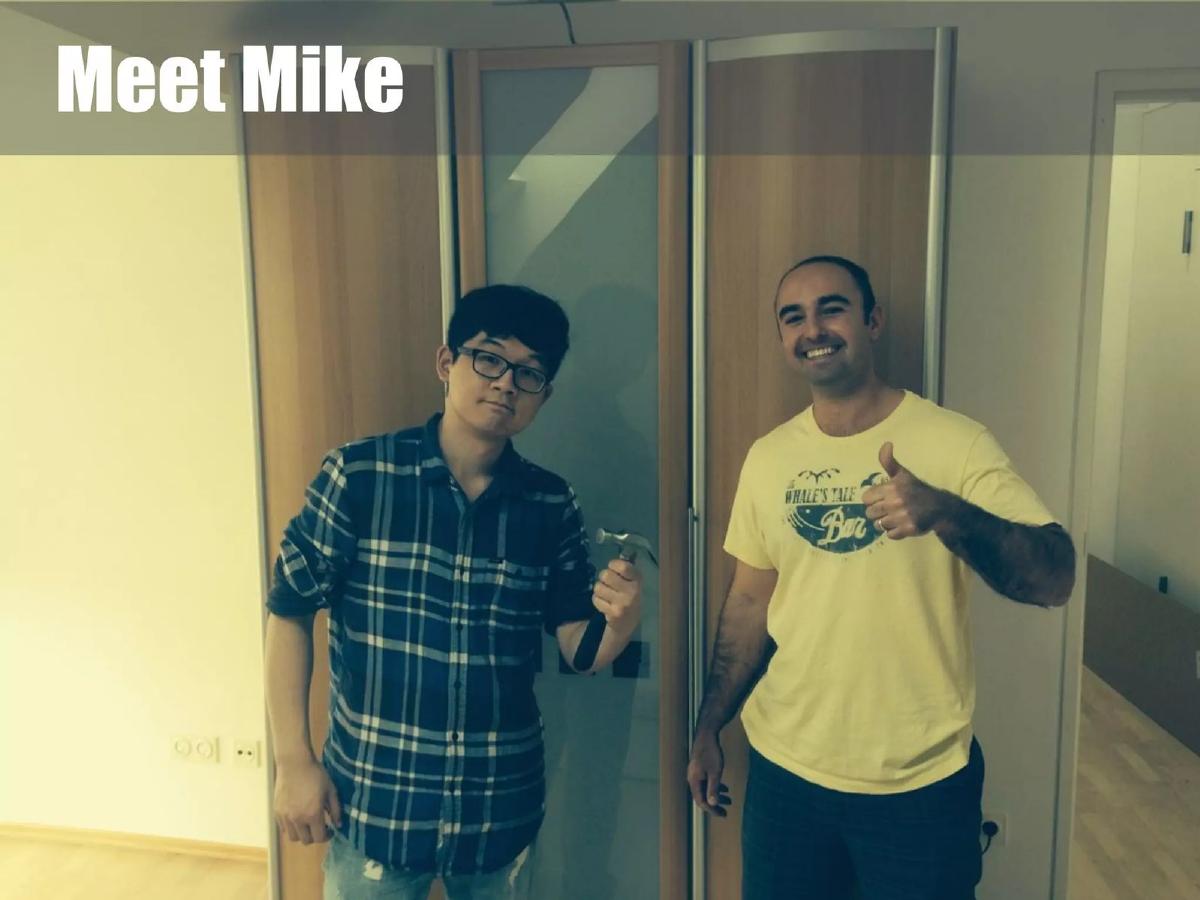
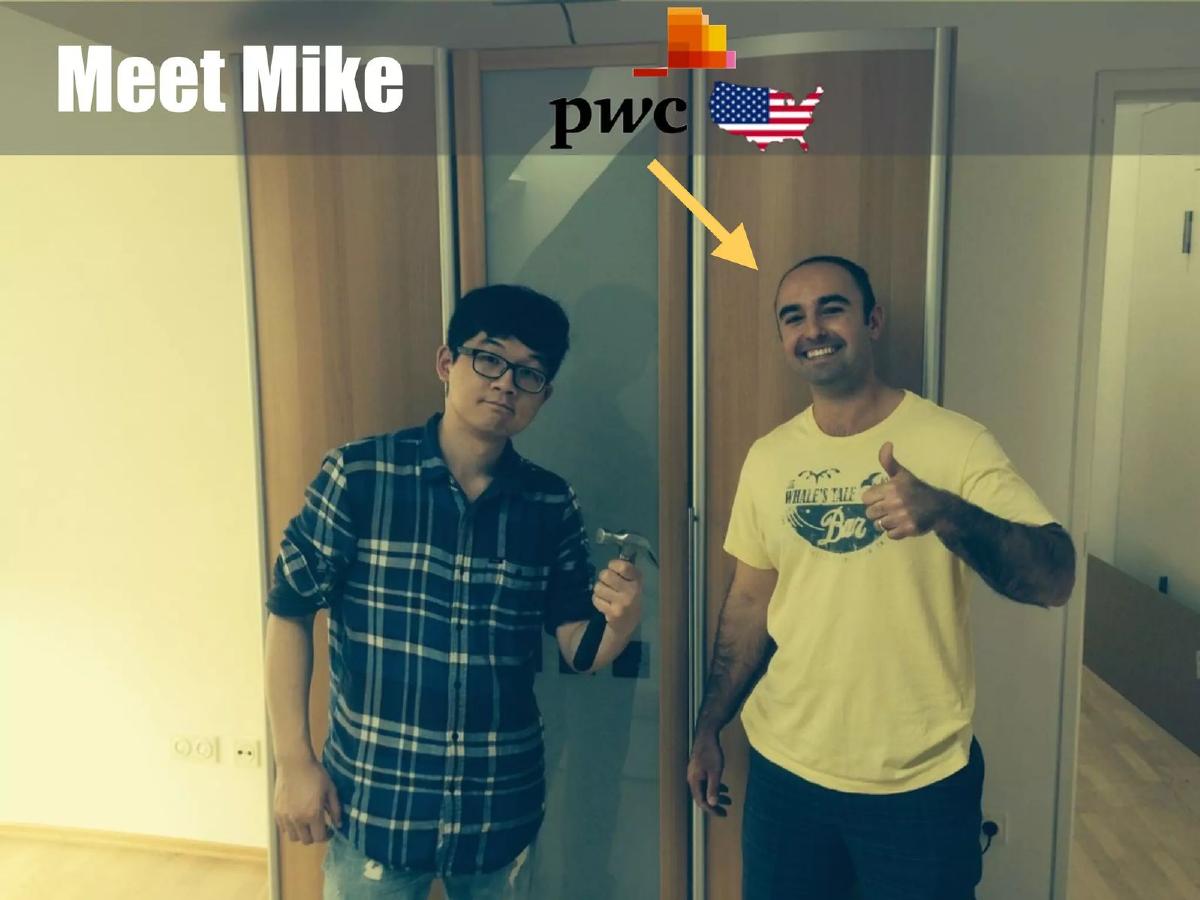
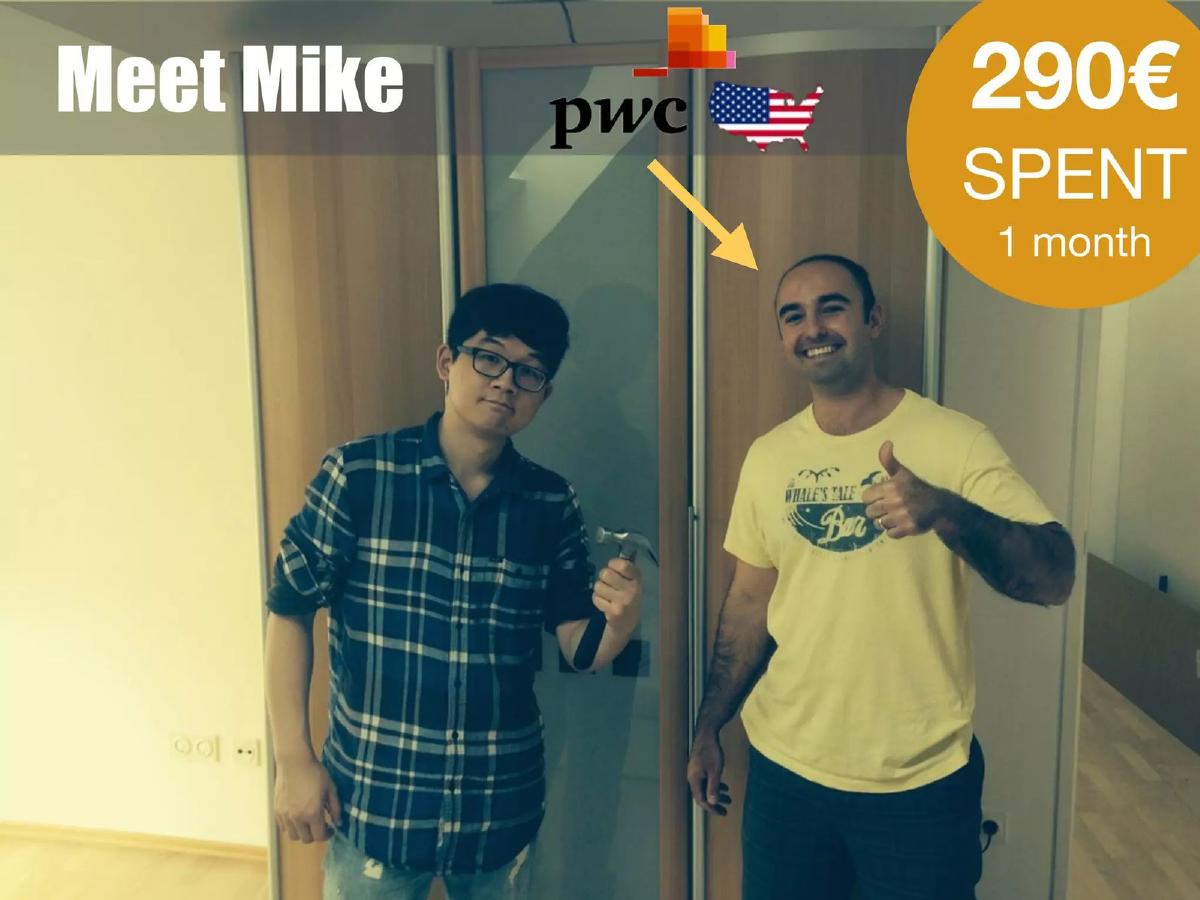
Slide 2: 'Meet Mike.' This slide uses a narrative approach to introduce the target customer. Mike is identified as an employee at PwC in the USA (indicated by logos and a map icon). This establishes the 'Busy Professional' persona.
Slide 3: The deck highlights Mike's motivation: he 'CARES about Work-Life balance.' The visual of a scale tipped toward 'Work' suggests the problem the company intends to solve.
Slide 4 & 5: These slides illustrate the specific tasks Mike needs help with: 'Assembly wardrobes' and 'Empty a basement.' The use of relatable, high-friction domestic chores helps ground the abstract concept of 'delegation' into concrete use cases.
Defining the Problem (Slides 6-7)
Slide 6: Titled 'PROBLEM,' this slide shows a Google search for 'umzug munich' (moving Munich). It highlights the overwhelming nature of search results, which include ads, maps, and organic links that require significant vetting.
Slide 7: The problem is further emphasized by showing a collage of existing solutions: Google, Gelbe Seiten (Yellow Pages), and eBay Kleinanzeigen. The implication is that the current market is fragmented, outdated, and lacks a unified, trustworthy interface for booking services.
The Solution and Product (Slides 8-14)
Slide 8: A transition slide featuring the Doido logo inside a heart-shaped globe, reinforcing the 'Delegate. EVERYTHING.' mission on a global scale, though the subsequent slides focus heavily on Germany.
Slide 9: 'SOLUTION.' This slide introduces the user interface. It shows a two-step process: 'Describe your task' and 'View a profile.' The profile shown is for 'Keith R.' in Munich, featuring social media verification icons (Facebook, LinkedIn, etc.) and a '100% money back guarantee.'
Slide 10: The 'Beta' interface is shown. It features a simple text box asking, 'What would you like to delegate today?' with an 'Estimated Price' box currently at 0 Euro.
Slide 11: Demonstrates the natural language processing or interactive nature of the app. When the user types 'I need to clean my flat,' a tooltip asks 'How big is it?' and the user adds '30m2.' The estimated price updates to 35-90 Euro.
Slide 12: The final booking screen shows a specific address in Munich (Kaufingerstr. 15) and a refined price estimate of 35-65 Euro. The integration of Google Maps suggests a location-aware service.
Slide 13: A mobile mockup showing the same flow, emphasizing that this is a 'on-the-go' solution for busy users.
Slide 14: A significant pivot or expansion is teased here: a 'Telefonica Personal Assistant' branded app. The task described is professional: 'Do 10 customer interviews about our new app.' This suggests a B2B or white-label potential for the platform.
Market and Competition (Slides 15-16)
Slide 15: 'MARKET SIZE.' Doido cites Eurostat data to claim a Total Addressable Market (TAM) of 160 Billion Euro for temporary labor in Europe. They narrow this down to a Serviceable Available Market (SAM) of 22.1 Billion Euro for the 'Temporary labour market in Germany active online.'
Slide 16: 'COMPETITION.' A standard checkmark grid compares Doido against Desk/Elance, eBay Kleinanzeigen, TaskRabbit, and Yellow Pages. Doido claims to be the only player offering the combination of local transactions, review checks, German presence, and an 'Intelligent matching algorithm.'
Traction and Customer Segments (Slides 17-18)
Slide 17: 'HISTORY.' This timeline shows the company's journey from June 2014 to a projected June 2015. Key milestones include participation in the Pirate Summit and Web Summit, acceptance into the Wayra accelerator in November, and a traction point of 1,792 Euro in tasks delegated with '0 Euro spent on marketing.' It also lists an expansion plan for five major German cities.
Slide 18: 'CUSTOMERS.' This slide maps the ecosystem. Delegators include busy professionals, small businesses (C2B), expatriates, and tech-savvy people. Doers include students, retirees, and moms. The deck marks 'Expatriates,' 'Tech-savvy people,' 'Students,' and 'New comers in a city' as 'VERIFIED' segments, suggesting these are the groups showing the most early activity.
What Doido Does Well
The deck is exceptionally strong at defining its target user persona . By starting with 'Mike' and his specific needs (wardrobes and basements), the founders move the conversation away from abstract 'marketplaces' and toward practical utility. The visual demonstration of the 'Problem' (Slide 7) is also effective; it uses recognizable screenshots of cluttered search results to prove that finding help is currently a chore in itself.
The product walkthrough (Slides 10-12) is intuitive. It shows a 'magic' interface where a user simply types a need and receives a price. This suggests a sophisticated backend (or at least a vision for one) that removes the need for manual bidding, which is a common pain point in older platforms like Elance.
What is Missing from the Deck
The most glaring omission is the Team Slide . In early-stage fundraising, the 'who' is often more important than the 'what.' There is no information regarding the founders' technical expertise, previous exits, or domain experience in the labor market. This is a significant red flag for professional investors.
Additionally, the deck lacks a Business Model slide. While we see transaction prices (35-65 Euro), we don't know how Doido makes money. Do they take a 20% commission? Is there a subscription fee for 'Doers'? Without this, the 22.1 Billion Euro market size remains a vanity metric because the actual revenue potential for the startup is undefined.
Finally, there is no Financial Ask . A pitch deck is a tool to facilitate a transaction. By failing to state how much money they are looking for and what they plan to achieve with that capital, the founders miss the opportunity to set the terms of the negotiation.
Founder Takeaways: What to Copy
Use 'Verified' Tags: On Slide 18, Doido marks specific customer segments as 'VERIFIED.' This is a clever way to show that you have moved past assumptions and have actual data on who is using the platform, even if the total numbers are still small. · Visual Problem Definition: Instead of just saying 'the market is fragmented,' Slide 7 shows the fragmentation. Use screenshots of the current, painful user journey to make the 'Problem' feel visceral to the investor. · Natural Language UI Mockups: The way Slides 10-12 show the interface responding to user input is a great way to demonstrate 'Intelligent Matching' without needing to show complex code or flowcharts. It focuses on the user benefit (instant pricing) rather than the technical feature. · Localized SAM: Rather than just claiming a trillion-dollar global market, Doido narrows its focus to the 'German market active online' (Slide 15). This makes the goal feel achievable and shows the founders have a specific go-to-market strategy.
Frequently asked questions
- What is Doido's primary value proposition?
- Doido's value proposition is centered on the concept of 'Delegate. EVERYTHING.' It aims to remove the friction of finding reliable temporary help for tasks ranging from wardrobe assembly to professional customer interviews. By using an intelligent matching algorithm and a verified community of 'Doers,' it seeks to provide a more trustworthy and efficient experience than generic classifieds or search engines.
- How does Doido plan to compete with TaskRabbit?
- According to Slide 16, Doido's competitive advantage lies in its 'Presence in Germany' and its 'Intelligent matching algorithm.' While TaskRabbit is noted as having local transactions and review checks, the deck claims TaskRabbit lacks a presence in the German market and does not utilize the same level of matching technology that Doido offers.
- Who are the target users for this platform?
- The deck splits its audience into 'Delegators' and 'Doers.' Delegators are defined as busy professionals earning over 45-50k Euro per year, expatriates, and tech-savvy individuals. Doers are primarily students, retirees, and newcomers to a city who are looking for flexible work opportunities. Slide 18 notes that the expatriate and student segments have already been 'verified' as active users.
- What stage of development is the company in?
- Based on the history timeline on Slide 17, the company was in a 'Beta' phase around late 2014 and early 2015. It had successfully completed the Wayra accelerator program and was planning a rollout to major German cities including Hamburg, Frankfurt, Berlin, Cologne, and Stuttgart by June 2015. The reported revenue at that time was modest, indicating a seed or pre-seed stage.
- What critical information is missing from the deck?
- The deck is missing several standard investor requirements. There is no 'Team' slide detailing the founders' backgrounds, no 'Business Model' slide explaining the commission or fee structure, and no 'Ask' slide specifying how much capital is being raised or how it will be allocated. Furthermore, there are no detailed financial projections or unit economics beyond a single traction data point.