Doctronic’s 11-slide pitch deck is a masterclass in leveraging early traction to justify a bold, high-risk vision. By claiming the #1 search result for 'AI doctor' and reporting 50,000 weekly consultations on Slide 7, the company moved past the 'if we build it' stage to the 'we are already winning' stage. The deck balances a highly technical and medical founding team (Slide 3) with a simple D2C business model that funnels AI-triaged patients to licensed human professionals (Slide 5). While the deck is light on specific unit economics and competitive landscape details, the sheer volume of enga…
Key takeaways
- The company successfully raised $5M in a 2023 Seed round as reported by Business Insider.
- Slide 7 highlights a significant acquisition advantage, claiming the #1 organic search result for the high-intent keyword 'AI doctor.'
- Traction is substantial for a Seed stage, with Slide 7 reporting 50,000 weekly AI consultations and a 20% week-over-week growth rate.
- The founding team (Slide 3) provides 'founder-market fit' through a combination of a UCSF vascular surgeon-scientist and a repeat tech founder with two exits.
- Slide 8 defines the revenue model as 'providing and coordinating care,' indicating a dual stream from AI interactions and human doctor referrals.
- Slide 10 claims the platform facilitated 5 million chats within its first year of operation.
- The deck identifies a $300B primary care market on Slide 11, positioning the startup as a 'blue ocean' player.
- The 'Ask' is clearly stated on Slide 11 as $5M to build technology, product, and the customer base.
Introduction: The Aggressive Simplicity of Doctronic
Doctronic’s 11-slide deck is a study in minimalist design paired with maximalist claims. Raising a $5M Seed round in 2023—a year where venture capital became significantly more discerning—required more than just an 'AI' prefix. As reported by Business Insider, this North American healthcare startup successfully navigated the fundraising environment by leaning on two pillars: a high-pedigree team and undeniable organic traction. The deck does not get bogged down in the minutiae of LLM architecture; instead, it focuses on the 'Digital Front Door' concept, positioning AI as the primary triage layer for a $300B market.
Slide 1: The Vision Statement
The deck opens with a bold declaration: 'The world’s first digital doctor.' This is a classic 'flag in the ground' slide. It doesn't explain how it works or what it costs; it simply defines the category the founders intend to own. For a Seed round, this level of ambition is necessary to signal that the company is chasing a venture-scale outcome rather than a niche tool.
Slide 2: The Digital Front Door
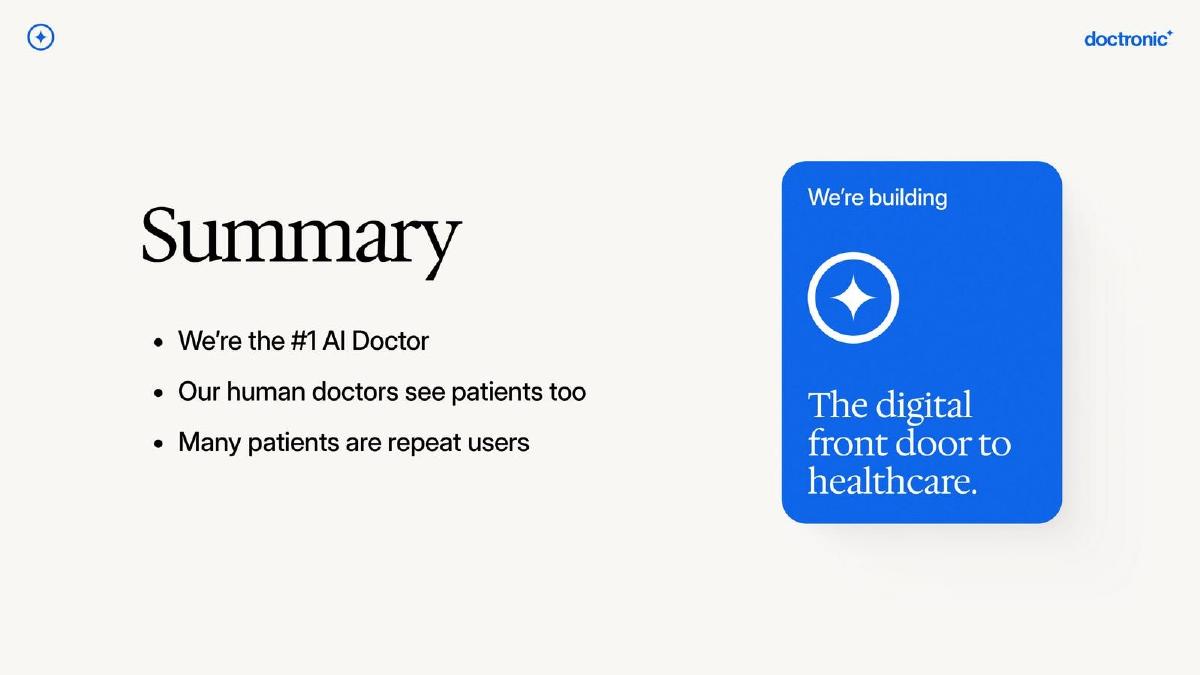
Slide 2 introduces the concept of the 'digital front door to healthcare.' In the industry, this term usually refers to the initial point of contact a patient has with a health system. By claiming this title, Doctronic is suggesting they want to sit upstream of every other healthcare interaction, capturing the patient at the moment of intent.
Slide 3: The Team
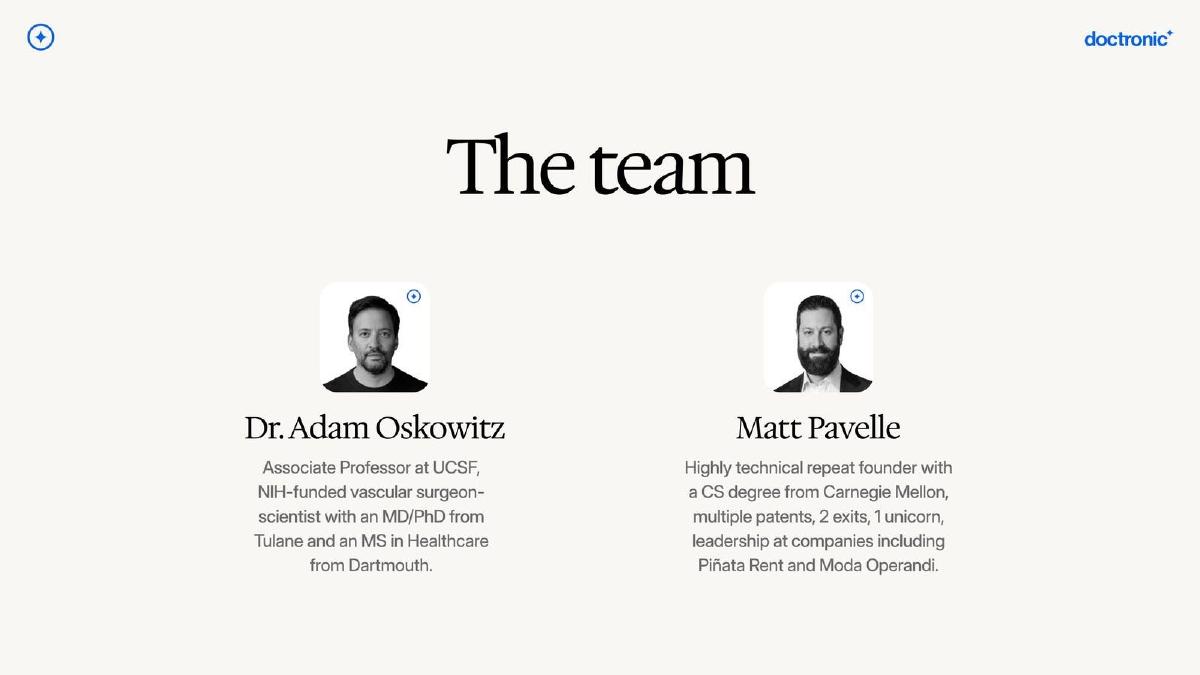
This is arguably the strongest slide in the deck. In healthcare, credibility is the primary currency. Dr. Adam Oskowitz brings the 'Medical' side (UCSF Professor, NIH-funded surgeon, MD/PhD), while Matt Pavelle brings the 'Tech' side (Carnegie Mellon CS, two exits, one unicorn). This 1:1 pairing of deep domain expertise and proven scaling ability is exactly what Seed investors look for to mitigate execution risk. The inclusion of specific institutions like Dartmouth and Tulane adds further weight to their credentials.
Slide 4: The Problem
Slide 4 identifies 'access' as the biggest problem in healthcare. This is a well-understood pain point: long wait times for appointments and the difficulty of reaching a provider after hours. By framing the problem as one of access, they set the stage for an AI solution that is available 24/7 and instantaneous.
Slide 5: The Solution
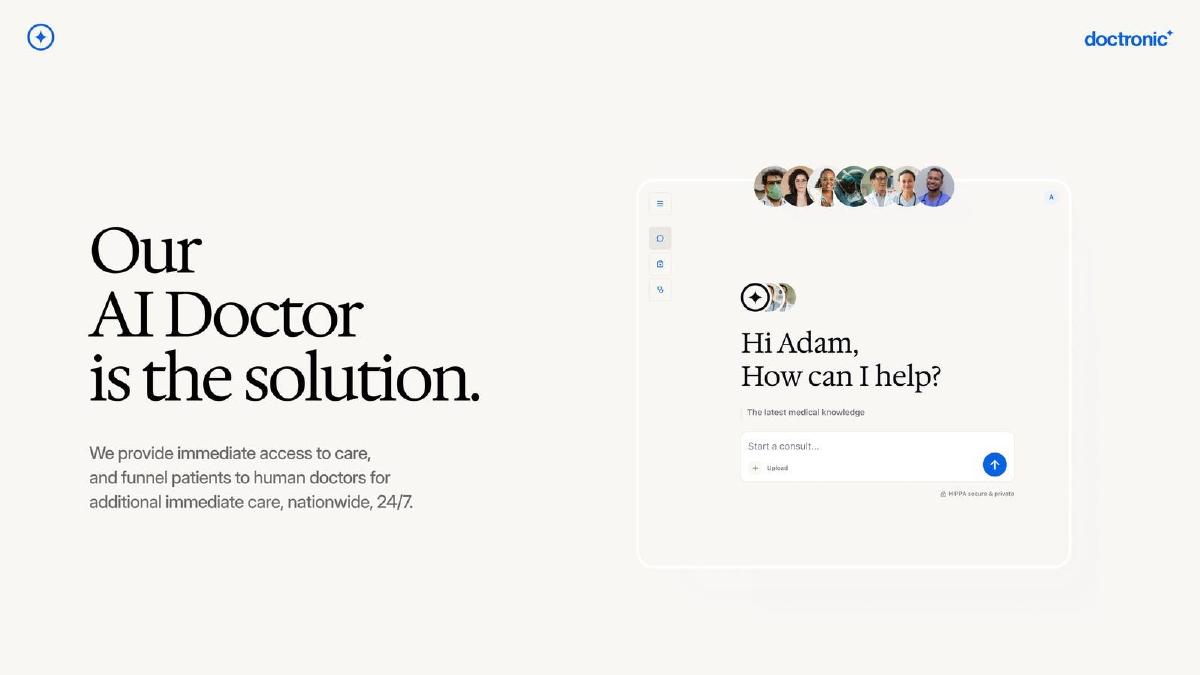
The solution slide shows a clean, chat-based interface. The text explains the workflow: 'immediate access to care' via AI, which then 'funnels patients to human doctors' for nationwide 24/7 care. This is a critical distinction—they aren't just building a chatbot; they are building a triage system that connects to a human-in-the-loop network. This helps bypass some of the immediate regulatory and safety concerns associated with 'AI-only' medical advice.
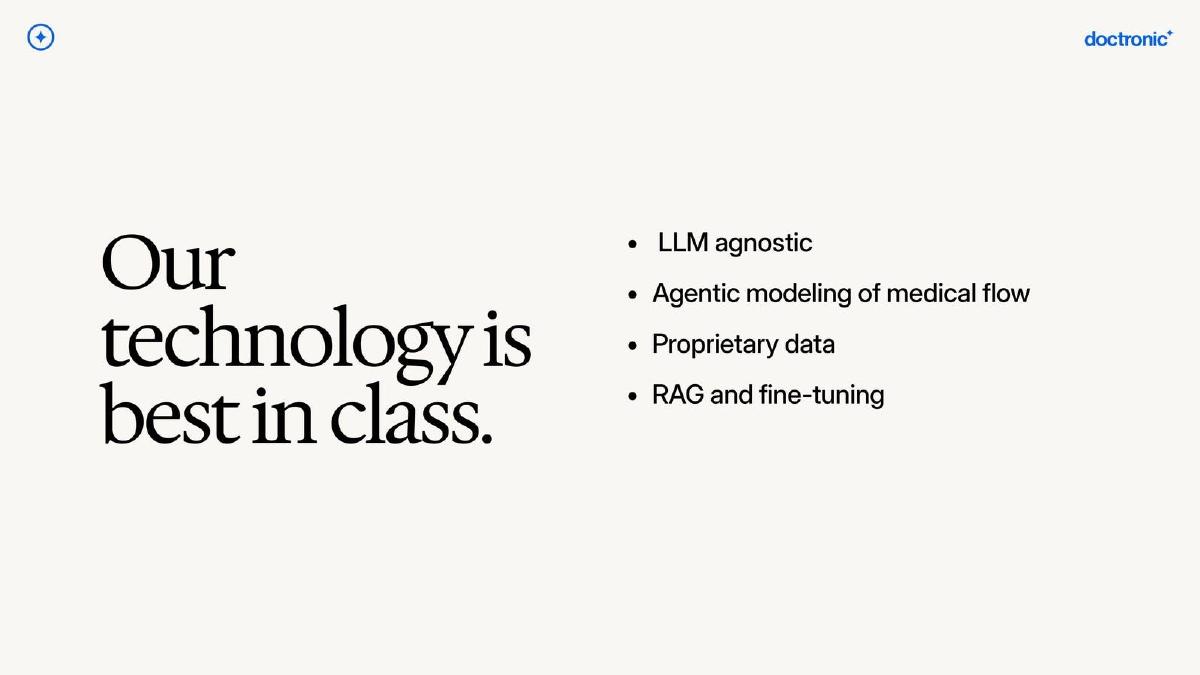
Slide 6: Technology
Slide 6 claims 'best in class' technology. While the text provided is brief, the goal of this slide in a pitch is usually to reassure investors that the company isn't just a wrapper for a generic API. Given the team's background, this slide likely serves to hint at proprietary models or specialized training data, though the specific technical details are omitted from the summary.
Slide 7: The Traction Powerhouse
This is the 'money slide.' Doctronic claims to be the #1 search result for 'AI doctor.' In a world where customer acquisition costs (CAC) are skyrocketing, owning a high-intent organic search term is a massive competitive advantage. The metrics listed are impressive for a Seed stage: 50,000 AI consultations per week, a 40% return rate within 5 days, and 20% week-over-week growth. An NPS of 68 indicates that despite being an automated service, users find it highly valuable.
Slide 8: The Business Model
Slide 8 addresses monetization: 'We make money providing and coordinating care.' This suggests a multi-layered revenue stream. They likely charge for the human doctor consultations (providing care) and may have referral or lead-generation fees for other services (coordinating care). It keeps the business model aligned with the patient's journey from symptom search to treatment.
Slide 9: The Strategy for Winning
Slide 9 outlines four strategic pillars: 'D2C, replace not enhance,' 'Already ahead,' 'Agents for long tail SEO,' and 'Proprietary data.' The 'replace not enhance' phrasing is particularly aggressive; it suggests they aren't looking to sell software to hospitals, but rather to replace the traditional hospital visit for the consumer. The mention of 'long tail SEO' reinforces that their growth engine is built on content and search dominance.
Slide 10: Milestones
Slide 10 quantifies their first year of progress: 5 million chats. This number is large enough to suggest they have already achieved a level of product-market fit and have a massive dataset to use for further refining their AI models (the 'proprietary data' mentioned on the previous slide).
Slide 11: The Ask and Market Size
The final slide uses the 'Blue Ocean' metaphor to describe the $300B primary care market. It clearly states the 'Raising seed $5m' ask and lists the intended use of funds: 'Build tech and product' and 'Build our customer base.' It’s a standard, clean closing that ties the immediate capital need to the massive market opportunity.
What Works in the Doctronic Deck
The Traction-First Approach: Many AI startups pitch on the 'potential' of their models. Doctronic pitches on the 'reality' of their traffic. By showing 50,000 weekly consultations and a #1 Google ranking, they prove that there is a massive, existing demand for their specific solution. This shifts the investor conversation from 'will people use this?' to 'how do we monetize this volume?'
Founder-Market Fit: The combination of a high-level academic surgeon and a technical founder with successful exits is a 'gold standard' for healthcare tech. It provides the necessary medical authority to navigate the healthcare space and the technical chops to build a scalable platform.
Clarity of Triage: The deck clearly explains that the AI is a 'front door' that funnels to human doctors. This is a much more investable business model than a pure AI play, as it creates a clear path to billable medical events and reduces the liability profile of the company.
What is Missing from the Doctronic Deck
Regulatory and Compliance Details: In healthcare, HIPAA compliance and medical liability are massive hurdles. The deck mentions 'HIPAA secure' in a small caption on Slide 5, but a dedicated slide on how they handle medical accuracy, liability, and state-by-state licensing for their human doctor network would be expected in a deeper due diligence process.
Unit Economics: While the growth is impressive, the deck doesn't mention the cost of these 50,000 consultations. Even 'free' organic traffic has costs in terms of server load and AI tokens. Investors would eventually want to see the LTV (Life Time Value) of a patient funneled to a human doctor versus the cost of maintaining the AI infrastructure.
Competitive Landscape: The 'Blue Ocean' claim is a bit hyperbolic. The space for AI symptom checkers and telehealth is crowded with players like Ada Health, Babylon (at the time), and even Google’s own health search features. A slide acknowledging these competitors and explaining why Doctronic’s SEO-first approach is superior would have strengthened the 'Why we win' argument.
What Other Founders Should Copy
The 'Proof of Intent' Slide: If you have a top ranking for a major keyword, show it. Slide 7 is incredibly effective because it uses a recognizable Google search bar to prove that the market is coming to them. It’s a visual way to demonstrate 'pull' rather than 'push' marketing.
Minimalist Design with High-Impact Text: The deck uses a clean, serif-heavy aesthetic that feels 'medical' and 'authoritative' without being cluttered. Each slide has one clear takeaway. Founders often try to cram too much data onto a single slide; Doctronic proves that a single, massive number (like 5 million chats) is more memorable than a dozen small charts.
Direct Strategy Statements: Slide 9’s 'replace not enhance' is a bold strategic choice. Even if an investor disagrees with it, they will remember it. Being clear about your stance on the market—whether you are an enabler or a disruptor—helps you find the right investors who share your worldview.
Frequently asked questions
- What is Doctronic's primary value proposition?
- Doctronic positions itself as the 'digital front door to healthcare' (Slide 2). It uses an AI agent to provide immediate, anonymous medical advice and then funnels those patients to licensed human doctors for 24/7 video visits when further care is required (Slide 5).
- How does the company acquire users?
- The deck leans heavily on organic search. Slide 7 claims they are the #1 search result for 'AI doctor' and Slide 9 mentions using AI agents for 'long tail SEO' to maintain a low-cost acquisition funnel.
- Who are the founders of Doctronic?
- The team consists of Dr. Adam Oskowitz, a vascular surgeon and Associate Professor at UCSF with an MD/PhD from Tulane, and Matt Pavelle, a Carnegie Mellon CS graduate and repeat founder with two exits and experience at a unicorn (Slide 3).
- What specific metrics did Doctronic use to prove traction?
- Beyond the 5 million total chats (Slide 10), the company reported 50,000 weekly consultations, a 40% return rate within 5 days, a 20% week-over-week growth rate, and a Net Promoter Score (NPS) of 68 (Slide 7).
- What is missing from the Doctronic pitch deck?
- The deck lacks a detailed breakdown of unit economics (CAC vs. LTV), a specific competitive matrix comparing them to other telehealth or AI symptom checkers, and a clear regulatory/compliance roadmap, which is critical for healthcare startups.