Domi Labs presents a 17-slide deck focused on digitizing the rental application process through Self-Sovereign Identity (SSI). The company identifies a clear pain point in the German market: high administrative overhead and significant GDPR compliance risks, citing a €14.5M fine issued to a housing company as a primary motivator. Their solution involves a 'Digital Passport' for tenants and an automation dashboard for property managers. While the deck excels at defining the problem and the specific regulatory tailwinds in Europe, it lacks a formal financial 'Ask,' a detailed business model, an…
Key takeaways
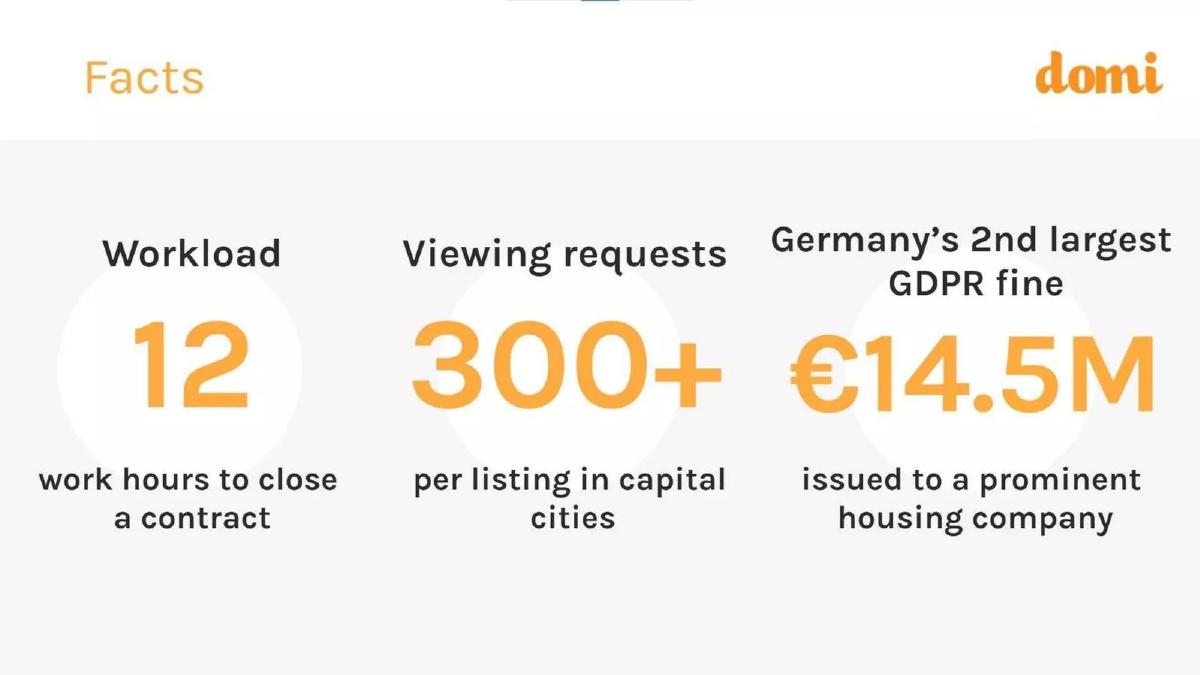
- The deck identifies a massive administrative burden, stating it takes 12 work hours to close a single rental contract (Slide 5).
- Domi leverages regulatory fear by highlighting Germany's 2nd largest GDPR fine of €14.5M issued to a housing provider (Slide 5).
- The technology is based on Self-Sovereign Identity (SSI), allowing users to store personal data only on their own devices (Slide 13).
- Market potential is segmented into Global (€26B), Europe (€6B), and DACH (€2B) regions (Slide 15).
- The team consists of two founders with deep technical and project management backgrounds, including 20+ years in software and 10+ years in urban infrastructure (Slide 2).
- Customer research indicates that 83% of interviewed rental companies view GDPR compliance as a major business concern (Slide 15).
- The deck omits a traditional funding ask, instead offering a call to action for a meeting or a referral to strategic partners (Slide 17).
- The product vision includes a unified 'Digital Passport' for tenants to enable one-click applications across different platforms (Slide 14).
The Strategy of Trust: A Teardown of Domi Labs
Domi Labs enters the proptech space not just as a workflow tool, but as a privacy-first identity layer. In a market like Germany, where data privacy (GDPR) is treated with extreme legal weight and the rental market is notoriously paper-heavy, Domi’s approach is highly localized and strategic. The deck is less about 'disrupting' real estate and more about 'de-risking' it for large institutional landlords.
The Opening: Team and Purpose
Slide 1: Title Slide The deck opens with a clear value proposition: "Workflow automation powered by verifiable identity – starting with the rental market." It establishes the company as a technology-first entity (Domi Labs UG) rather than just a real estate portal.
Slide 2: Team The founders are positioned as experts in their respective fields. Pavel Metelitsyn (CTO) is credited with 20+ years of software development in blockchain and fintech. Katrie Lowe (CEO) is a chartered civil engineer with 10+ years in urban infrastructure. The slide includes logos for the Self-Sovereign Identity Incubator and the Deep Tech Award 2021, providing immediate third-party validation.
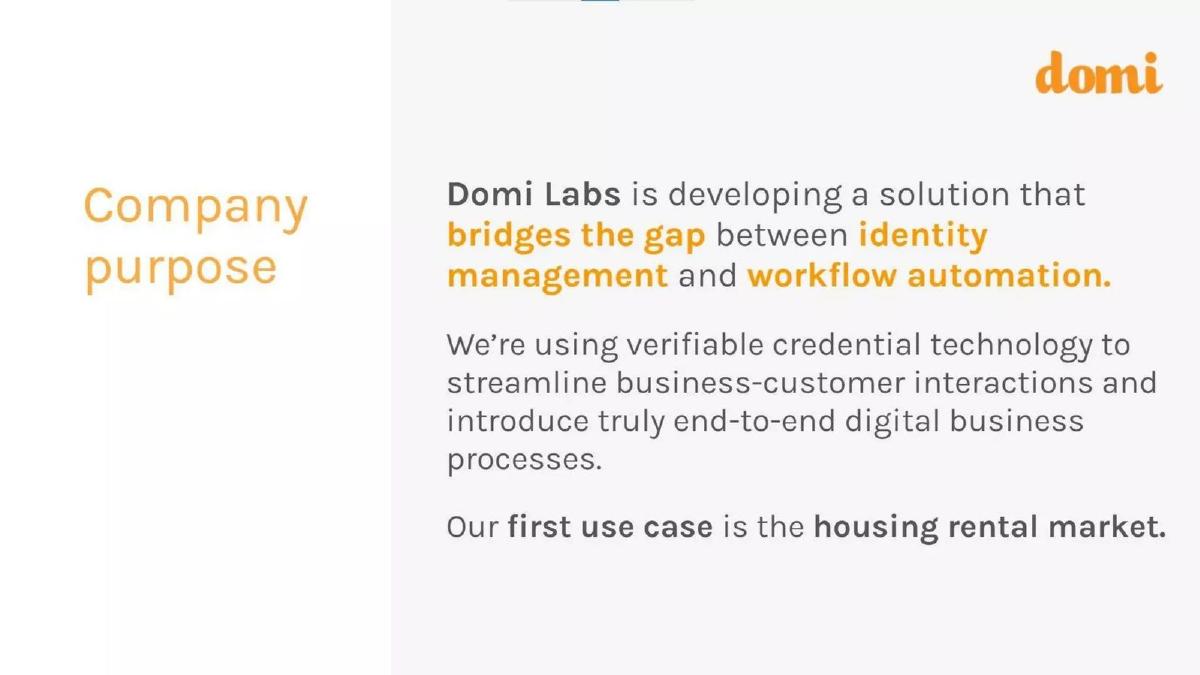
Slide 3: Company Purpose This slide defines the mission: bridging the gap between identity management and workflow automation. It explicitly mentions using "verifiable credential technology" to introduce end-to-end digital processes, with housing as the first use case.
The Problem: Friction and Fines
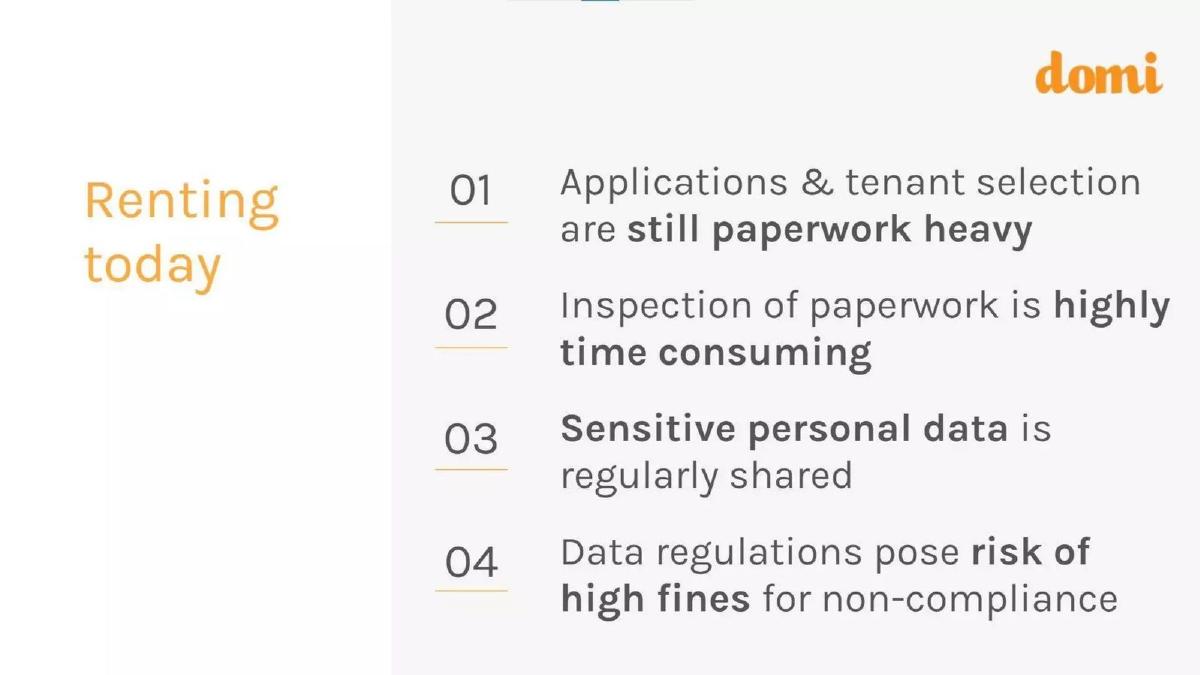
Slide 4: Renting Today The problem is broken down into four points: heavy paperwork, time-consuming inspections, regular sharing of sensitive data, and the risk of high fines for non-compliance with data regulations.
Slide 5: Facts This is a high-impact slide. It quantifies the problem with three metrics: 12 work hours to close a contract, 300+ viewing requests per listing in capital cities, and a €14.5M GDPR fine issued to a prominent housing company. This last point is a powerful 'fear-based' motivator for their target B2B customers.
Slide 6: The Pivot Point A simple transition slide stating that rental applications are the most inefficient part of the process and that Domi intends to change that.
The Solution: The Digital Passport
Slide 7: Solution Overview Domi describes itself as a mobile app and software platform for the secure exchange of pre-verified identity, financial, and credit information. The focus is on speed for managers and data control for tenants.
Slide 8: Efficiency and Security This slide visualizes the two-sided nature of the platform. The property manager gets a software platform and API for tenant selection, while the tenant gets a "Digital Passport" mobile app for one-click applications.
Slide 9: Product Demo (Video Link) A placeholder for a product demo showing the dashboard. The static image shows a list of applicants with verification badges for Government ID, Bank account, and Income & Affordability.
Slide 10: For Property Managers Details the B2B features: application management dashboard, API, tenant selection based on verifiable data, and digital contract drafting with electronic signatures.
Slide 11: For Tenants Details the B2C features: reusable digital identity, bank and credit credentials, and 100% user data control. The UI shown is in German, reinforcing the initial market focus.
The Technology: Self-Sovereign Identity
Slide 12: Self Sovereign Identity (SSI) This slide explains the underlying philosophy. SSI allows users to have complete control over their data. It mentions cryptography and decentralization as the tools to achieve privacy and data minimisation.
Slide 13: Innovation Four pillars of innovation are listed: Verifiable Credentials (replacing paper), Decentralised Data Storage (data stays on the user's device), Selective Disclosure (sharing only what is needed), and Marketplace Independence (Domi works regardless of where the listing is advertised).
Slide 14: Benefits A summary slide comparing benefits. For managers: lower costs and 50% time savings. For tenants: one-click apply and privacy-by-design.
Market and Timing
Slide 15: Market Potential The deck presents a top-down market analysis. It claims a €26B global market, a €6B European market, and a €2B DACH market. It also includes customer insights: 75% of managers want a new digital solution, and 83% are concerned about GDPR.
Slide 16: Why Now? This slide argues that the proptech market is at an inflection point. It cites 2021 news regarding Vonovia's adoption of digital contracts and new German legislation regarding smartphone identity proof as evidence of a shifting landscape.
Slide 17: The Call to Action Unusually, there is no request for a specific dollar amount. Instead, the slide offers two paths: "Let's line up a call!" or "Please pass me onto someone that fits Domi's ideal partner profile." It lists the CEO's contact information and the type of partners they seek (early-stage investors, industry leaders, or those with housing networks).
What Works in the Domi Deck
Specific Pain Point Quantification: The use of the €14.5M GDPR fine (Slide 5) is excellent. In B2B sales, especially in conservative industries like German real estate, the fear of regulatory penalty is often a stronger driver than the promise of incremental efficiency. By leading with this, Domi frames their product as an insurance policy as much as a productivity tool.
Clear User Personas: The deck does a great job of separating the value proposition for the two sides of the market (Slides 10 and 11). It recognizes that while the property manager pays (presumably), the tenant must adopt the app for the system to work. Reusability of the 'Digital Passport' is the key hook for the tenant.
Regulatory Alignment: The 'Why Now' slide (Slide 16) is very strong. It doesn't just say "the market is growing"; it points to specific legislative changes and moves by industry giants (Vonovia). This suggests that the technical hurdles to adoption are being cleared by the government and market leaders, not just by the startup.
What is Missing from the Domi Deck
The Business Model: There is no mention of how Domi makes money. Do they charge property managers a subscription fee? Is there a fee per verified application? Do tenants pay for the passport? Without this, it is difficult for an investor to evaluate the €2B DACH market potential (Slide 15) because the 'take rate' is unknown.
The Funding Ask: Most pitch decks end with a slide detailing how much money is being raised, the valuation (optional), and the milestones that the funding will enable. Domi’s final slide (Slide 17) is very soft, asking for a call or a referral. This makes the deck feel more like a business development presentation than a venture capital fundraising deck.
Competitive Landscape: The deck assumes a vacuum. There are no mentions of other proptech players, traditional credit bureaus (like Schufa in Germany), or other identity providers. Investors need to know why Domi’s SSI approach is superior to a centralized digital signature platform like DocuSign or a specialized rental platform like Zillow or ImmoScout24.
Unit Economics and Traction: While the deck mentions "interviewed" companies (Slide 15), it does not list any pilot programs, signed Letters of Intent (LOIs), or current user numbers. There is no data on the cost to acquire a property manager versus the lifetime value of that customer.
What a Founder Should Copy
The 'Innovation' Breakdown: Slide 13 is a masterclass in explaining complex technology (SSI) through the lens of user benefits. Instead of talking about hashes and blockchains, they talk about "Selective Disclosure" and "Marketplace Independence." Founders with technical products should copy this format to ensure their 'how' stays linked to their 'why.'
Localized Market Sizing: Rather than just showing a single 'Global TAM' number, Domi breaks it down into Global, Europe, and DACH (Slide 15). This shows a realistic understanding of their go-to-market strategy. They are starting where the pain (GDPR) is highest, which is a logical and defensible strategy.
Visual Consistency: The deck uses a consistent color palette (orange and white) and a clean, modern illustration style. It looks professional and cohesive, which builds trust—a vital component for a company whose core product is 'Identity.'
Final Assessment: Domi Labs has a compelling 'Why Now' and a very clear problem definition. However, the lack of a business model and a clear financial ask makes this deck feel incomplete for a standard Seed round. It is highly effective at explaining the logic of the business, but less effective at explaining the mechanics of the investment opportunity.
Frequently asked questions
- What is the core technology behind Domi?
- Domi is built on Self-Sovereign Identity (SSI) principles. As explained on Slide 12, this model gives users complete control over their personal data using cryptography and decentralization. Unlike centralized databases, personal data is stored only on the user's device (Slide 13), which mitigates the risk of large-scale data breaches for property managers.
- How does Domi solve the problem for property managers?
- For property managers, the platform offers an application management dashboard and API. According to Slide 14, it provides pre-checked and verified applicant information, leading to a claimed 50% time savings over existing digital solutions. It also simplifies GDPR compliance by reducing the amount of sensitive data the manager needs to store centrally.
- What market is Domi targeting first?
- Domi is specifically targeting the housing rental market, with an initial focus on the DACH region (Germany, Austria, Switzerland). Slide 15 values the DACH rental market potential at €2B, involving 53 million renters and 4.2 million rental contract transactions per year.
- Is there a clear revenue model in the deck?
- No, the deck does not explicitly outline its pricing structure or revenue model. While it mentions 'lower operational costs' for managers and 'marketplace independence' (Slide 13, 14), it does not state whether they charge per transaction, per user, or via a SaaS subscription model.
- What are the 'Why Now' factors for this business?
- Slide 16 points to three major 2021 catalysts: Vonovia (a major German residential real estate company) adopting digital contracts, German legislation allowing proof of identity via smartphone, and the European Digital Identity Wallet initiative. These factors suggest a regulatory and industry shift toward the technology Domi provides.