Doorman’s 11-slide pitch deck is a masterclass in identifying a universal consumer frustration and presenting a scalable operational solution. The deck highlights a massive market gap—100 million failed deliveries out of 5 billion retail shipments in 2013—and proposes a scheduled evening delivery service. By showcasing early traction from their January 2014 beta, including 20% week-over-week growth, the founders demonstrated immediate product-market fit. The financial modeling is particularly granular, projecting revenue outcomes based on customer density in San Francisco, ranging from $114k…
Key takeaways
- The deck identifies a massive inefficiency in the US logistics market: 100 million failed deliveries annually as of 2013 (Slide 3).
- Doorman positions itself as a premium layer on top of existing e-commerce, offering scheduled delivery until midnight (Slide 4).
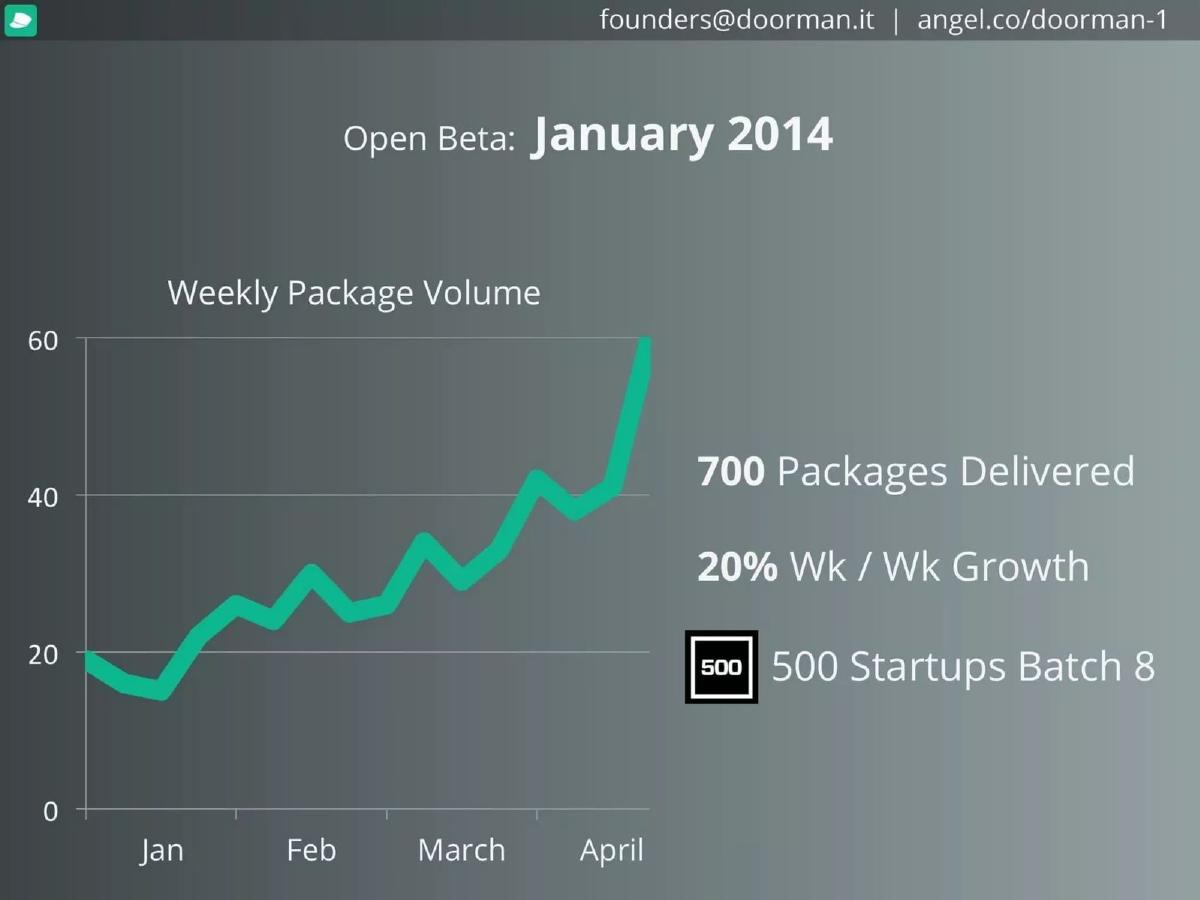
- Traction is demonstrated through an open beta starting January 2014, achieving 700 deliveries and 20% week-over-week growth (Slide 6).
- The business model is highly localized, with a San Francisco scenario projecting $11.4M in annual revenue at 50,000 customers (Slide 7).
- Integration is a key growth lever, with a Shopify app in development to offer scheduled delivery for $5.99 at checkout (Slide 8).
- The competitive analysis explicitly calls out incumbents like FedEx and UPS for their limited 5pm delivery windows (Slide 9).
- The team slide leverages high-signal logos including Pixar, IBM, and Wharton to establish technical and operational credibility (Slide 10).
- The deck lacks a specific 'Ask' slide detailing how much capital is being raised or the intended use of funds.
Introduction: The Last-Mile Logistics Gap
Doorman’s 2017 seed deck is a focused, 11-slide presentation that addresses one of the most persistent headaches in the e-commerce era: the missed delivery. The company raised $1.9 million in seed funding from a roster of high-profile investors including Matrix Partners and 500 Startups. The deck is characterized by its simplicity, leaning heavily on a single, relatable pain point and backing it up with early traction and clear scaling projections.
Slides 1-3: The Hook and The Problem
Slide 1 introduces the brand with a minimalist logo and the tagline: "Perfecting the most important moment of e-commerce." This immediately frames the company not just as a delivery service, but as a customer experience optimizer. By calling the delivery the "most important moment," they elevate the stakes of the logistics industry.
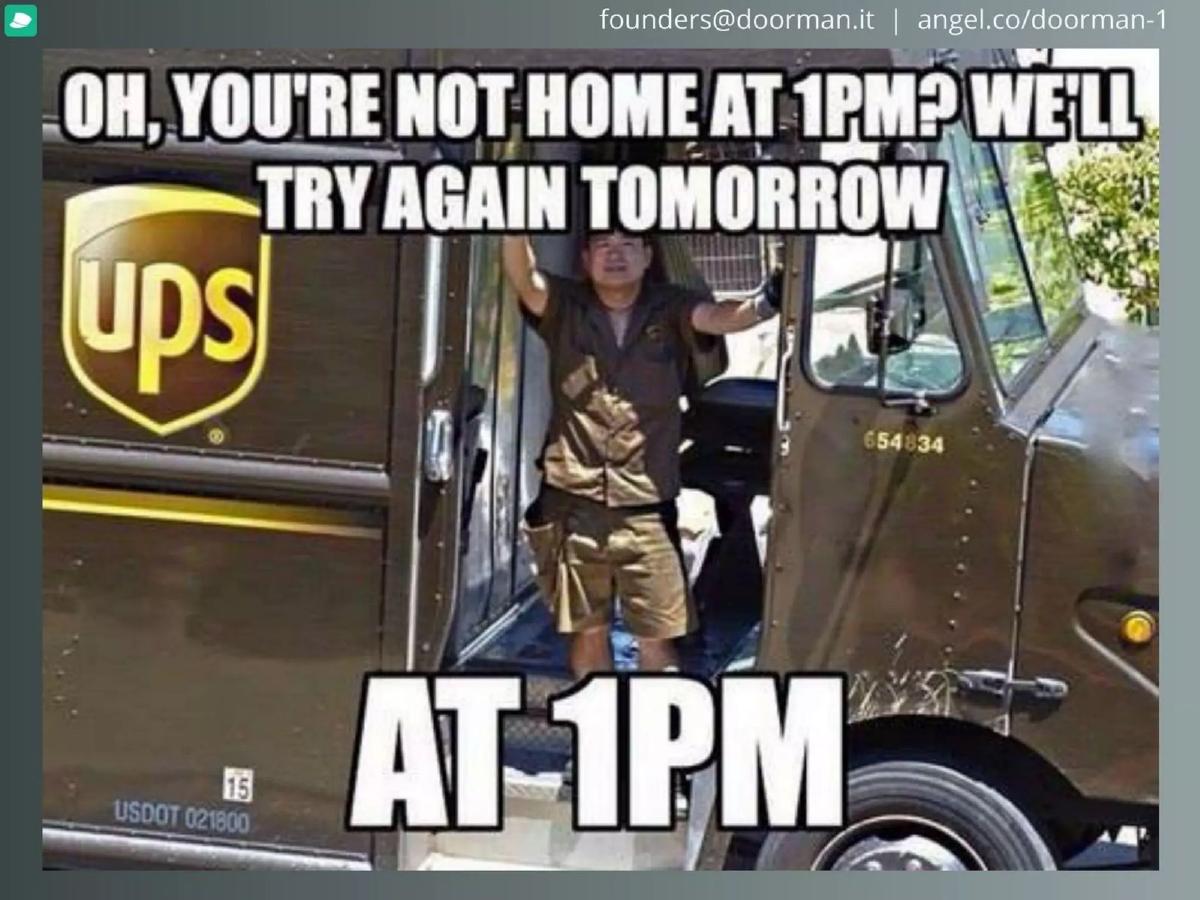
Slide 2 uses an unconventional approach by featuring a meme of a UPS driver with the text: "Oh, you're not home at 1pm? We'll try again tomorrow at 1pm." While using memes in a professional deck can be risky, it effectively communicates the visceral frustration of the target customer. It humanizes the problem before the deck pivots to hard data.
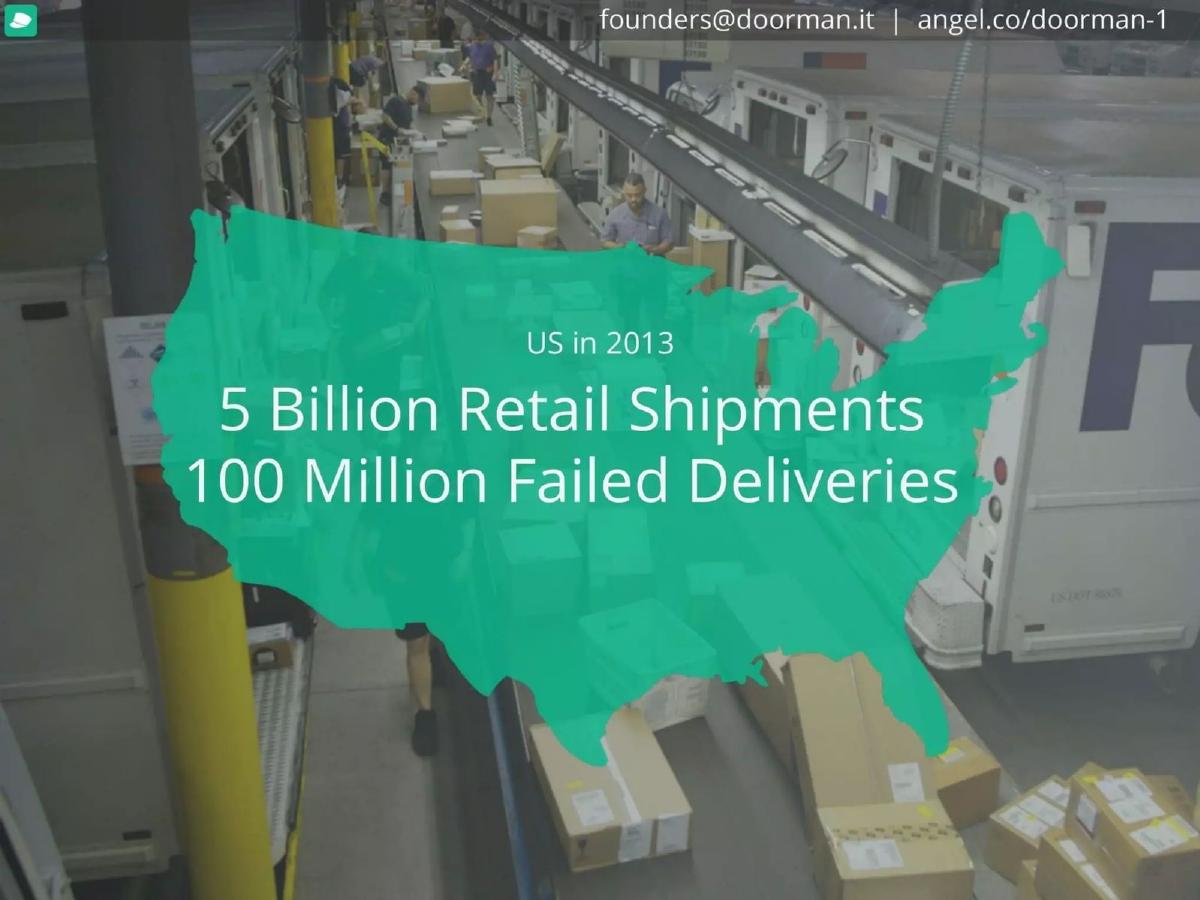
Slide 3 provides the market validation for that frustration. It states that in 2013, the US saw 5 Billion Retail Shipments and, crucially, 100 Million Failed Deliveries . This 2% failure rate represents a massive operational inefficiency and a significant market opportunity. By quantifying the problem at a national scale, Doorman justifies the need for a specialized solution.
Slides 4-5: The Solution and Product Interface
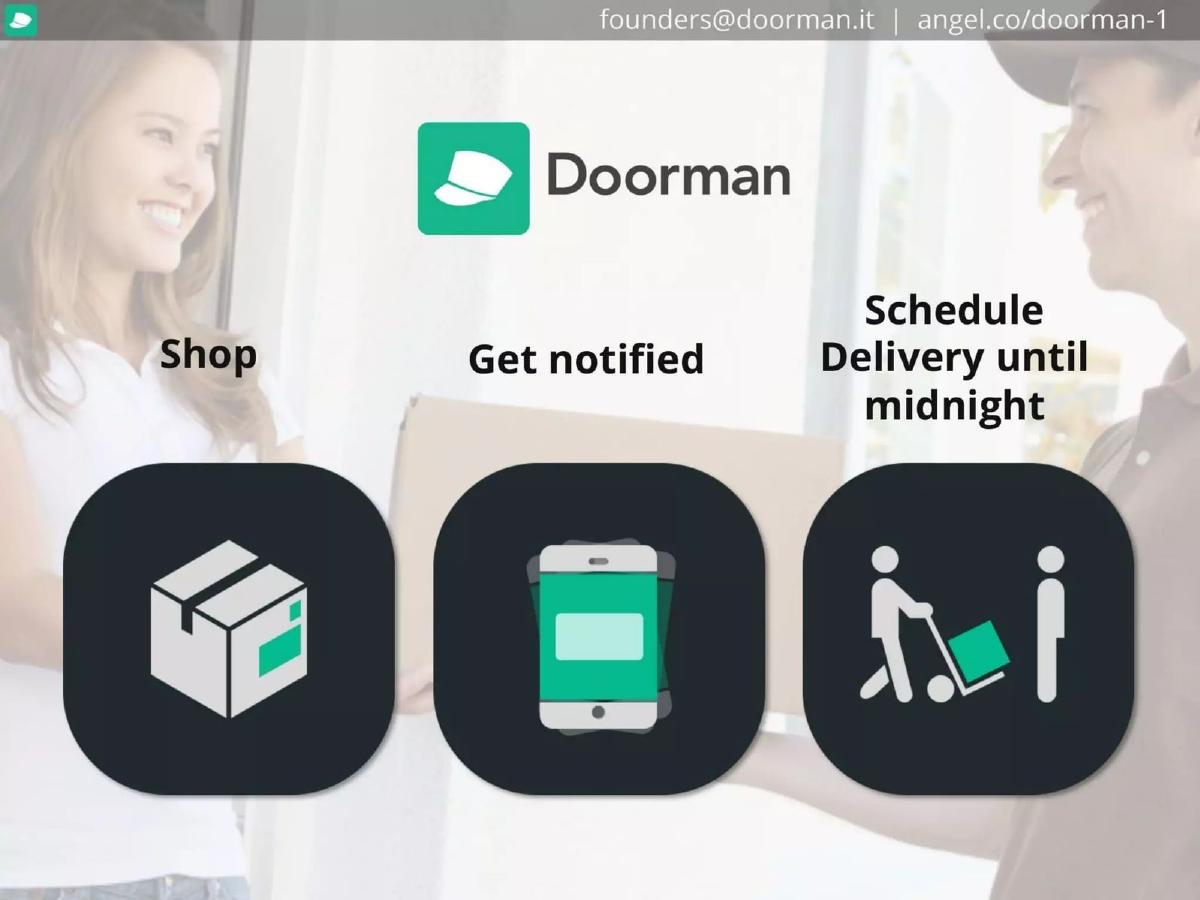
Slide 4 outlines the three-step user journey: Shop, Get notified, and Schedule Delivery until midnight. The emphasis on "until midnight" is the core value proposition, as it solves the problem of customers being away at work during standard delivery hours. The icons are clean and reinforce a mobile-first approach.
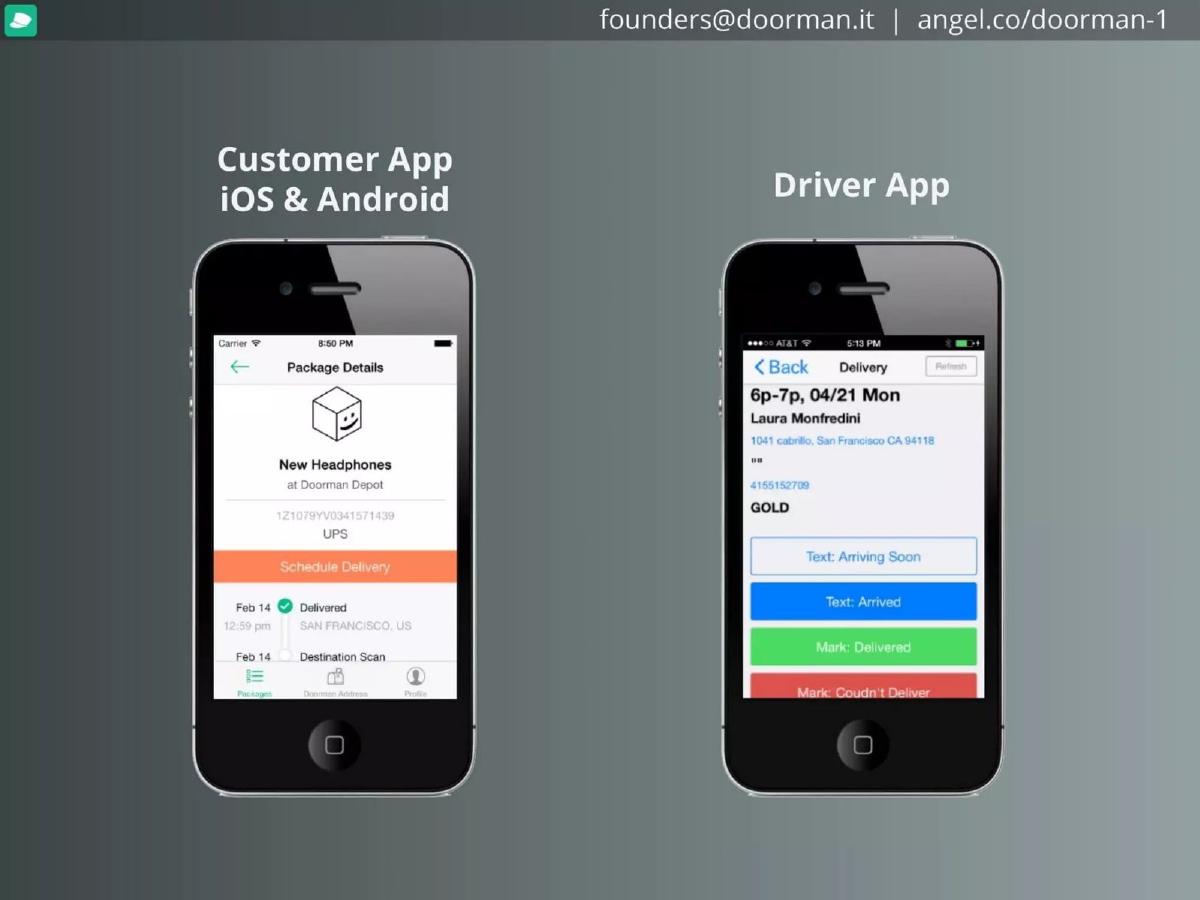
Slide 5 showcases the Customer App (iOS & Android) and the Driver App . The customer interface shows a package tracking screen with a prominent orange "Schedule Delivery" button. The driver interface displays a specific delivery window (e.g., 6p-7p) and status buttons like "Text: Arriving Soon" and "Mark: Delivered." Showing both sides of the marketplace demonstrates that the technology is already built and operational, reducing execution risk in the eyes of investors.
Slides 6-7: Traction and Scaling Scenario
Slide 6 highlights the Open Beta: January 2014 . The chart for Weekly Package Volume shows a steady upward trend from January through April. Key metrics cited include 700 Packages Delivered and 20% Wk / Wk Growth . The inclusion of the 500 Startups Batch 8 logo provides social proof, indicating that the company has already passed through a rigorous accelerator vetting process.
Slide 7 is one of the most important slides in the deck, titled "Doorman Scenario in San Francisco." It provides a granular table mapping customer counts to revenue. At the low end, 500 customers generate $9.5k Rev/month . At the high end, 50,000 customers are projected to generate $950k Rev/month or $11.4M Rev/year . This slide also includes operational requirements, noting that 50,000 customers would require 65 drivers per day . This level of detail shows that the founders have thought through the physical logistics required to scale, not just the software.
Slides 8-9: Market Integration and Competition
Slide 8 introduces a B2B growth lever: the Doorman Shopify App . It shows a mockup of a checkout screen where "Doorman Scheduled Delivery" is an option for $5.99 . This is a critical strategic pivot, moving from a consumer-facing app to an integrated part of the e-commerce checkout flow. It suggests a path to lower customer acquisition costs (CAC) by capturing users at the point of sale.
Slide 9 addresses the Competition . It categorizes rivals into four buckets. Notably, it attacks Premium Delivery Services like FedEx and UPS My Choice, pointing out that their latest window is 5pm and that UPS charges $40/year + $5 per scheduled delivery . By comparing their midnight window to the incumbents' 5pm limit, Doorman highlights a clear competitive advantage for the working professional demographic.
Slides 10-11: Team and Closing
Slide 10 introduces the founders. Zander Adell (Co-Founder, CEO) brings pedigree from Pixar , Idle Games , and Wharton . Kapil Israni (Co-Founder, CTO) has a background with IBM , Banjo , and Loqly . The mix of high-level creative management (Pixar) and technical infrastructure (IBM) is a strong combination for a company that sits at the intersection of consumer experience and complex logistics.
Slide 11 is a simple contact slide with the company logo, a founder email address, and an AngelList URL. It serves as a placeholder for the final Q&A session.
What Works in the Doorman Deck
The deck excels at problem identification . By using a relatable meme followed by a staggering statistic (100 million failed deliveries), the founders ensure the investor understands the pain point within the first 60 seconds. The operational transparency on Slide 7 is also a major strength. Many tech founders gloss over the "meat and potatoes" of logistics, but Doorman explicitly lists how many drivers are needed for specific revenue targets, which builds credibility with investors who understand the complexities of the last mile.
Furthermore, the Shopify integration slide (Slide 8) shows a clear understanding of distribution. Relying solely on consumers to download a new app is difficult; integrating into the checkout flow of thousands of merchants is a much more scalable growth strategy.
What is Missing from the Doorman Deck
The most glaring omission is The Ask . There is no slide detailing how much money is being raised, the valuation expectations, or how the funds will be allocated (e.g., hiring, geographic expansion, marketing). This is a fundamental component of a fundraising deck and its absence is notable.
Additionally, the deck lacks Unit Economics . While Slide 7 shows revenue, it does not show the cost of goods sold (COGS). We see that 65 drivers are needed for $950k in monthly revenue, but we don't know what those drivers are paid or what the warehouse/depot costs are. Without these figures, an investor cannot determine if the business is actually profitable at scale or if it loses money on every delivery.
Finally, there is no Roadmap . The deck shows what has happened (the beta) and a hypothetical scenario in San Francisco, but it doesn't outline which cities are next or the timeline for the Shopify app rollout.
What a Founder Should Copy
Founders should emulate Doorman’s clarity of value proposition . The phrase "Scheduled delivery until midnight" is a perfect "only-we" statement that differentiates them from every major carrier. If you can summarize your competitive advantage in four words, you are ahead of most startups.
The Scenario Modeling on Slide 7 is also worth copying. Instead of just showing a "hockey stick" graph, showing a table that links customer milestones to specific operational requirements (like headcount or drivers) shows a level of maturity and realism that investors appreciate. It demonstrates that you aren't just building an app, but a functioning business.
Lastly, the Competitive Matrix on Slide 9 is a good example of how to frame incumbents. Rather than saying "UPS is bad," they specifically pointed out the 5pm window limitation. Finding a specific, measurable weakness in a giant competitor is much more effective than general disparagement.
Company: Doorman · Sector: Logistics / E-commerce · Stage: Seed · Year: 2017 · Slides: 11 · Deck Type: Investor Pitch Deck · Outcome: Raised $1,900,000 · HQ: San Francisco, CA
Frequently asked questions
- What was the primary problem Doorman aimed to solve?
- Doorman focused on the 'failed delivery' problem. According to Slide 3, there were 100 million failed deliveries in the US in 2013 out of 5 billion total shipments. The deck uses a meme on Slide 2 to illustrate the frustration of missed delivery windows from major carriers like UPS, positioning Doorman as the solution for people not home during standard business hours.
- How did Doorman plan to generate revenue?
- The deck outlines two primary revenue paths. Slide 7 shows a subscription or per-package model where 50,000 customers in a city like San Francisco could generate $950k in monthly revenue. Slide 8 introduces a B2B2C approach via a Shopify app, where customers pay a $5.99 flat fee at the point of purchase for scheduled delivery.
- What traction did the company show at the time of the pitch?
- On Slide 6, Doorman reports that their open beta began in January 2014. By the time of the deck's creation, they had delivered 700 packages and were maintaining a 20% week-over-week growth rate. They also highlighted their participation in 500 Startups Batch 8 as a mark of early institutional validation.
- Who were Doorman's main competitors according to the deck?
- Slide 9 categorizes competition into four groups: Direct Competition (Parcel in NYC), Same-day local delivery (Google Shopping Express, Postmates, Amazon Fresh), Delivery Lockers (Amazon Locker), and Premium Delivery Services (FedEx and UPS My Choice). Doorman differentiates itself by offering later delivery windows (until midnight) compared to the 5pm limits of incumbents.
- What is missing from this pitch deck?
- The deck is notably missing a 'Use of Funds' or 'The Ask' slide, which is standard for fundraising. It also omits detailed unit economics; while it lists revenue projections on Slide 7, it does not detail the costs associated with the 65 drivers needed to service 50,000 customers, making it difficult to assess net margins.