Doola’s 14-slide deck for their $1M extension round is a masterclass in 'wedge' strategy. The company positions its core service—US business formation for non-US residents—as a low-friction entry point to a much larger financial services ecosystem. The deck effectively uses social proof by highlighting $11.6M in prior funding from top-tier investors like Y Combinator and Nexus Venture Partners. It clearly articulates the transition from a service-based 'Formation 1.0' model to a 'B2B API Infrastructure 2.0' model. While the deck is light on specific unit economics and current revenue figures,…
Key takeaways
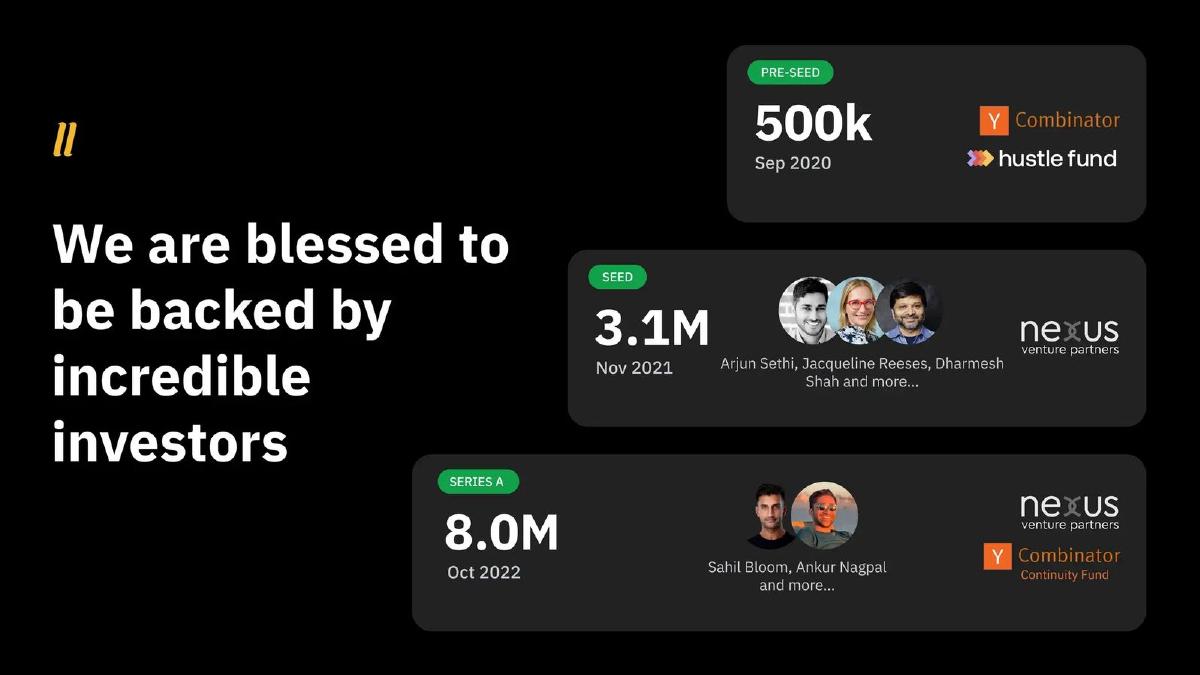
- The company has raised $11.6M across three rounds prior to this extension, including an $8M Series A in October 2022 (Slide 2).
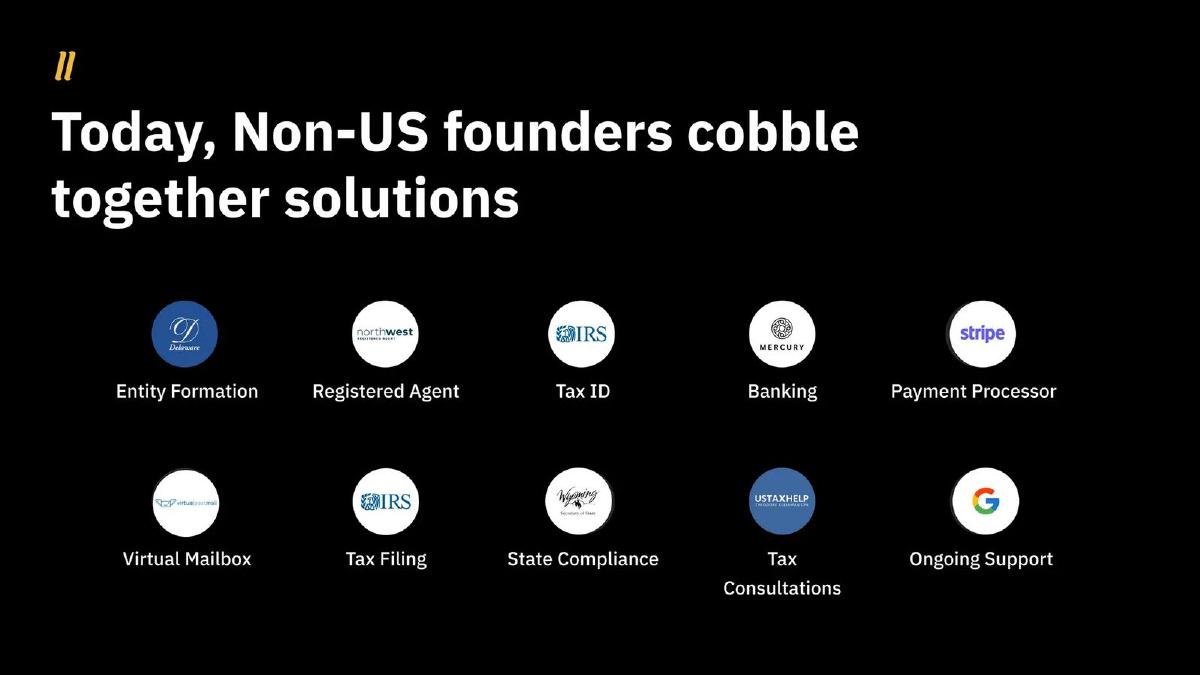
- Doola identifies a fragmented market where non-US founders must 'cobble together' solutions from ten different providers like Stripe, Mercury, and the IRS (Slide 3).
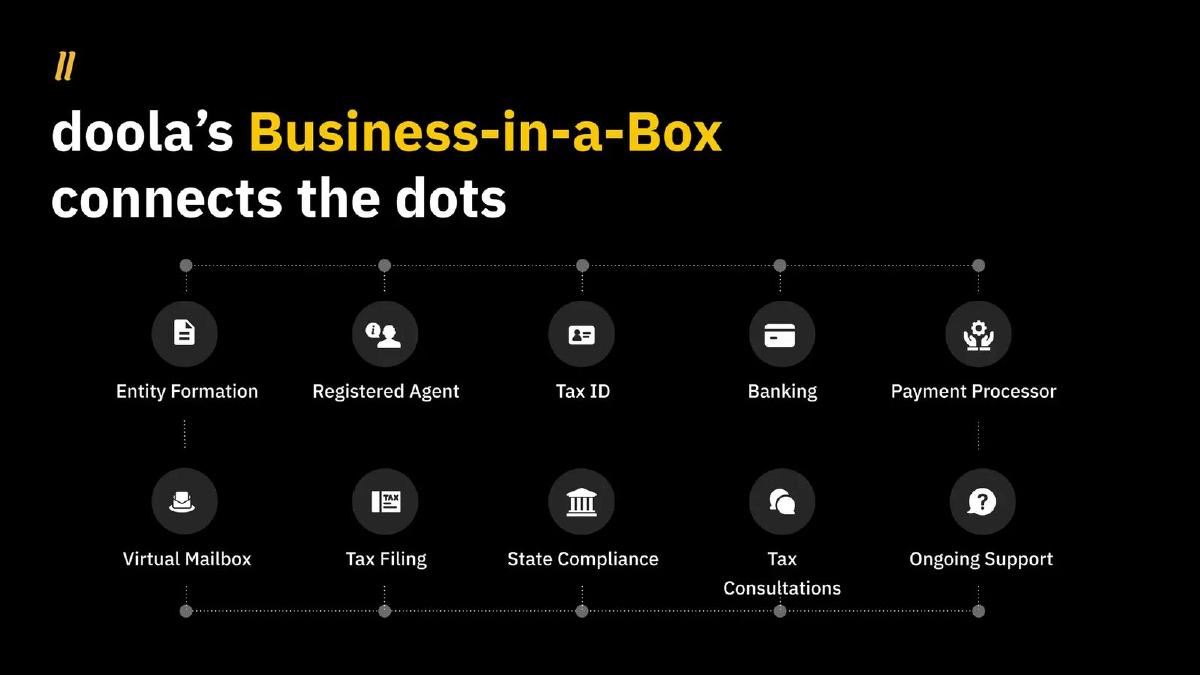
- The product is positioned as a 'Business-in-a-Box' that centralizes entity formation, banking, tax filing, and compliance (Slide 4).
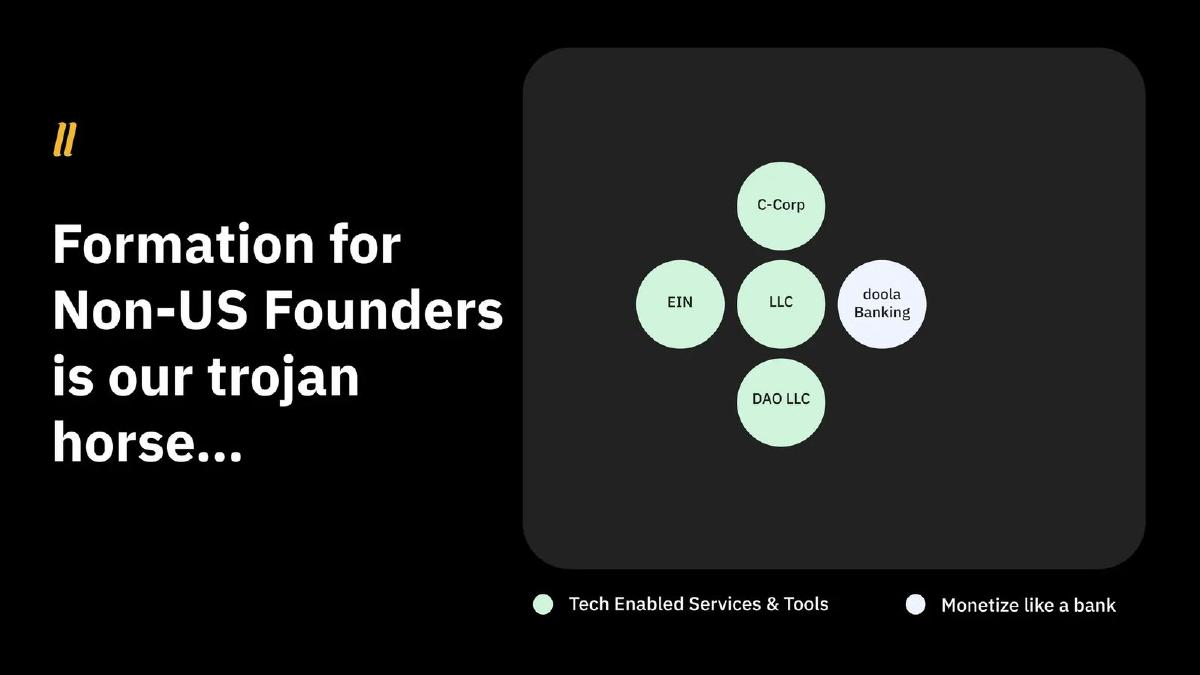
- Formation is explicitly described as a 'trojan horse' to acquire customers for high-margin financial services like lending and payroll (Slides 6-7).
- The deck benchmarks Doola against multi-billion dollar incumbents like Intuit ($102B), Stripe ($95B), and ADP ($85B) to illustrate the scale of the fintech opportunity (Slide 8).
- The 'wedge' revenue opportunity is calculated at $4.5B, based on 5M US companies formed annually with a 30% non-US founder rate and a $3K annual subscription (Slide 10).
- Doola differentiates itself from competitors like Stripe Atlas by moving toward a B2B API infrastructure model rather than just a formation service (Slide 12).
- The team emphasizes founder-market fit, noting their global composition matches a world where 95.75% of the population resides outside the US (Slide 13).
Executive Summary: The Wedge Strategy in Action
Doola's $1M extension deck is a concise, 14-slide presentation that focuses heavily on strategic positioning and market expansion. Rather than dwelling on past performance metrics, the deck is designed to convince investors that the company's initial success in business formation is merely the entry point into a massive fintech ecosystem. By framing their service as 'Access to American Entrepreneurship,' they tap into a global demand for US-based legal and financial infrastructure.
Slide 1: The Hook
The cover slide establishes the brand identity and core mission: 'Access to American Entrepreneurship.' It introduces the 'Business-in-a-Box' concept, which serves as the central metaphor for the entire pitch. The imagery features diverse founders, reinforcing the global nature of their target audience.
Slide 2: Investor Pedigree and Funding History
This slide provides immediate social proof. It lists three distinct funding rounds: a $500k Pre-Seed (Sep 2020) , a $3.1M Seed (Nov 2021) , and an $8.0M Series A (Oct 2022) . Notable investors mentioned include Y Combinator, Hustle Fund, Nexus Venture Partners, and individuals like Arjun Sethi, Jacqueline Reses, Dharmesh Shah, Sahil Bloom, and Ankur Nagpal. This establishes that Doola is already a 'venture-backed' entity with significant institutional support.
Slide 3: The Problem - Fragmented Solutions
Doola illustrates the pain point by showing ten different logos that a non-US founder must currently interact with to start a business. These include Delaware (formation), Northwest (registered agent), IRS (tax ID), Mercury (banking), Stripe (payments), and others. The slide uses the word 'cobble' to describe the current user experience, framing it as inefficient and frustrating.
Slide 4: The Solution - Connecting the Dots
This slide mirrors Slide 3 but replaces the fragmented logos with a unified Doola interface. It lists the same ten categories—Entity Formation, Registered Agent, Tax ID, Banking, Payment Processor, Virtual Mailbox, Tax Filing, State Compliance, Tax Consultations, and Ongoing Support—showing how Doola 'connects the dots' into a single workflow.
Slide 5: The Product Interface
A high-fidelity screenshot of the Doola dashboard is shown. It displays an 'Available Balance' of $2,137.59 and lists features like Transactions, Cards, Payments, and Statements. This slide is critical because it transitions the narrative from a 'service' company to a 'software' company, explicitly stating: 'Formation software is our wedge to building a fintech platform.'
Slides 6-8: The Trojan Horse Strategy
This three-slide sequence explains the long-term business model. Slide 6 shows the 'trojan horse' of EIN, LLC, and C-Corp formation. Slide 7 expands this into 'broader financial services' like ITIN, Bookkeeping, 83Bs, Charge Cards, Lending, and Payroll. Slide 8 completes the vision by mapping these services to multi-billion dollar incumbents. It lists companies like Intuit ($102B) , Stripe ($95B) , ADP ($85B) , and Gusto ($10B) , suggesting that Doola intends to capture a slice of each of these markets for the non-US segment.
Slide 9: Ecosystem Integrations
Doola acknowledges it cannot do everything in-house. It shows integrations with 'world class Companies' including Shopify, HubSpot, Amazon, Stripe, and Google (Gmail). This demonstrates that Doola acts as a central hub for the entrepreneur's entire tech stack.
Slide 10: Market Size and Revenue Math
The deck provides a specific calculation for its Total Addressable Market (TAM). It starts with 5M US Companies projected to be formed in 2022. It assumes 30% are Non-US Founders (noting their current base is 80% non-US). It applies a $3K Doola Subscription ($2K/yr Business Plan + Banking + Services). The result is a $4.5B potential revenue opportunity for the 'non-US' market alone.
Slide 11: Competitive Landscape
A 2x2 grid maps Doola against competitors. The Y-axis distinguishes between 'Non-US Focused' and 'US Focused,' while the X-axis covers C-Corps, LLCs, and DAO LLCs. Doola is the only company positioned in the 'Non-US Focused' category across all three entity types, while competitors like Stripe Atlas, Clerky, and LegalZoom are placed in the 'US Focused' segments.
Slide 12: The Infrastructure Pivot
This slide differentiates Doola from its most direct competitor, Stripe Atlas. It labels Atlas as 'Formation 1.0' and Doola as 'B2B API Infrastructure 2.0.' It shows a snippet of code representing a 'doola()' function that automates LLC formation, banking, and taxes, suggesting a shift toward becoming a platform that other companies can build upon.
Slide 13: Team and Global Reach
The deck highlights that the Doola team is as global as its customer base, with members from all over the world and an in-person HQ in NYC. It uses a demographic chart to show that while the US is only 4.25% of the world population, the 'Rest of World' is 95.75%, emphasizing the scale of the untapped market they are targeting.
Slide 14: The Ask and Contact
The final slide features Founder & CEO Arjun Mahadevan, his credentials (Dropbox, Wharton), and his contact information. The call to action is a play on a famous slogan: 'JUST DOOLA IT.'
What Works in This Deck
The 'Wedge' Narrative: The deck is exceptionally clear about how it intends to grow. By calling formation a 'trojan horse,' it signals to investors that the founders understand the difference between a low-margin entry service and a high-margin platform business.
Social Proof: Highlighting the $11.6M already raised and the specific logos of high-profile investors (YC, Nexus) immediately lowers the perceived risk for an extension round investor.
Visual Consistency: The use of dark backgrounds with bright accents and clean iconography makes the deck feel modern and 'fintech-forward,' rather than like a traditional legal services firm.
What Is Missing
Current Revenue and Growth Metrics: For a company that has already raised a Series A, the lack of current Annual Recurring Revenue (ARR), Month-over-Month (MoM) growth rates, or customer acquisition costs (CAC) is notable. Investors in an extension round usually want to see the 'bridge' metrics that justify the extra capital.
Unit Economics: While Slide 10 provides a 'potential' revenue calculation, it does not show the actual margins on the $3,000 subscription or the take-rate on banking services.
Detailed Team Slide: While the CEO is featured on the final slide, there is no slide detailing the broader leadership team or their specific backgrounds in fintech or compliance.
Founder Takeaways
Sell the Vision, Not Just the Product: Doola could have pitched itself as a 'better way to form an LLC.' Instead, they pitched 'Access to American Entrepreneurship.' Founders should look for the higher-order benefit their product provides.
Use Competitors to Your Advantage: Slide 12 is a bold move. By labeling a giant like Stripe Atlas as '1.0,' Doola creates a category of one for itself ('2.0'). If you are entering a crowded market, you must define why the existing solutions are obsolete.
Simplify the Math: The TAM calculation on Slide 10 is easy to follow. Founders often overcomplicate their market size slides with layers of research; Doola’s '5M x 30% x $3K' approach is much more digestible during a quick pitch.
Frequently asked questions
- What is Doola's primary value proposition?
- Doola provides a 'Business-in-a-Box' for non-US founders, allowing them to access American entrepreneurship by handling entity formation, EIN acquisition, US banking, and tax compliance in a single interface. According to Slide 4, they 'connect the dots' between services that founders previously had to manage individually through multiple third-party vendors.
- How does Doola plan to monetize beyond business formation?
- The deck outlines a strategy to 'monetize like a bank.' Slide 7 shows an expansion roadmap into broader financial services including charge cards, credit cards, lending, payroll, and insurance. By using formation as a low-cost customer acquisition tool, they aim to capture the long-term lifetime value of a business's financial operations.
- Who are Doola's main competitors according to the deck?
- Slide 11 maps the competitive landscape, showing Doola competing with Stripe Atlas, Clerky, and Gusto in the C-Corp space, and ZenBusiness and LegalZoom in the LLC space. Notably, Slide 12 singles out Stripe Atlas, positioning it as 'Formation 1.0' while Doola claims to be 'B2B API Infrastructure 2.0'.
- What is the total funding Doola has raised to date?
- As of the date of this deck, Doola had raised a total of $11.6M. This includes a $500k Pre-Seed in September 2020, a $3.1M Seed in November 2021, and an $8M Series A in October 2022. The deck was created for a subsequent $1M extension round.
- What market size does Doola target?
- Slide 10 calculates a $4.5B revenue opportunity for their 'wedge' offering alone. This assumes 5 million new US companies formed per year, a 30% non-US founder rate, and a $3,000 annual subscription fee for the Doola Business Plan plus banking and services.