Doola’s Series A deck is a masterclass in the 'wedge' strategy. By solving the fragmented process of US entity formation for international founders, Doola captures customers at the very inception of their business journey. The deck effectively transitions from a service-oriented 'Business-in-a-Box' to a high-scale fintech play, aiming to monetize through banking, lending, and payroll. With $8M raised in this round from investors like Nexus Venture Partners and Y Combinator, the presentation relies on clear visual metaphors and a massive TAM calculation based on the 95.75% of the world's popul…
Key takeaways
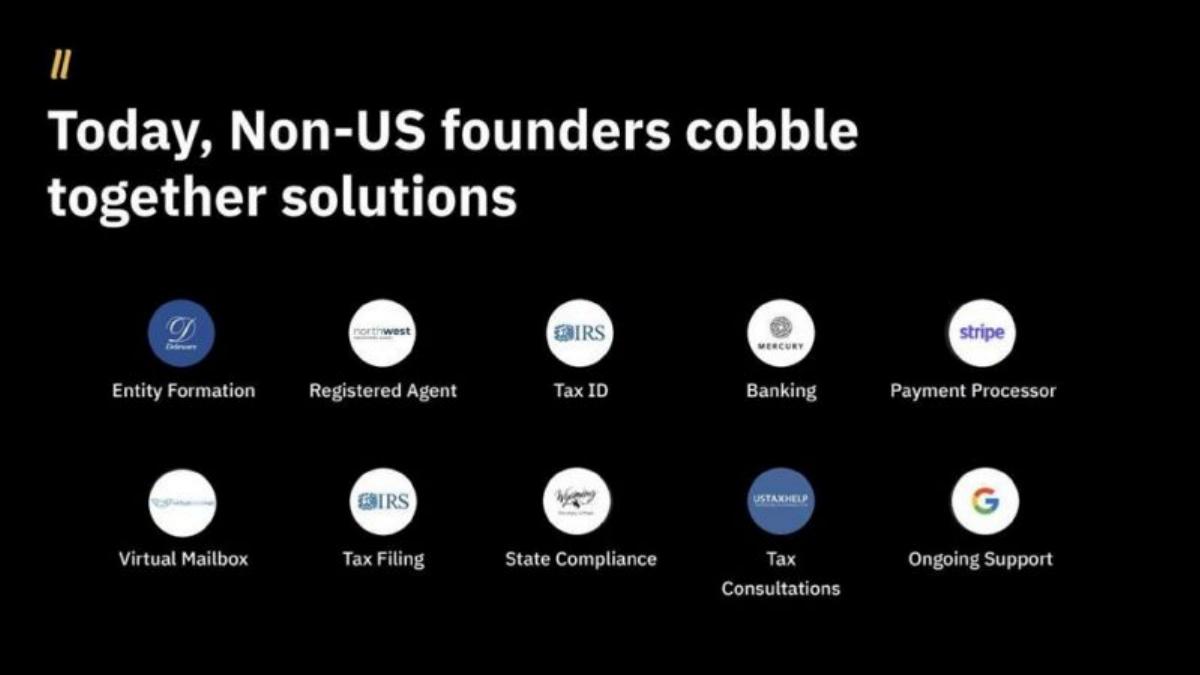
- Doola identifies a fragmented market where non-US founders currently 'cobble together' ten different services to start a business (Slide 3).
- The company positions formation software as a strategic 'wedge' to build a broader fintech platform (Slide 5).
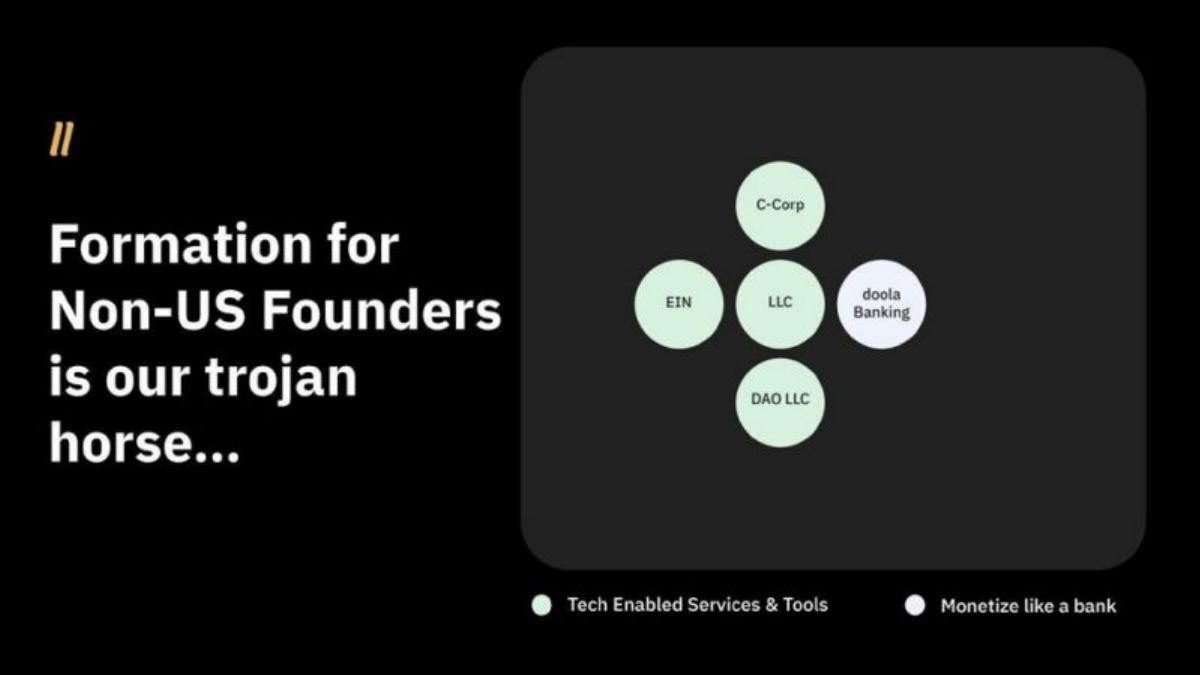
- The deck explicitly uses the term 'Trojan Horse' to describe how LLC and C-Corp formation leads to banking monetization (Slide 6).
- Doola calculates a $4.5B revenue opportunity for their wedge offering alone, based on 5M projected US company formations in 2022 (Slide 10).
- The customer base is stated to be 80% non-US and 20% US residents (Slide 10).
- Doola differentiates itself from Stripe Atlas by positioning Atlas as a '1.0' formation service and itself as '2.0' B2B API infrastructure (Slide 12).
- The deck highlights a global reach, noting that the 'Rest of World' represents 95.75% of the population compared to 4.25% in the US (Slide 13).
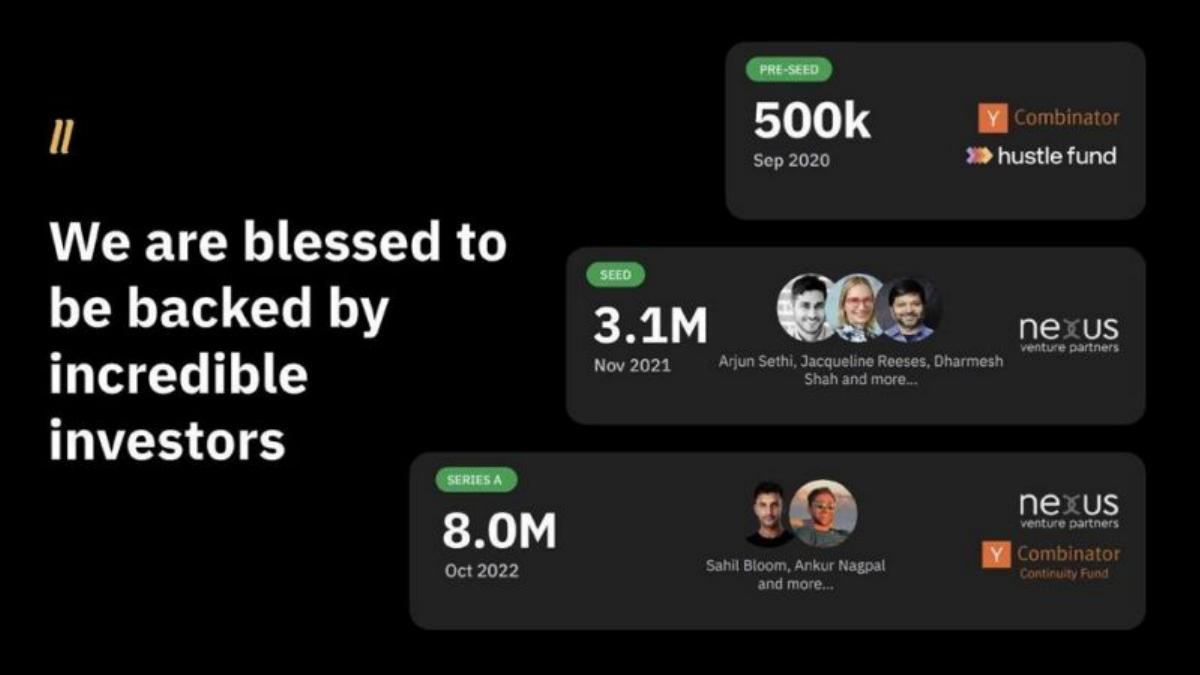
- The Series A round raised $8.0M in October 2022, following a $3.1M Seed and $500k Pre-Seed (Slide 2).
The Narrative: From Formation to Financial Powerhouse
Doola’s pitch deck is a clinical example of how to sell a 'wedge' strategy. The company does not lead with the complexities of banking regulations or payment processing. Instead, it leads with a simple, painful problem: the friction of starting a US business from abroad. By framing formation as the 'Trojan Horse,' Doola convinces investors that they aren't just a service company, but a future fintech giant that captures users at the moment of inception.
Slide 1: The Vision
The cover slide sets a broad, aspirational tone: "Access to American Entrepreneurship." It defines Doola as a "Business-in-a-Box." The imagery features diverse founders and international flags (UK, India), immediately signaling that their primary market is global, not domestic.
Slide 2: Investor Traction
Doola chooses to show its 'pedigree' early. This slide tracks the funding history: a $500k Pre-Seed in September 2020 (Y Combinator, Hustle Fund), a $3.1M Seed in November 2021 (Nexus Venture Partners, and angels like Dharmesh Shah), and the $8.0M Series A in October 2022. Highlighting names like Jacqueline Reses and Arjun Sethi provides immediate social proof for a Series A pitch.
Slide 3: The Problem – Fragmented Solutions
This slide illustrates the 'before' state. It shows ten different logos—including the IRS, Delaware, Mercury, and Stripe—to demonstrate how non-US founders currently "cobble together" solutions. The visual message is clear: the current process is a headache involving multiple disconnected vendors for entity formation, banking, and compliance.
Slide 4: The Solution – Connecting the Dots
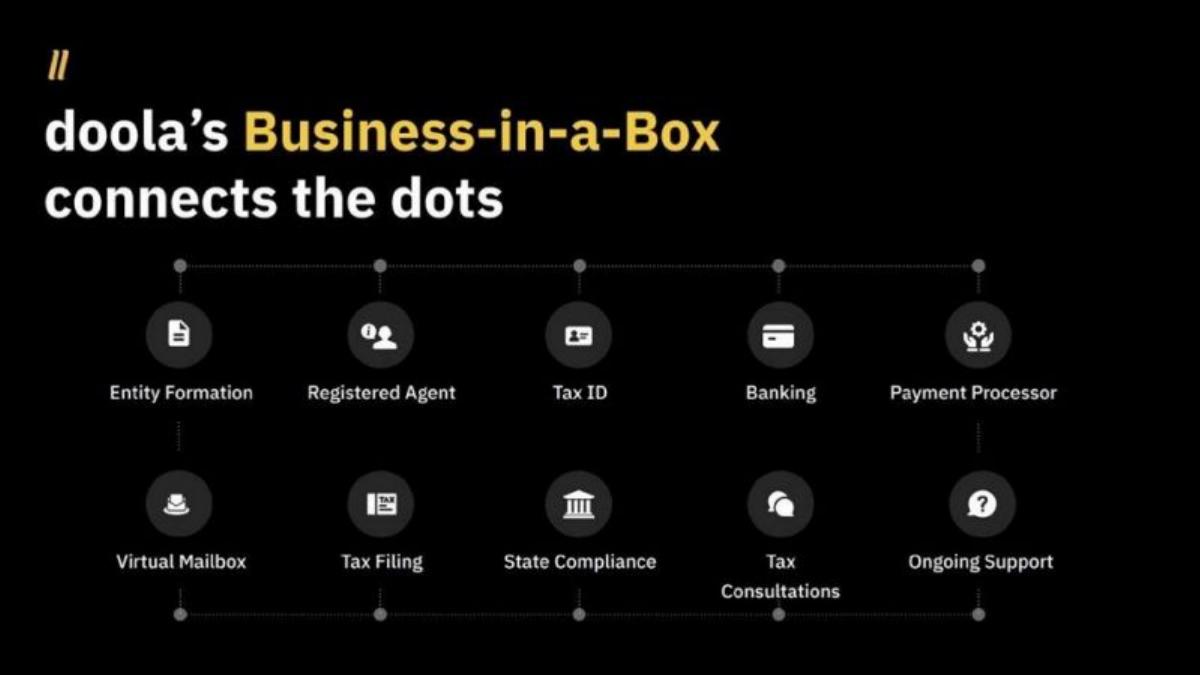
Doola mirrors the previous slide but replaces the fragmented logos with a unified, connected grid under the Doola brand. This is the "Business-in-a-Box" in action, covering everything from Registered Agents to Tax Consultations in a single workflow.
Slide 5: The Wedge Strategy
This is a pivotal slide for a fintech investor. Doola explicitly states: "Formation software is our wedge to building a fintech platform." It shows a clean dashboard UI with a balance of $2,137.59, moving the conversation from 'paperwork' to 'money management.'
Slide 6 & 7: The Trojan Horse Expansion
Slide 6 introduces the "Trojan Horse" metaphor. It shows formation (LLC, C-Corp, EIN) as the entry point, with "doola Banking" as the first step toward monetization. Slide 7 expands this into a massive ecosystem of financial services: Charge Cards, Lending, Payroll, Insurance, and Cap Table management. The color-coding distinguishes between "Tech Enabled Services" (the wedge) and "Monetize like a bank" (the scale).
Slide 8: The Billion Dollar Opportunity
Doola maps its potential services against existing giants. It places itself at the center of a web featuring Intuit ($102B), Stripe ($95B), Gusto ($10B), and Brex ($12B). The slide argues that by owning the formation, Doola can eventually compete for the revenue currently captured by these specialized multi-billion dollar entities.
Slide 9: Ecosystem Integrations
For the services Doola does not yet provide in-house, they show a hub-and-spoke model of integrations. Logos include Shopify, HubSpot, Amazon, and Stripe. This suggests that Doola is the 'operating system' that connects a new business to the rest of the world-class SaaS ecosystem.
Slide 10: Market Sizing (TAM)
The math here is transparent: 5M US companies projected to form in 2022, multiplied by a 30% non-US founder rate (Doola notes their own base is 80% non-US), multiplied by a $3,000 annual value ($2k subscription + banking/services). This results in a $4.5B potential revenue figure for the "Non-US" market alone. It’s a bottom-up calculation that feels grounded in their current user data.
Slide 11: Competitive Landscape
Doola uses a 2x2-style grid to differentiate. They position themselves as the only player that is both "Non-US Focused" and covers the full spectrum of C-Corps, LLCs, and DAO LLCs. Competitors like LegalZoom and ZenBusiness are relegated to the "US Focused" LLC quadrant, while Stripe Atlas and Clerky are shown as "US Focused" C-Corp tools.
Slide 12: Doola as Infrastructure
This slide targets the technical investor. It contrasts Stripe Atlas ("Formation service 1.0") with Doola ("B2B API Infrastructure 2.0"). The use of code snippets (e.g., function doola() { llc(); ccorp(); }) suggests that Doola is building a programmable layer for business creation, not just a manual service portal.
Slide 13: Global Ambition
A bubble map shows the distribution of potential customers globally, with massive bubbles for China (1412) and India (1379). It reinforces the earlier point: 95.75% of the world lives outside the US, and Doola is their gateway to the US economy.
Slide 14 & 15: The Close
The deck concludes with a photo of CEO Arjun Mahadevan, noting his background at Dropbox and Wharton. The call to action is a play on a famous slogan: "JUST DOOLA IT."
What Works in the Doola Deck
The 'Wedge' Narrative: Doola successfully argues that formation is the highest-leverage point in a company's lifecycle. By owning the 'birth' of the company, they have a natural right to provide the bank account and payroll. This turns a low-margin service business into a high-margin fintech story.
Visual Consistency: The deck uses a consistent dark theme with bright, color-coded accents to distinguish between services and financial products. The 'connecting the dots' visual from Slide 3 to Slide 4 is a very effective way to communicate value proposition without using too much text.
Clear TAM Calculation: Instead of citing a vague Gartner report, Doola builds its market size using its own internal customer data (80% non-US) and projected formation rates. This makes the $4.5B figure feel earned rather than invented.
What is Missing
Unit Economics: For a Series A, investors usually want to see the LTV/CAC ratio. While Doola mentions a $3k revenue potential, they don't disclose what it actually costs to acquire these international founders or what their current churn rate looks like.
Team Depth: The deck is very founder-centric. While Arjun Mahadevan has a strong background, a Series A company usually needs to showcase its broader leadership team, especially in highly regulated sectors like fintech and compliance.
Historical Growth: There are no charts showing the trajectory of formations or revenue over the 2020-2022 period. The deck focuses almost entirely on the future opportunity rather than proving the current momentum with hard numbers.
What Other Founders Should Copy
The 'Trojan Horse' Slide: If you are building a service-heavy business with the goal of becoming a platform, use Slide 6 and 7 as a template. It clearly shows how 'Step A' (the service) leads to 'Step B' (the scalable product).
The Comparison Slide: Slide 12 is a great way to handle a 'Goliath' competitor like Stripe. By labeling them as '1.0' and yourself as '2.0,' you frame the incumbent as a legacy solution without having to disparage their success.
Problem/Solution Visuals: The 'cobbled together' vs. 'unified' visual on Slides 3 and 4 is the most efficient way to explain a middleware or aggregator business model. It identifies the pain and the relief in two seconds of viewing.
Frequently asked questions
- What is Doola's core business model according to the deck?
- Doola operates a 'Business-in-a-Box' model that simplifies US entity formation for global entrepreneurs. While it starts with tech-enabled services like LLC formation, EIN acquisition, and tax filings, the long-term model is a fintech platform. They aim to 'monetize like a bank' by offering banking, credit cards, lending, and payroll once the entity is established.
- How does Doola compare itself to competitors like Stripe Atlas or LegalZoom?
- On Slide 11, Doola positions itself as the only player focused on both US and Non-US residents across C-Corps, LLCs, and DAO LLCs. It specifically labels Stripe Atlas as a '1.0' formation service, while calling Doola '2.0' B2B API infrastructure, suggesting a more deeply integrated and developer-friendly technical stack.
- What are the primary revenue drivers identified in the pitch?
- The deck identifies a $3,000 annual revenue potential per customer. This is broken down into a $2,000/year 'Business Plan' subscription plus additional revenue from banking and other financial services. They multiply this by the 1.5 million projected non-US founders (30% of 5M total formations) to reach a $4.5B TAM for the wedge alone.
- Who are the key investors in Doola's Series A?
- According to Slide 2, the $8M Series A was led by Nexus Venture Partners and the Y Combinator Continuity Fund. Notable individual investors mentioned include Sahil Bloom and Ankur Nagpal. The company also lists HubSpot Ventures as an investor in the catalogue facts.
- What is missing from the Doola pitch deck?
- The deck is notably missing a traditional 'Team' slide showcasing the full executive bench or advisors, though the CEO is featured on the final slide. It also lacks a detailed breakdown of unit economics (CAC/LTV), a specific 'Use of Funds' slide for the $8M raised, and a detailed historical growth chart showing month-over-month revenue or user acquisition.