The DoorDash 'deck' is unique because it consists of a three-page internal investment memo from Sequoia Capital dated March 31, 2014, followed by two conceptual slides. At the time, DoorDash was operating at a $10M annual GPV run-rate with a 21% take rate, yielding over $2M in annual revenue. The document is a masterclass in cohort analysis, showing that while customer retention dropped to 40% after the first month, the remaining users increased their spending over time, with some cohorts reaching nearly $200 in GPV per returning customer. Sequoia identified the 'pre-mortem' risks—such as irr…
Key takeaways
- The company achieved a $10M annual GPV run-rate within 9 months of operation (Slide 1).
- DoorDash maintained a take rate of over 21%, resulting in a $2M+ annual revenue run-rate (Slide 1).
- Customer retention stabilized at 30-40% after an initial one-month drop-off (Slide 2).
- Returning customers showed increasing spend over time, with GPV per customer rising from ~$100 to nearly $200 (Slide 3).
- The founders personally worked as drivers for Papa John’s, UberX, and Lyft to understand logistics (Slide 1).
- Sequoia identified Grubhub, Postmates, and Caviar as primary competitors in 2014 (Slide 3).
- The internal recommendation was to invest $7M-$10M for a 25% equity stake (Slide 3).
- The long-term vision was to move beyond food into a 'real-time delivery network for local commerce' (Slide 4).
The Internal Lens: Analyzing the Sequoia Memo
Most pitch deck teardowns focus on the story a founder tells an investor. This teardown is different. We are looking at the 2014 internal investment memo from Sequoia Capital. This document represents the 'truth' as seen by one of the world's most successful VC firms after they have performed due diligence. It consists of three pages of dense analysis followed by two visual slides that illustrate the product's 39-minute delivery promise and its three-sided marketplace structure.
Slide 1: The Due Diligence Memo (Introduction, Market, Team)
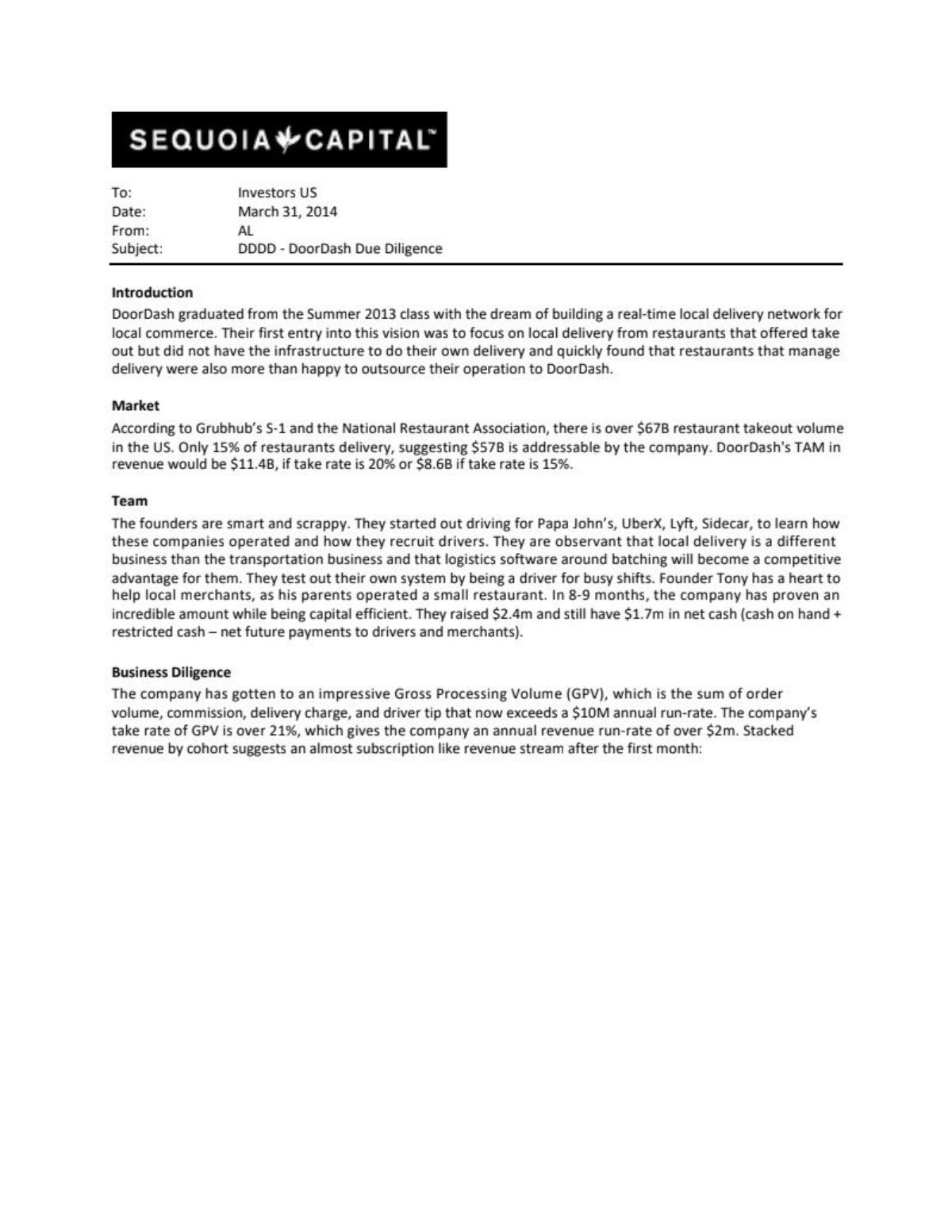
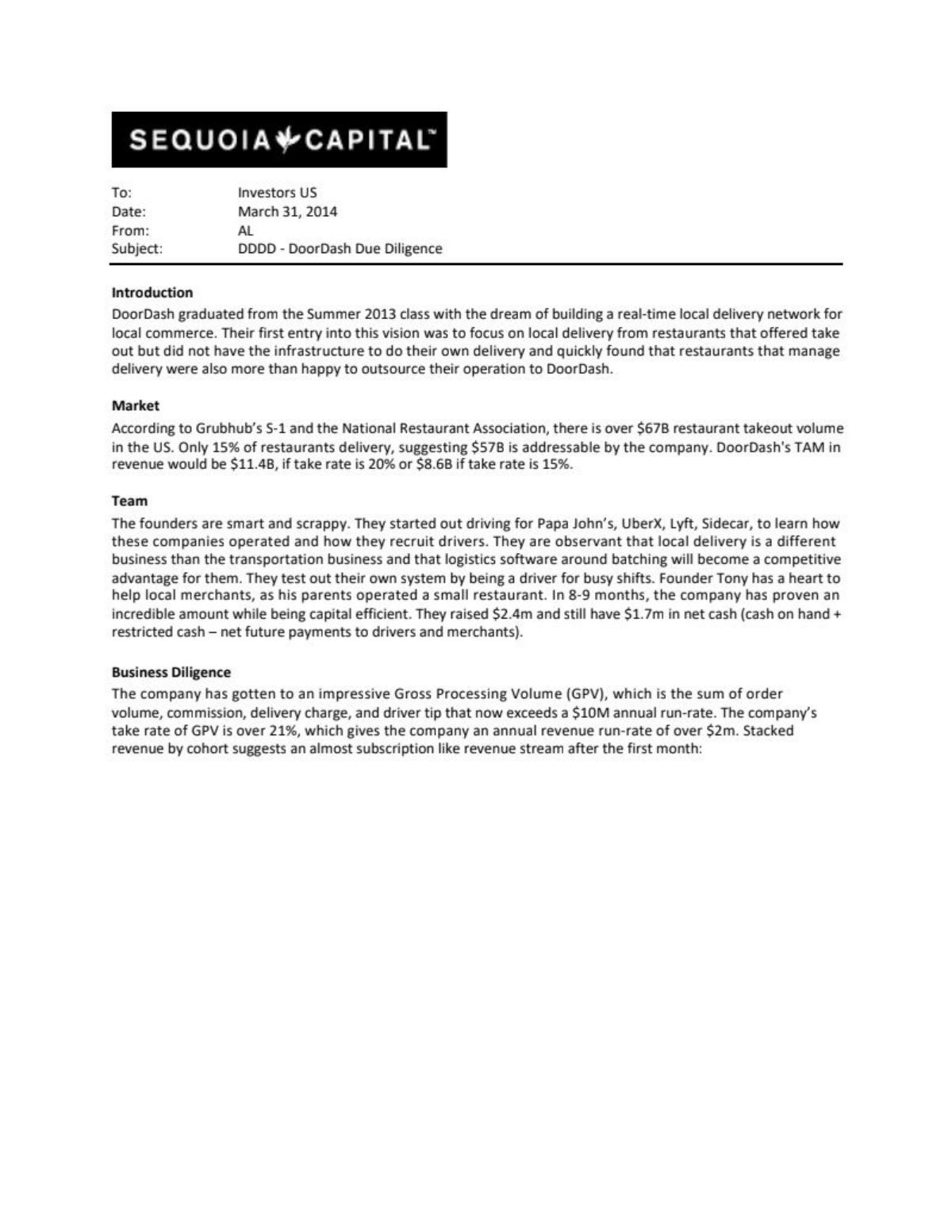
The first slide is a formal memo dated March 31, 2014. It identifies DoorDash as a graduate of the Y Combinator Summer 2013 class. The introduction establishes the core thesis: DoorDash is building a 'real-time local delivery network for local commerce,' starting with restaurants that lack their own delivery infrastructure.
The Market section cites Grubhub’s S-1 and the National Restaurant Association to value US restaurant takeout at $67B. Sequoia notes that only 15% of restaurants offer delivery, leaving a $57B addressable gap. They calculate a potential TAM of $8.6B to $11.4B based on a 15-20% take rate.
The Team section provides a rare look at founder 'scrappiness.' It explicitly states that the founders (Tony Xu, Andy Fang, Stanley Tang, and Evan Moore) drove for Papa John’s, UberX, Lyft, and Sidecar to learn driver recruitment and logistics. This hands-on research led them to believe that logistics software for 'batching' would be their primary competitive advantage. Financially, the slide reveals the company had raised $2.4M and still held $1.7M in net cash, demonstrating high capital efficiency.
Slide 2: Cohort Analysis and Retention
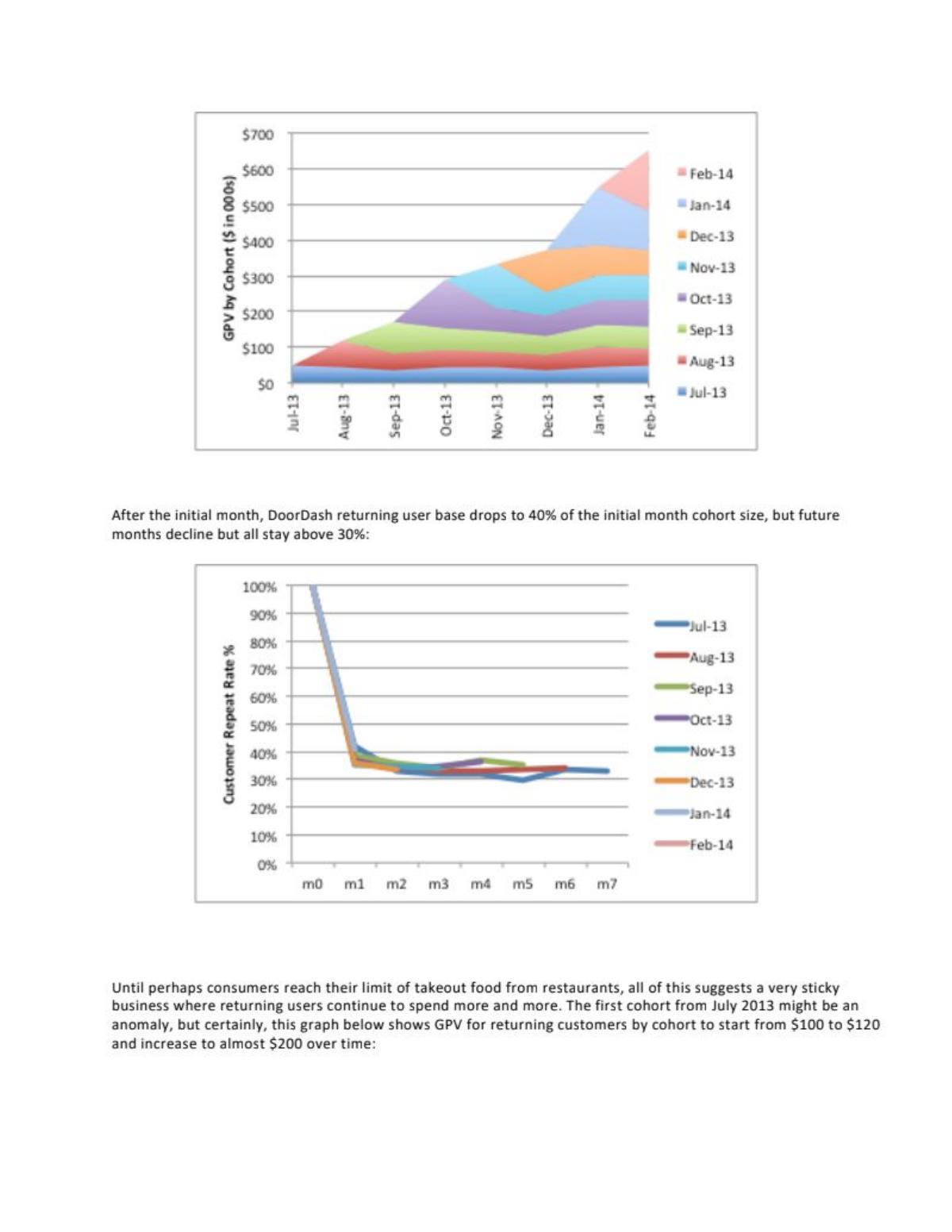
The second slide is purely data-driven, featuring two critical charts. The top chart shows GPV by Cohort from July 2013 to February 2014. The stacked area graph shows a healthy 'layer cake' effect, where total volume is growing not just from new users, but from the sustained activity of older users. By February 2014, the monthly GPV was approaching $700,000.
The bottom chart, Customer Repeat Rate % , is the most honest slide in the deck. It shows a steep drop from month 0 to month 1, where retention falls to roughly 40%. However, the lines flatten out significantly between months 1 and 7, staying above 30%. This 'long tail' of retention is what VCs look for in marketplaces; it proves that once a user is hooked, they become a permanent part of the ecosystem.
Slide 3: Unit Economics and the 'Pre-Mortem'
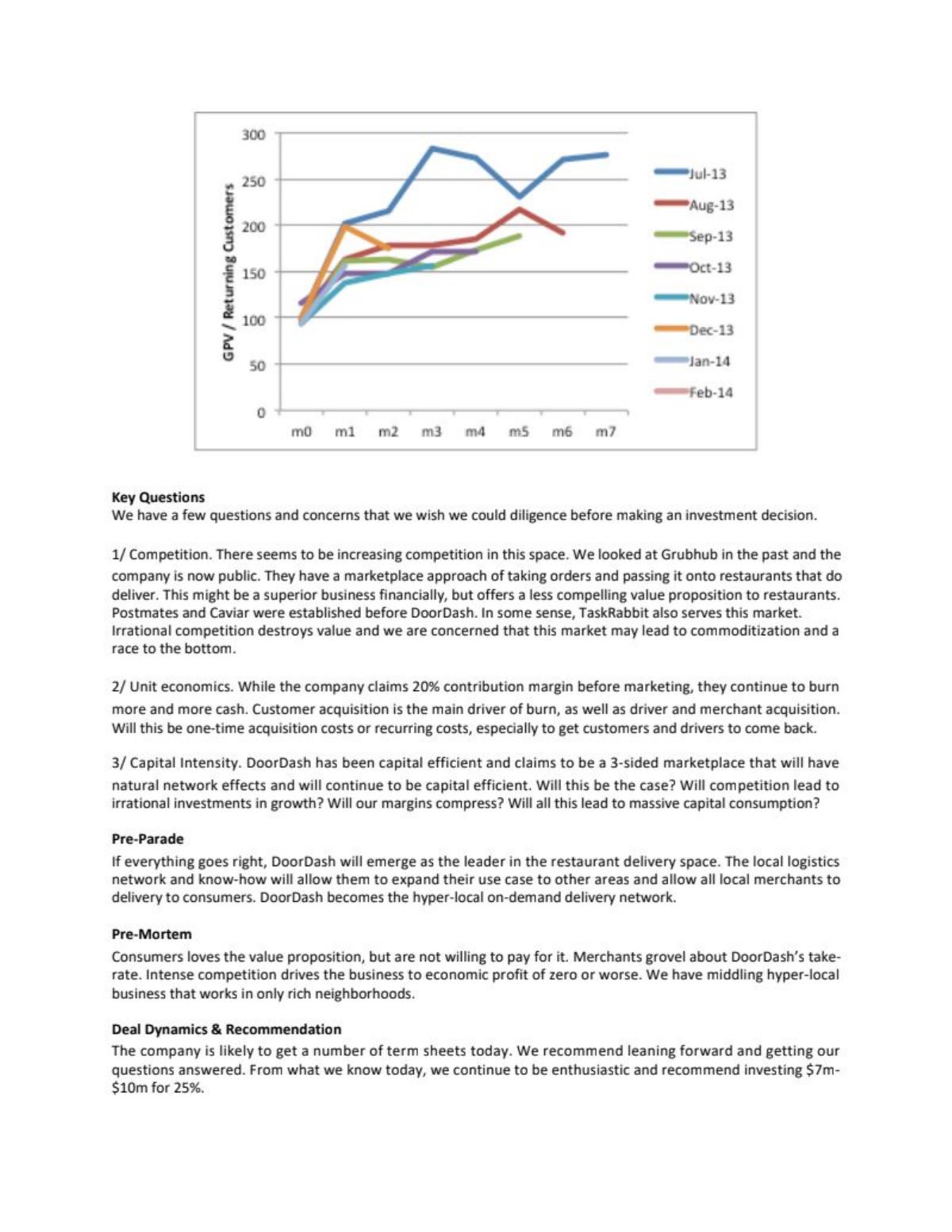
The third slide continues the data deep-dive with a chart showing GPV per Returning Customer . This is the 'aha' moment for the investment: while many users leave, those who stay actually spend more over time. The July 2013 cohort started at $100 in GPV and grew to nearly $200 by month 7.
The Key Questions section is a sobering look at VC concerns. Sequoia identifies three risks: 1) Competition from Grubhub, Postmates, and Caviar leading to 'commoditization'; 2) Unit economics, specifically whether the 20% contribution margin can survive high customer acquisition costs; and 3) Capital intensity.
The Pre-Mortem is particularly brutal: it imagines a future where merchants 'grovel' about take rates and the business only works in 'rich neighborhoods.' Despite these risks, the Recommendation is clear: invest $7M-$10M for 25% of the company. Sequoia recognized that if the 'local logistics network' vision held true, DoorDash would move far beyond food.
Slide 4: The Three-Sided Marketplace
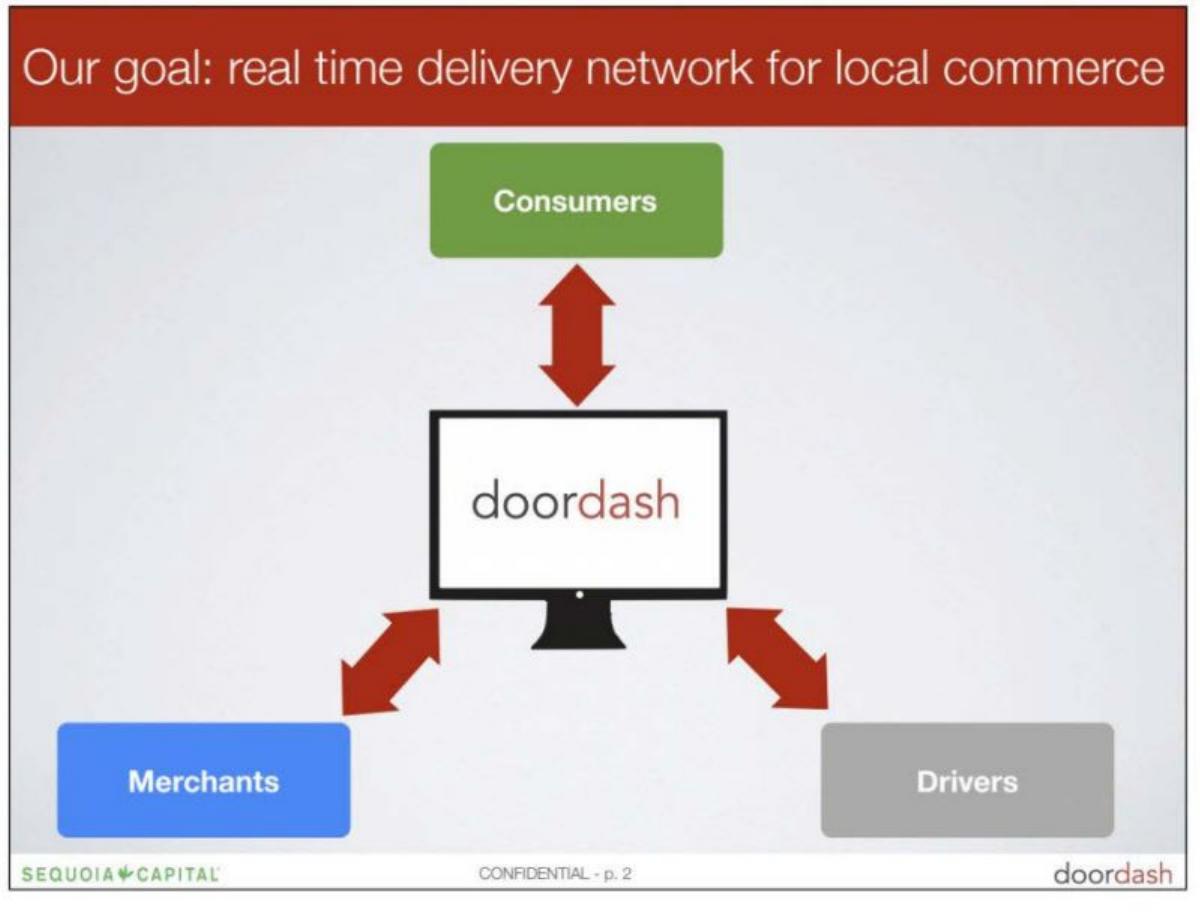
This slide moves into the visual 'pitch' territory. It illustrates the three-sided marketplace model. At the center is the DoorDash platform (represented by a computer monitor), connected by red double-sided arrows to three distinct groups: Consumers , Merchants , and Drivers . This is a classic platform play. The slide emphasizes that DoorDash isn't just a delivery company; it is the connective tissue between these three nodes. The goal stated at the top is 'real time delivery network for local commerce,' signaling that food is just the first vertical.
Slide 5: The 39-Minute Promise
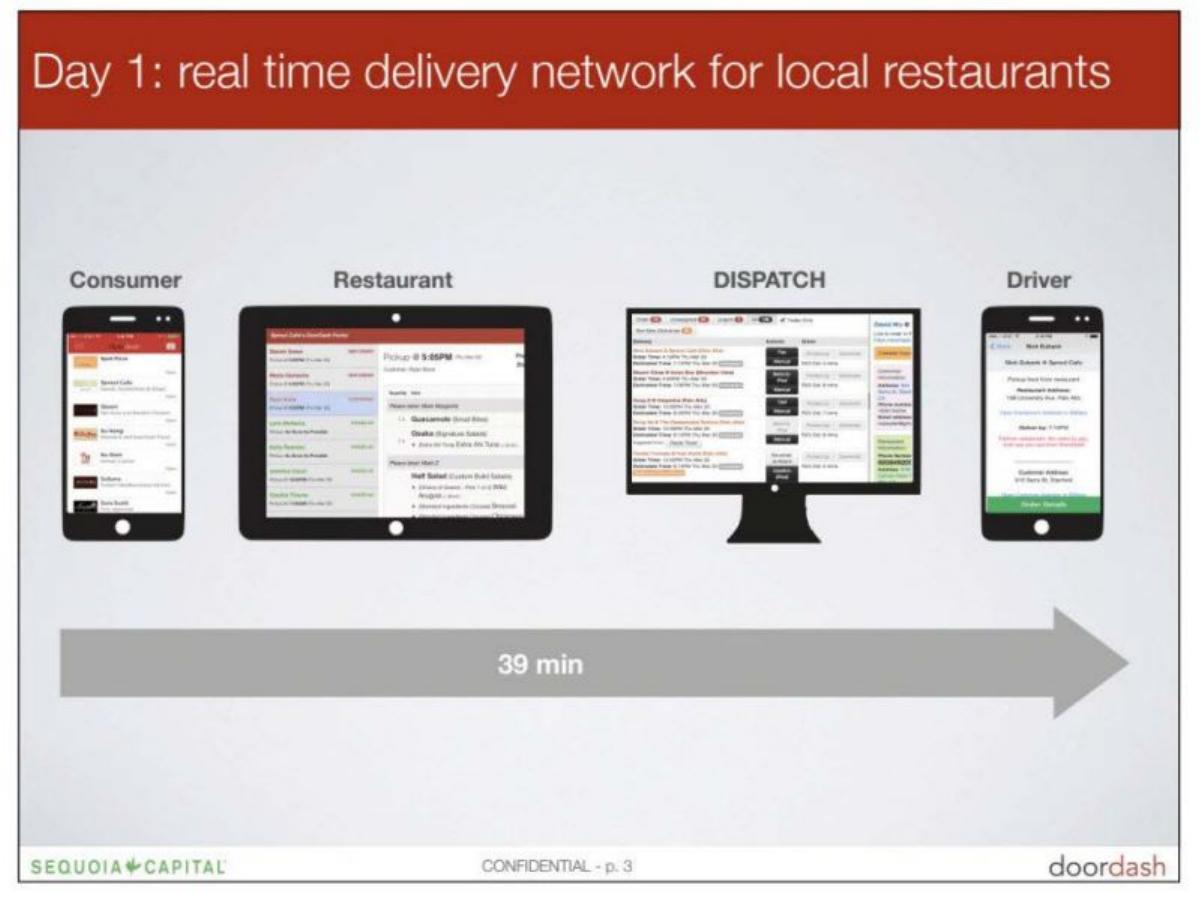
The final slide provides a 'Day 1' look at the operational flow. It shows the interfaces for the four participants in a single transaction: the Consumer (mobile app), the Restaurant (tablet portal), Dispatch (centralized monitoring), and the Driver (mobile app). A large grey arrow at the bottom sets a clear performance benchmark: 39 min . This slide is effective because it demonstrates that the 'logistics software' mentioned in the memo isn't just a theory—it is a functional suite of tools that manages a complex, time-sensitive operation in under 40 minutes.
What DoorDash Got Right
Radical Transparency: Because this is an internal memo, it doesn't hide the flaws. It shows the 60% churn after the first month. However, it uses that data to highlight the 40% who stay and double their spending. Founders should learn that showing 'ugly' data with a 'beautiful' explanation is more convincing than hiding the data entirely.
Operational Empathy: The fact that the founders drove for competitors to understand the 'driver' side of the marketplace is a massive signal of founder-market fit. It proved they weren't just ivory-tower engineers, but operators who understood the friction of the street.
The 'Layer Cake' Growth: The cohort charts are the gold standard for marketplace pitches. They prove that the business isn't a 'leaky bucket' where you have to buy every single dollar of revenue through new ads. The growth is compounding.
What is Missing
Marketing Strategy: The memo mentions that customer acquisition is the main driver of burn, but there is no detail on how they actually acquire users or what the CAC (Customer Acquisition Cost) is relative to LTV (Lifetime Value).
Regulatory Risk: In hindsight, the biggest challenge for DoorDash has been labor law and driver classification. In 2014, this was barely a blip on the radar, and it is entirely absent from the 'Key Questions' or 'Pre-Mortem' sections.
Product Roadmap: While the 'local commerce' vision is mentioned, there are no specifics on what comes after food. Is it groceries? Pharmacy? Alcohol? The deck stays hyper-focused on the current restaurant traction.
What Founders Should Copy
The Cohort Chart: If you are running a subscription or marketplace business, you must have a chart like the one on Slide 2. It is the only way to prove you have a 'sticky' product.
The Pre-Mortem: Founders should perform their own pre-mortem before meeting VCs. If you can identify the three reasons your company might fail and explain why you are the right person to navigate those risks, you build immense credibility.
The Three-Sided Diagram: Slide 4 is a perfect example of how to simplify a complex business model. It clearly defines who the stakeholders are and places the company's technology at the center of the value exchange.
Frequently asked questions
- Is this the original deck DoorDash used to pitch investors?
- No. This document is an internal due diligence memo created by Sequoia Capital analysts for their investment committee. While it contains slides that likely originated from the founders, the text reflects the investor's perspective, including a 'Pre-Mortem' section detailing why the business might fail.
- What were DoorDash's key metrics at the time of this round?
- DoorDash was seeing over $10M in annual Gross Processing Volume (GPV). Their take rate was 21%, and they claimed a 20% contribution margin before marketing expenses. They had raised $2.4M previously and still had $1.7M in net cash on hand.
- How did Sequoia view the competition in 2014?
- Sequoia was concerned about 'irrational competition' from Grubhub, Postmates, and Caviar. They specifically noted that Grubhub’s marketplace model (not handling delivery) might be financially superior but offered a less compelling value proposition to restaurants than DoorDash’s full-service model.
- What was the 'Pre-Mortem' for DoorDash?
- The memo's pre-mortem suggested the business could fail if consumers were unwilling to pay for delivery, if merchants revolted against high take rates, or if intense competition drove economic profit to zero, leaving DoorDash as a 'middling hyper-local business' only viable in wealthy areas.
- What was the ultimate investment recommendation?
- The memo recommended 'leaning forward' to lead the round, suggesting an investment of $7M to $10M in exchange for a 25% ownership stake in the company.