Venzee’s pitch deck is a masterclass in brevity, consisting of only seven slides. The company targets a specific inefficiency in the ecommerce supply chain: the 90% of vendors still using manual spreadsheets to share product data. By positioning itself as the 'transform' layer between raw vendor data and major retail platforms like Shopify and SAP, Venzee presents a viral B2B growth model where one major retailer (like Staples) pulls its entire vendor network into the ecosystem. Despite the lack of a team slide, financial history, or a specific investment 'ask,' the deck successfully communic…
Key takeaways
- The deck identifies that 90% of the world's vendors still use manual spreadsheets to share product information (Slide 2).
- Venzee positions itself as a real-time integration tool that allows retailers like Staples to update online stores in seconds (Slide 3).
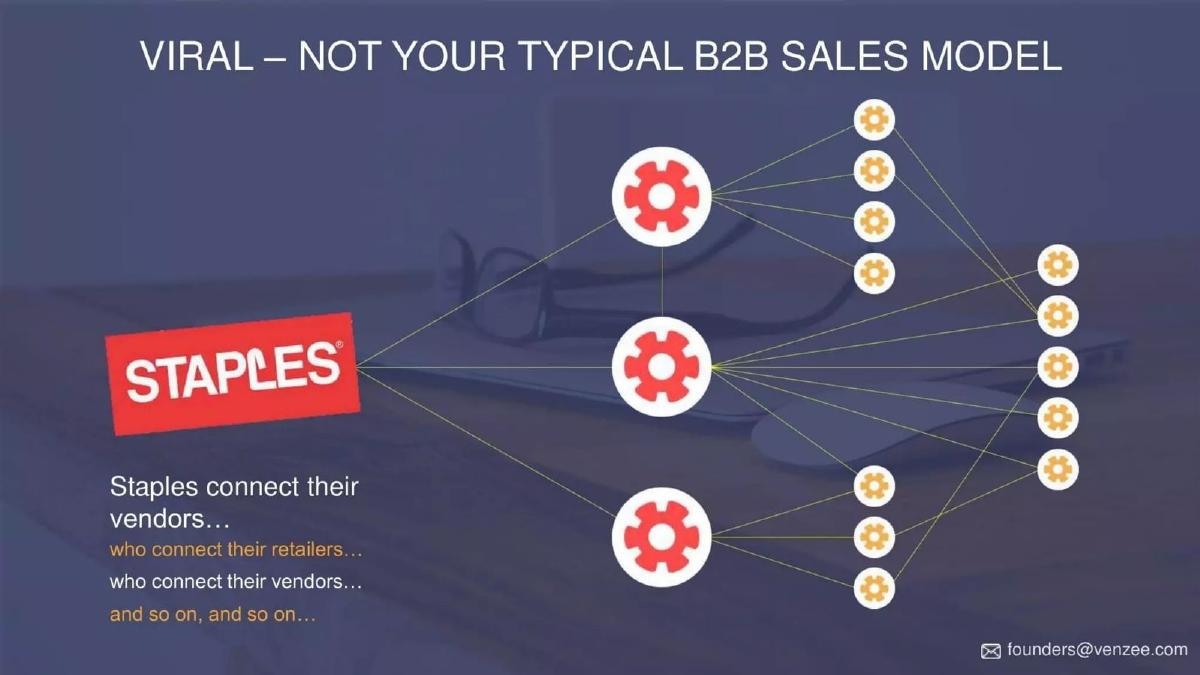
- The company claims a viral B2B sales model where retailers connect their vendors, who in turn connect other retailers (Slide 4).
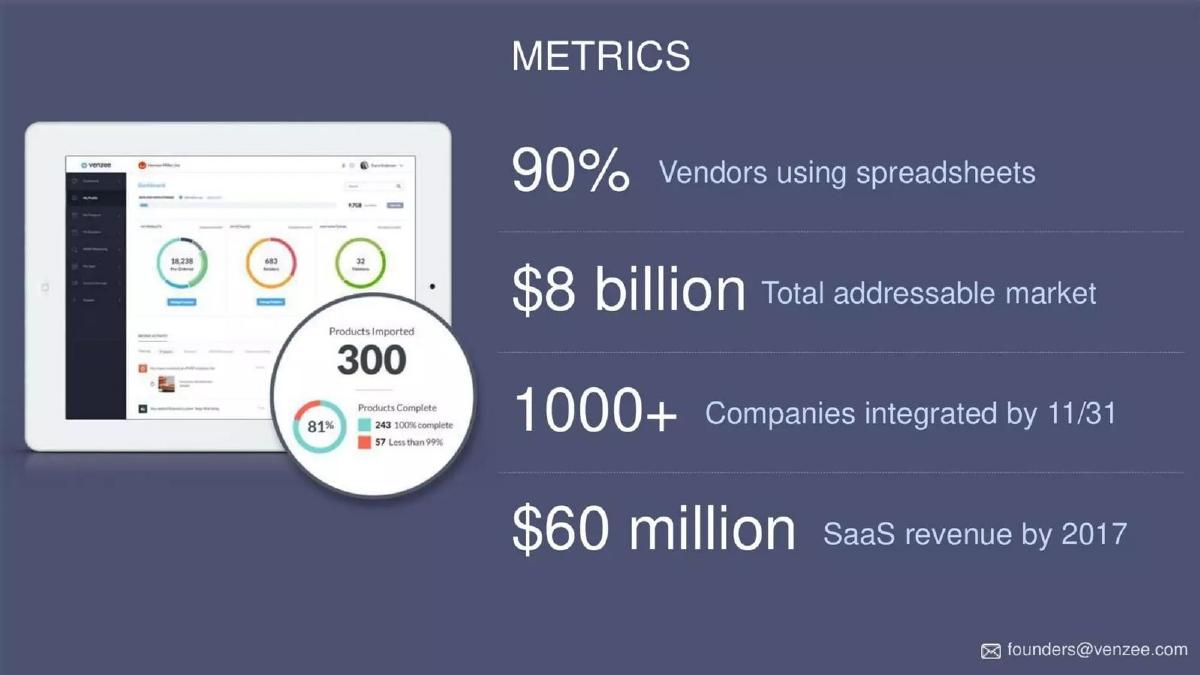
- The total addressable market is valued at $8 billion (Slide 5).
- Venzee projected reaching $60 million in SaaS revenue by 2017 (Slide 5).
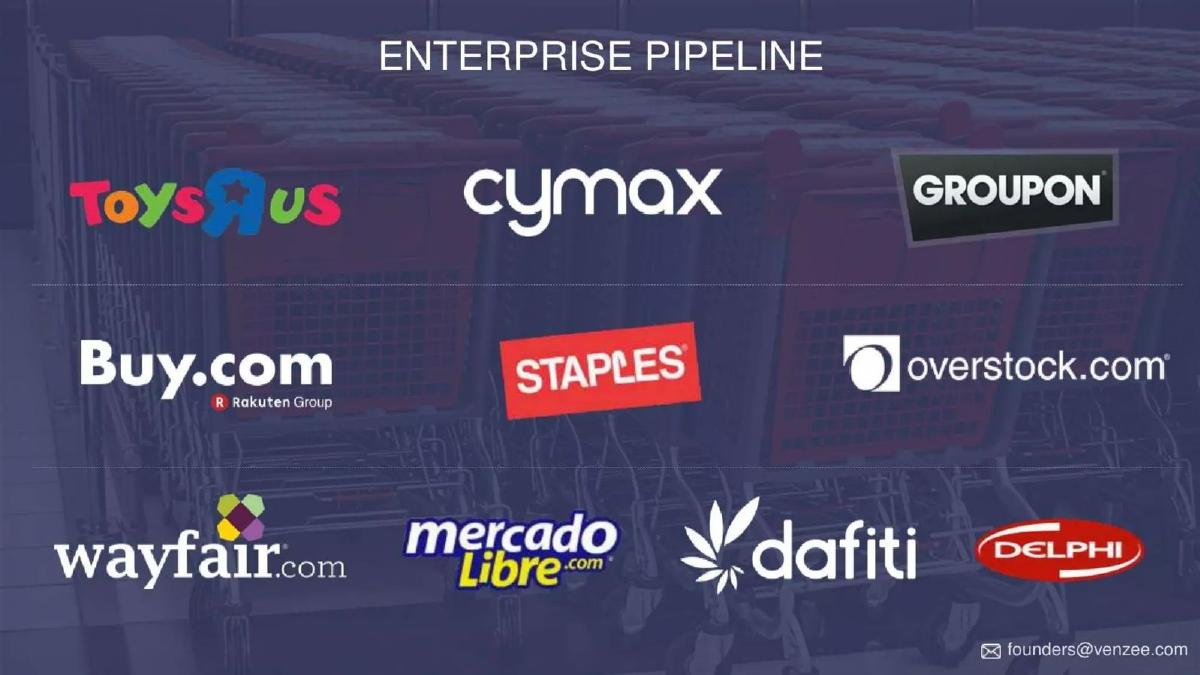
- The enterprise pipeline includes major logos such as Toys R Us, Staples, Wayfair, and Groupon (Slide 6).
- The deck completely omits a team slide, detailed unit economics, and a specific funding ask (Slides 1-7).
- The product is marketed under the hashtag #nomorespreadsheets to emphasize the removal of manual labor (Slide 1).
The Power of a Seven-Slide Narrative
Venzee’s pitch deck is an anomaly in the world of venture capital. While many founders struggle to condense their vision into 20 slides, Venzee managed to raise $6.9 million using just seven. The deck is characterized by a high-contrast design, minimal text, and a relentless focus on a single enemy: the spreadsheet. By framing the entire business around the hashtag #nomorespreadsheets, Venzee created a clear, digestible narrative that even a non-technical investor could immediately grasp.
Slides 1-3: The Problem and The Pivot
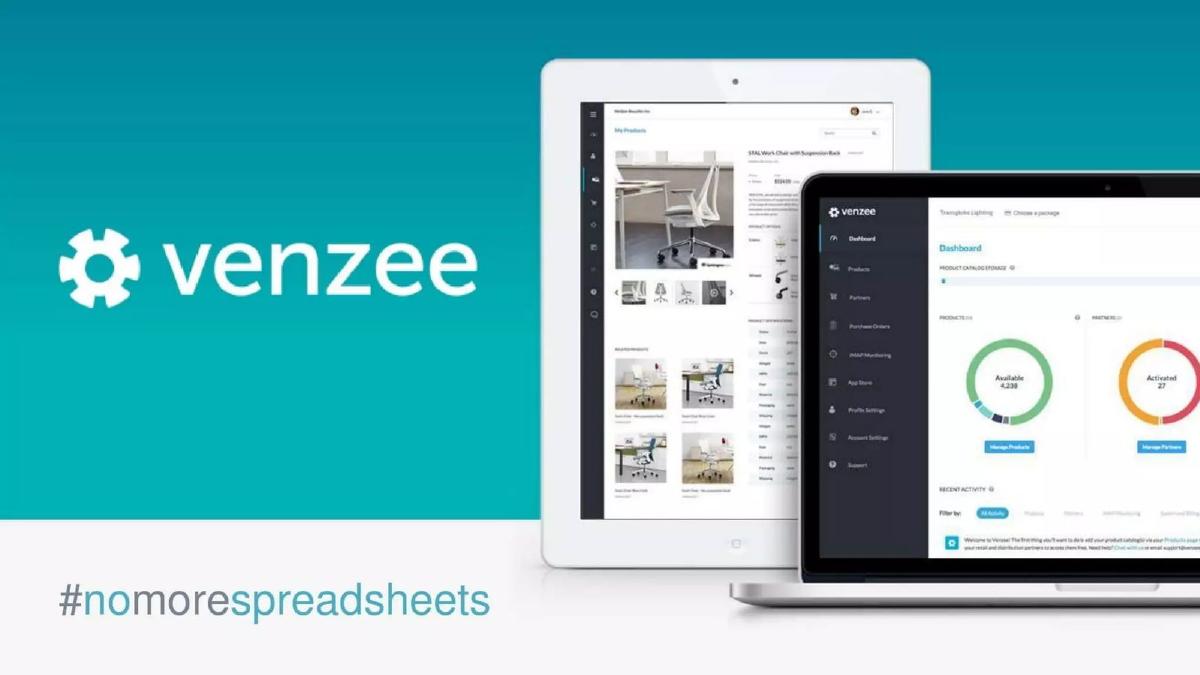
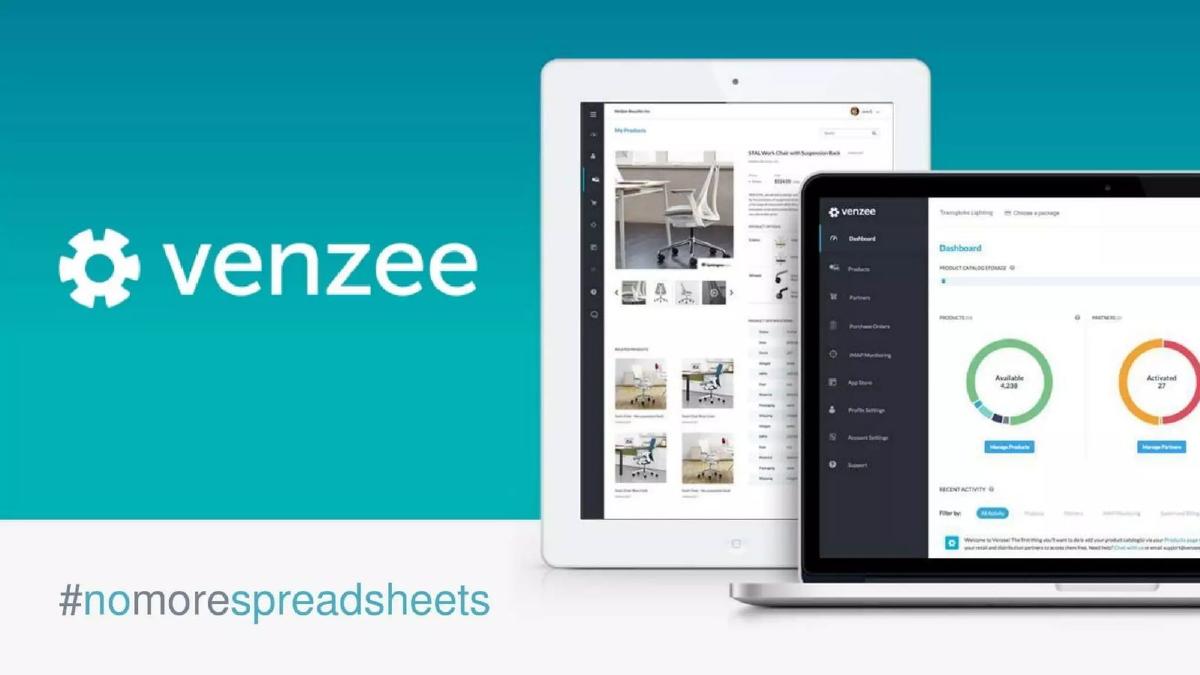
Slide 1: Title Slide The deck opens with the Venzee logo and a clean product shot showing the interface on both a tablet and a laptop. The most important element here is the footer: #nomorespreadsheets. This sets the tone for the entire presentation. It isn't just a software pitch; it is a campaign against an outdated workflow.
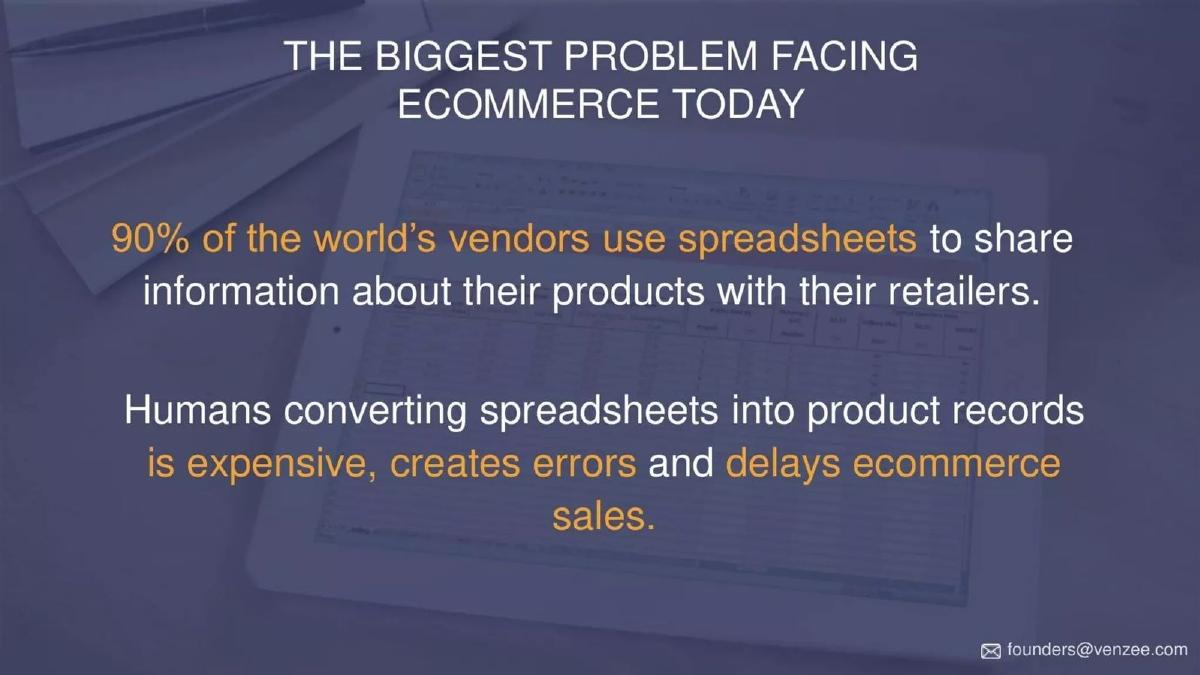
Slide 2: The Biggest Problem Facing Ecommerce Today Slide 2 identifies the villain. It states that 90% of the world’s vendors use spreadsheets to share information. The slide argues that human conversion of these spreadsheets into product records is expensive, creates errors, and delays sales. By quantifying the problem (90%) and listing the consequences (cost, errors, delays), Venzee establishes the necessity of their solution before even explaining how it works.
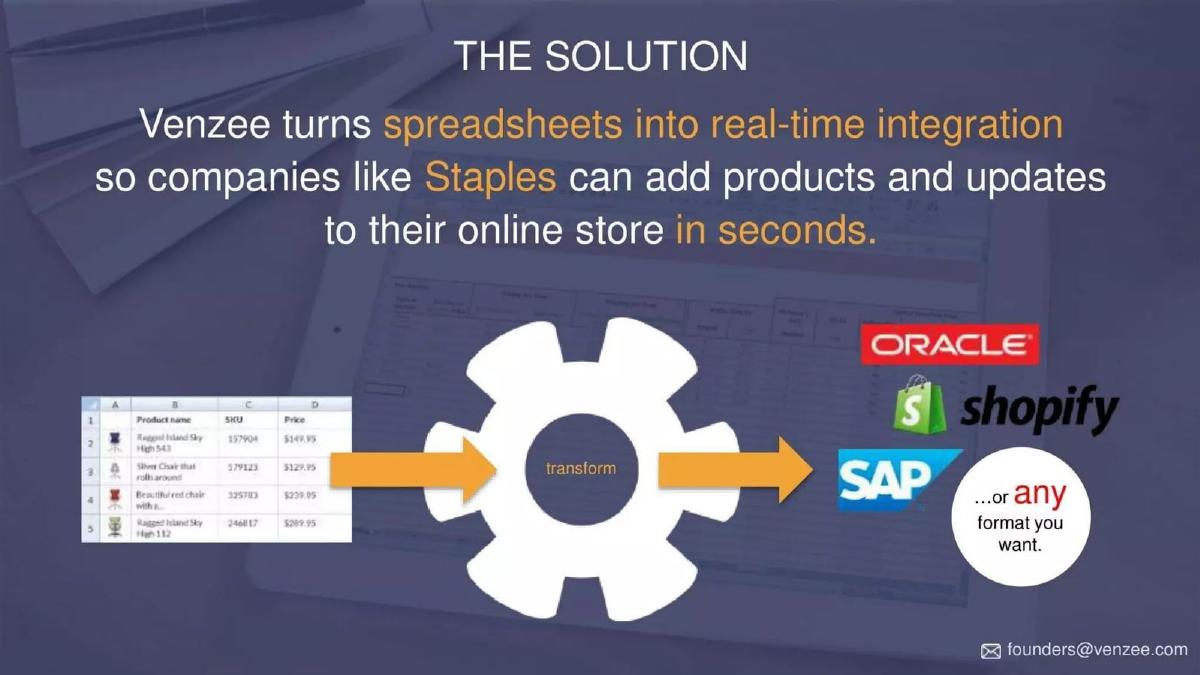
Slide 3: The Solution The solution slide is a simple flow diagram. On the left, a raw spreadsheet; in the middle, a Venzee gear icon labeled 'transform'; on the right, the logos of Oracle, Shopify, and SAP. The text claims Venzee turns spreadsheets into real-time integration so companies like Staples can add products in seconds. This slide is effective because it positions Venzee as the 'middleware' of the ecommerce world, compatible with the giants already in the space.
Slides 4-5: Growth Strategy and Market Size
Slide 4: Viral – Not Your Typical B2B Sales Model This is perhaps the most important slide for an investor. B2B SaaS is often criticized for having high customer acquisition costs (CAC). Venzee counters this by illustrating a viral loop. Using Staples as the anchor, the diagram shows how one retailer brings in multiple vendors, who then bring in their other retail partners. If this model holds, it implies a decreasing CAC and exponential growth, which justifies a higher valuation.
Slide 5: Metrics Slide 5 provides the 'big numbers.' It reiterates the 90% spreadsheet usage and introduces an $8 billion Total Addressable Market (TAM). It sets two specific targets: 1000+ companies integrated by 11/31 and $60 million in SaaS revenue by 2017. A small inset graphic shows a dashboard with '300 Products Imported' and an '81% Products Complete' rate, providing a glimpse into the actual product performance.
Slides 6-7: The Pipeline and The Call to Action
Slide 6: Enterprise Pipeline This slide is a 'logo wall' featuring Toys R Us, Cymax, Groupon, Buy.com, Staples, Overstock.com, Wayfair.com, Mercado Libre, Dafiti, and Delphi. While it doesn't specify which are active customers versus leads, the sheer scale of these brands suggests that Venzee is operating at the highest levels of global retail. The background image of shopping carts reinforces the industry focus.
Slide 7: Join the Spreadsheet Revolution The final slide is a contact page that doubles as a summary of the pain points. It uses a word cloud of negative descriptors: expensive, frustrating, clumsy, inefficient, and 'doesn't scale.' It provides a founder email and a URL. Notably, there is no mention of how much money they are looking for or what the terms of the deal are.
What Works in the Venzee Deck
The primary strength of this deck is its clarity of purpose . Many startups try to be everything to everyone; Venzee is only one thing: the tool that kills spreadsheets in the supply chain. This focus makes the value proposition undeniable. If you believe that spreadsheets are a bottleneck for a multi-billion dollar industry, you have to believe in Venzee.
The visual communication is also excellent. Slide 3, which shows the transformation from a spreadsheet to SAP/Shopify, explains a complex technical process in a way that requires zero technical knowledge. The use of recognizable logos (Staples, Oracle, Shopify) provides instant social proof and helps the investor visualize where Venzee fits in the existing tech stack.
Finally, the viral growth model presented on Slide 4 is a compelling narrative for venture capital. Investors love 'network effects,' and Venzee manages to frame a standard B2B integration as a viral growth engine. This suggests that the company doesn't just need a massive sales team; it needs to land a few 'whales' who will then force the rest of the market to adopt the platform.
What is Missing from the Venzee Deck
While the deck was successful in raising capital, it is missing several components that are usually considered mandatory in a modern pitch deck:
The Team Slide: There is no mention of who is building this. In early-stage investing, the 'who' is often as important as the 'what.' The omission of founder backgrounds, previous exits, or technical expertise is a significant gap. · The Ask: The deck never states how much money is being raised. While this might be intentional to allow for flexibility in different rooms, it leaves the investor without a sense of the round's scale or the company's valuation expectations. · Unit Economics: While the deck mentions a $60 million revenue goal, it says nothing about the cost to acquire a customer, the churn rate, or the lifetime value (LTV). For a SaaS business, these are the metrics that prove the model is sustainable. · Competition: The deck acts as if Venzee is the only solution to this problem. It ignores existing PIM (Product Information Management) systems or EDI (Electronic Data Interchange) providers that have been serving this market for decades. · Financial History: There is no mention of current revenue or burn rate. The metrics provided are largely projections or market statistics rather than historical performance data.
What a Founder Should Copy
Founders should emulate Venzee’s ruthless editing . Most decks are too long. Venzee proves that if your problem is big enough and your solution is simple enough, you don't need 20 slides to get a meeting. The 'one slide, one idea' rule is followed perfectly here.
The branding of the problem is another key takeaway. By using #nomorespreadsheets, Venzee turned a boring back-office process into a 'revolution.' Founders should look for ways to give their problem a name or a hashtag that makes it memorable and easy to discuss after the meeting ends.
Lastly, the use of a 'Whale' to explain the ecosystem (Slide 4) is a brilliant way to show market entry. Instead of saying 'we will sell to everyone,' Venzee says 'we will sell to Staples, and Staples will bring everyone else to us.' This shows a strategic understanding of how their specific industry operates and how to leverage existing power structures for growth.
Final Analysis
Venzee’s deck is a high-conviction document. It relies on the strength of a single observation: that the retail world is drowning in manual data entry. By focusing entirely on that pain point and offering a 'viral' way out of it, the company managed to raise $6.9 million despite omitting many standard deck elements. It is a reminder that in fundraising, the narrative and the perceived scale of the opportunity often outweigh the granular details of the business plan.
Frequently asked questions
- How much did Venzee raise with this deck?
- According to the catalogue listing, Venzee raised $6,900,000. This is particularly notable given that the deck contains only seven slides and lacks traditional elements like a team biography or a detailed breakdown of how the funds would be spent.
- What is the core problem Venzee solves?
- The deck states on Slide 2 that the biggest problem facing ecommerce is that 90% of vendors use spreadsheets to share product information. This manual process is described as expensive, error-prone, and a cause of significant delays in getting products to market.
- Who are Venzee's target customers?
- Venzee targets both large retailers and their vendors. Slide 6 lists an 'Enterprise Pipeline' featuring major brands like Staples, Toys R Us, Wayfair, Groupon, and Mercado Libre, suggesting a focus on high-volume ecommerce platforms.
- What is the 'Viral B2B' model mentioned in the deck?
- Slide 4 illustrates a network effect where a single large retailer (Staples) connects its vendors to the platform. Those vendors then connect their other retail partners, creating a self-propagating growth loop that differs from traditional linear B2B sales cycles.
- What metrics does the deck use to prove traction?
- Slide 5 lists a goal of 1000+ companies integrated by 11/31 and a projected SaaS revenue of $60 million by 2017. It also highlights a product import success rate of 81% for a sample of 300 products shown in a dashboard screenshot.