VeraCash’s 2017 pitch deck from Web Summit positions the company as a stable, asset-backed alternative to both traditional banking and volatile cryptocurrencies. By leveraging physical gold and silver as the underlying value for its VRC currency, VeraCash aimed to capture a market segment wary of fiat inflation and crypto speculation. The deck highlights significant early traction, including 21 million Euros in turnover for 2016 and over 12,000 users. However, the presentation lacks critical details on unit economics, a specific funding ask, and a team slide. While the competitive landscape i…
Key takeaways
- VeraCash utilizes a proprietary currency (VRC) backed by physical gold and silver, as shown on slide 1.
- The company positions itself as a safer alternative to Bitcoin, citing concerns over cyber-criminality and lack of physical counterparts on slide 3.
- Market sentiment data suggests 2/3 of people believe gold will never lose long-term value, providing a psychological basis for the product on slide 4.
- VeraCash claims a distinct market position high on both 'Innovation' and 'Exchange' axes compared to Revolut, N26, and Goldmoney on slide 5.
- The company reported 21 million Euros in turnover for the year 2016 on slide 6.
- Operational scale included 4 tons of gold and 25 tons of silver vaulted at the time of the presentation, according to slide 6.
- User adoption reached over 12,000 individuals with 50 million VRC issued by the 2017 summit date on slide 6.
- The business model includes a P2P payment feature that is free of charge, as stated on slide 7.
Introduction
The VeraCash pitch deck, prepared for the 2017 Web Summit, represents a specific era of fintech where the volatility of early cryptocurrency was being met with 'stable' alternatives. Unlike the algorithmic stablecoins that would follow, VeraCash looked backward to the gold standard to move forward. The deck is a concise 13-slide presentation (with 7 key slides available for analysis) that focuses heavily on market sentiment and existing traction rather than technical architecture.
Slide 1: Title and Value Proposition
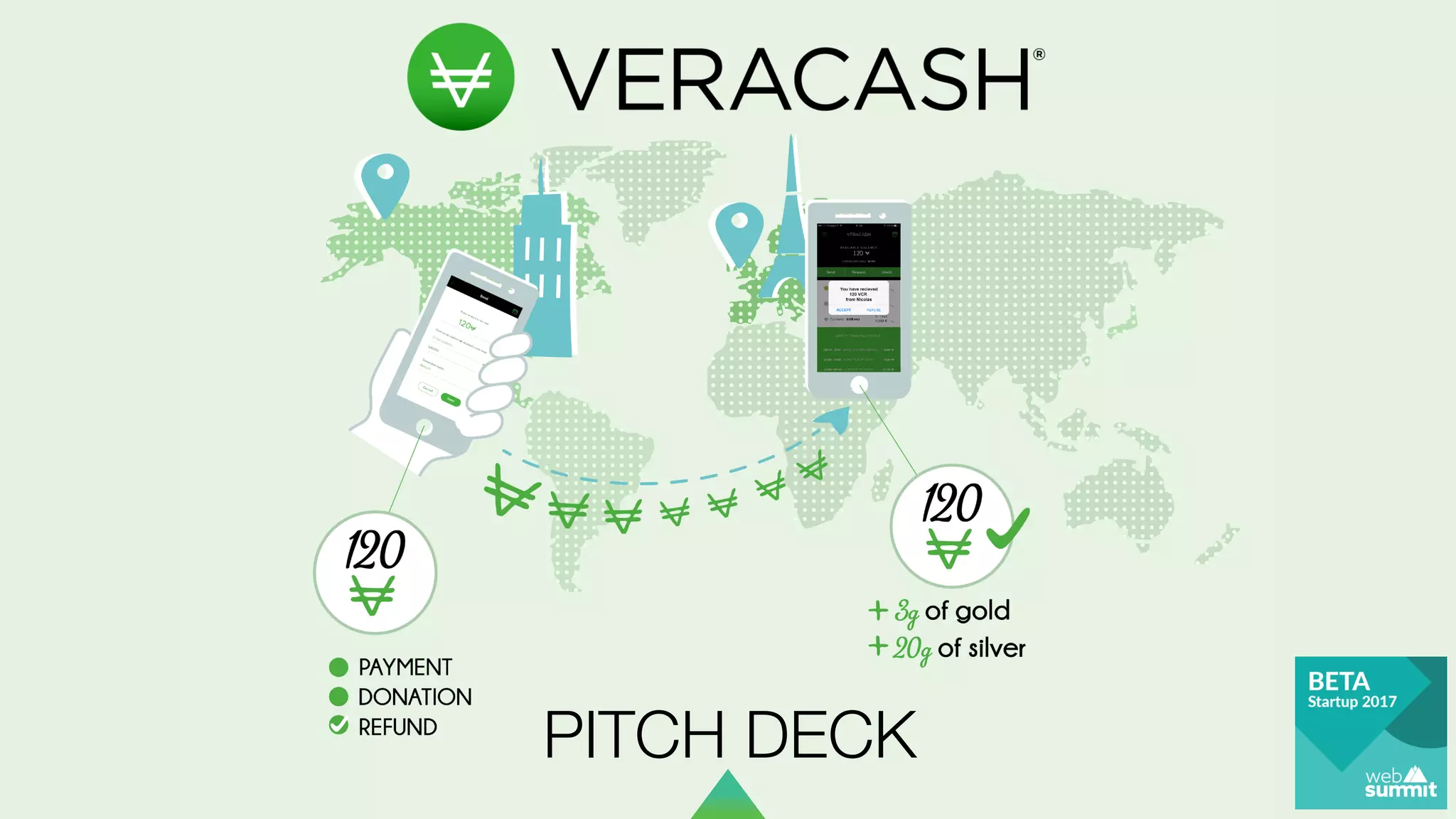
The cover slide introduces the VeraCash branding and the core concept: a mobile-first payment system. The visual elements show a smartphone interface and a world map, implying global remittance capabilities. Most importantly, it quantifies the value of a 120 VRC (VeraCash currency) balance as being equivalent to 3g of gold and 20g of silver . The slide lists three primary use cases: Payment, Donation, and Refund . The inclusion of the 'BETA Startup 2017' badge from Web Summit establishes the context of the presentation as a competitive pitch in a high-pressure environment.
Slide 2: The Problem with Traditional Banking
Slide 2 uses a two-pronged approach to define the problem. On the left, it acknowledges the existence of modern payment rails like Apple Pay, Android Pay, and PayPal . On the right, it uses a political cartoon to critique traditional banking institutions, specifically naming Societe Generale and referencing the Kerviel scandal (4.9 billion Euro loss). The implication is that while modern interfaces exist, the underlying banking infrastructure is untrustworthy and prone to institutional failure. This sets the stage for a 'third way' that bypasses traditional fiat banking risks.
Slide 3: The Critique of Bitcoin
In a move that distinguishes VeraCash from the broader 'crypto' movement of 2017, slide 3 explicitly questions Bitcoin. The slide lists three major concerns: 'Out of control: cyber-criminality and fraud,' 'No physical counterpart,' and 'Highly speculative.' By positioning Bitcoin as a risky gamble, VeraCash attempts to capture the 'conservative innovator'—someone who wants the convenience of digital payments but the security of a tangible asset. The visual of a man standing on a large Bitcoin coin emphasizes the perceived instability of the asset class.
Slide 4: The Appeal of Gold
To justify their choice of backing, slide 4 cites market research. It claims that 2/3 of people believe gold will never lose value in the long term (citing the World Gold Council, Dec 2016) and 1/3 believe gold could be a better currency than EUR or USD (citing an Opinion Way poll). This slide is crucial for the pitch because it validates the demand for the product. It shifts the argument from 'we like gold' to 'the market trusts gold more than fiat.' This is a classic 'market pull' slide designed to show that the founders are solving a recognized psychological need for financial stability.
Slide 5: Competitive Landscape
The competitive matrix on slide 5 plots various players on axes of Innovation vs. Savings and Features vs. Exchange . VeraCash places itself in the top-right quadrant, claiming high innovation and high exchange utility. Notable competitors included in the map are Revolut, N26, and Goldmoney . The deck suggests that while Revolut and N26 are innovative, they are tied to fiat (Exchange), and while Goldmoney is tied to gold, it is less focused on daily exchange (Savings). This positioning is intended to show that VeraCash is the only player successfully bridging the gap between a store of value and a medium of exchange.
Slide 6: Traction and Metrics
This is the 'proof' slide. It contains five significant data points that demonstrate the company was not just a concept in 2017:
+12,000 users · 50 M VRC issued · 21 M€ turnover in 2016 · 1M VRC exchanged in 2016 · 4 Tons of gold and 25 Tons of silver vaulted
The turnover figure of 21 million Euros is particularly impressive for a startup at a 'Beta' stage, suggesting a high volume of asset purchases or transfers. The physical asset count (4 tons of gold) provides a sense of the operational complexity and the scale of the trust users have placed in the platform.
Slide 7: Conclusion and Product Visuals
The final slide (in this set) serves as a thank you and a product showcase. It displays the VeraCarte (a physical Mastercard), physical gold and silver coins, and the mobile app. The quote 'The world changes. I change for a positive money' serves as the company's mission statement. Crucially, it adds a final piece of product information: 'VeraCash P2P payments are free of charge.' This indicates that the company likely generates revenue from the spread on gold/silver purchases or card transaction fees, rather than charging users to send money to one another.
What Works in This Deck
The deck excels at clear differentiation . In 2017, most fintech startups were either 'better banks' or 'crypto wallets.' VeraCash carved out a unique middle ground. The use of a proprietary currency (VRC) that is directly pegged to a physical weight of metal is a simple, easy-to-understand value proposition. Furthermore, the traction metrics on slide 6 are robust. Reporting 21 million Euros in turnover and 4 tons of vaulted gold provides immediate credibility that this is a functioning business with real assets and a significant user base.
What is Missing
The most glaring omission in the provided slides is the Team Slide . In early-stage fundraising, the 'who' is often as important as the 'what.' There is no mention of the founders' backgrounds in finance, security, or precious metals. Additionally, there is no Business Model slide that explains exactly how the 21 million Euro turnover translates into company revenue. While they mention free P2P payments, the mechanics of their monetization (e.g., storage fees, exchange spreads, or card interchange) are not detailed. Finally, there is no 'The Ask' slide. An investor looking at this deck would not know how much money the company is seeking or what the specific milestones for the next 18 months are.
Founder Takeaways
Use market sentiment to back your 'why.' VeraCash didn't just say gold is good; they used third-party data (World Gold Council) to show that a large percentage of the population already agrees with them. This reduces the 'vision risk' for an investor. Quantify your operations. If you are a physical-digital hybrid, showing the scale of your physical operations (like the tons of metal vaulted) is a powerful way to demonstrate 'moat' and operational maturity. Address the elephant in the room. By proactively explaining why they are not Bitcoin, VeraCash avoided being lumped into the 2017 crypto bubble, which was a strategic move for attracting more conservative fintech investors.
Frequently asked questions
- What is the core product of VeraCash?
- VeraCash is a digital wallet and payment system that uses its own currency, VRC. Unlike fiat or standard crypto, VRC is backed by physical precious metals. Slide 1 and slide 6 indicate that users hold balances that correspond to specific weights of gold and silver (e.g., 3g of gold and 20g of silver) stored in vaults.
- How does VeraCash differentiate itself from Bitcoin?
- On slide 3, VeraCash explicitly distances itself from Bitcoin. It labels Bitcoin as 'out of control' and 'highly speculative.' The primary differentiator is the 'physical counterpart'—VeraCash is backed by vaulted metals, whereas it claims Bitcoin has no physical basis, appealing to more conservative investors.
- What was the company's financial performance leading up to the deck?
- Slide 6 reveals that in 2016, VeraCash achieved a turnover of 21 million Euros. During that same period, 1 million VRC were exchanged. This suggests a high level of activity relative to their user base of 12,000, indicating that their users were actively transacting rather than just holding assets.
- Who are VeraCash's main competitors according to the deck?
- Slide 5 provides a competitive matrix. It includes traditional money transfer services like Western Union and PayPal, neobanks like N26 and Revolut, and other gold-centric platforms like Goldmoney and BullionVault. VeraCash positions itself as more innovative than the storage-heavy platforms and more exchange-focused than the neobanks.
- What information is missing from this pitch deck?
- The deck is missing several standard venture components. There is no slide introducing the founding team or their expertise. Furthermore, there is no 'Ask' slide detailing how much capital is being raised or how it will be spent. Finally, the deck lacks a clear explanation of the revenue model beyond the mention that P2P payments are free.