Venn's Series B deck is a masterclass in category creation, reframing property management software as a 'Resident Operating System.' The presentation successfully argues that the real estate industry is shifting toward a consumer-centric model where 'experience is brand.' By showcasing a massive addressable market of 47.3 million units and a clear path to $750M in ARR through a $25/unit/month pricing model, Venn justifies its $52M raise. The deck relies heavily on a robust integration network—featuring giants like Yardi, RealPage, and Entrata—to position itself as the unified layer above lega…
Key takeaways
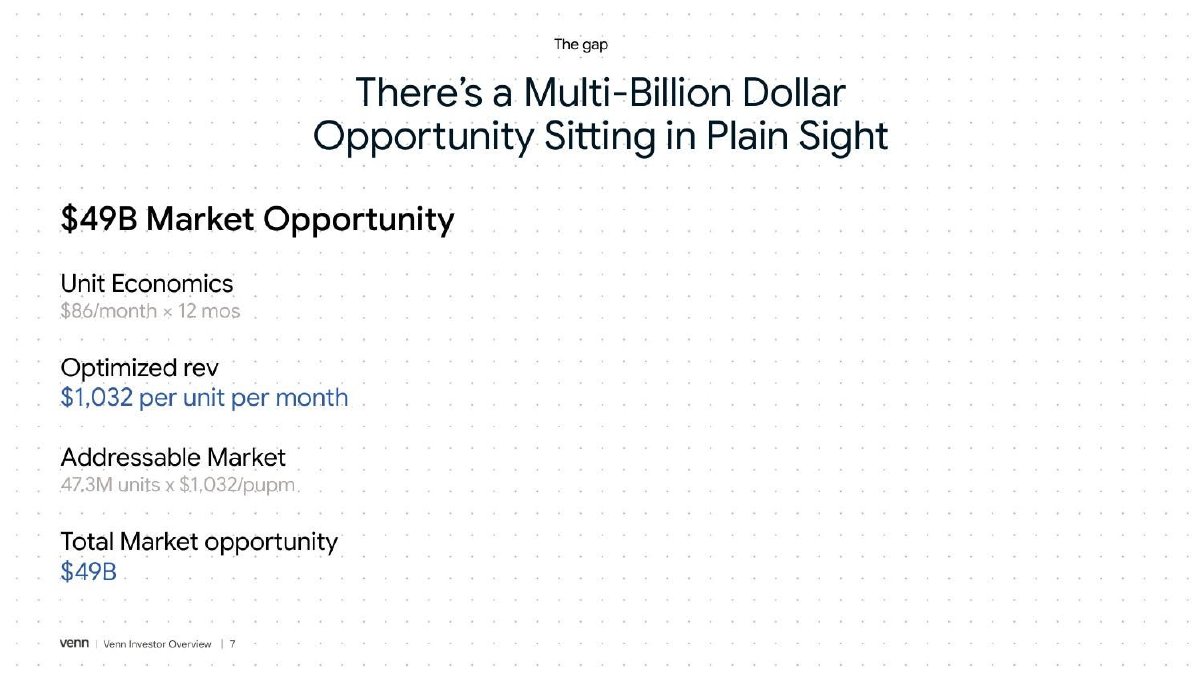
- Venn identifies a $49B market opportunity based on an addressable market of 47.3M units at a target revenue of $1,032 per unit per year (Slide 7).
- The product is positioned as a 'Resident Operating System' that unifies leasing, smart home, and social tools into one layer (Slide 10).
- The platform relies on a deep integration network including industry incumbents like Yardi, RealPage, and Entrata (Slide 10).
- Venn projects a 'hyper-growth phase' starting in 2025, aiming for 500,000 residents by early 2026 (Slide 16).
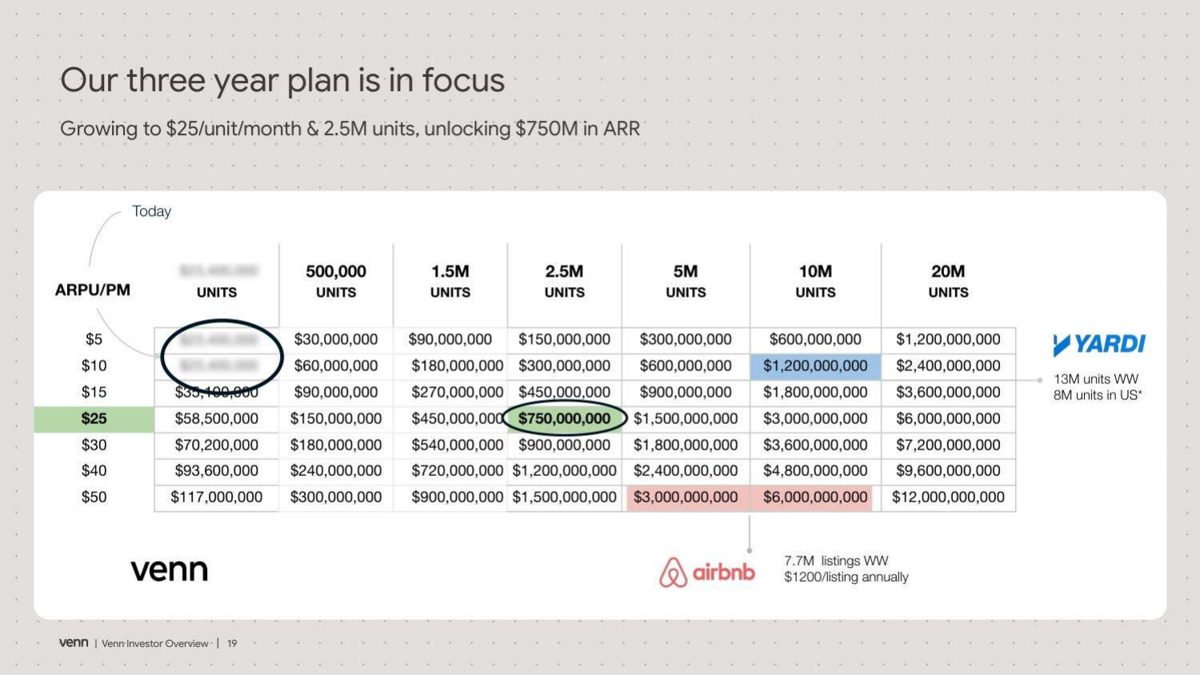
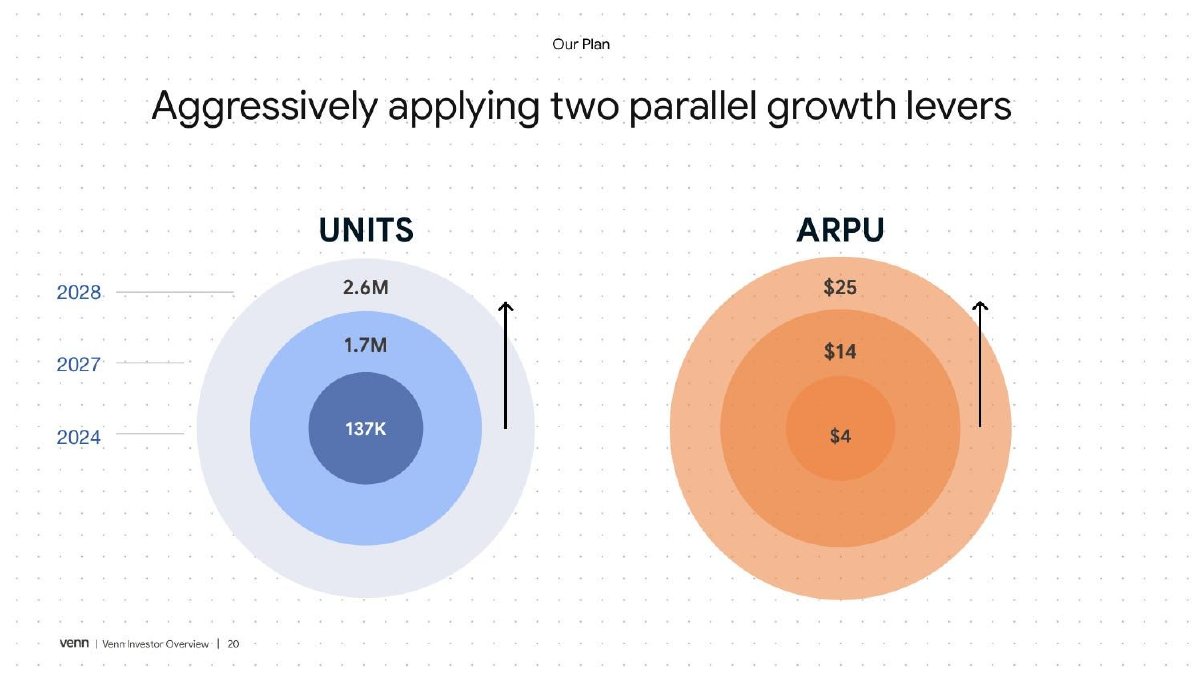
- The financial model targets a $25/unit/month ARPU to reach $750M in ARR at 2.5 million units (Slide 19).
- The go-to-market slide lists 20 immediate deals representing over 703,000 units and $42.1M in potential ARR (Slide 23).
- Venn uses a 'Resident Lifecycle' approach, covering everything from application and move-in to amenities and community engagement (Slide 13).
- The deck emphasizes a shift in industry thinking where residents are treated as consumers and personalization is the key value driver (Slide 26).
Venn Pitch Deck Teardown: The $52M Series B Resident OS
Venn’s 2024 Series B deck, which secured $52M as reported by Business Insider, is a strategic pivot away from traditional property management software toward a consumer-centric 'Resident Operating System.' The deck is structured to convince institutional investors that the multifamily real estate sector is undergoing a fundamental shift, moving from a focus on buildings to a focus on the people living inside them.
Slide 1-6: Setting the Stage and Market Momentum
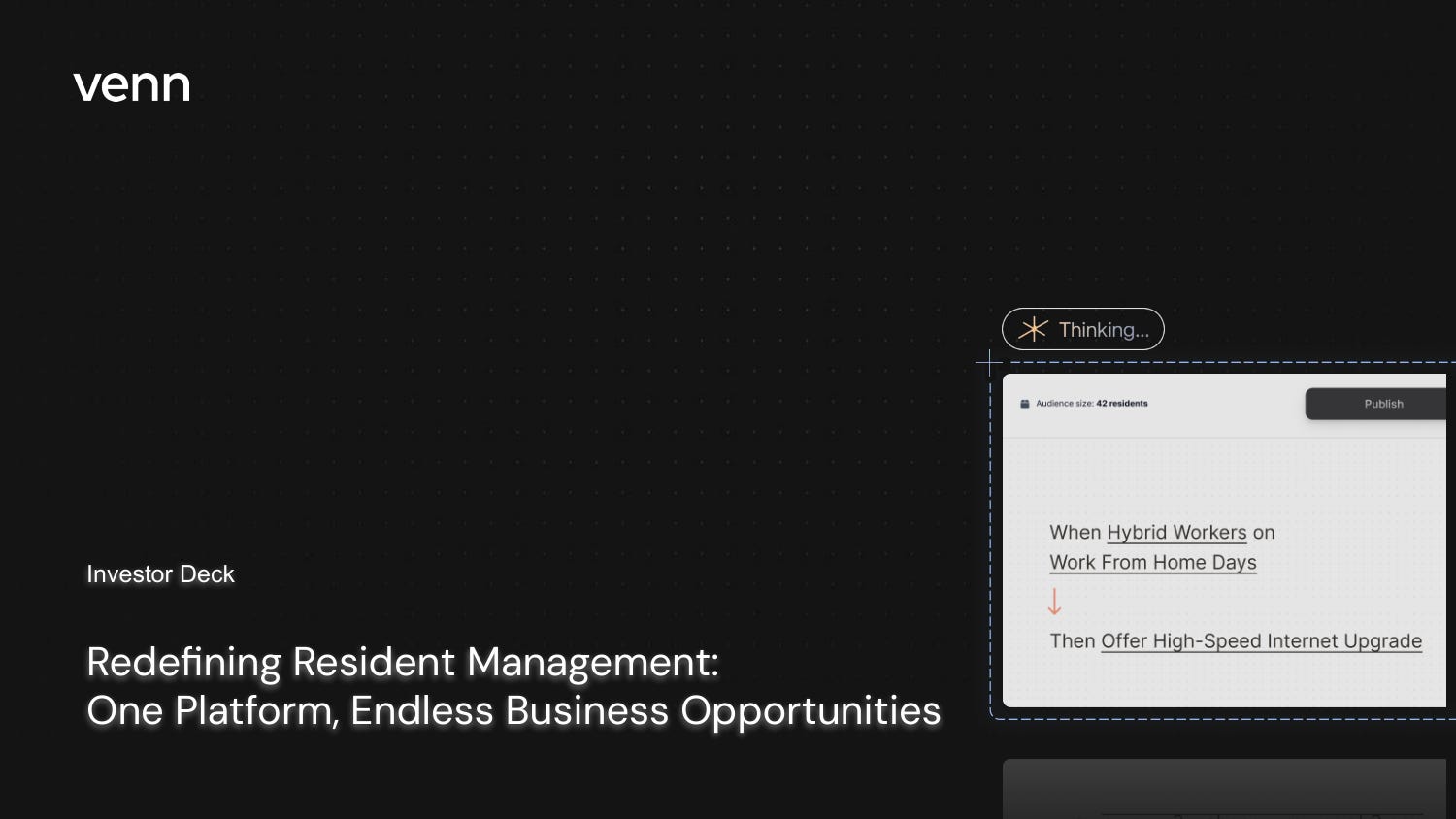
The deck opens with a clean, dark-themed title slide (Slide 1) that immediately establishes the brand's aesthetic. The subtitle, 'Redefining Resident Management: One Platform, Endless Business Opportunities,' sets the tone for a platform-play rather than a point-solution. Slide 4 provides the macro-economic justification for the business: a bar chart showing 'Multifamily New Construction' from 2006 through 2024. The data, sourced from Dodge Data & Analytics, shows a massive spike in apartment completions in 2023 and 2024, peaking at over 200,000 units. This slide serves to prove that the target market is not just large, but currently expanding at a record pace.
Slide 7: The Multi-Billion Dollar Opportunity
Slide 7 is the 'money slide.' It presents a $49B market opportunity with a clear, bottom-up calculation. Venn breaks this down into:
Unit Economics: $86/month x 12 months. · Optimized Revenue: $1,032 per unit per year. · Addressable Market: 47.3M units. · Total Market Opportunity: $49B.
By stating a target of $1,032 per unit per year, Venn is signaling that they aren't just charging a small SaaS fee; they are capturing a significant portion of the resident's wallet or the property's operational budget through their 'optimized' revenue model.
Slide 10: The Resident Operating System Architecture
This slide explains the 'how.' Venn positions itself as the 'operating layer' that sits between the resident and the property team. The slide is divided into three sections: the Resident Management System (RMS) core infrastructure, the Venn Store (a modular feature marketplace), and the Integration Network. The Integration Network is particularly impressive, listing dozens of logos including Yardi, RealPage, Entrata, Salto, Stripe, and OpenAI . This visual communicates that Venn is not trying to replace the existing tech stack, but rather to unify it, reducing friction for property managers who are often stuck with fragmented tools.
Slide 13: The Resident Experience Journey
Slide 13 uses a mobile-first visual to show the resident's lifecycle. It highlights 'Onsite touchpoints,' 'Application,' 'Move-in,' 'Welcome,' 'Lifestyle Agent' (an AI-driven interface), 'Home,' 'Services,' 'Amenities,' and 'Communication.' The goal here is to show that Venn is present at every high-value moment of a resident's tenure. By including a 'Lifestyle Agent' that asks 'Ask me anything,' Venn leans into the 2024 AI trend, suggesting a frictionless, conversational interface for residents.
Slide 16: The Hyper-Growth Projection
Slide 16 presents a 'Residents Adoption Growth' chart. It shows a relatively flat line from 2022 through 2024, followed by a near-vertical 'hockey stick' projection starting in January 2025. The chart aims for 500,000 residents by early 2026. While the chart lacks historical data points for the 2022-2024 period (it appears mostly as a baseline), it clearly communicates the company's expectation that their Series B capital will act as the catalyst for exponential scale.
Slide 19: The Path to $750M ARR
This slide is a sensitivity analysis table that maps ARPU (Average Revenue Per Unit) against total units. The 'Today' column is blurred, but the target is circled: 2.5M units at $25/unit/month equals $750M in ARR . To provide context, Venn includes logos for Yardi (13M units worldwide) and Airbnb (7.7M listings), suggesting that their targets are conservative compared to established giants in the real estate and hospitality sectors. This slide is critical for Series B investors who need to see a path to a billion-dollar valuation.
Slide 23: The Pipeline and Immediate Deals
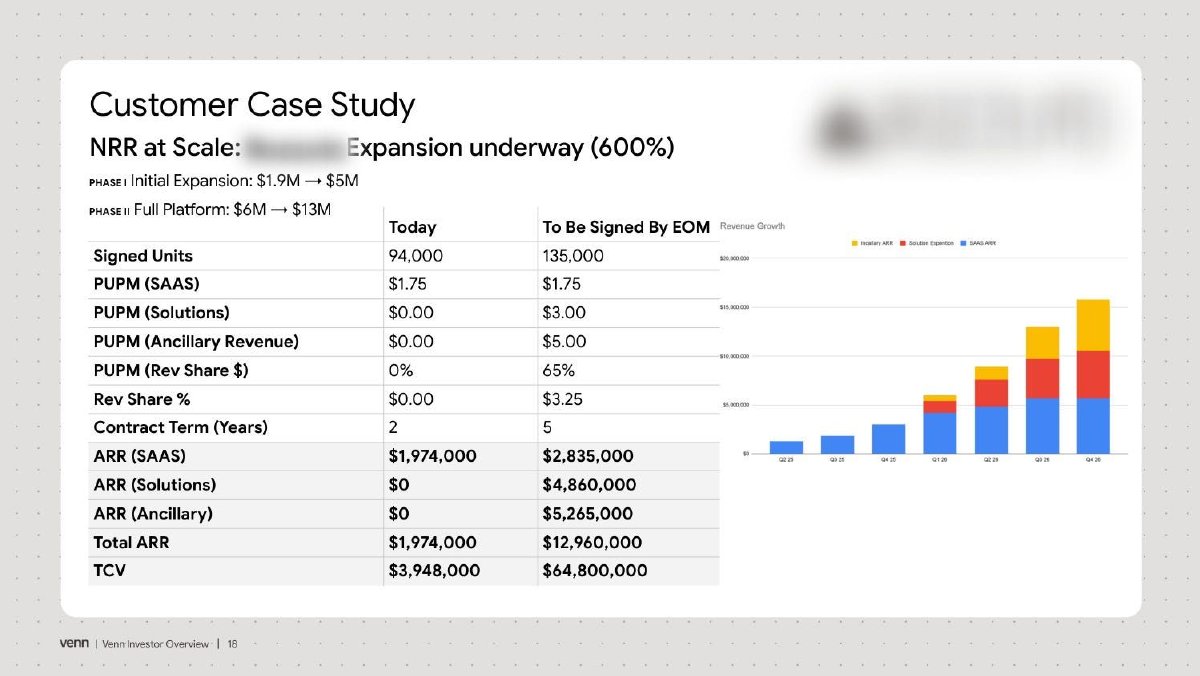
Slide 23 provides the most granular evidence of traction. It lists '20 immediate deals' representing 703,089 units and $42,185,340 in ARR . The table breaks down specific deals (with names blurred) by unit count, ARR, and stage (e.g., 'Signed,' 'Contract,' 'Solution Development,' 'Demo'). The fact that they have over $38M in ARR in the 'Q3 + Q4 Deals' section alone suggests a very high level of sales activity and validates the growth curve shown on Slide 16.
Slide 26: Category-Defining Movement
The final slide in the set is a collage of social proof. It features photos of the team at industry events like 'Apartmentalize 2025,' press clippings from 'Multifamily Executive,' and a mention of Marc Mathieu (Salesforce SVP) joining to lead AI strategy. The headline, 'A Category-Defining Movement,' reinforces the idea that Venn is not just a software company, but the leader of a shift in how the entire multifamily industry operates. It emphasizes that 'residents are consumers' and 'experience is brand.'
What Venn Does Well
Venn excels at reframing the market . Instead of competing in the crowded Property Management Software (PMS) space, they created a new category: the Resident Operating System. This allows them to position legacy players like Yardi and RealPage as partners (integrations) rather than direct competitors. Their math is transparent ; by showing exactly how they get to a $49B market size and $750M in ARR, they make the investment thesis easy to follow. Finally, the pipeline transparency on Slide 23 is exceptional. Showing over 700k units in the immediate pipeline provides a level of 'de-risking' that is rare in pitch decks.
What is Missing from the Venn Deck
The most notable omission in the provided slides is a detailed Team Slide . While Slide 26 shows photos of the team and mentions a key AI hire, there is no slide detailing the founders' backgrounds or the executive leadership's specific experience in real estate or tech. Additionally, there is a lack of Unit Economics/Burn Rate data. While they show revenue potential, they don't show the cost to acquire these units (CAC) or the lifetime value (LTV) based on historical churn. For a Series B, investors usually expect to see how efficiently the company can turn marketing dollars into ARR. Lastly, there is no 'The Ask' slide in the provided set, though publisher reports confirm the $52M raise.
Founder Takeaways: What to Copy
The Sensitivity Table: Slide 19 is a great way to show investors multiple paths to success. By showing what happens at $5, $15, and $25 ARPU, you demonstrate that you don't need to hit a 'perfect' number to build a massive business. · Integration as a Moat: If you are building in a legacy industry, don't try to replace the incumbents immediately. Copy Venn’s Slide 10—show how you sit on top of the existing ecosystem to add value without requiring a total 'rip and replace' of old systems. · Pipeline Granularity: If you have a strong sales pipeline, don't just say 'we have $40M in the works.' Use a table like Slide 23 to show the stages (Demo, Discovery, Signed) and the specific close dates. It builds immense credibility. · Macro Justification: Use Slide 4 as a template. Find the one macro-economic trend (like new construction starts) that makes your business inevitable and put it front and center.
Frequently asked questions
- What is Venn's core product offering?
- Venn offers a 'Resident Operating System' (RMS) designed to be the unified interface for apartment living. As shown on Slide 10, it includes a core API, communication tools, and a 'Venn Store' that integrates resident lifecycle management, smart home controls, and revenue generation tools. It acts as a layer on top of existing Property Management Systems (PMS).
- How does Venn calculate its $49B market opportunity?
- On Slide 7, Venn breaks down the math: they estimate an addressable market of 47.3 million units. By optimizing revenue to $1,032 per unit per year (calculated as $86/month), they arrive at a total market opportunity of $49 billion. This represents a significant expansion over traditional SaaS fees in the space.
- Who are Venn's primary integration partners?
- Slide 10 lists an extensive network of integrations. Key partners include legacy property management systems like Yardi, RealPage, and Entrata. They also integrate with hardware and service providers like Salto, Schlage, Honeywell, Stripe, and Plaid, as well as AI partners like OpenAI and AI21 Labs.
- What are Venn's growth targets for 2025 and 2026?
- According to Slide 16, Venn expects to enter a hyper-growth phase in 2025. Their 'Residents Adoption Growth' chart shows a trajectory aiming for approximately 500,000 residents by the start of 2026. Slide 23 supports this with a pipeline of 20 deals totaling over 703,000 units.
- What is the 'Venn Store' mentioned in the deck?
- The Venn Store is described on Slide 10 as a flexible architecture that connects native and best-in-class solutions. It allows property managers to toggle features like Resident Living Experience, Branding & Reputation, and Revenue Generation, effectively letting them customize the resident experience through a modular marketplace.