VCV's 2017 pitch deck is a masterclass in minimalist storytelling, relying on bold typography and high-contrast visuals rather than dense data tables. The deck successfully raised $1.9 million by focusing on a single, powerful value proposition: reducing the time to select a candidate from 21 hours to 45 minutes. By front-loading the presentation with tier-one enterprise logos like PwC, Mars, and L'Oreal, VCV established immediate market credibility. While the deck lacks traditional components like a detailed team slide with biographies, a competitive matrix, or a specific financial 'ask,' it…
Key takeaways
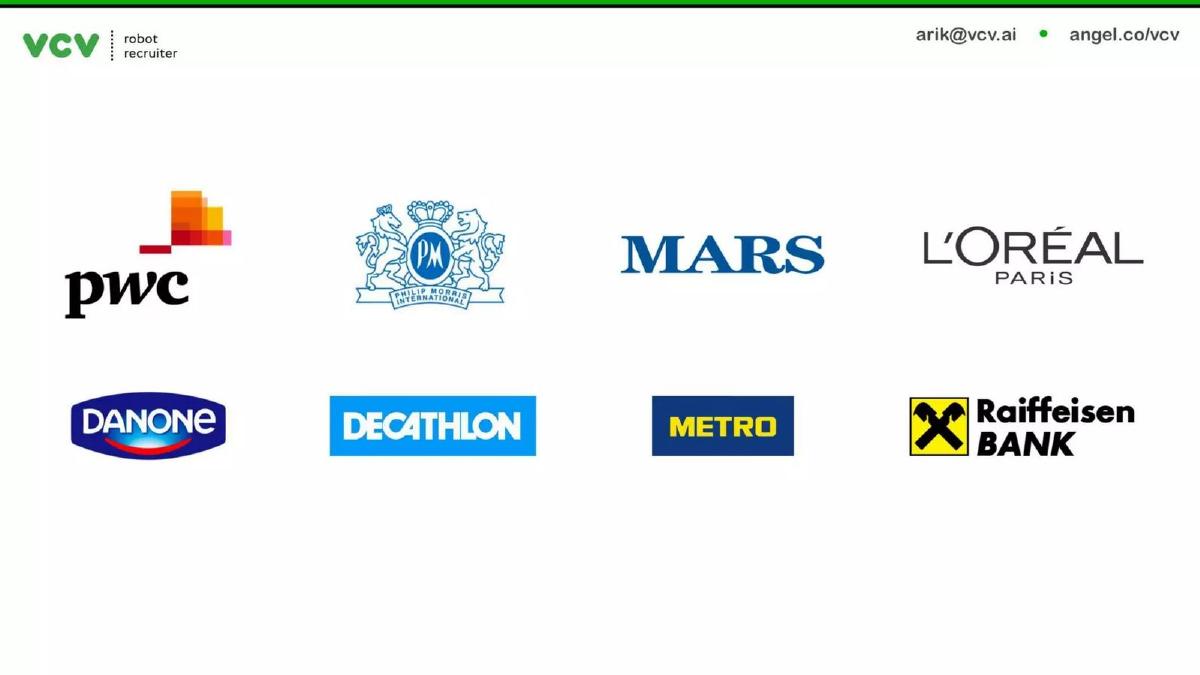
- The deck leads with a logo wall featuring global brands like PwC, Mars, and L'Oreal on slide 2 to establish instant credibility.
- VCV claims a significant efficiency gain, reducing the time to select one person from 250 applicants from 21 hours to 45 minutes (slides 5-7).
- The product is presented as a three-stage automated funnel: Search bot, Voice bot, and Video bot (slides 8-10).
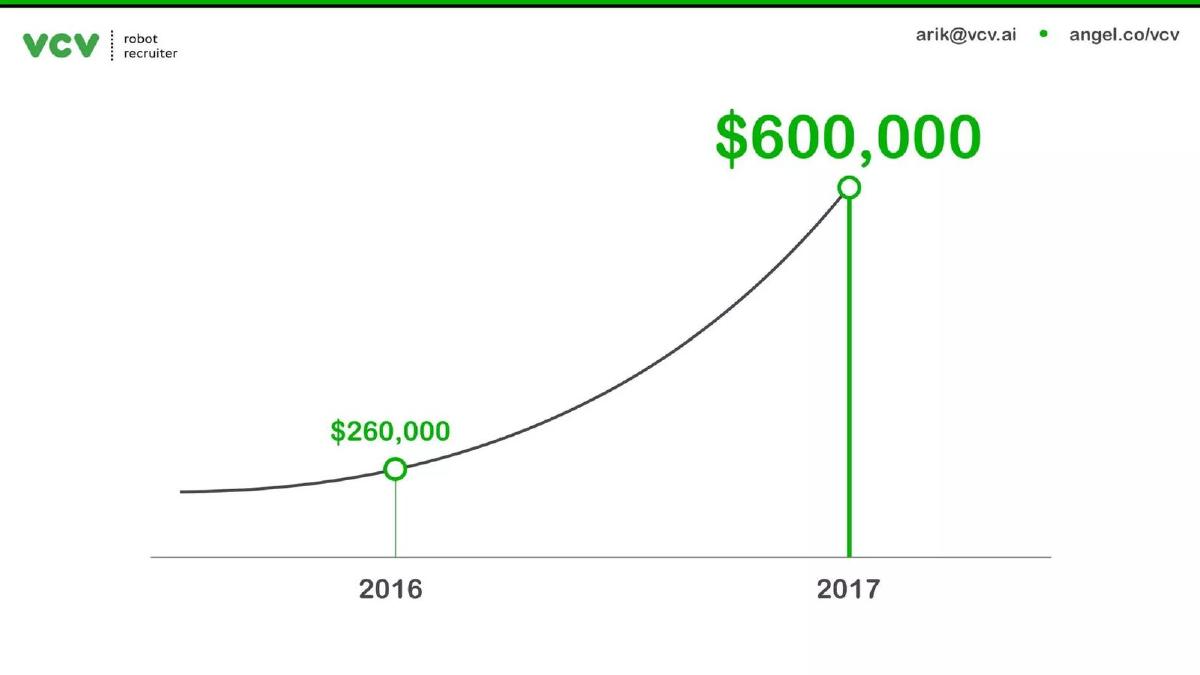
- Traction is highlighted through a growth curve showing a jump from $260,000 in 2016 to $600,000 in 2017 (slide 3).
- The company reports a 20% Month-over-Month (MoM) growth rate and a team size of 20 people (slide 15).
- VCV positions its AI as 'Gender & Ethnicity neutral' to appeal to diversity and inclusion requirements (slide 12).
- The deck identifies a $200B total market, with 57% of that opportunity located in the USA and Europe (slide 14).
- There is no dedicated team slide featuring founder backgrounds or a slide detailing the specific funding ask.
The Minimalist Power of the VCV Pre-Seed Deck
VCV’s 2017 pitch deck is an exercise in extreme brevity. In an era where decks often bloat to 30 slides of dense technical jargon, VCV opted for a 15-slide presentation that uses large-format text and minimal data points to drive home a single narrative: recruiting is inefficient, and AI can fix it. This teardown examines how a company raised $1,900,000 with a deck that contains fewer than 200 words in total.
Slides 1-3: Credibility and Traction First
Slide 1: Title The deck opens with a simple logo and the tagline 'robot recruiter.' It includes contact information for 'arik@vcv.ai' and a link to their AngelList profile. This sets a functional, no-nonsense tone immediately.
Slide 2: The Logo Wall Unusually, VCV places its social proof on the second slide. This is a strategic move for a pre-seed company. By showing logos for PwC, Philip Morris International, Mars, L'Oreal, Danone, Decathlon, Metro, and Raiffeisen Bank, they immediately signal that their 'robot recruiter' is already trusted by some of the largest employers in the world. This mitigates the perceived risk of the 'Pre-Seed' label.
Slide 3: Revenue Growth The third slide is a simple line graph showing revenue growth. It marks two points: $260,000 in 2016 and $600,000 in 2017. The curve is aggressively upward-sloping. By placing this at the front of the deck, VCV ensures that every subsequent slide about their technology is viewed through the lens of a business that is already generating significant capital.
Slides 4-7: The Problem and the '20x' Solution
Slide 4: The Hook A full-bleed image of a meeting with the text 'RECRUITING SUCKS!' in all caps. It is a blunt, emotional appeal to anyone who has ever managed a hiring pipeline.
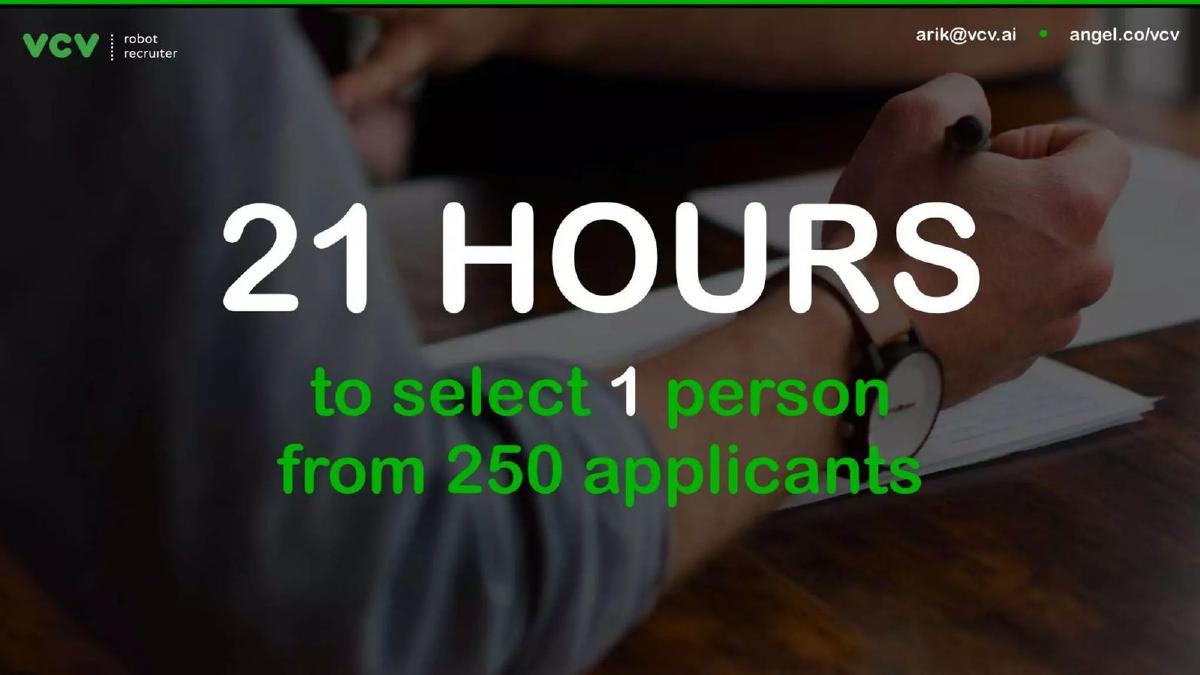
Slide 5: The Quantitative Problem VCV quantifies the 'suck' by stating it takes '21 HOURS to select 1 person from 250 applicants.' This slide establishes the baseline metric that the rest of the deck will attempt to disrupt.
Slide 6: The Value Proposition A simple '20x faster' headline over a blurred image of a speeding car. This is the 'aha' moment of the deck, promising a massive order-of-magnitude improvement over the status quo.
Slide 7: The Comparison This slide bridges the gap between the problem and the solution, showing a transition 'From 21 hours to 45 minutes using vcv.' By providing a specific time-saving figure (45 minutes), the founders give investors a concrete number to model the ROI for potential customers.
Slides 8-11: Product Architecture and Workflow
Slide 8: Search Bot The product walkthrough begins. The first step is the 'Search bot,' illustrated with a UI mockup showing a search in progress for a candidate named 'Chandler Bings.' This indicates the top-of-funnel automation.
Slide 9: Voice Bot The second step adds the 'Voice bot.' The graphic shows a mobile phone receiving a call from 'VCV BOT' with the text 'Hey I'm voice bot speak with me.' This highlights the automated screening interview capability.
Slide 10: Video Bot The final step of the automated funnel is the 'Video bot.' The mockup shows a candidate recording a video with facial recognition markers overlaid on their face, suggesting a layer of AI analysis beyond simple video recording.
Slide 11: The Hiring Process Integration This slide clarifies where VCV sits in the broader HR workflow. It divides the 'Basic Hiring Process' into two zones. VCV handles the 'Application,' 'Phone Screen,' and '1st Interview.' The 'Hiring Manager' only steps in for the '2nd Interview' and the 'Offer.' This visualizes the '20x' time savings by showing that the human is removed from 60% of the traditional steps.
Slides 12-15: Market, Efficacy, and Team Stats
Slide 12: Differentiation and Ethics VCV highlights three key features: 'Customized scenario,' '24/7' operation, and 'Gender & Ethnicity neutral.' In 2017, the focus on 'neutral' AI was a forward-looking attempt to address the growing concern regarding algorithmic bias in hiring.
Slide 13: Human vs. Robot Efficacy This is a critical data slide. It claims that 19% of people are hired by human recruiters, whereas 21% are hired by the 'robot.' By showing a higher conversion rate for the AI, VCV argues that their tool isn't just faster—it's actually better at identifying talent than a human.
Slide 14: Market Size The deck identifies a '$200B' market opportunity. It further segments this by stating '57% USA & Europe.' This tells investors that while the problem is global, the primary revenue targets are in high-value Western markets.
Slide 15: The Summary/Team Slide The final slide serves as a summary of the current state of the company. It lists '20 our team,' '$600K ARR,' and '20% Growth (MoM).' It repeats the top four logos (PwC, Philip Morris, Mars, L'Oreal) to end on a note of enterprise validation. Notably, there are no photos or names of the founders on this slide, which is a significant departure from standard pitch deck structure.
What Works in the VCV Deck
Clarity of Value: The deck is obsessed with time. By repeating the '21 hours vs. 45 minutes' comparison, the founders ensure that no investor leaves the room without understanding exactly what the product does for a customer's bottom line.
Enterprise Validation: For a pre-seed company, having eight global brands on slide 2 is an incredible feat. It effectively ends the conversation about whether the product works or if companies will buy it, allowing the founders to focus on the 'how' and the 'how much.'
Visual Hierarchy: The use of large, green text for key metrics against dark, high-quality background images makes the deck highly readable. It is designed to be presented, not read as a document, which is often more effective in live pitch settings.
What is Missing from the VCV Deck
Founder Pedigree: There is no team slide. While it mentions a team of 20, it doesn't list who the founders are, where they worked previously, or why they are the right people to build an AI recruiting bot. In early-stage investing, the 'team' is often as important as the 'traction.'
The Ask: The deck never explicitly states how much money they are looking for or what the terms of the round are. While the catalogue listing confirms they raised $1.9M, the deck itself leaves the investor guessing about the capital requirements.
Competitive Landscape: The deck operates in a vacuum. It doesn't acknowledge competitors like HireVue or traditional ATS players. Investors generally want to know how a startup plans to defend its position against incumbents and other well-funded startups.
What a Founder Should Copy
The 'Problem-to-Metric' Pipeline: Founders should emulate how VCV takes a vague problem ('Recruiting sucks') and immediately turns it into a hard metric ('21 hours'). This makes the solution ('45 minutes') much easier to sell.
The Workflow Boundary: Slide 11 is a perfect example of how to show product integration. By clearly boxing off what the AI does versus what the human does, VCV manages expectations and shows how they fit into existing corporate structures without requiring a total overhaul of the HR department.
Leading with Traction: If you have revenue and big-name customers, do not hide them on slide 12. Move them to the front. VCV’s decision to put their $600k ARR and PwC logo in the first three slides likely did more to secure their funding than any of the technical slides that followed.
Frequently asked questions
- How does VCV demonstrate product-market fit in this deck?
- VCV demonstrates product-market fit primarily through its logo wall on slide 2 and slide 15, featuring major enterprises like PwC and Danone. Additionally, slide 3 shows a clear revenue trajectory, increasing from $260,000 to $600,000 within one year. This combination of blue-chip customers and doubling revenue serves as a proxy for market validation in the absence of detailed case studies.
- What is the core technology behind the VCV platform?
- According to the product walkthrough on slides 8 through 10, the technology consists of three distinct 'bots.' The Search bot identifies candidates, the Voice bot conducts automated phone screenings, and the Video bot facilitates recorded interviews. The catalogue listing further specifies that the system uses voice recognition and AI to search for and screen candidates 24/7.
- Is there a competitive analysis included in the deck?
- No, the deck completely omits a competitive landscape slide. It does not mention other AI recruiting tools or traditional Applicant Tracking Systems (ATS). Instead, it focuses entirely on the internal efficiency gains of its own process compared to a traditional 'human' recruiter, as seen on slide 13.
- What are the primary metrics VCV uses to attract investors?
- VCV leans heavily on three metrics: time efficiency, revenue growth, and hiring efficacy. It highlights a 20x speed increase in the hiring process (slide 6), a $600,000 ARR with 20% MoM growth (slide 15), and a claim that robots result in a 21% hire rate compared to 19% for humans (slide 13).
- What is missing from this deck that a typical Series A investor would require?
- This deck lacks several standard elements: a detailed team slide with professional histories, a clear breakdown of how the $1.9M investment would be spent, a roadmap for future product development, and a detailed breakdown of unit economics (CAC/LTV). It functions more as a high-level teaser for a pre-seed round than a comprehensive business plan.