Veem’s 14-slide deck is a highly functional product-led presentation used to secure a $31M strategic round in 2020. The narrative is built on the stark contrast between '1970s tech' bank wires and Veem’s modern, multi-rail approach that includes blockchain, cards, and bank accounts. The deck excels at visualizing the 'invisible' complexity of cross-border payments, making a strong case for their 0.5% to 2% FX fee model. While it lacks a traditional team slide or detailed financial projections, it compensates with strong social proof—citing 225,000 verified accounts—and a clear demonstration o…
Key takeaways
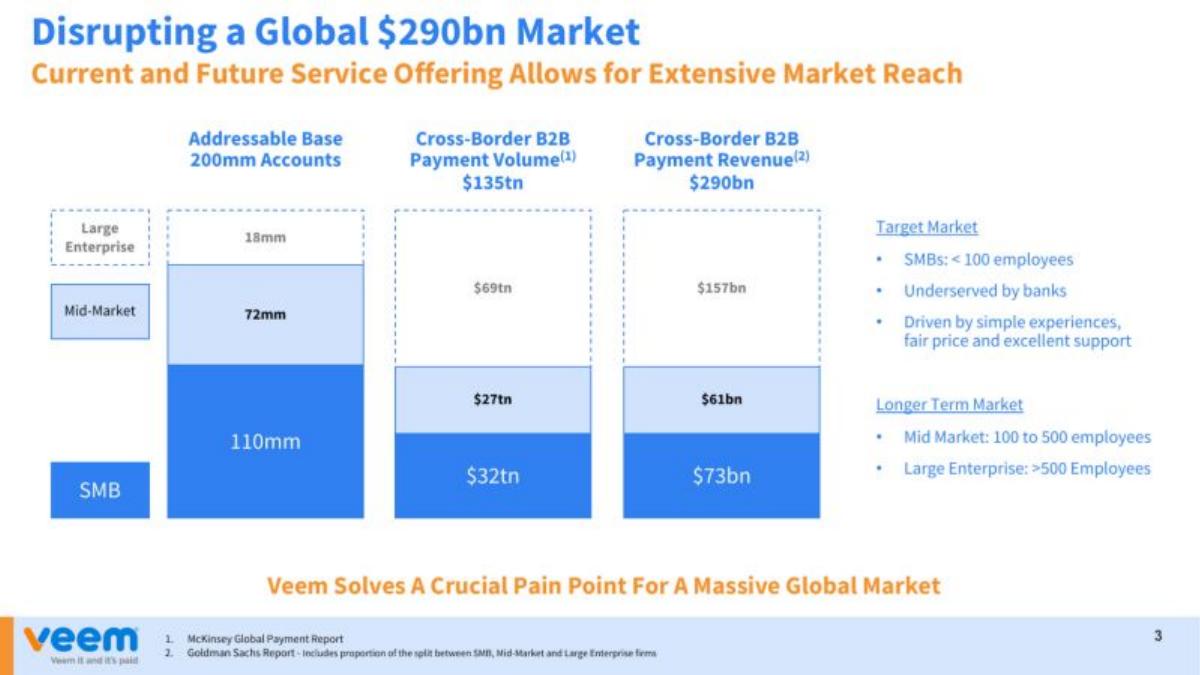
- The total addressable market for cross-border B2B payment revenue is valued at $290bn (Slide 3).
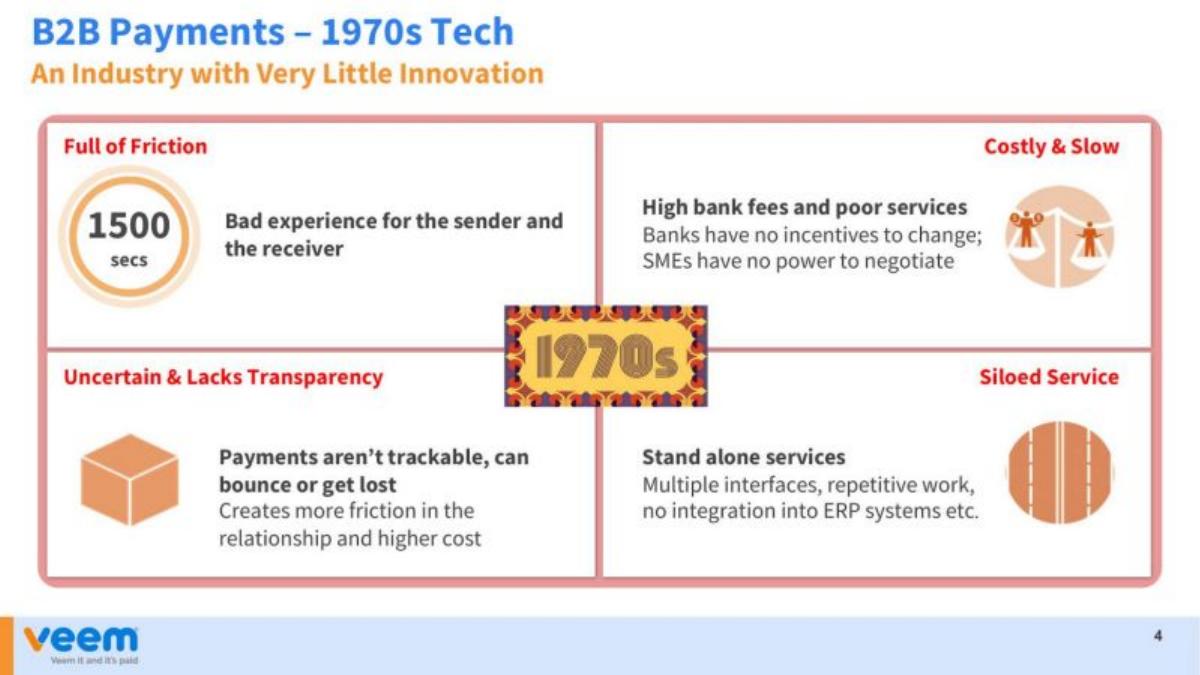
- Veem identifies the '1970s tech' of current B2B payments as a bad experience taking 1500 seconds of manual work (Slide 4).
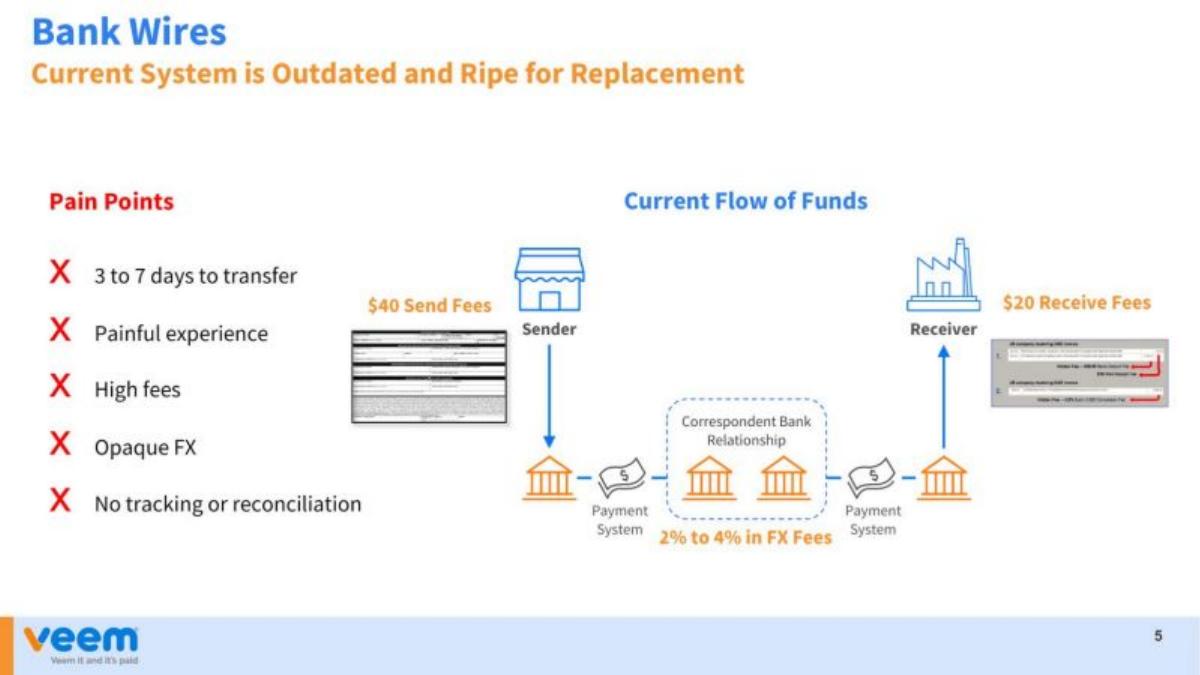
- Legacy bank wires are criticized for having $40 send fees, $20 receive fees, and 2% to 4% hidden FX fees (Slide 5).
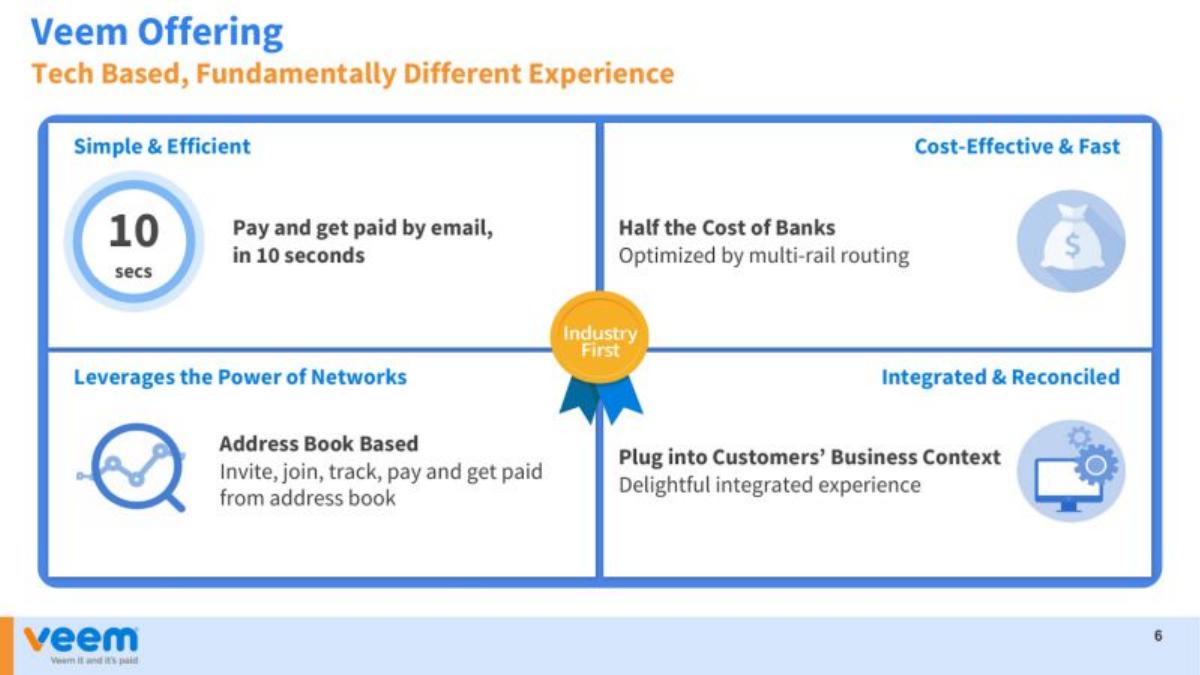
- The product claims to allow users to pay and get paid by email in just 10 seconds (Slide 6).
- Veem utilizes 'Multi-Rail Routing' across blockchain, cards, and bank partners to optimize for cost and speed (Slide 8).
- The platform features 'Network Tracking' that allows businesses to track payments with the granularity of a FedEx package (Slide 9).
- Strategic integrations with Oracle NetSuite, Xero, and QuickBooks are central to their 'plug-in' adoption strategy (Slide 10).
- At the time of the deck, Veem had reached a milestone of over 225,000 verified accounts (Slide 11).
Executive Summary: The Modernization of B2B Rails
Veem’s 2020 pitch deck is a clinical breakdown of why the global banking system is failing small businesses. Raising $31M in a strategic round led by Truist Ventures, the company used this 14-slide deck to showcase its transition from a simple payment tool to a massive global business network. The deck focuses heavily on the 'Multi-Rail' technology that allows them to bypass traditional correspondent banking fees, which they claim can eat up 2% to 4% of a transaction in hidden costs.
Slide 1: Title Slide
The deck opens with a clean, blue-branded title slide featuring the company logo and the tagline: "Veem it and it's paid." This immediately establishes the brand's goal of becoming a verb in the B2B space, similar to how Venmo or PayPal operate in the P2P and B2C sectors.
Slide 2: Our Vision
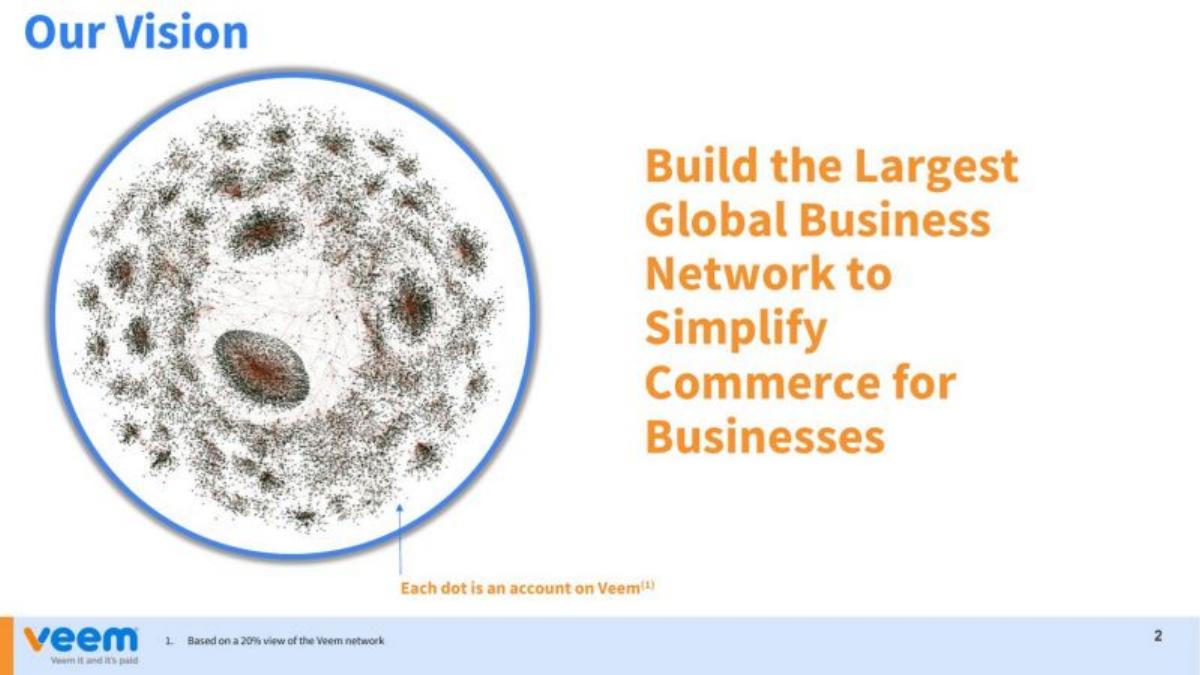
Slide 2 presents a visual representation of the Veem network. A circular cluster of dots represents the network, with a footnote stating this is "Based on a 20% view of the Veem network." The stated vision is to "Build the Largest Global Business Network to Simplify Commerce for Businesses." This slide is designed to show momentum and the 'network effect'—the idea that the platform becomes more valuable as more businesses join the address book.
Slide 3: Market Opportunity
Veem targets a "Global $290bn Market." Slide 3 breaks this down into three categories: Addressable Base (200mm accounts), Cross-Border B2B Payment Volume ($135tn), and Cross-Border B2B Payment Revenue ($290bn). They segment their target market into SMBs (<100 employees), which they describe as "underserved by banks." This slide successfully establishes the massive ceiling for the business, moving from the current SMB focus to future Mid-Market and Enterprise opportunities.
Slide 4: The Problem - 1970s Tech
This slide is the 'villain' of the story. Veem characterizes the current B2B payment industry as having "Very Little Innovation." They cite four major friction points: a bad experience taking 1500 seconds for the sender/receiver, high bank fees, lack of transparency (payments can "bounce or get lost" ), and siloed services with no ERP integration. The visual center of the slide is a 1970s-style graphic, emphasizing that the competition is literally decades behind.
Slide 5: The Anatomy of a Bank Wire
Slide 5 provides a detailed flow chart of a traditional bank wire. It highlights the "Pain Points" : 3 to 7 days to transfer, $40 Send Fees , $20 Receive Fees , and 2% to 4% in FX Fees hidden within the correspondent bank relationship. By visualizing the 'Current Flow of Funds,' Veem makes the case that the existing system is unnecessarily complex and expensive.
Slide 6: The Veem Offering
This is the 'hero' slide. Veem presents its solution as "Tech Based" and "Fundamentally Different." They claim users can "Pay and get paid by email, in 10 seconds." Key pillars include being half the cost of banks, leveraging an address-book-based network, and integrating directly into the customer's business context. A gold seal labeled "Industry First" sits in the center, though it doesn't specify which exact feature holds that title.
Slide 7: User Experience
Slide 7 shows the actual interface for both the sender and the receiver. The sender experience is simplified to a single screen asking "Who do you want to pay?" and "How much?" The receiver experience shows a clear conversion from USD to CNY (Chinese Yuan), allowing the receiver to see exactly what they are accepting. This reinforces the "10 seconds" claim made in previous slides.
Slide 8: Multi-Rail Routing Technology
This is arguably the most important technical slide in the deck. It explains how Veem achieves lower costs. Instead of a single path, they use "Intelligent, Automated Multi-Rail Routing." The rails include Blockchain (noting they are a "Pioneer, Largest Payment Processor on Blockchain" ), Cards, Veem Bank Accounts, Payment Partners, and traditional Bank Partners (SWIFT). This allows them to offer $0 Send Fees in 50+ countries and $0 Receive Fees in 100+ countries, making their money on the 0.5% to 2% Currency Exchange Fees .
Slide 9: Network Effects and Tracking
Slide 9 focuses on the "Power of Networks." It shows an address book feature where businesses can "Pay and get paid from address book." It also introduces "Network Tracking," comparing it to FedEx. A screenshot shows a timeline of a $16,194.00 USD payment, from submission to deposit, providing the transparency that Slide 4 claimed was missing from traditional banks.
Slide 10: Software Integrations
To prove they are not a "Siloed Service," Slide 10 lists their integrations. Logos for Oracle NetSuite, Xero, QuickBooks, Magento, and Zapier are displayed. They show a screenshot of the Oracle NetSuite interface with a "Veem It!" button embedded directly into the bill payment workflow. This is a powerful 'moat' slide, showing how Veem becomes a sticky part of a company's accounting stack.
Slide 11: Social Proof and Traction
Slide 11 features "225,000+ Strong Verified Accounts." It includes three testimonials from CEOs and founders. One quote from Scott Scharf of Catching Clouds states, "We actually had a client save $5,000 in wire fees last year by using Veem." This slide serves to validate that the product is already operating at scale and delivering the promised cost savings.
Slide 12: Revenue Model
The revenue model is presented as a donut chart with three segments: Domestic Transfers, Foreign Currencies, and funds Held in USD Abroad. They clarify that domestic payments have a "Small fee per transaction," cross-border USD payments have a "Fee per transaction... paid by receiver," and FX payments involve a "% of payment" spread. This transparency regarding their take-rate is essential for a strategic investment round.
Slide 13 & 14: Conclusion
The deck concludes with a "Thank You" slide and a promotional slide for the source of the deck. There is no specific 'Ask' slide in this version of the deck, which is common in strategic rounds where the terms may have been pre-negotiated or the deck was used for a broader partnership discussion.
What Veem Does Well
Clarity of the 'Villain': Veem does an excellent job of making the traditional banking system look ancient. By using terms like "1970s Tech" and showing a messy flow chart of correspondent banks, they make their own solution look like an inevitable evolution.
Visualizing the Invisible: Cross-border payments are abstract and complex. Veem uses simple UI screenshots and a clear 'Multi-Rail' diagram to explain exactly how they move money and where they save the customer money.
Integration as a Strategy: Highlighting the Oracle NetSuite and QuickBooks integrations is a smart move. It shows that Veem isn't just a destination website, but a utility that lives inside the tools businesses already use.
What is Missing from the Veem Deck
The Team: There is no slide introducing the founders or the executive team. In a strategic round, investors often want to see the pedigree of the people managing the regulatory and compliance hurdles of global fintech.
The Competition: The deck ignores other fintech players. While it attacks 'Banks,' it doesn't explain why a business should choose Veem over Wise (formerly TransferWise) or Payoneer, both of which were well-established by 2020.
Unit Economics: While they show the revenue model, they don't show the LTV (Lifetime Value) or CAC (Customer Acquisition Cost). For a company with 225,000 accounts, investors would typically want to see the efficiency of that growth.
What Founders Should Copy
The 'FedEx' Comparison: If you are building a product in a category known for being 'opaque' or 'uncertain,' use a familiar analogy like package tracking to explain your value proposition instantly.
The Multi-Rail Diagram: If your backend is complex, don't hide it—visualize it. Showing the different 'rails' (Blockchain, Cards, Banks) gives the investor confidence that you have built a robust, redundant infrastructure rather than just a pretty wrapper on a single API.
Direct Cost Comparisons: Slide 5 and Slide 8 work together to show exactly where the money goes. If your product saves money, show the 'Before' (with all the hidden fees) and the 'After' (with your transparent fee) side-by-side.
Frequently asked questions
- What is Veem's primary value proposition?
- Veem positions itself as a modern alternative to legacy bank wires. According to Slide 6, it offers a 'tech-based, fundamentally different experience' that is half the cost of banks. Its primary hooks are speed (10-second payment initiation), transparency (FedEx-like tracking), and ease of use (paying via email address rather than complex SWIFT codes).
- How does Veem actually move money?
- Veem uses what they call 'Multi-Rail Routing' (Slide 8). Instead of relying solely on the traditional SWIFT network, the system intelligently routes payments through the most efficient path available, which can include blockchain, credit card networks, Veem's own global bank account network, or third-party payment partners.
- Who is Veem's target customer according to the deck?
- Slide 3 explicitly identifies Small and Medium Businesses (SMBs) with fewer than 100 employees as the primary target market. These businesses are described as 'underserved by banks.' The deck also notes a longer-term market expansion strategy into Mid-Market (100-500 employees) and Large Enterprise (500+ employees).
- How does the company generate revenue?
- As shown on Slide 12, the revenue model consists of three pillars: small fees per transaction on domestic payments (paid by the sender), transaction fees on cross-border USD payments (paid by the receiver), and a percentage-based spread on foreign exchange (FX) transactions ranging from 0.5% to 2%.
- What is missing from the Veem pitch deck?
- The deck is notably missing a Team slide, which is unusual for a $31M round. It also lacks a detailed 'Ask' slide specifying exactly how the $31M will be spent, a Competition slide comparing them to other fintechs like Wise or Payoneer, and a Roadmap slide detailing future product features.