Vascular Devices LLC is pitching a paradigm shift in interventional cardiology, moving from tethered catheters to untethered 'Biocompatible Modules' (BCMs) that use laser energy to vaporize arterial plaque. The deck identifies a clear technical gap in 'prior-art' solutions—specifically the 130cm reach limit of current catheters—and proposes a system driven by MRI mapping and computer-assisted algorithms. However, the financial ask is exceptionally high for an early-stage medtech firm, totaling $100 million across three phases, with the first $20 million seeking a 20% equity stake. While the t…
Key takeaways
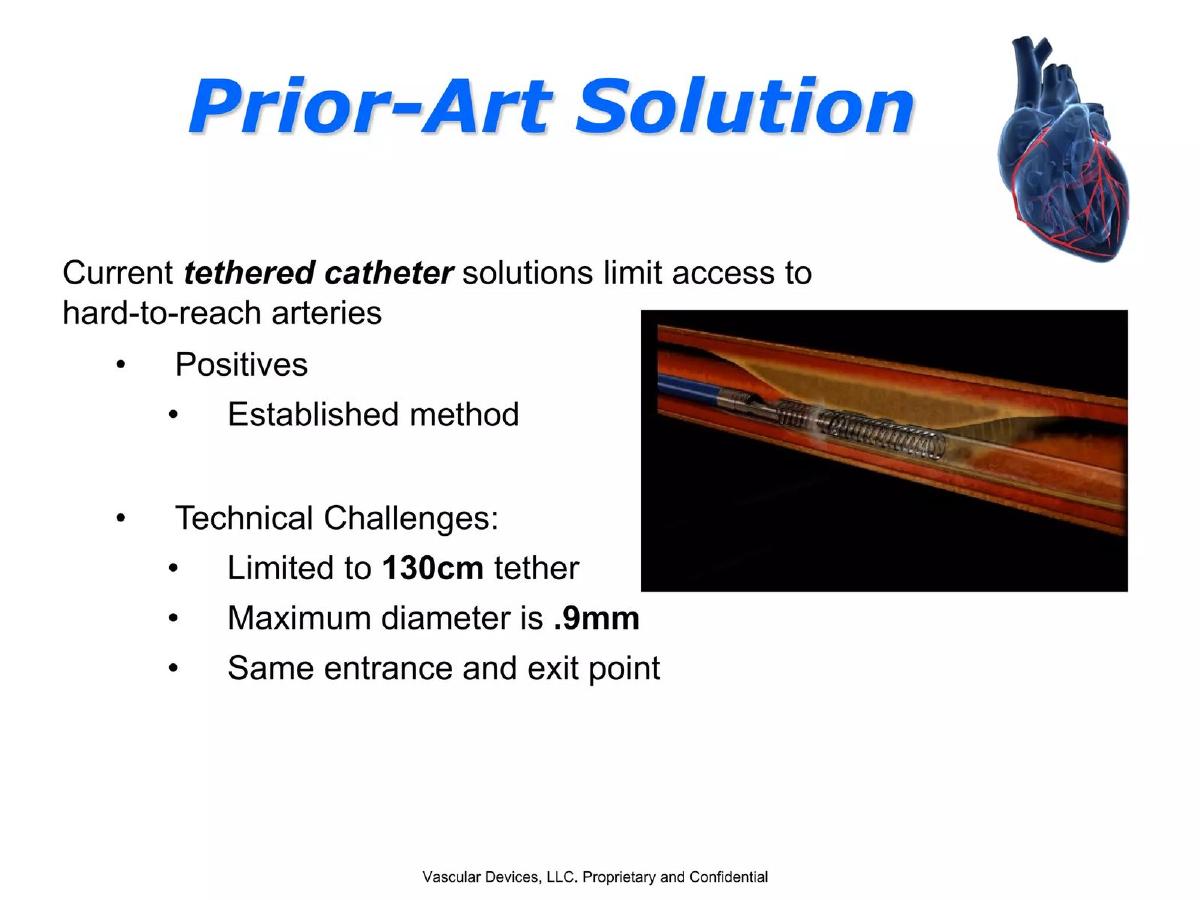
- The company identifies a specific technical limitation in current tethered catheters, which are restricted to a 130cm tether and a .9mm maximum diameter (Slide 2).
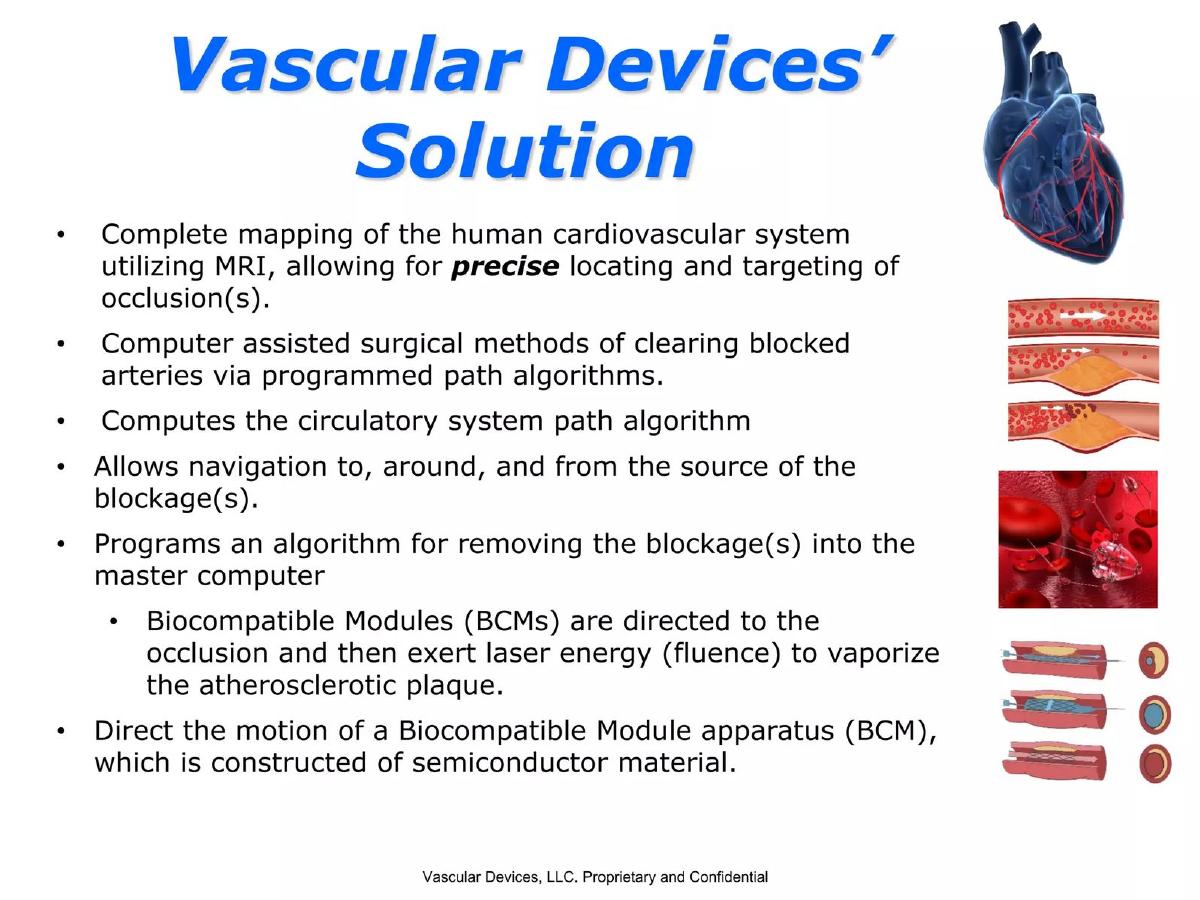
- The proposed solution involves Biocompatible Modules (BCMs) constructed from semiconductor material that exert laser energy to vaporize plaque (Slide 3).
- The competitive landscape includes major incumbents like Medtronic and Boston Scientific, whom the company claims are 'risk averse' and limited to tethered solutions (Slide 4).
- The development roadmap is split into two primary technical phases: building a prototype and then a multi-chip module under .9mm for FDA approval (Slide 5).
- The total funding requirement is $100 million, divided into $20M for Phase I, $40M for Phase II, and $40M for Phase III commercialization (Slide 6).
- Phase I investors are offered a 20% equity stake for their $20 million contribution (Slide 6).
- Financial projections show the company remaining cash flow negative until 2026, with net income reaching approximately $82 million by 2030 (Slide 7).
- The core intellectual property is anchored by U.S. Patent Number US8663209B2, titled 'Vessel clearing apparatus, devices and methods' (Slide 8).
Executive Summary: The Untethered Ambition
Vascular Devices LLC presents a high-stakes, high-capital pitch for a fundamental redesign of endovascular surgery. The deck, dated February 2021, outlines a transition from mechanical, tethered catheters to autonomous, semiconductor-based modules guided by MRI. While the technical vision is expansive, the financial requirements—totaling $100 million—place this firmly in the category of 'moonshot' medical technology. The teardown below examines the progression from identifying a 30-year stagnation in cardiology to the specific engineering hurdles the team intends to clear.
Slide 1: Title and Visual Concept
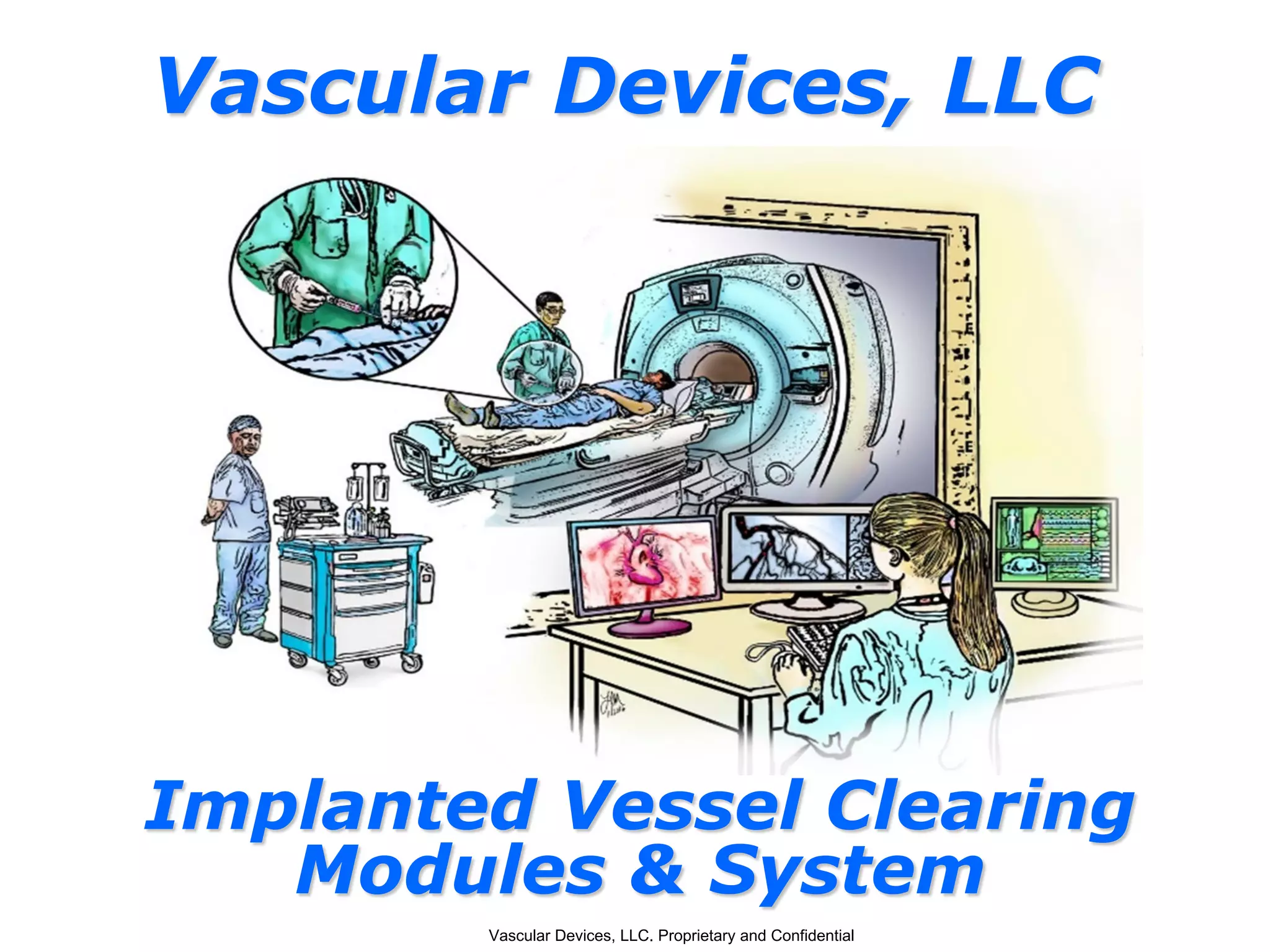
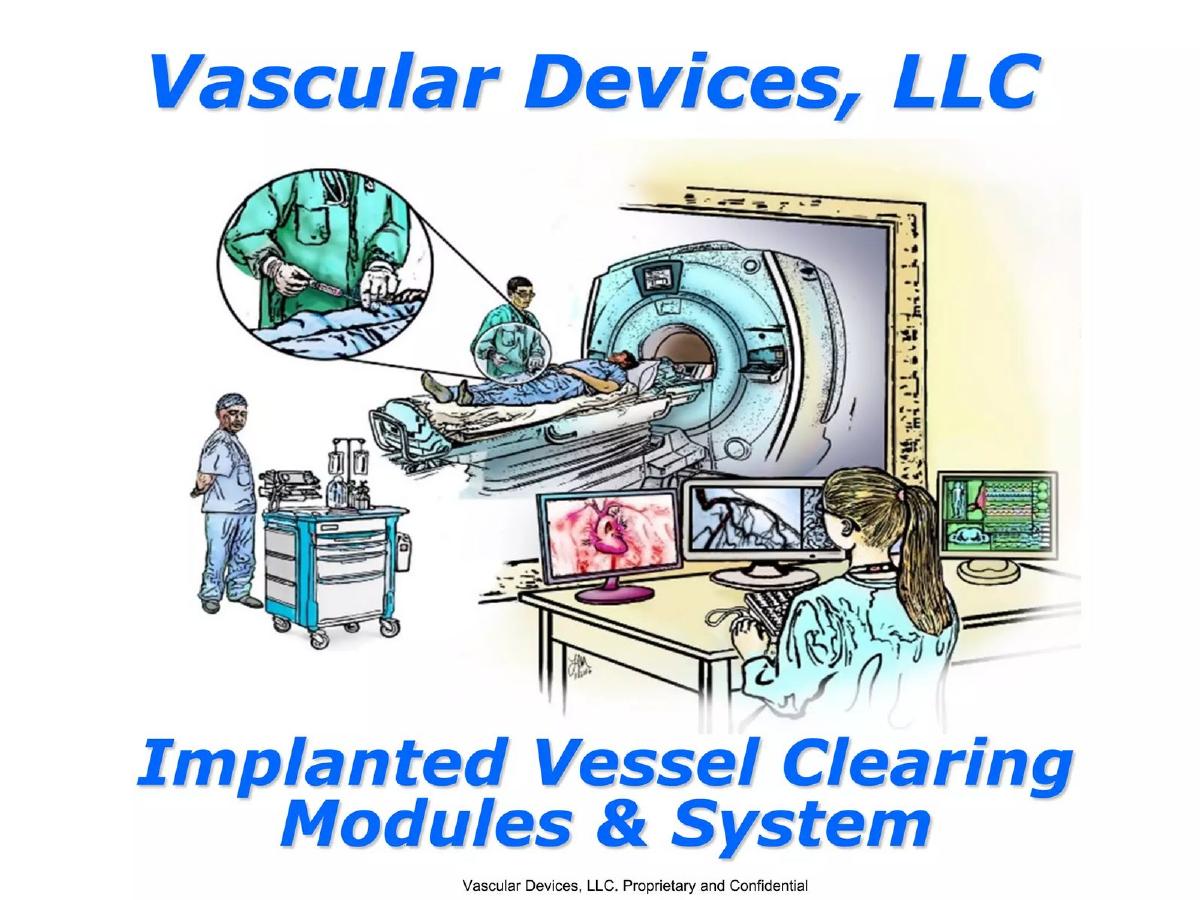
The cover slide introduces Vascular Devices, LLC and its 'Implanted Vessel Clearing Modules & System.' The central illustration depicts a clinical setting featuring an MRI machine, a patient, and a clinician monitoring multiple screens. This visual establishes the 'system' aspect of the pitch—it is not just a device, but an integrated diagnostic and surgical environment. The footer notes the content is 'Proprietary and Confidential.'
Slide 2: The 'Prior-Art' Problem
The deck identifies the current industry standard as 'tethered catheter solutions.' It acknowledges these are an 'established method' but highlights three critical technical failures: a 130cm length limit, a .9mm maximum diameter, and the requirement for the same entrance and exit point. By quantifying these limits, the company sets a specific benchmark for their own technology to beat.
Slide 3: The Vascular Devices Solution
This slide details the proposed workflow. It starts with MRI mapping for 'precise locating' of occlusions, followed by 'computer assisted surgical methods' using 'programmed path algorithms.' The core innovation is the Biocompatible Module (BCM). Constructed of semiconductor material, these BCMs are directed to the occlusion to 'vaporize' plaque using laser energy. The slide includes diagrams of the BCM navigating a vessel and clearing a blockage, emphasizing a move away from mechanical force toward energy-based ablation.
Slide 4: Competitive Landscape
The company names six industry giants: Boston Scientific, Medtronic, Abbott Laboratories, Philips Healthcare, Terumo Medical, and Cardinal Health. The primary critique offered is that these companies are 'risk averse' and 'weighed down by vested interests.' The slide quotes a 'common clinician observation' stating that 'Nothing has really changed in cardiology in 30 years.' This slide frames the incumbents as stagnant, creating a market opening for a disruptive, 'patient friendly' approach that can reach smaller arteries.
Slide 5: Development Roadmap
The roadmap is divided into two phases. Phase I focuses on the 'Prototype System,' including 'PCB Board rendition' and burning down risk for 'MCM implementation.' Phase II targets 'FDA approval' with a 'Multi-chip module' that is less than .9mm in diameter. A technical schematic on the right side of the slide labels various components, including an 'Intermediate Laser Beam Transmission Unit' and a 'Wireless Instruction Unit Trans/Rec,' suggesting a complex interplay of hardware and wireless communication.
Slide 6: Funding Requirements
This is the most critical slide for potential investors. The company requests a total of $100 million across three phases:
Phase I: $20 million for prototype construction and MRI/NMR retrofit. The company offers a 20% Equity Stake for this round. · Phase II: $40 million for technical functions, communication between the master machine and modules, and retaining an FDA compliance officer. · Phase III: $40 million for commercialization of the master machine and modules.
The inclusion of a specific equity offer ($20M for 20%) is a bold move that sets a firm $100M post-money valuation for the initial phase.
Slide 7: Financial Projections (2021-2030)
The financial slide provides a ten-year outlook. The bar chart shows significant losses (negative net income and cash flow) from 2021 through 2025, coinciding with the heavy R&D and regulatory phases. The company projects a 'hockey stick' growth curve starting in 2027, with net income rising from approximately $15 million in 2027 to over $80 million by 2030. These figures are highly speculative, as they depend on successful FDA approval and market adoption of a completely new surgical paradigm.
Slide 8: Key Media and Intellectual Property
To build credibility, the deck lists U.S. Patent Number US8663209B2. It also provides links to a proof-of-concept video, an interview with inventor William H. Zurn in Global Innovation Magazine, and an article in Inventor's Digest from February 2016. The age of the media links (some dating back to 2016) suggests that this technology has been in development for several years prior to this 2021 deck.
Slide 9: The Team
Paul Knapp, CFO: Background in finance and cost accounting within the semiconductor and laser industries, including roles at Affymetrix and Coherent Inc. · Senzi Li, Chief Fabrication Technologist: A Ph.D. in Chemical Engineering with 10+ years in MEMS and semiconductor process technology. · Julian Javier, MD, FACC: A board-certified cardiologist with over 20 years of practice, providing the necessary clinical validation for the project.
The team composition reflects the multidisciplinary nature of the product: finance, semiconductor fabrication, and clinical cardiology.
Slide 10: Contact Information
The final slide provides the company's address in Sunnyvale, CA, and contact details for Clifford M. Thornton (Company Representative) and William H. Zurn (Proprietor & Chairman of the Board). The Sunnyvale location is strategic, placing the company in the heart of Silicon Valley's hardware and semiconductor talent pool.
What Works in This Deck
Specific Technical Benchmarking: By identifying the 130cm tether limit and .9mm diameter of current solutions, the founders give investors a concrete metric for success. If they can prove their module is smaller and has unlimited range, the value proposition is clear.
Intellectual Property Foundation: Citing a specific U.S. Patent number (US8663209B2) is essential for a medtech pitch. It moves the conversation from 'idea' to 'protected asset,' which is a prerequisite for a $20 million Phase I ask.
Multidisciplinary Team: The combination of a cardiologist (clinical need) and a MEMS fabrication expert (technical feasibility) addresses the two biggest risks in medical device development.
What Is Missing or Weak
Regulatory Detail: For a $100 million project, the mention of 'FDA approval' is remarkably brief. There is no discussion of the specific FDA pathway (e.g., PMA vs. 510k), clinical trial design, or the anticipated timeframes for human trials. In medtech, the regulatory hurdle is often more expensive and time-consuming than the engineering hurdle.
Current Traction/Stage: The deck mentions a 'Prototype System' in Phase I, but it is unclear if a functional prototype currently exists or if the $20 million is needed to build the very first one. The 'Prior-Art' slide uses a 3D render, and the 'Solution' slide uses illustrations, leaving a gap in evidence of physical progress.
Valuation Justification: Asking for $20 million for a 20% stake at the prototype stage is an aggressive valuation. The deck does not provide a 'bottom-up' justification for why the company is worth $80 million pre-money before the prototype is even completed.
Founder Takeaways
Quantify the 'Old Way': One of the strongest parts of this deck is Slide 2. Don't just say the competition is 'old'; say exactly where their technology stops (e.g., 130cm). This forces the investor to agree that a problem exists.
Phase Your Funding: While $100 million is a daunting number, breaking it into three distinct phases with specific goals (Prototype, FDA, Commercialization) makes the 'ask' more digestible. However, founders should be prepared for heavy scrutiny on the valuation of that first phase.
Lead with IP: In deep tech and medtech, your patent is your most valuable slide. Vascular Devices LLC correctly places their patent and media validation toward the end to reinforce the technical claims made earlier in the deck.
Frequently asked questions
- What is the primary problem Vascular Devices LLC is solving?
- The company targets the limitations of current 'tethered' catheter technology used in cardiology. According to Slide 2, existing solutions are restricted by a 130cm tether length and a maximum diameter of .9mm, which prevents access to smaller, hard-to-reach arteries. They aim to replace these physical tethers with untethered modules guided by MRI and computer algorithms.
- How does the technology actually clear arterial blockages?
- As described on Slide 3, the system uses MRI to map the cardiovascular system and locate occlusions. It then deploys 'Biocompatible Modules' (BCMs) made of semiconductor material. These modules are directed to the blockage via programmed algorithms, where they exert laser energy (fluence) to vaporize atherosclerotic plaque rather than just pushing it aside.
- What is the investment structure and valuation implied?
- Slide 6 explicitly states the 'Phase I' requirement is $20 million in exchange for a 20% equity stake. This implies a post-money valuation of $100 million for a company that, according to Slide 5, is still in the 'Prototype System' and 'PCB Board rendition' phase. The total capital path described reaches $100 million before commercialization is complete.
- Who are the key competitors mentioned in the deck?
- Slide 4 lists six major medical device and healthcare companies: Boston Scientific, Medtronic, Abbott Laboratories, Philips Healthcare, Terumo Medical, and Cardinal Health. The deck argues these incumbents are 'weighed down by vested interests' in late-product lifecycle systems and remain strictly limited to tethered solutions.
- What is the timeline for profitability according to their projections?
- Based on the bar chart on Slide 7, the company expects to be net income and cash flow negative from 2021 through 2025. They project a small positive turn in 2026, with significant scaling occurring between 2028 and 2030, eventually reaching over $80 million in annual net income by the end of the decade.