FrontFundr’s 2016 pitch deck, presented by Jill Earthy at VanFUNDING, outlines a clear mission to democratize the private capital markets in Canada. The deck identifies a significant problem: retail investors are largely excluded from private company investments due to a lack of efficient online channels. Leveraging the rapid growth of the equity crowdfunding market—which grew from $1 billion in 2014 to $2.6 billion in 2015—FrontFundr positions itself as a dual-sided marketplace. It offers companies a way to raise funds and build community, while giving investors access to screened opportunit…
Key takeaways
- The deck identifies two primary pain points: retail investors being locked out of private markets and a lack of efficient online channels (Slide 4).
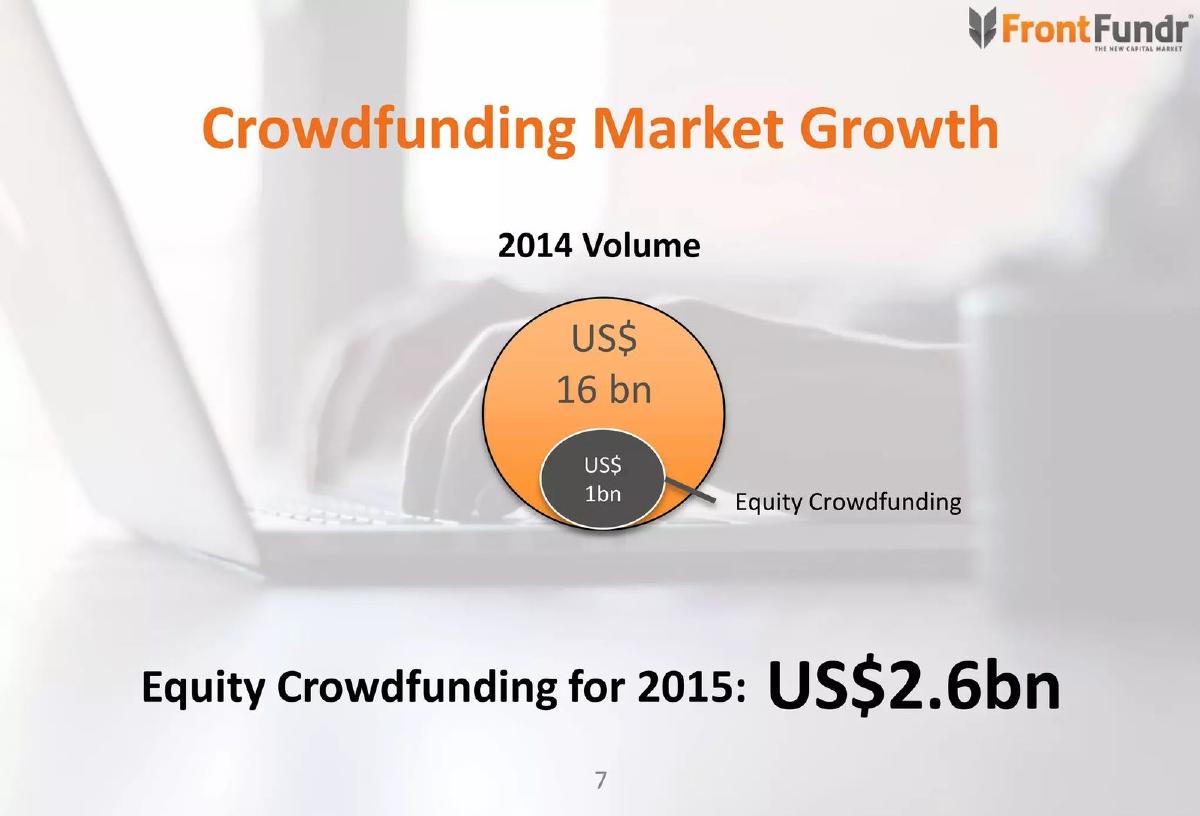
- Equity crowdfunding market growth is a central theme, noting a jump from $1 billion in 2014 to $2.6 billion in 2015 (Slide 7).
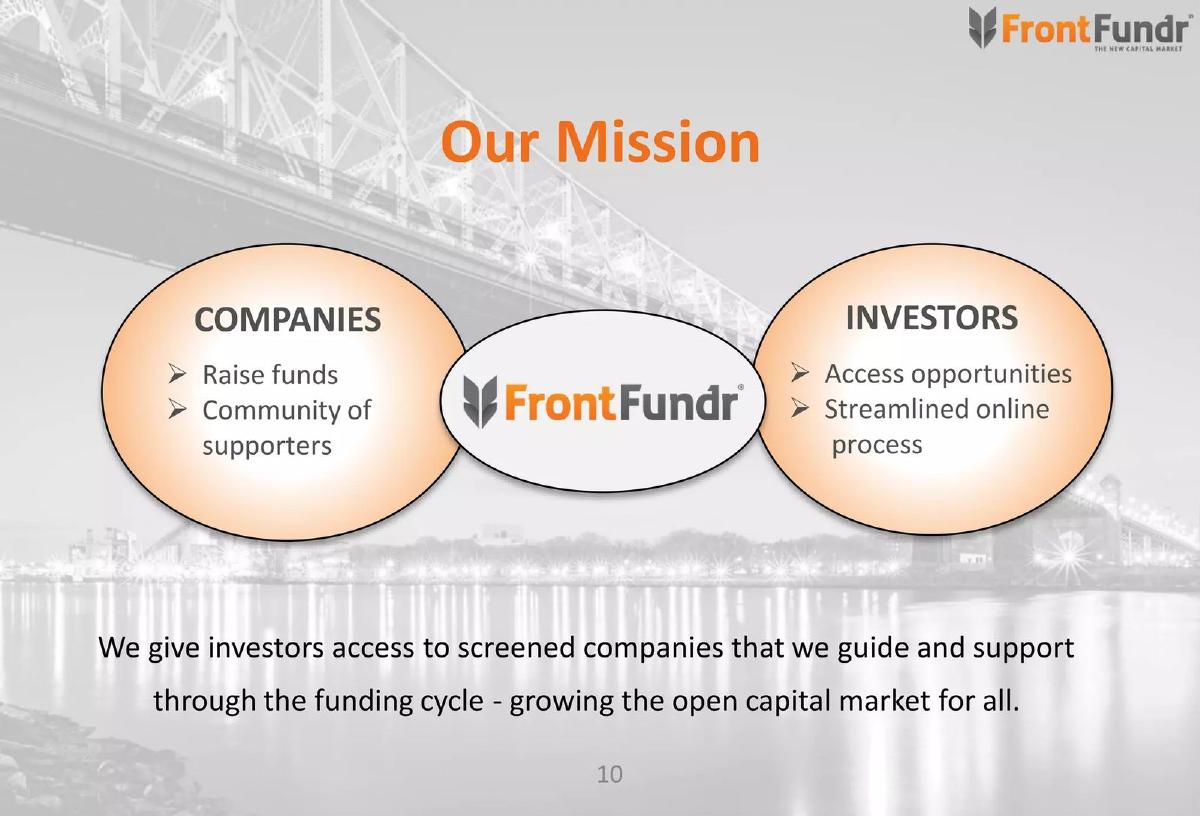
- FrontFundr defines its mission as a bridge between companies needing funds and investors seeking access to screened opportunities (Slide 10).
- Early traction is demonstrated by a user base exceeding 4,000 individuals (Slide 13).
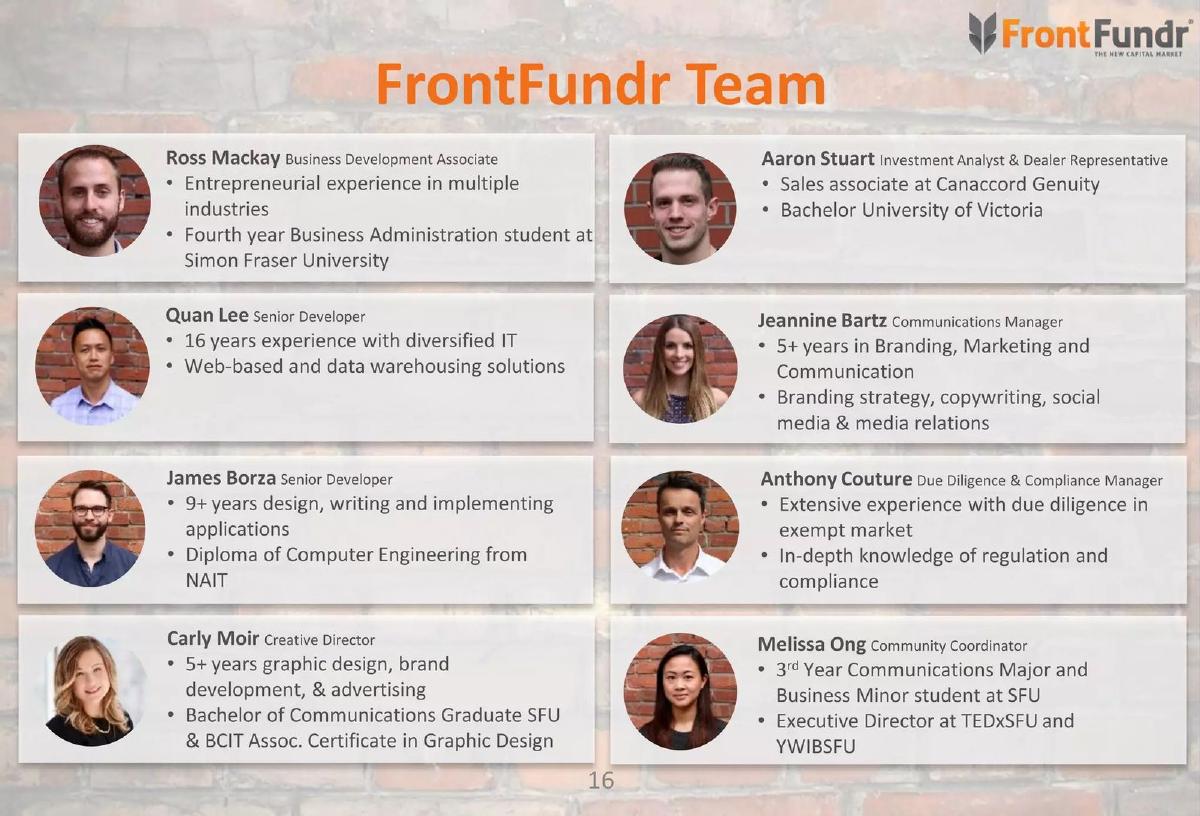
- The team slide showcases a mix of technical, marketing, and compliance expertise, including a dedicated Due Diligence & Compliance Manager (Slide 16).
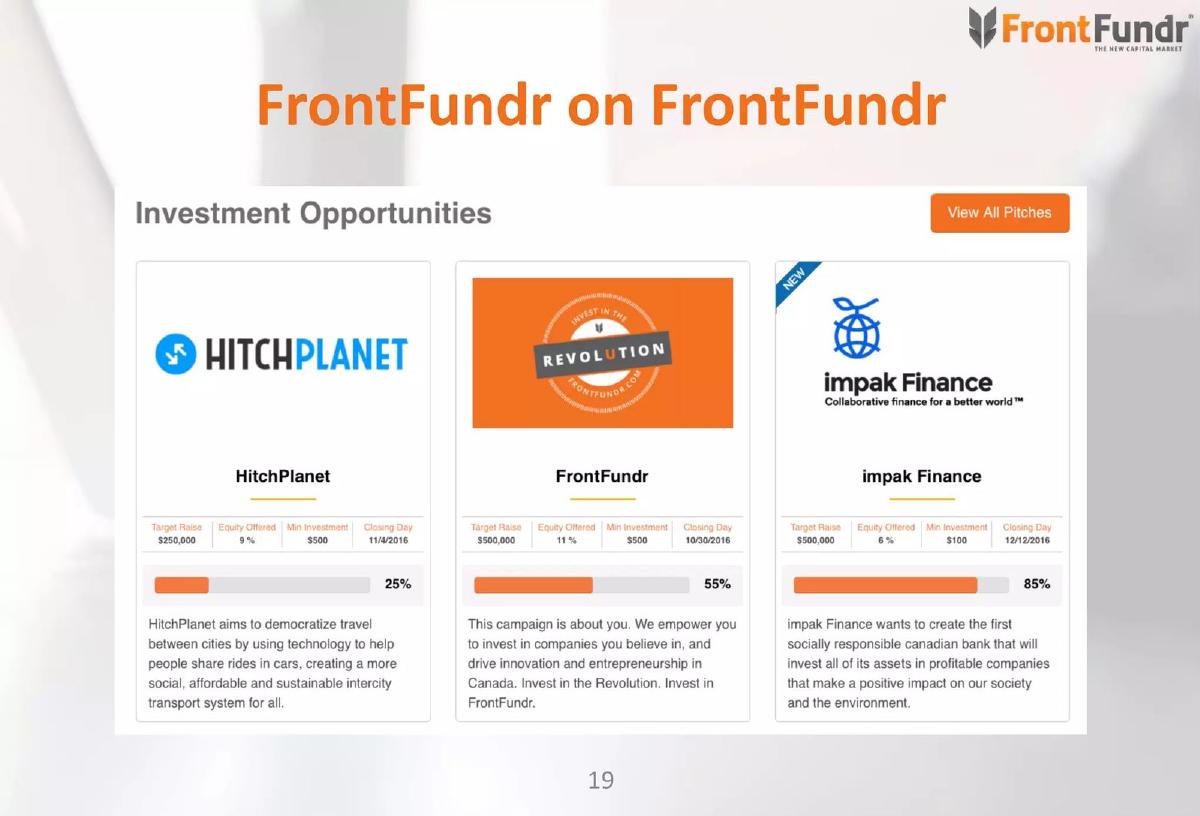
- The platform's functionality is shown through active campaigns like HitchPlanet and impak Finance, alongside their own internal raise (Slide 19).
- FrontFundr is explicitly noted as a trade name for Silver Maple Ventures Inc., a registered Exempt Market Dealer in eight Canadian provinces (Slide 22).
- The deck omits specific financial projections, detailed unit economics, and a clear breakdown of how the requested funds will be allocated.
FrontFundr Pitch Deck Analysis
The FrontFundr pitch deck from 2016 is a foundational document for one of Canada's most prominent equity crowdfunding platforms. Presented by Jill Earthy at the VanFUNDING conference, the deck focuses on the transition of private capital markets into the digital age. It frames the company not just as a website, but as a regulatory-compliant bridge that allows everyday retail investors to participate in the growth of private companies—a privilege previously reserved for the wealthy or well-connected.
Slide 1: Title Slide
The title slide introduces the brand with the tagline "Online Investing for Everyone." It establishes the date as October 18th, 2016, in Vancouver. The branding is clean, using a dark background that makes the orange and white logo stand out. The use of the registered trademark symbol on the logo suggests a level of professional maturity and brand protection early on.
Slide 4: The Problem
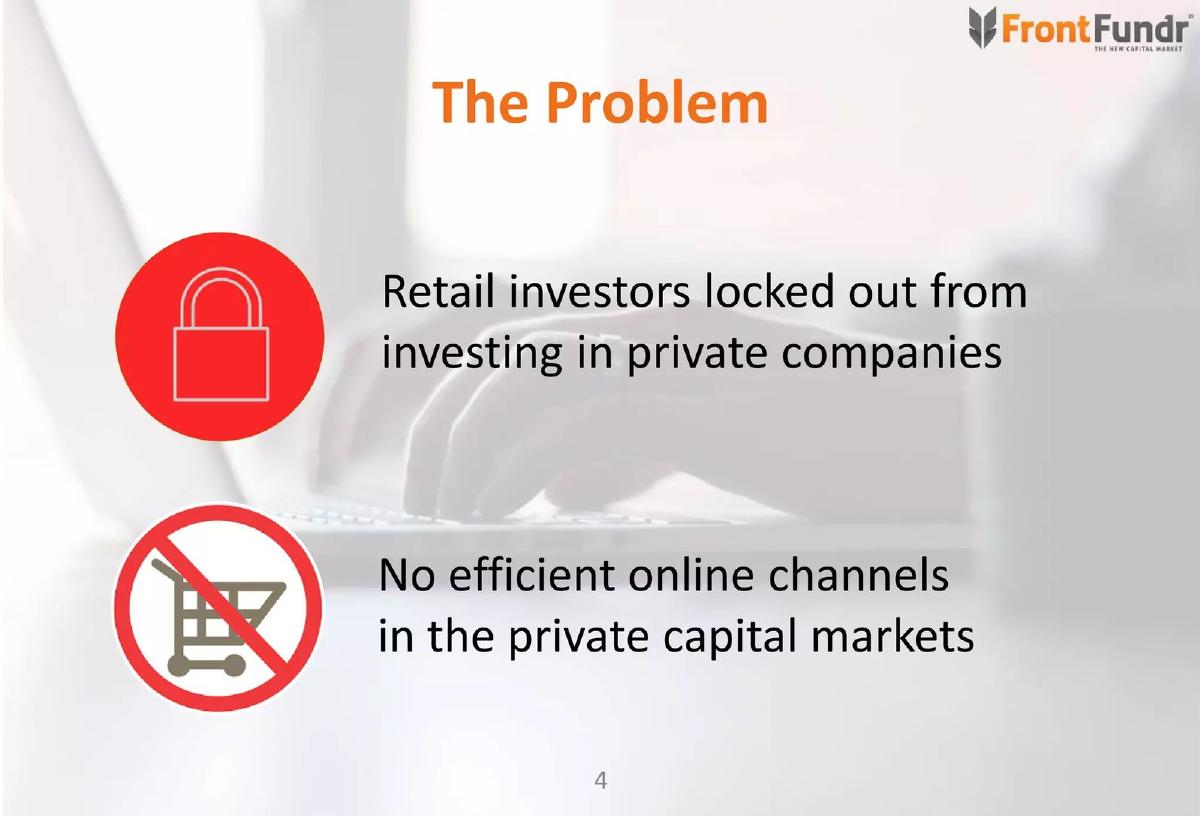
FrontFundr identifies two distinct problems in the current financial landscape. First, retail investors are "locked out" from investing in private companies, represented by a red lock icon. Second, there are "no efficient online channels" in the private capital markets, represented by a crossed-out shopping cart. This slide successfully identifies both a regulatory/access barrier and a technological gap, setting the stage for their solution.
Slide 7: Crowdfunding Market Growth
This slide provides the macro-economic justification for the business. It cites 2014 volume at US$16 billion, with equity crowdfunding representing a US$1 billion slice of that pie. Crucially, it highlights that equity crowdfunding grew to US$2.6 billion in 2015. By showing a 160% year-over-year growth in the specific sub-sector they operate in, FrontFundr demonstrates that they are riding a powerful market trend.
Slide 10: Our Mission
The mission slide uses a Venn diagram to show how FrontFundr sits at the intersection of companies and investors. For companies, the value proposition is raising funds and building a community of supporters. For investors, it is accessing opportunities through a streamlined online process. The summary text at the bottom emphasizes that they provide access to "screened companies," which is a subtle nod to their role as a gatekeeper and due diligence provider.
Slide 13: The Revolution has Begun
This is the primary traction slide. It features a collage of diverse individuals under the banner "I'm an Investor," humanizing the retail investor base they are targeting. The key metric provided is "4,000+ users." While it doesn't specify how many of these are active investors versus registered observers, it shows significant early interest in the platform.
Slide 16: FrontFundr Team
The team slide is comprehensive, featuring eight members. It highlights a balance between business development (Ross Mackay), technical execution (Quan Lee, James Borza), marketing (Jeannine Bartz, Carly Moir, Melissa Ong), and critically, compliance (Aaron Stuart, Anthony Couture). Mentioning "extensive experience with due diligence in exempt market" for Anthony Couture is vital for a fintech company operating in a highly regulated space.
Slide 19: FrontFundr on FrontFundr
This slide acts as a product demo and a proof of concept. It shows three active campaigns: HitchPlanet (seeking $250,000), impak Finance (seeking $500,000), and FrontFundr's own raise (seeking $500,000). The progress bars (25%, 85%, and 55% respectively) provide social proof that the platform is functional and that capital is actually moving through it. It also shows the variety of industries they cater to, from travel to socially responsible banking.
Slide 22: Thank You and Compliance
The final slide provides contact information for Jill Earthy (CGO). More importantly, the fine print at the bottom serves as a legal and regulatory anchor. It identifies FrontFundr as a trade name for Silver Maple Ventures Inc. and lists the eight Canadian provinces where they are a registered Exempt Market Dealer. It also displays logos for the PCMA and NCFA, reinforcing their status as an established player in the Canadian financial ecosystem.
What FrontFundr Does Well
FrontFundr excels at establishing regulatory credibility . In the world of equity crowdfunding, the biggest hurdle is often the legal framework. By explicitly listing their EMD registrations and their compliance-focused team members, they alleviate investor fears regarding the legality of the platform. They also do a great job of market timing , using clear, simple charts to show that equity crowdfunding is a fast-growing segment of the larger crowdfunding market.
Clear Value Proposition: The dual-sided nature of the marketplace is explained simply on slide 10. · Visual Social Proof: Using photos of real people and showing active campaign progress bars makes the concept feel tangible rather than theoretical. · Team Breadth: They show a full team, not just founders, which suggests they have the infrastructure to scale.
What is Missing from the Deck
While the deck is strong on mission and early traction, it lacks several key financial details that a Series A or late-seed investor would typically require. There is no mention of unit economics —how much does it cost to acquire a user, and what is the lifetime value of an investor on the platform? Furthermore, the revenue model is not explicitly detailed; while one can assume they take a percentage of funds raised, the specific fee structure is absent.
Financial Projections: There are no slides showing expected revenue growth or path to profitability. · Competitive Analysis: The deck does not mention other platforms (like Seedrs or Crowdcube in the UK, or US competitors) and how FrontFundr differentiates itself beyond being Canadian-focused. · The Ask: While slide 19 shows they are raising $500,000, there is no breakdown of how that specific capital will be used (e.g., 40% marketing, 30% engineering).
Founder Takeaways: What to Copy
Founders building in regulated industries should take note of how FrontFundr handles compliance as a feature . Instead of burying their legal status in an appendix, they weave it into the team slide and the closing slide, making it a core part of their value proposition. This builds trust with both investors and the companies looking to raise on the platform.
Use macro trends to justify your existence: If your sub-sector is growing faster than the broader market, make that the centerpiece of your market slide (Slide 7). · Humanize your user base: If you are building a B2C or retail-facing platform, show the faces of your users to make the "revolution" feel real (Slide 13). · Show, don't just tell: The screenshot of the platform with active raises (Slide 19) is far more effective than a list of features. It proves the product is live and the market is responding.
Frequently asked questions
- What is FrontFundr's core business model based on the deck?
- FrontFundr operates as an online investment platform that connects private companies with both retail and institutional investors. According to slide 10, they provide companies with a way to raise funds and build a community of supporters, while offering investors a streamlined online process to access screened investment opportunities. They position themselves as the 'new capital market' for everyone.
- How does FrontFundr address regulatory concerns in Canada?
- Regulatory compliance is a major focus of the deck. Slide 22 states that FrontFundr is a trade name of Silver Maple Ventures Inc., which is a registered Exempt Market Dealer (EMD) in Alberta, British Columbia, Manitoba, New Brunswick, Nova Scotia, Ontario, Quebec, and Saskatchewan. They also highlight their membership in the Private Capital Markets Association of Canada (PCMA) and the National Crowdfunding Association of Canada (NCFA).
- What evidence of market demand does the deck provide?
- The deck uses macro-market data to show demand. Slide 7 highlights that the total crowdfunding market volume was $16 billion in 2014, with equity crowdfunding specifically growing from $1 billion in 2014 to $2.6 billion in 2015. This suggests a rapidly expanding sector that FrontFundr is positioned to capture within the Canadian landscape.
- Who are the key members of the FrontFundr team mentioned?
- Slide 16 lists eight team members with diverse backgrounds. Key roles include Ross Mackay (Business Development), Quan Lee and James Borza (Senior Developers), Aaron Stuart (Investment Analyst), and Anthony Couture (Due Diligence & Compliance Manager). The contact person for the deck is Jill Earthy, who is listed as the Chief Growth Officer (CGO) on slide 22.
- What kind of traction did FrontFundr have at the time of this pitch?
- FrontFundr demonstrated early traction by reporting over 4,000 users on slide 13. Additionally, slide 19 shows active investment opportunities on their platform, including HitchPlanet (25% funded), impak Finance (85% funded), and FrontFundr's own campaign, which was 55% funded toward a $500,000 target at the time the slide was created.