Davakhaana’s pitch deck outlines a strategy to disrupt the Indian e-pharmacy space by moving away from the centralized warehouse model used by competitors like NetMeds and 1mg. By partnering with local pharmacies, the company claims to eliminate stocking costs and delivery overhead while offering a 2-hour delivery window—significantly faster than the industry standard of 1 to 7 days. The financial projections are aggressive, targeting a jump from 6,668 monthly orders in FY 16-17 to over 69,000 in FY 17-18. While the deck excels at defining a lean business model, it lacks a formal 'Team' slide…
Key takeaways
- The company seeks a total capital raise of INR 3.5 Cr to cover 50 lacs in Capex and 3 Cr in operating losses until profitability (Slide 6).
- Davakhaana claims a 2-hour delivery window, contrasting with competitors who take between 1 and 7 days (Slide 4).
- The business model relies on a 12% to 15% margin on orders, with higher margins expected from diagnostic tests and alternative medicines (Slide 3).
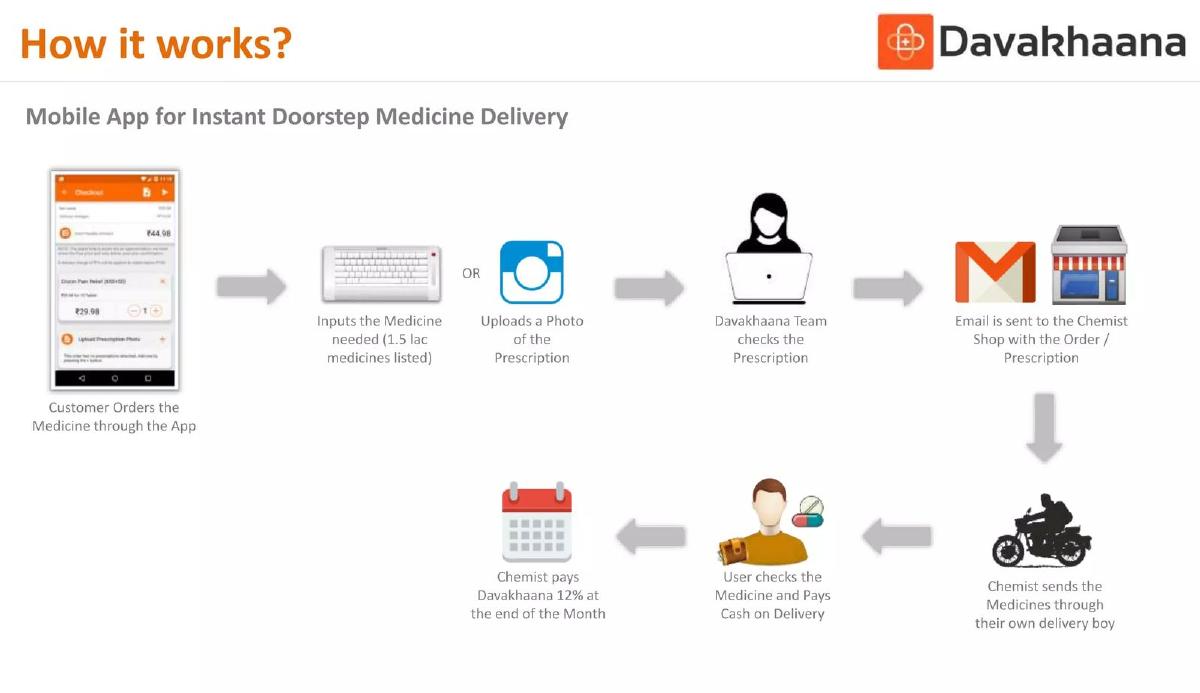
- Operational costs are minimized through outsourced technology and a 'no delivery cost' model, presumably by leveraging existing pharmacy infrastructure (Slide 3).
- The market opportunity is anchored in a Rs 60,000 crore pharma retail market growing at 15% annually, citing 2015-2016 data (Slide 5).
- Financial projections for FY 17-18 estimate a gross revenue of 513,666,563 INR and a positive EBITDA of 21,045,445 INR (Slide 6).
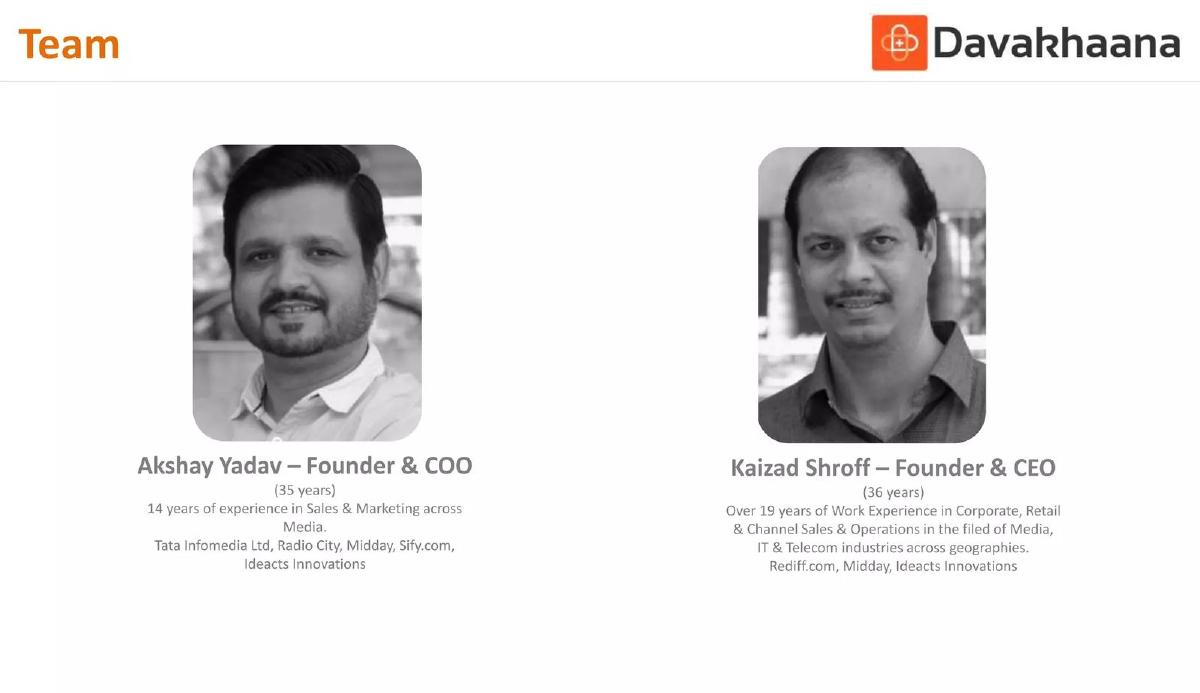
- The deck features a 'Mentors' slide with three experienced advisors but notably lacks a dedicated slide for the founding executive team (Slide 2).
- Inventory risk is mitigated by a 'no stocking cost' policy, as medicines are sourced from local partners rather than owned warehouses (Slide 4).
Executive Summary: The Hyper-Local Pharmacy Marketplace
Davakhaana’s investor deck presents a vision for an 'Instant Medicine Delivery App' tailored for the Indian market. The core thesis is that the existing e-pharmacy giants are too slow and too detached from the local ecosystem. By positioning itself as a technology layer over existing local pharmacies, Davakhaana aims to provide 2-hour delivery without the massive capital requirements of owning inventory or managing a dedicated delivery fleet. The deck is structured to highlight operational efficiency and a clear path to profitability within two fiscal years.
Slide 1: Title Slide
The deck opens with a clean, orange-themed logo and the tagline: "Instant Medicine Delivery App." The branding is straightforward, emphasizing the 'Davakhaana' name, which translates to 'pharmacy' or 'clinic' in several Indian languages, immediately establishing the sector and service. There is no mention of the specific funding stage or the date on this slide.
Slide 2: Mentors
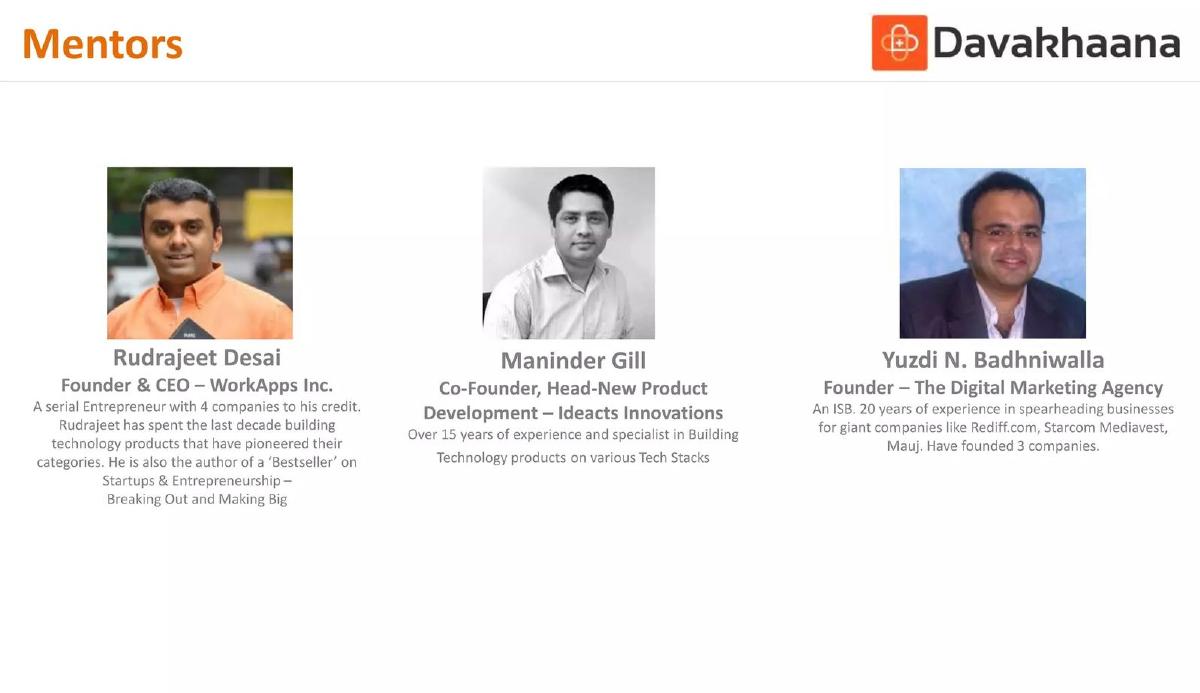
Interestingly, the second slide focuses on 'Mentors' rather than the founding team. It features three individuals: Rudrajeet Desai , a serial entrepreneur and CEO of WorkApps Inc.; Maninder Gill , a technology specialist with 15 years of experience; and Yuzdi N. Badhniwalla , a marketing agency founder with 20 years of experience. While these profiles provide credibility in tech and marketing, the omission of a 'Founders' slide in the first half of the deck is a notable choice. It suggests that the company may be in a very early stage where the advisors' reputations are being used to anchor the pitch.
Slide 3: Business Model
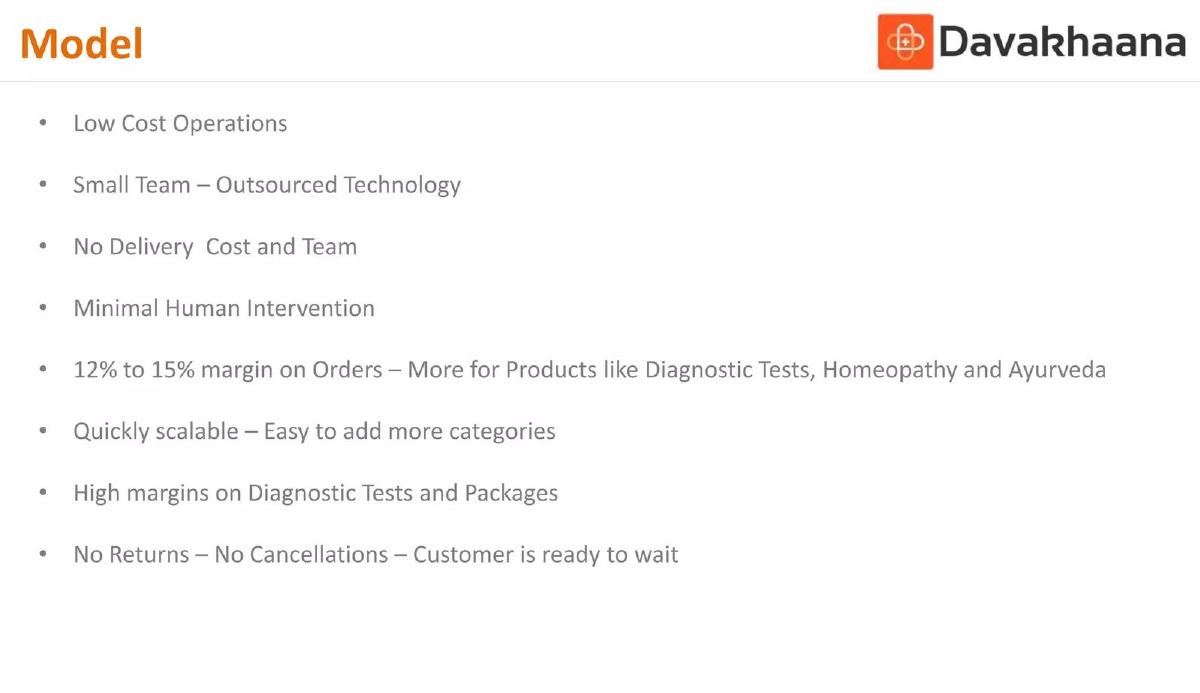
The 'Model' slide outlines a lean operational strategy. Key points include:
Low Cost Operations: Achieved through a small team and outsourced technology. · Asset-Light: The slide explicitly states "No Delivery Cost and Team" and "No Stocking Cost." · Margins: The company targets a 12% to 15% margin on standard orders, with higher margins expected from diagnostic tests, homeopathy, and Ayurveda. · Customer Behavior: A unique claim is made that there are "No Returns – No Cancellations – Customer is ready to wait," though this appears to contradict the competitive analysis on Slide 4 which says items "Can be returned anytime."
Slide 4: Competitive Landscape (Other Players)
This slide uses a comparison table to pit Davakhaana against NetMeds, 1mg, and Pharmeasy. The primary differentiators are:
Speed: Davakhaana claims delivery "Within 2 Hours," compared to 1-7 days for competitors. · Database: They claim 1.5 lacs (150,000) medicines listed. · Cost Structure: Davakhaana claims zero stocking and delivery costs to the company, whereas competitors like NetMeds and 1mg bear courier or internal delivery team costs. · Trust: The company leverages "Local Pharmacy Trust" against what it calls the "Invisible Brand" of larger competitors.
Slide 5: Market Opportunity
The market size is justified using two clippings from the Times of India. The first, dated December 2015, values the pharma retail market at nearly Rs 60,000 crore with 15% growth. The second, from February 2016, shows global funding for e-pharma companies, highlighting Chinese firms like 7LK ($148mn) and Yiyao ($72mn). This slide serves to prove that the sector is both large and attractive to venture capital, though the data is now several years old.
Slide 6: The Ask and Financials
The final slide in this set details the financial projections and the funding requirement. The Total ASK is INR 3.5 Cr . The budget allocation is split between Talent (38%), Product Development (35%), and Marketing (7.7%). The financial table shows a projected jump in Net Revenue from 5,668,185 INR in FY 16-17 to 61,639,988 INR in FY 17-18. This growth is driven by an increase in outlets (from 498 to 1,000) and a massive increase in monthly orders (from 6,668 to 69,072). The company expects to reach an EBITDA of 21,045,445 INR in the second year.
What Works in This Deck
Clear Differentiation: The deck does an excellent job of identifying the 'pain point' of slow delivery in the e-pharmacy space. By focusing on a 2-hour window, Davakhaana creates a clear value proposition that distinguishes it from the warehouse-heavy models of larger incumbents.
Asset-Light Focus: For a seed-stage company, demonstrating how to scale without heavy capital expenditure is vital. The emphasis on 'No Stocking Cost' and 'No Delivery Team' shows a commitment to a marketplace model that could theoretically scale faster than a logistics-heavy competitor.
Specific Financial Ask: Many decks fail to specify how they will use the funds. Davakhaana provides a clear breakdown of the 3.5 Cr ask, separating Capex from operational runway, which gives investors a clear picture of the company's burn rate and milestones.
What Is Missing or Needs Improvement
The Founding Team: The most glaring omission is a slide dedicated to the actual founders. While mentors are valuable, investors fund founders. Without knowing who is running the day-to-day operations and what their specific backgrounds are, the 'Mentors' slide feels like a distraction.
Contradictory Claims: Slide 3 claims there are "No Returns – No Cancellations," while Slide 4 claims items "Can be returned anytime" and "Can be cancelled anytime." This inconsistency in the core service offering needs to be resolved to maintain credibility.
Unit Economics: While the deck mentions a 12-15% margin, it doesn't detail the Customer Acquisition Cost (CAC) or Lifetime Value (LTV). Given the low marketing budget (only 7.7% of the ask), investors would want to see how the company plans to acquire 69,000 monthly orders so cheaply.
Founder's Takeaway: The Marketplace Playbook
Founders should look at Davakhaana’s deck as a template for pitching a hyper-local marketplace . If you are entering a crowded market dominated by well-funded giants, your best path is often to find a service level they cannot match—in this case, speed. By leveraging existing local infrastructure (pharmacies), you can pitch a business that is "capital efficient" because you aren't building warehouses; you are building software. However, ensure your team slide is front and center. Advisors are the garnish; the founders are the meal.
Frequently asked questions
- What is Davakhaana's primary competitive advantage?
- According to Slide 4, Davakhaana's primary advantage is speed and flexibility. It promises delivery within 2 hours, whereas competitors like NetMeds (7 days) and 1mg (3 days) are significantly slower. Additionally, Davakhaana allows for anytime returns and cancellations, which it claims competitors restrict. This is achieved by leveraging 'Local Pharmacy Trust' rather than building an 'Invisible Brand' through centralized warehouses.
- How does Davakhaana plan to achieve high margins with low operations?
- Slide 3 details a 'Low Cost Operations' model. By outsourcing technology and maintaining a small team, the company keeps overhead low. Crucially, they claim to have 'No Delivery Cost and Team' and 'No Stocking Cost,' suggesting they act as a pure marketplace layer that facilitates transactions between existing local pharmacies and customers, taking a 12-15% commission.
- What are the specific financial requirements for this round?
- Slide 6 states a 'Total ASK' of INR 3.5 Cr. This is broken down into two main categories: 50 lacs for Capital Expenditure (Capex) and 3 Cr to cover operating losses until the company reaches profitability. The budget allocation pie chart shows that 38% of funds are earmarked for Talent, 35% for Product Development, and 7.7% for Marketing.
- Who is advising the company, and why is this significant?
- Slide 2 lists three mentors: Rudrajeet Desai (CEO of WorkApps Inc.), Maninder Gill (Tech specialist from Ideacts Innovations), and Yuzdi N. Badhniwalla (Marketing veteran). The presence of these mentors suggests the company is leaning on external expertise for technology and scaling, which is consistent with their stated model of 'Outsourced Technology' on Slide 3.
- What is the projected growth trajectory for the company?
- Slide 6 shows an aggressive growth plan. In FY 16-17, the company reports an average of 498 outlets and 6,668 monthly orders. For FY 17-18, they project scaling to 1,000 outlets and 69,072 monthly orders. This represents a more than 10x increase in order volume, which they expect will flip the company from a 2.7 Cr EBITDA loss to a 2.1 Cr EBITDA profit.