Daybreak’s March 2023 investor deck positions the company as an all-in-one generative AI suite for recruitment, moving beyond simple sourcing to cover the entire hiring lifecycle from planning to post-offer engagement. The deck is notable for its heavy reliance on early-stage validation, citing an MVP trial conducted between January 7th and February 15th with 29 accounts. By segmenting these users—38% mid-market and 35% SMB—and providing specific testimonials from companies like AlmaBetter and Ayoconnect, Daybreak attempts to prove product-market fit before scaling. However, the deck lacks cr…
Key takeaways
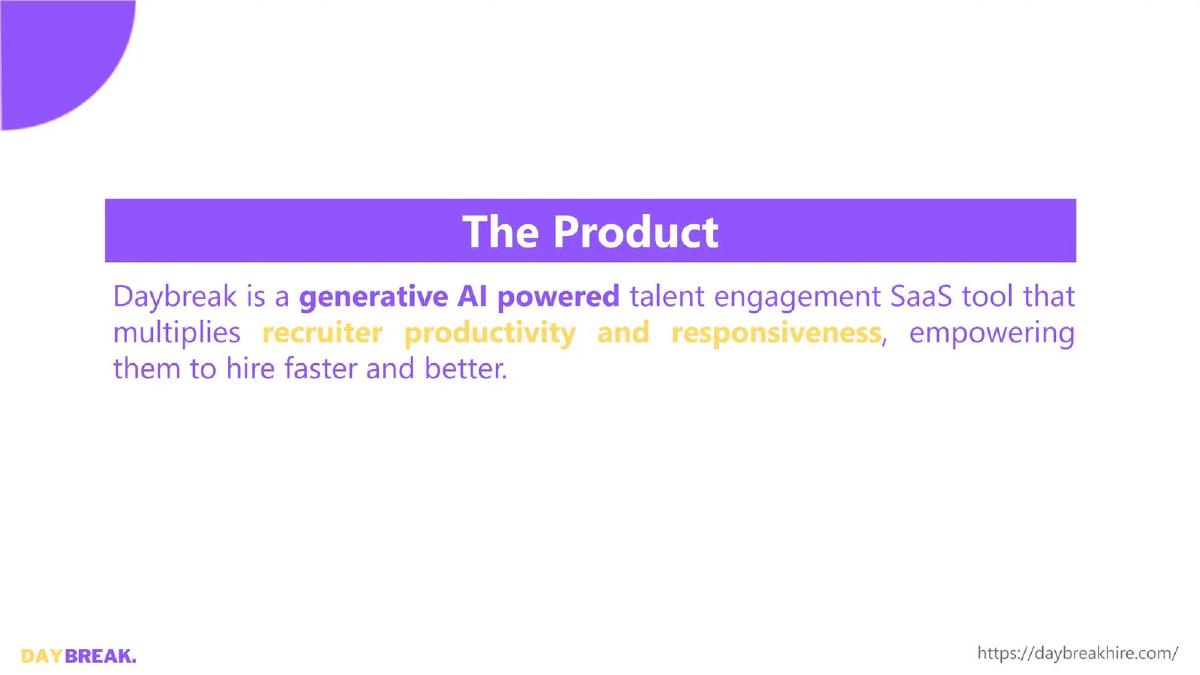
- The product is defined on slide 2 as a generative AI-powered talent engagement SaaS tool focused on recruiter productivity.
- Daybreak maps its features across a comprehensive recruitment timeline, covering 12 distinct touchpoints from hiring planning to post-offer engagement (slide 4).
- MVP trial data from slide 5 shows a diverse user base, with 38% of respondents from mid-market companies and 35% from SMBs.
- The company identifies a specific market opportunity of 12.5K+ Indian accounts and 100K+ global accounts (slide 7).
- Recruiting tech global market size is projected to grow from $2.4 billion in 2022 to $4.1 billion by 2030 (slide 7).
- Qualitative validation is provided through five detailed testimonials from talent acquisition leads and HR managers (slide 6).
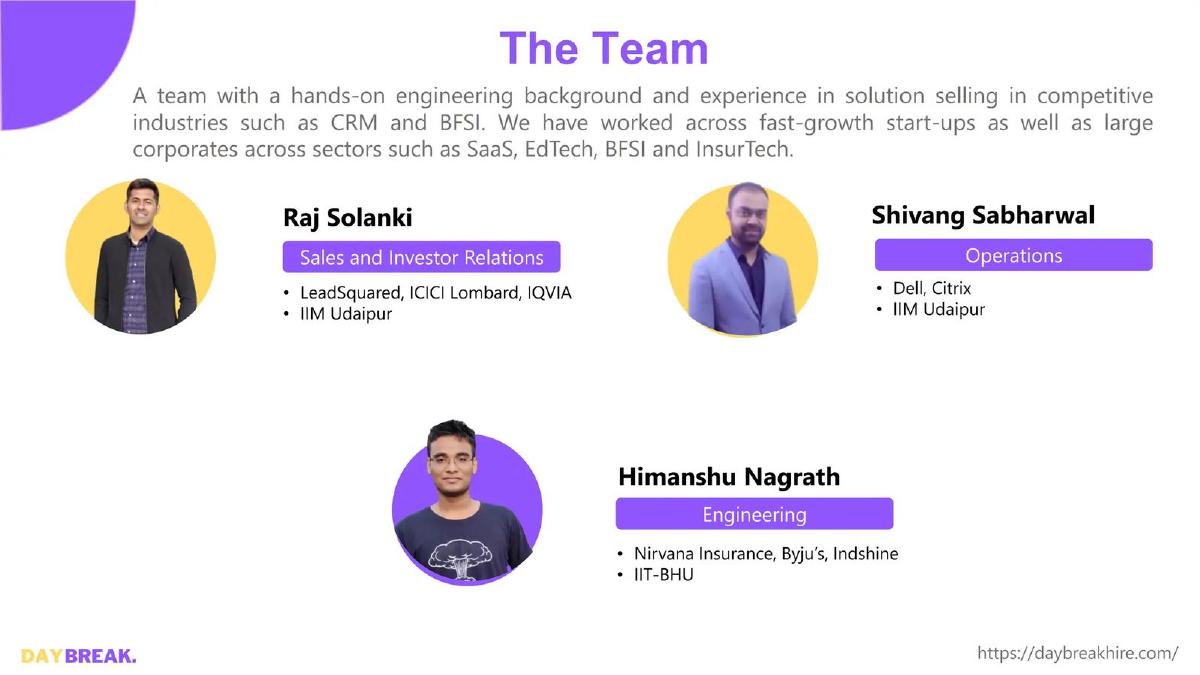
- The deck omits a team slide, failing to establish the founders' technical or industry expertise.
- There is no mention of unit economics, current revenue, or a specific capital requirement for the funding round.
Introduction and Product Vision
The Daybreak pitch deck, dated March 2023, introduces a generative AI-powered solution for the recruitment industry. The presentation is structured to move quickly from high-level vision to specific product features and early-stage validation data. Unlike many early-stage decks that lead with a 'Problem' slide, Daybreak leads with the 'Product' as the central pillar of their narrative.
Slide 1: Title Slide
The title slide establishes the brand identity with the tagline, "All the superpowers that modern recruiting teams need." It clearly identifies the document as an "Investor Pitch Deck" and provides a version date of March 2023. The imagery is professional yet generic, featuring a waterfront walkway, which does little to convey the technical nature of the product but maintains a clean aesthetic.
Slide 2: The Product Definition
Slide 2 provides a concise mission statement: "Daybreak is a generative AI powered talent engagement SaaS tool that multiplies recruiter productivity and responsiveness, empowering them to hire faster and better." By highlighting "generative AI" and "SaaS," the company immediately categorizes itself within high-growth tech sectors. The focus on "productivity" and "responsiveness" addresses the two most common pain points in high-volume recruiting.
Slide 3: Core Features
This slide breaks down the technical offering into four quadrants:
Statement-based workflow designer: Suggests a customizable automation engine. · Dynamic candidate engagement scoring: A data-driven approach to prioritizing leads. · Browser extension: A tool for "instant sourcing," likely integrating with platforms like LinkedIn. · AI powered 24X7 screening chatbot: A standard but necessary component for modern top-of-funnel management.
The slide emphasizes the balance between "personalisation and scale," a difficult trade-off in traditional recruitment.
Slide 4: The Recruitment Lifecycle
Slide 4 is perhaps the most ambitious in the deck. It presents an "All encompassing suite to enrich every recruitment touchpoint." The slide uses a color-coded spectrum to map out 12 stages of hiring, from "Hiring Planning" to "Post Offer Engagement." By positioning themselves across this entire timeline, Daybreak is signaling that they intend to be a platform of record (like an ATS) rather than just a point solution. The stages are categorized into six buckets: Plan, Conceptualize, Market, Assess, Engage, and Monitor.
Slide 5: MVP Trial Results [1/2]
Validation is the core of this deck. Slide 5 details an MVP trial executed between 7th Jan to 15th Feb . The company documented feedback from 29 accounts . The demographic breakdown is specific:
38% Mid-Market (500 - 5K employees) · 35% SMB (500 or less employees) · 19% Corporate (5K - 20K employees) · 8% Enterprise (>20K employees)
The respondent roles are also segmented, with 62% coming from Talent Acquisition/HR. This level of detail provides credibility to their early claims of product-market fit.
Slide 6: User Testimonials
Slide 6 provides qualitative support for the quantitative data on the previous slide. It features five quotes from industry professionals. A Manager of Talent Acquisition at AlmaBetter praises the user-friendliness, while a Talent Acquisition Lead at Ayoconnect highlights the need for a "one stop hiring solution," explicitly mentioning competitors they currently switch between: Darwin box, Phenom, and LinkedIn. This is the only place in the deck where competitors are indirectly identified.
Slide 7: The Global Opportunity
The market slide uses data from Verified Market Research and LinkedIn Research. It shows the recruiting tech global market size growing from $2.4 Billion in 2022 to $4.1 Billion in 2030 . The slide also sets a target for the "Opportunity to transform hiring" for 12.5K+ Indian accounts and 100K+ Global accounts . This suggests a geographic focus on India as a primary or initial market before global expansion.
Slide 8: Closing Slide
The final slide is a simple "Thank You" with the company logo (DB) and a contact email for "raj@daybreakhire.com." It lacks a call to action or a summary of the investment opportunity, which is a missed chance to reinforce the deck's main message.
What Works in This Deck
Specific Validation: The inclusion of a dedicated MVP trial results slide (Slide 5) is a strong move. Many early-stage startups speak in generalities about their potential; Daybreak provides specific dates, account counts, and company size segments. This gives investors a clear picture of who is actually testing the software.
Lifecycle Mapping: Slide 4 effectively visualizes the complexity of the recruitment process. By showing how their features map to every stage from planning to onboarding, they make a compelling case for why a recruiter would want to stay within their ecosystem rather than using multiple disconnected tools.
Direct Testimonials: The quotes on Slide 6 are not anonymous. Attributing feedback to specific roles at named companies like LeadSquared and Dozee adds a layer of social proof that is often missing in seed-stage decks.
What Is Missing
The Team: This is the most significant omission. Investors at the early stage are primarily betting on the founders. There is no information regarding who is building Daybreak, their technical background in AI, or their previous experience in the HR tech space.
The Ask: The deck does not state how much capital is being raised, the valuation, or the intended use of funds. Without a clear 'Ask,' the deck functions more as a product brochure than a fundraising document.
Business Model and Unit Economics: While the deck identifies the market size, it does not explain how Daybreak makes money. Is it per-seat, per-hire, or a flat monthly subscription? There is no mention of Customer Acquisition Cost (CAC) or Lifetime Value (LTV) projections.
Competitive Landscape: Aside from a brief mention of other tools in a user testimonial, there is no formal competitive analysis. In a crowded HR tech market, failing to explain how Daybreak specifically beats established players or other AI startups is a weakness.
Founder Takeaways
Use Real Data Early: Even if your sample size is small (like Daybreak’s 29 accounts), presenting it with clear charts and segments is much more persuasive than saying "users love the product." If you have run a pilot, show the data.
Map the Workflow: If your product covers a complex process, use a timeline or spectrum (like Slide 4) to show where you fit. It helps investors visualize the 'stickiness' of your solution.
Don't Forget the 'Who': Never send a deck without a team slide. Even if the product is revolutionary, investors need to know why you are the right person to execute the vision. A lack of a team slide often raises red flags about founder credibility or commitment.
Define the Market Specifically: Daybreak’s breakdown of Indian vs. Global accounts (Slide 7) shows they have a strategic starting point. Founders should avoid just citing a massive global number and instead show a realistic 'beachhead' market they can capture first.
Frequently asked questions
- What is Daybreak's core value proposition?
- According to slide 2, Daybreak is a generative AI-powered talent engagement SaaS tool. Its primary goal is to multiply recruiter productivity and responsiveness, enabling teams to hire faster and better. It differentiates itself by offering an 'all-encompassing suite' that touches every part of the recruitment process, rather than just a single niche like sourcing or screening.
- How did Daybreak validate its product early on?
- Daybreak conducted an MVP trial between January 7th and February 15th (slide 5). They gathered feedback from 29 accounts across various company sizes. The data shows that 62% of respondents were in Talent Acquisition/HR roles, while 23% were Hiring Managers. This specific data set helps prove that the tool is being used by its intended target audience.
- What specific features does the platform offer?
- Slide 3 highlights four key features: a statement-based workflow designer, dynamic candidate engagement scoring, a browser extension for instant sourcing, and an AI-powered 24x7 screening chatbot. These features are designed to balance personalization with the ability to scale recruitment efforts.
- What is the projected market growth for this sector?
- Slide 7 cites Verified Market Research and LinkedIn Research, stating the recruiting tech global market size was $2.4 billion in 2022. It is projected to grow to $4.1 billion by 2030. The deck specifically targets a transformation of over 100,000 global accounts, with a focused sub-segment of 12.5K+ Indian accounts.
- What critical information is missing from this pitch deck?
- The deck is missing several standard components required for a full investment evaluation. Most notably, there is no team slide, no financial projections, no mention of current traction/revenue (beyond the MVP trial), and no specific 'ask' detailing how much money they are raising or how it will be spent.