Day One Ventures' 2017 deck is a masterclass in differentiation for emerging fund managers. At a time when capital was becoming a commodity, founder Masha Drokova positioned the firm as a strategic partner that solves the most expensive and difficult problem for early-stage startups: visibility. The deck leans heavily on social proof, featuring a 10.5x return from an early angel investment (Slide 4) and extensive testimonials from founders who credit the firm with high-impact press coverage (Slide 12). By framing PR as a tool for customer acquisition and talent recruitment rather than just 'b…
Key takeaways
- The firm highlights a specific 10.5x return on NtechLab, invested in May 2016 and exited in October 2017, to prove investment acumen (Slide 4).
- Day One positions itself against the 'spray paint' approach of other VC funds, arguing that capital has become a commodity (Slide 9).
- The deck identifies three core investment pillars: AI/ML, VR/AR, and Fintech, citing specific market growth projections for each (Slide 6).
- A dedicated slide on dealflow metrics claims the firm evaluates 200-250 opportunities per month to make 1-2 investments (Slide 8).
- The 'Value of PR' slide uses Tesla and Robinhood as case studies to show how communications can replace traditional advertising spend (Slide 10).
- Founders from Domuso, DigitalGenius, Home61, and Lvl5 provide direct testimonials regarding the firm's active role in their growth (Slide 12).
- The firm's 'Big Vision' involves expanding beyond PR into product, go-to-market, recruiting, and design services (Slide 13).
- The deck lists five high-profile advisors, including the Head of Google Cloud startup program and the co-founder of Acronis (Slide 5).
The Hybrid VC Model: A Teardown of Day One Ventures
Day One Ventures launched at a pivotal moment in the venture capital ecosystem. In 2017, the rise of Initial Coin Offerings (ICOs) and the massive scale of the SoftBank Vision Fund were beginning to reshape how startups viewed capital. This deck is a strategic response to those shifts, positioning a new firm not as a source of money, but as a source of growth through communications.
Introduction and Track Record
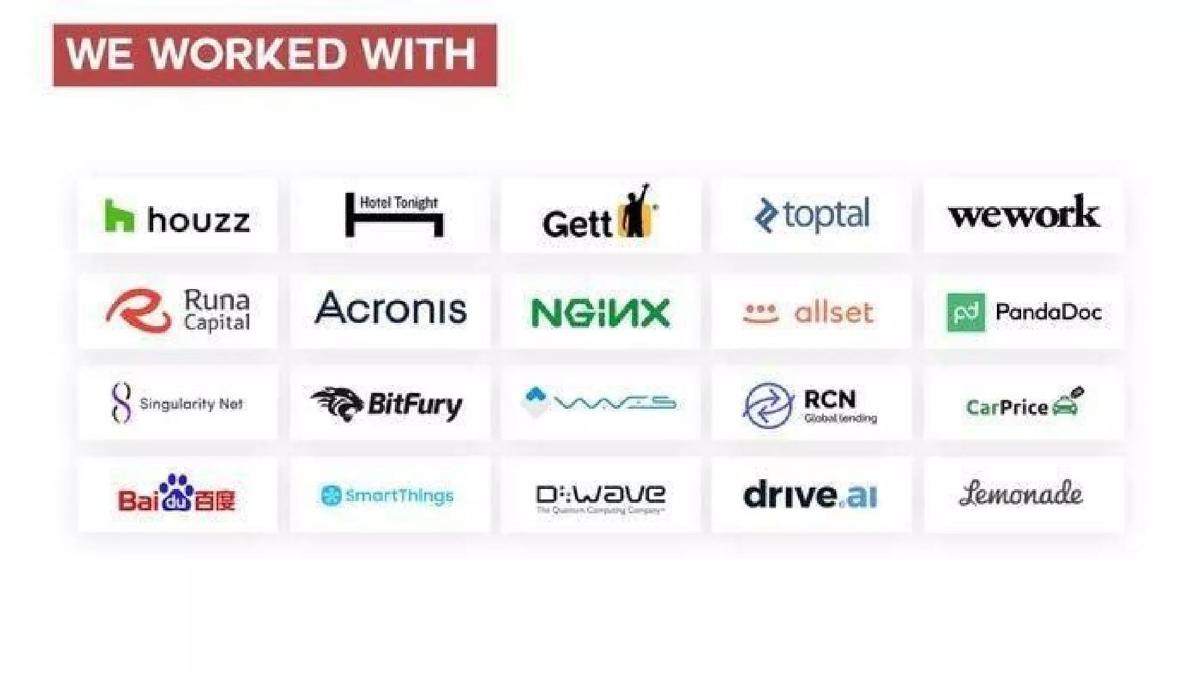
The deck begins by establishing immediate credibility through association. Slide 2, titled WE WORKED WITH , displays a grid of 20 logos including major names like Houzz, Wework, Lemonade, and Baidu. This slide serves to show the breadth of the team's network and previous professional engagements before diving into the specific investment thesis.
Slide 3, INVESTING IN PRODUCTS PEOPLE LOVE , uses a collage of social media posts and Product Hunt screenshots. This is a visual representation of 'customer obsession.' By showing real users tweeting about portfolio companies like Truebill and Octi, Day One demonstrates that they invest in companies that generate organic word-of-mouth—a key prerequisite for their PR-heavy strategy to be effective.
The Angel Portfolio and Advisory Board
For an emerging manager, the 'track record' slide is the most critical. Slide 4, ANGEL PORTFOLIO , provides specific data points. It highlights NtechLab , noting an investment in May 2016 and an exit in October 2017 with a 10.5x return . Crucially, the slide links this financial success to PR activity, stating that Masha Drokova managed all PR efforts, generating 100+ publications which led to 600+ international B2B inbound leads . Other companies listed in the angel portfolio include DigitalGenius, Truebill, Chatfuel, and MEL Science.
Slide 5 introduces the ADVISORS . The firm surrounds its founder with deep enterprise and cloud expertise. Notable names include Joel Englander (Head of Google Cloud startup program and early Instacart investor) and Serguei Beloussov (CEO of Acronis). This balances the founder's communications background with heavy-duty technical and operational experience.
Investment Strategy and Market Thesis
Slide 6, INVESTMENT AREAS , breaks down the firm's focus into three sectors: AI/ML, VR/AR, and Fintech. For each, the deck provides a market growth stat (e.g., the global AI market growing to $6,141.5 million by 2022 ) and lists current portfolio companies in those spaces, such as Knowhere in AI and Arcus in Fintech.
Slide 7, WHAT WE LOOK FOR , outlines the firm's investment criteria. These are standard VC benchmarks: potential for a $1+ billion valuation , TAM of at least a few billion, and high LTV/CAC. However, the final point, Fits Our Vision (Day One culture), suggests a qualitative filter that allows the firm to be selective about the founders they partner with.
The 'Why Now' and The Value Proposition
Slide 9, LANDSCAPE IS CHANGING , is the 'Why Now' slide. It argues that VCs are becoming 'unnecessary middlemen' unless they bring value beyond a check. It cites that startups raised $5.6B via ICOs in 2017 and that the $100B SoftBank Vision Fund has made the market extremely competitive. This sets the stage for Day One's unique value proposition.
Slide 10, VALUE OF PR , explains why their specific value-add matters. It claims PR agencies are expensive ( $10-30k per month ) and that most founders lack PR experience. It uses Tesla and Robinhood as examples of companies that reached massive valuations (Robinhood at $5.6 billion ) with little to no traditional advertising, relying instead on high-quality communications.
Social Proof and Future Vision
Slide 11, FUND'S COVERAGE , showcases press quotes from TechCrunch, Reuters, WSJ, and VentureBeat. The Reuters quote is particularly strong, quoting Serguei Beloussov saying, "Masha knows a lot of people... She is good in that she gets access to very good startups." This reinforces the idea that the firm's PR expertise is a magnet for top-tier deal flow.
Slide 12, WHAT OUR FOUNDERS SAY , provides testimonials from four CEOs. Damian Langere (Domuso) and Mikhail Naumov (DigitalGenius) both emphasize that Day One provides "results," not just advice, specifically citing "high impact press coverage" and help with "critical points in the company's growth cycle."
The deck concludes with Slide 13, BIG VISION . It reveals that while they started with communications, the plan is to expand into Product, Go-To-Market, Recruiting, and Design services. This positions Day One not just as a PR-focused fund, but as a full-service platform for early-stage companies.
What works in this deck
Tangible PR Outcomes: Instead of vague promises of 'help,' the deck cites specific numbers of publications and inbound leads generated for portfolio companies. · Strong Social Proof: The combination of high-profile advisors and enthusiastic founder testimonials makes the 'hybrid model' feel proven rather than experimental. · Clear Differentiation: By calling capital a 'commodity,' the firm forces the investor to look at their service offering as the primary asset.
What is missing from this deck
Fund Structure and Terms: The deck does not specify the total fund size being raised, the management fee structure, or the expected deployment timeline. · Detailed Team Slide: While the founder is mentioned in the description and advisors are listed, a slide detailing the full-time investment team and their specific backgrounds is absent from the provided 13 slides. · Exit Strategy for the Fund: While it mentions a 10.5x return for one angel investment, it does not provide a broader view of how the fund intends to return capital to LPs across the entire portfolio.
What a founder should copy
The 'Landscape' Slide: If you are entering a crowded market, use a slide like Slide 9 to explain how the macro environment has changed and why the old way of doing things is no longer sufficient. · Case Study Format: Slide 10's use of Tesla and Robinhood is a great way to use 'industry giants' to validate your own business model. · Founder Testimonials: Don't just list your portfolio; get quotes that specifically address the unique value you provided. It is much more convincing than a list of logos.
Frequently asked questions
- What is Day One Ventures' core investment thesis?
- Day One Ventures operates on a hybrid model where they provide both capital and high-level communications/PR services. Their thesis is that in a market where venture capital is a commodity, the best founders will choose investors who provide tangible value-add services that help them attract customers, partners, and talent without traditional advertising spend.
- Which industries does the firm focus on?
- According to Slide 6, the firm focuses on three primary areas: AI/ML (citing a market growth to $6.1 billion by 2022), VR/AR (projected to reach a combined $94 billion by 2023), and Fintech (noting that global funding exceeded $31 billion in 2017).
- How does the firm prove its track record as a new fund?
- The firm uses an 'Angel Portfolio' slide (Slide 4) to show the founder's previous successes. It highlights NtechLab specifically, showing a 10.5x return in under 18 months. It also lists other recognizable names like Truebill, Chatfuel, and MEL Science to demonstrate access to high-quality deals before the fund was officially launched.
- What specific PR metrics does the deck mention?
- Rather than just listing 'press hits,' the deck connects PR to business outcomes. For example, on Slide 4, it mentions that PR efforts for Piper led to 100+ publications and 4 new investors, while NtechLab's PR resulted in 600+ international B2B inbound leads.
- Who are the key people involved in the firm?
- The firm was founded by Masha Drokova. The deck also highlights a strong advisory board (Slide 5) including Joel Englander (Google Cloud), Ilya Zubarev and Serguei Beloussov (Acronis/Runa Capital), Riccardo Di Blasio (DXC Technology), and Luis A. Navia (Verizon).