DC Alliance is a Singapore-based owner-operator of Tier-certified data centers, primarily targeting the Australia and Asia Pacific regions. The deck, dated November 2020, focuses heavily on the company's acquisition of Pier DC, a Tier III facility in Perth, Australia. The business model emphasizes an 'engineering-led' design and a flexible 'PAYU' (Pay-As-You-Use) power model. While the deck successfully establishes the company's technical credibility and existing asset base, it lacks critical forward-looking financial projections, a specific funding ask, and a detailed competitive analysis. I…
Key takeaways
- The company identifies as an owner-operator of Tier Certified Data Centres on slide 2.
- DC Alliance acquired 100% of Pier DC, a Perth-based colocation provider, on September 11, 2020, as noted on slide 9.
- The Pier DC facility is described as the only Tier III certified colocation facility south of the Perth CBD on slide 9.
- Technical specifications for the Perth facility include a 1,000-rack capacity with a 5MW ICT load, according to slide 10.
- The management team includes Executive Chairman Roy Wong and General Manager Albert Wong, who is accredited by the Uptime Institute (slide 7).
- Institutional investors include Figtree Holdings Limited (listed on the SGX Catalist board) and ESW Holdings Pte Ltd, as shown on slide 8.
- The value proposition includes a 'PAYU' power model where customers only pay for what they use, mentioned on slides 4 and 12.
- The deck lacks a specific investment ask, financial forecasts, or a clear exit strategy for new investors.
Executive Summary and Brand Positioning
Slides 1-3: Identity and Credo
The deck opens with a minimalist title slide dated November 2020, introducing the brand DC Alliance and its tagline, "Engineering Connected Ecosystems." Slide 2 immediately defines the company's core function: an "owner-operator of Tier Certified Data Centres." This is a critical distinction in the infrastructure space, signaling that they are not merely resellers or consultants but asset owners.
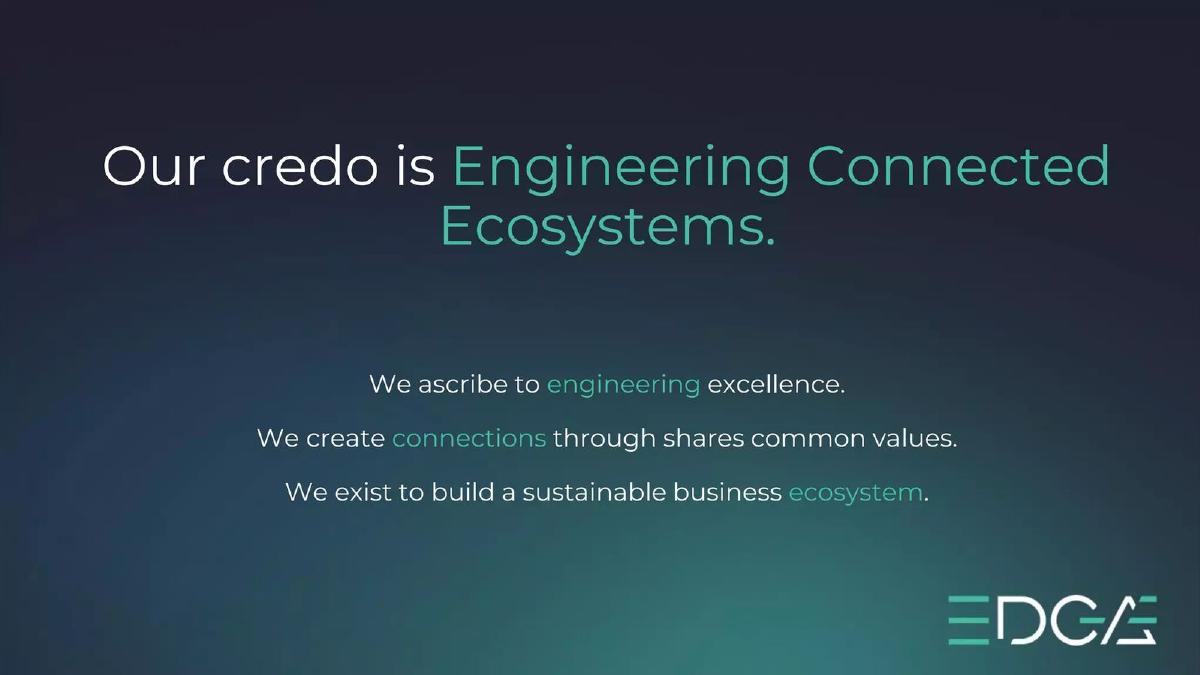
Slide 3 outlines the company "credo," which focuses on engineering excellence and building a sustainable business ecosystem. While these are high-level mission statements, they set the tone for a company that prioritizes technical rigor over aggressive marketing. The repetition of the word "Engineering" across these early slides reinforces their intended market position as a technical specialist.
Business Strategy and USPs
Slides 4-6: The DNA and Objectives
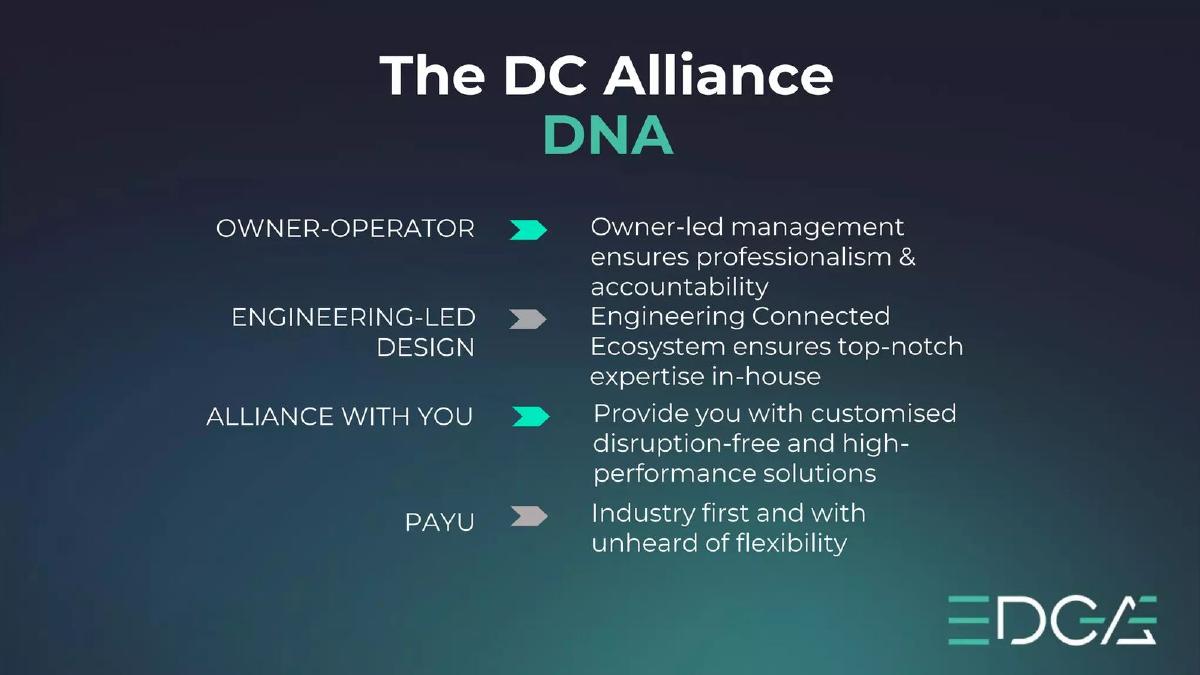
Slide 4 introduces the "DC Alliance DNA," which breaks down their competitive advantages into four pillars: Owner-Operator, Engineering-Led Design, Alliance With You (customized solutions), and "PAYU." The PAYU model is described as an "industry first" offering "unheard of flexibility." In the capital-intensive data center world, allowing customers to pay only for the power they use is a significant departure from traditional fixed-contract models.
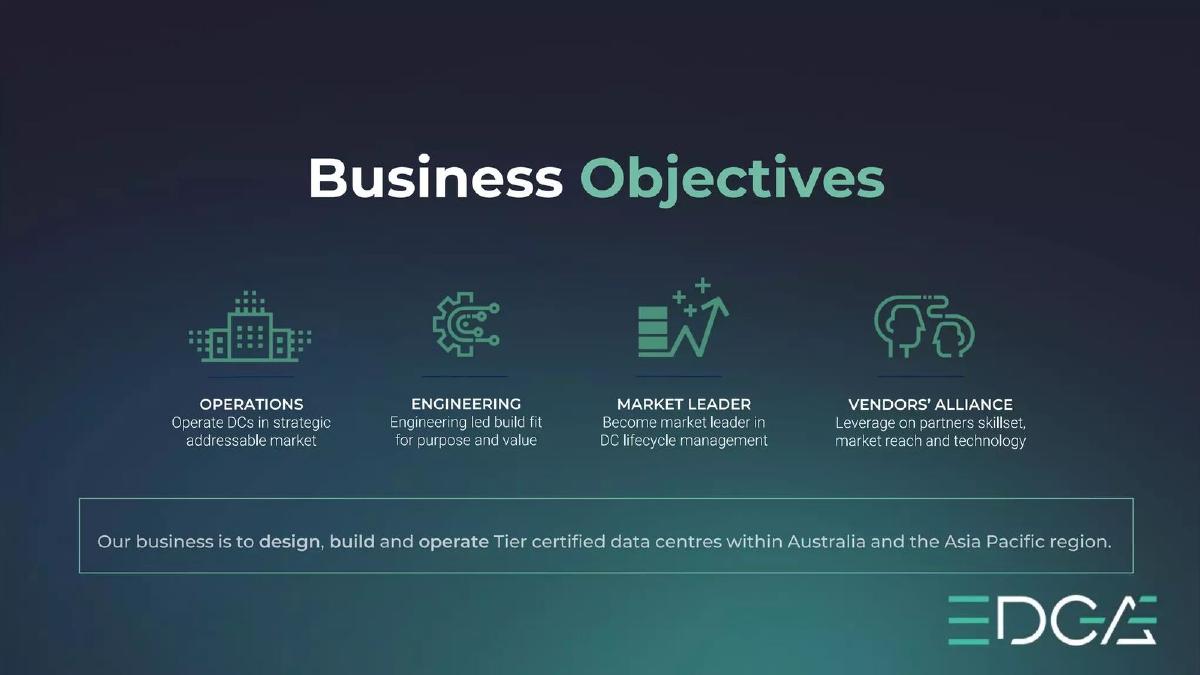
Slide 5 defines their Business Objectives . The company aims to design, build, and operate facilities specifically within Australia and the Asia Pacific region . They categorize their goals into Operations, Engineering, Market Leadership, and a Vendors' Alliance. This slide clarifies their geographic focus, which is essential for infrastructure investors looking for regional exposure.
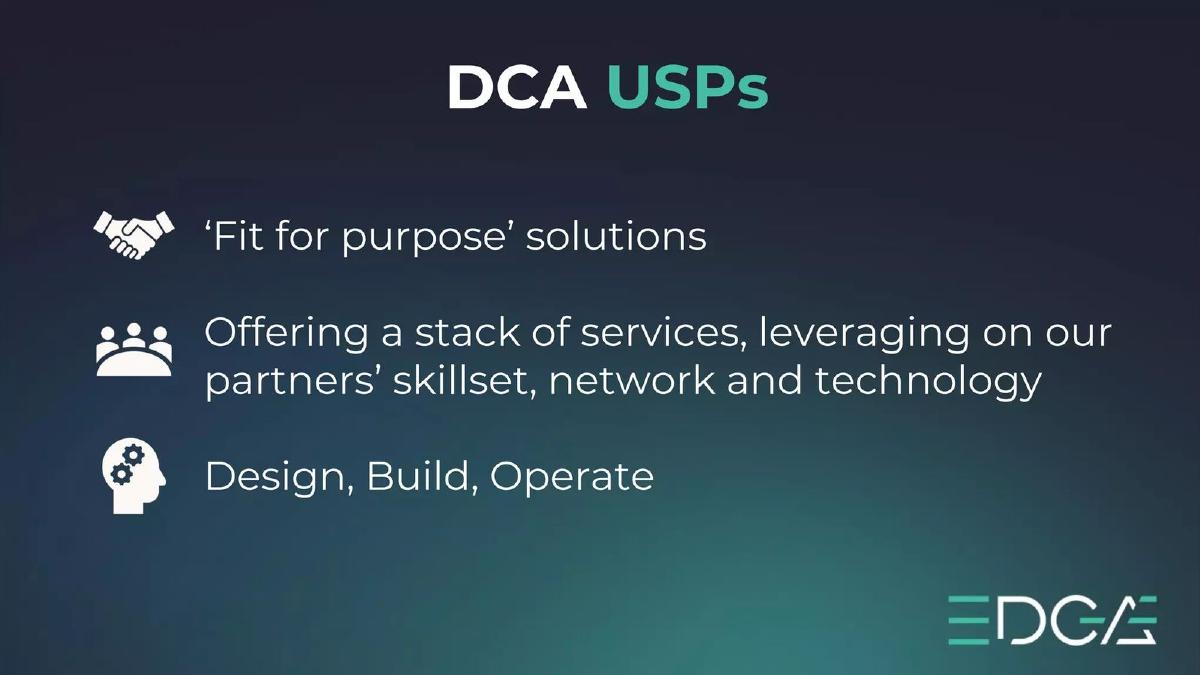
Slide 6 summarizes their Unique Selling Propositions (USPs) . It reiterates the "Fit for purpose" solutions and the "Design, Build, Operate" full-lifecycle capability. By controlling the entire lifecycle, DC Alliance suggests they can maintain higher quality standards and better cost control than competitors who outsource construction or management.
Leadership and Institutional Backing
Slides 7-8: Management and Investors
The Management Team slide (Slide 7) presents four key figures. Roy Wong (Executive Chairman) is credited with managing private businesses and pre-IPO companies since 2005. Albert Wong (General Manager) provides the technical backbone, being an engineer accredited by the Uptime Institute who has previously designed Tier III facilities. James Wong handles marketing communications, and Mark Ryan , a Chartered Accountant and former Finance Director at Kellogg Joint Venture Group, provides institutional governance. The team appears balanced between operational experience, technical certification, and financial oversight.
Slide 8, Investors , is a strong validation slide. It lists Figtree Holdings Limited , which is noted as being listed on the Singapore Stock Exchange (SGX) Catalist board, and ESW Holdings Pte Ltd , described as an established private equity firm. The presence of a publicly traded industrial design specialist (Figtree) suggests a strategic partnership that likely aids in the "Design and Build" phase of their data centers.
The Perth Acquisition Case Study
Slides 9-11: Pier DC Operations
Slide 9 serves as the centerpiece of the deck's current traction: the 100% acquisition of Pier DC on September 11, 2020. The slide includes press clippings from CRN and ARN to provide third-party verification. The facility is located in Canning Vale, Perth, and is highlighted as the "only Tier III certified colocation facility south of the Perth CBD." This geographic monopoly is a classic infrastructure moat.
Slide 10 provides the technical specifications of the Pier DC facility. Key metrics include:
Certified Tier III status. · 1,000 racks capacity. · 5MW ICT Load. · ISO 27001 Certification. · GovNext-ICT program approved member.
Slide 11 uses high-quality photography to showcase the physical infrastructure, including 1MW Air Cooled Chillers (N+1) , in-row CRAH units, and 47RU racks. For an infrastructure investor, these photos are not just filler; they prove the existence and quality of the asset, showing segregated data halls and cold air containment systems.
Value Proposition and Omissions
Slide 12: Detailed Value Proposition
The final slide summarizes the Value Proposition across six categories: Facility, Physical Security, Vendor Support, Connectivity, Racks, and Partner Program. It mentions 24/7/365 manned security, 360-degree surveillance, and connectivity to major telco providers including Vocus . The mention of "rebates/trailing commissions" in the Partner Program section suggests a mature channel sales strategy.
What is Missing from the Deck?
Despite the strong technical and asset-based presentation, this deck has several glaring omissions typical of a "credentials" deck rather than a "fundraising" deck:
No Financials: There are no historical revenue figures for Pier DC, no projections for future facilities, and no discussion of EBITDA margins or CapEx requirements. · No Ask: The deck does not state how much money is being raised or what the terms are. · No Roadmap: While they mention the Asia Pacific region, there is no specific timeline for the next acquisition or build-out beyond the Perth facility. · No Competitive Landscape: There is no mention of how they compete against global giants like Equinix or NEXTDC, other than the "south of CBD" geographic niche.
Founder Lessons
Focus on Asset Validation
For founders in hardware or infrastructure, DC Alliance provides a good template for asset validation . Instead of just claiming they can build data centers, they lead with a successful acquisition and provide detailed technical specs and photos of the facility. This moves the conversation from "if" they can do it to "how fast" they can scale.
The Power of Institutional Backing
Listing Figtree Holdings (a listed company) and ESW Holdings early in the deck provides immediate "adult in the room" credibility. For a company managing critical data infrastructure, proving that you are governed by experienced financial and industrial partners is more important than having a "disruptive" brand story.
Clarity of Service Model
The "Design, Build, Operate" and "PAYU" models are clearly defined. Founders should copy the way DC Alliance uses simple icons and bullet points to explain complex operational models. Even without a financial ask, the deck clearly communicates what they do and where they do it, which is the first step in any successful institutional fundraise.
Frequently asked questions
- What is the primary business model of DC Alliance?
- DC Alliance operates as an owner-operator that designs, builds, and manages Tier-certified data centers. According to slide 5, their objective is to operate in strategic addressable markets within Australia and the Asia Pacific region. They differentiate through an engineering-led design process and a flexible 'PAYU' (Pay-As-You-Use) pricing model for power consumption, which they claim is an industry first.
- What specific assets does the company currently own?
- The deck highlights the 100% acquisition of Pier DC in September 2020. Slide 10 details that this facility is a Certified Tier III Data Centre located in Canning Vale, Perth. It features a 1,000-rack capacity, a 5MW ICT load, and is an approved member of the GovNext-ICT program, providing connectivity to both public and private clouds.
- Who are the key members of the leadership team?
- The team is led by Executive Chairman Roy Wong, who has experience managing private businesses and start-ups since 2005. Albert Wong serves as General Manager and brings technical expertise as an Uptime Institute-accredited engineer. The board also includes Mark Ryan, a former Finance Director of Kellogg Joint Venture Group, who heads corporate finance and governance (slide 7).
- What technical standards does DC Alliance adhere to?
- The company focuses on Tier III certification, which implies high redundancy and availability. Slide 10 and 12 confirm the Perth facility is ISO 27001 certified for information security and maintains 100% uptime. Technical features mentioned on slide 11 include 1MW air-cooled chillers (N+1 redundancy), in-row CRAH for precision cooling, and cold air containment systems.
- Is there a clear investment opportunity presented in this deck?
- No. The deck functions primarily as a company profile or 'credentials deck.' It lists current investors like Figtree Holdings and ESW Holdings (slide 8) but does not include a slide detailing the amount of capital being sought, the valuation, or the specific use of proceeds. It serves to validate the company's existence and recent acquisition rather than solicit a specific round of funding.