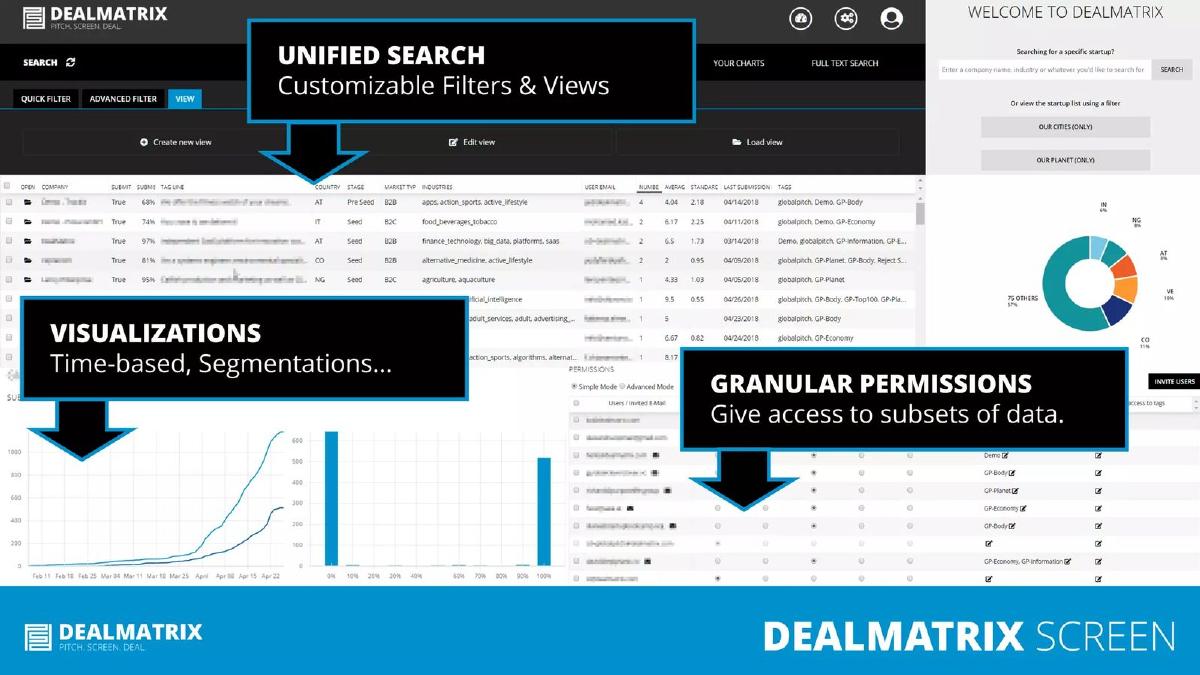
DealMatrix addresses the 'irreproducible decisions' inherent in traditional innovation scouting, where analysts and corporate partners rely on unstructured data and fragmented email threads. Their deck, presented at NOAH18 Berlin, highlights a transition from early-stage angel funding in 2016 to a projected €3.2M revenue by 2020. The platform positions itself as a 'Unified Corporate Innovation Platform' that bridges the gap between various innovation sources—like startups and patents—and internal stakeholders. While the deck effectively visualizes the product's collaborative evaluation interf…
Key takeaways
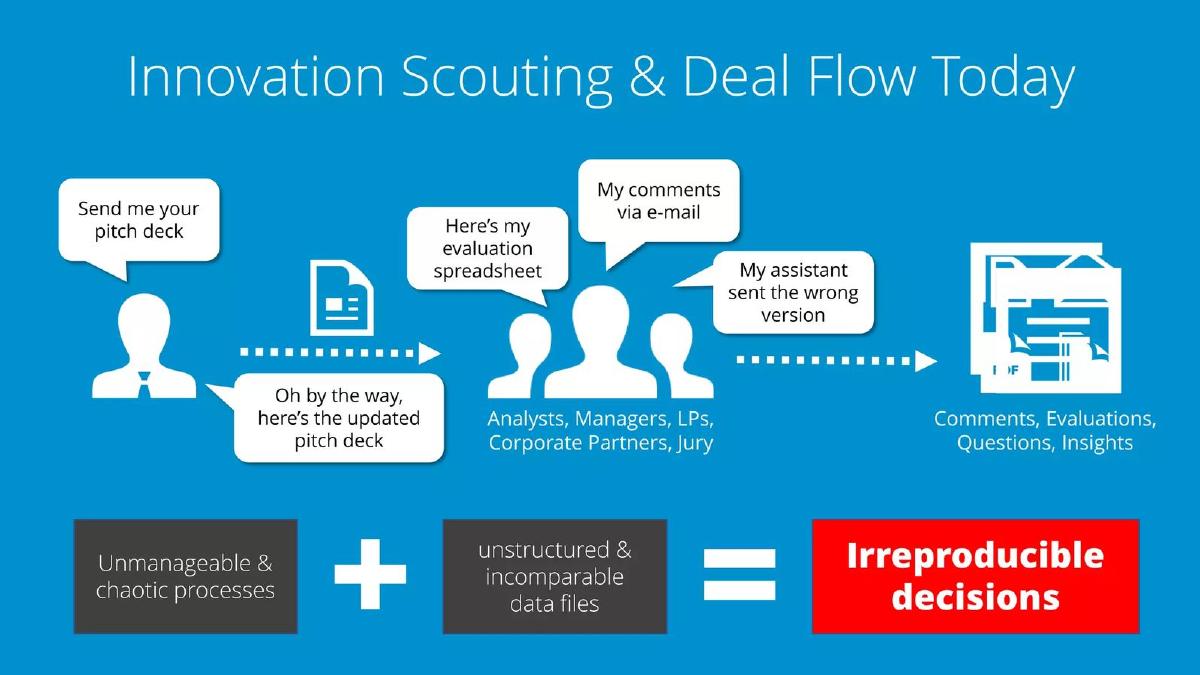
- The problem is defined as a combination of unmanageable processes and incomparable data files leading to 'irreproducible decisions' (Slide 2).
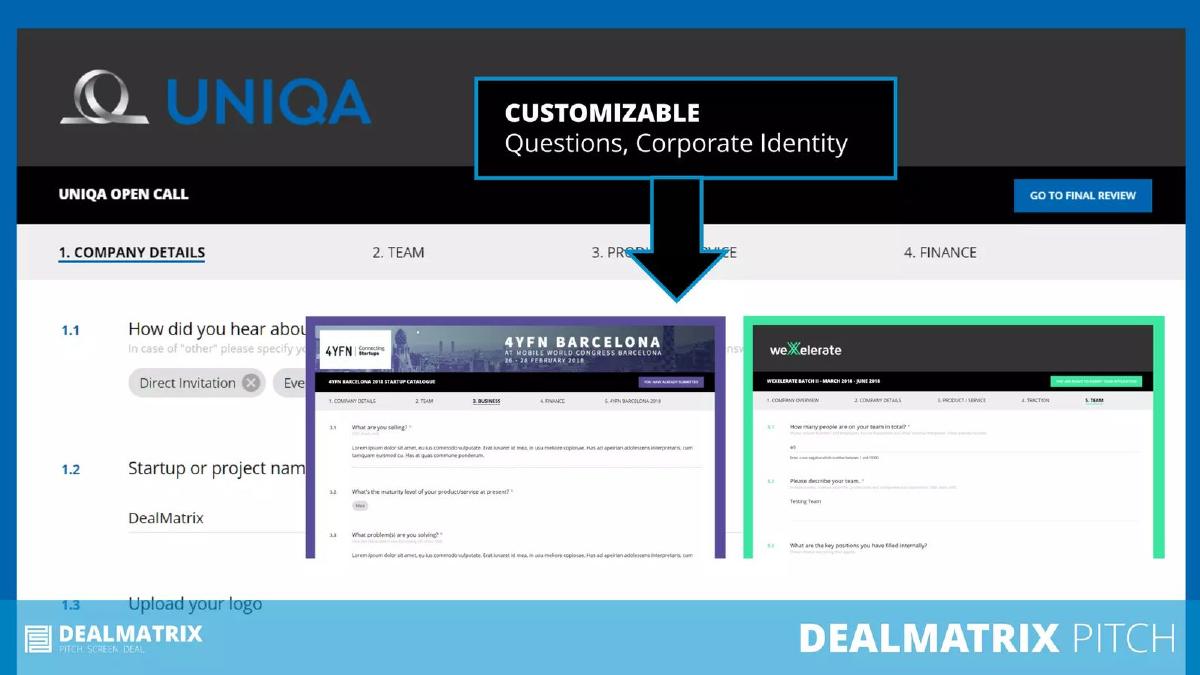
- The platform offers customizable intake forms that can be white-labeled for corporate identities like UNIQA or 4YFN Barcelona (Slide 3).
- Product features include 'Intelligent Signaling' based on AI to identify red flags and collaborative scoring systems for analysts (Slide 4).
- Revenue growth shows a steep trajectory from €17K in 2016 to a projected €3.2M in 2020 (Slide 5).
- Financing history includes an Angel Round in 2016, a Bridge Round in 2017, and a €180K grant in 2018 (Slide 5).
- The company aimed to close a funding round at a €4M pre-money valuation estimate in 2019 (Slide 5).
- The platform targets five specific innovation inputs: Startups, Internal Projects, Patents, Ideas, and Technical Transfer (Slide 6).
- The company is headquartered in Vienna, Austria, as indicated by the contact information for CEO Christoph Drescher (Slide 7).
DealMatrix Pitch Deck Analysis
The DealMatrix deck, presented at the NOAH18 conference in Berlin, is a functional look at a SaaS platform designed to professionalize the often-haphazard process of venture scouting and corporate innovation. The deck focuses heavily on the transition from manual, email-based workflows to a centralized, AI-enhanced system. It positions the company as a necessary infrastructure layer for any organization dealing with high volumes of inbound innovation data.
Slide 1: Title Slide
The cover slide introduces DealMatrix with the tagline "Pitch. Screen. Deal." and identifies the product as "The Platform for Unified Intelligent Innovation Scouting." It features Christoph Drescher, CEO, as the presenter. The imagery of a professional working at a laptop reinforces the B2B, productivity-focused nature of the software. The branding is clean, utilizing a blue and white color palette that persists throughout the deck.
Slide 2: The Problem - Innovation Scouting & Deal Flow Today
This slide uses a process flow diagram to illustrate the current 'chaos' in the industry. It visualizes a fragmented communication chain involving analysts, managers, LPs, and corporate partners. Key pain points highlighted include:
"Send me your pitch deck" requests leading to version control issues ("My assistant sent the wrong version"). · Fragmented feedback loops ("My comments via e-mail"). · Manual data entry ("Here's my evaluation spreadsheet").
The slide concludes with a mathematical representation of the problem: Unmanageable & chaotic processes + unstructured & incomparable data files = Irreproducible decisions . This is a strong framing because it appeals to the desire for data integrity in financial and corporate environments.
Slide 3: DealMatrix Pitch - Customization
Moving into the solution, slide 3 focuses on the 'Pitch' aspect of their tagline. It shows the user interface for an "Open Call" application. The primary value proposition here is customizability. The deck shows how the platform can be adapted for different organizations like UNIQA, 4YFN, and weXelerate. It lists "Customizable Questions" and "Corporate Identity" as the two main features, suggesting that the platform acts as a white-label portal for gathering startup data in a structured format from the outset.
Slide 4: DealMatrix Screen - Collaborative Evaluation
Slide 4 focuses on the 'Screen' aspect. It displays a dashboard titled "Workroom" for a fictional company called "Power Information Ltd." This slide is dense with product information:
Indicators: Claims to use Data and AI for "Intelligent Signaling" to identify red flags. · Collaborative Evaluation: Shows a list of users (Maria Toron, James Bunton, Alex Pistek) and their individual scores for a startup. · Quantitative Detailed Evaluation: Displays bar charts for categories like Team, Product, Market, Innovation, and Scalability, including a "Standard Deviation" metric to show how much the evaluators disagree.
This slide effectively communicates that the tool is not just a database, but a decision-support system.
Slide 5: Traction and Financing Timeline
This is arguably the most important slide in the deck for an investor. It provides a horizontal timeline from 2016 to 2020. Revenue Milestones:
2016: €17K · 2017: €100K · 2018: €300K · 2019: €1.0M (estimated) · 2020: €3.2M (estimated)
2016: Angel Round · 2017: Bridge Round · 2018: Double Equity and €180K Grant · 2019: Planned close of a round at a €4M Pre-money valuation (estimated).
The slide also maps their product development (MVP, V1, V2) against their target markets, showing a shift or expansion from VC/PE and Events into the "Corporate Innovation and Corporate Accelerators" space.
Slide 6: The Unified Corporate Innovation Platform
This slide acts as a summary of the platform's ecosystem. It uses a funnel graphic to show the inputs and outputs. The inputs are listed as Startups, Internal Projects, Patents, Ideas, and Technical Transfer. The platform (DealMatrix) sits in the center with the mission to "Search, Evaluate and Collaborate." The bottom of the funnel shows the stakeholders: Innovation Team, Employees, External Partners, Business Units, and Subsidiaries. This slide defines the "Unified" part of their title slide, showing that the tool is intended to be the single source of truth for all innovation-related activities in a large enterprise.
Slide 7: Contact and Closing
The final slide provides contact details for Christoph Drescher, including an email address, an Austrian phone number (+43), and the company's headquarters in Vienna. It also lists three URLs: dealmatrix.com, startupvoting.com, and globalpitch.com. This suggests the company may operate a suite of related tools or events under different domains to support their core platform.
What DealMatrix Does Well
The deck is exceptionally clear about the workflow . By visualizing the 'before' (Slide 2) and 'after' (Slide 4), the founders make a compelling case for why a specialized tool is better than a generic CRM or a collection of spreadsheets. The inclusion of a detailed financial timeline (Slide 5) is also a major strength; it provides a transparent look at their history and sets clear expectations for their valuation and growth targets. The use of specific UI screenshots (Slides 3 and 4) helps ground the pitch in reality, proving that the product is built and functional rather than just a concept.
What is Missing from the Deck
Despite its clarity on product and traction, the deck has several notable omissions:
Team Slide: While the CEO is mentioned on the first and last slides, there is no slide dedicated to the founding team, their backgrounds, or their technical expertise. In early-stage investing, the 'who' is often as important as the 'what.' · Market Size (TAM/SAM/SOM): The deck mentions target sectors (VC, Corporate Innovation), but it does not quantify the total addressable market. Investors need to know if this is a niche tool or a multi-billion dollar opportunity. · Competition: The deck operates as if DealMatrix is the only solution in the space. There is no mention of competitors like Affinity, Crunchbase, or specialized innovation management software like Brightidea or Hype Innovation. · Unit Economics: While total revenue is shown, there is no information on Customer Acquisition Cost (CAC), Lifetime Value (LTV), or churn rates, which are critical for evaluating a SaaS business.
Founder Takeaways
Visualize the 'Chaos': If you are building a productivity or workflow tool, use a slide like Slide 2 to show the mess you are cleaning up. It creates an immediate emotional connection with anyone who has suffered through that process. Be Transparent with Traction: The timeline on Slide 5 is a masterclass in presenting a company's history. It combines product versions, revenue, and funding into a single, easy-to-read graphic. Show, Don't Just Tell: Instead of listing features, DealMatrix uses call-outs on actual software screenshots (Slide 4). This makes the features feel tangible and ready to use. However, founders should ensure they don't forget the 'People' element; always include a team slide to build trust in your ability to execute the vision.
Frequently asked questions
- What specific problem does DealMatrix solve for VCs and Corporates?
- According to slide 2, DealMatrix solves the issue of 'Irreproducible decisions.' The current state of deal flow is described as a mess of 'Send me your pitch deck' emails, manual evaluation spreadsheets, and version control issues among analysts, managers, and LPs. By unifying these chaotic processes and unstructured data files, the platform aims to create a standardized, comparable data set for better decision-making.
- How does the platform handle the intake of new startup applications?
- Slide 3 demonstrates that the platform uses a 'Customizable' intake system. It allows organizations to set their own questions and maintain their corporate identity. Examples shown include white-labeled portals for UNIQA, 4YFN Barcelona, and weXelerate. This suggests a B2B SaaS model where the software acts as the infrastructure for innovation challenges and open calls.
- What are the core technical features of the screening tool?
- Slide 4 highlights three main areas: Indicators, Collaborative Evaluation, and Quantitative Detailed Evaluation. The 'Indicators' feature uses data and AI for 'Intelligent Signaling' to identify red flags quickly. The evaluation tools allow multiple users (e.g., Maria Toron, James Bunton) to provide scores that are then aggregated into a sum and standard deviation, providing a statistical view of team consensus.
- What is the financial history and projected growth of DealMatrix?
- Slide 5 provides a detailed timeline. The company launched an MVP in 2016 with €17K in revenue. By 2017, they reached V1 and €100K revenue. In 2018, they hit V2 and €300K revenue. The deck projects a significant jump to €1.0M in 2019 and €3.2M in 2020. Financing includes an Angel Round, a Bridge Round, 'Double Equity,' and a €180K grant.
- Who are the primary internal stakeholders for this platform?
- Slide 6 identifies the internal users of the 'Unified Corporate Innovation Platform.' These include the Innovation Team, general Employees, External Partners, specific Business Units, and Subsidiaries. This indicates the platform is designed to break down silos within large organizations, allowing innovation data to flow across different departments and geographic locations.