DeckMatch’s 14-slide deck is a masterclass in the 'wedge' strategy. By identifying a specific, painful problem—the 'firehose of unstructured data' at the top of the investment funnel—they establish immediate credibility with their primary audience: VCs. The deck effectively uses visual metaphors to illustrate the scale of the problem and provides a clear, milestone-driven roadmap for horizontal expansion into HR, procurement, and grant-making. While the deck is light on current financial metrics, it compensates with a strong product-led growth plan, including a goal of reaching 100 beta teste…
Key takeaways
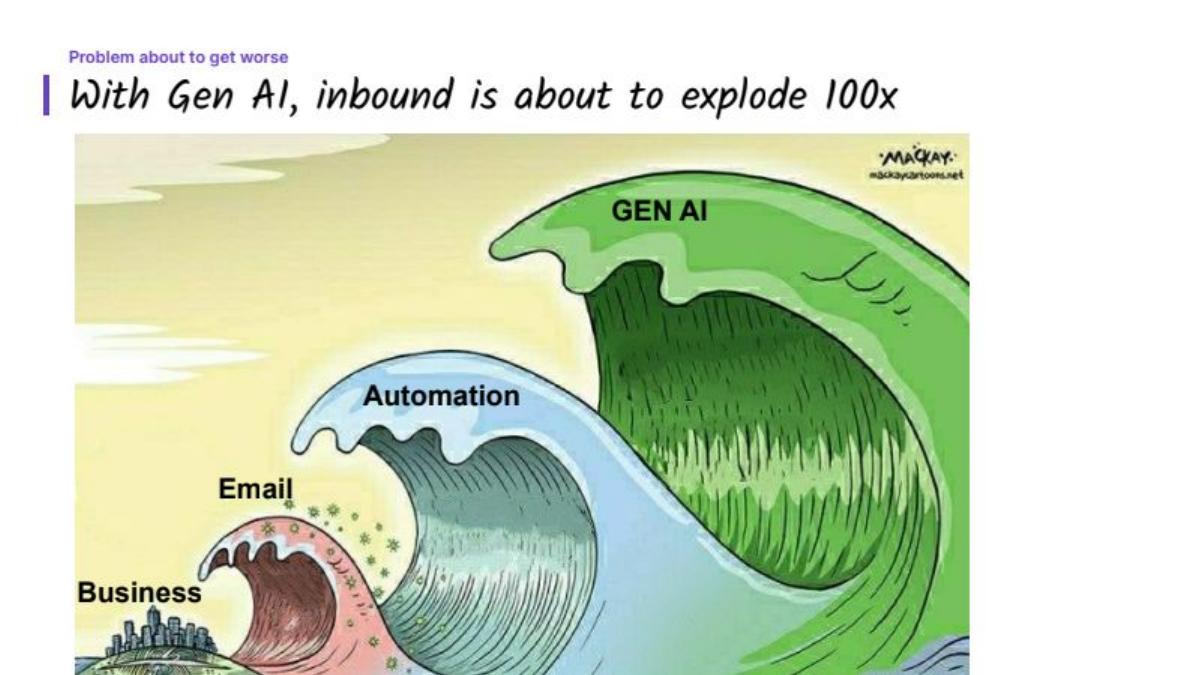
- The deck identifies a specific 'firehose' problem where inbound volume is expected to explode 100x due to Generative AI (Slide 3).
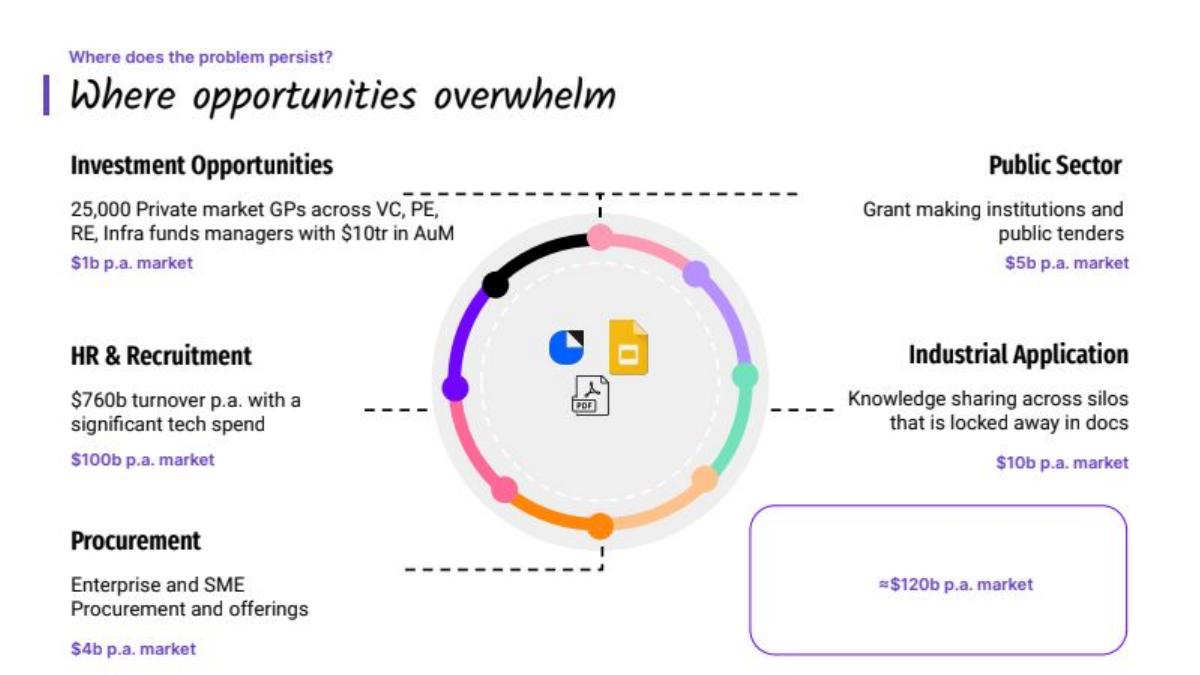
- The initial target market is 25,000 private market GPs managing $10tr in AuM, representing a $1b p.a. market (Slide 4).
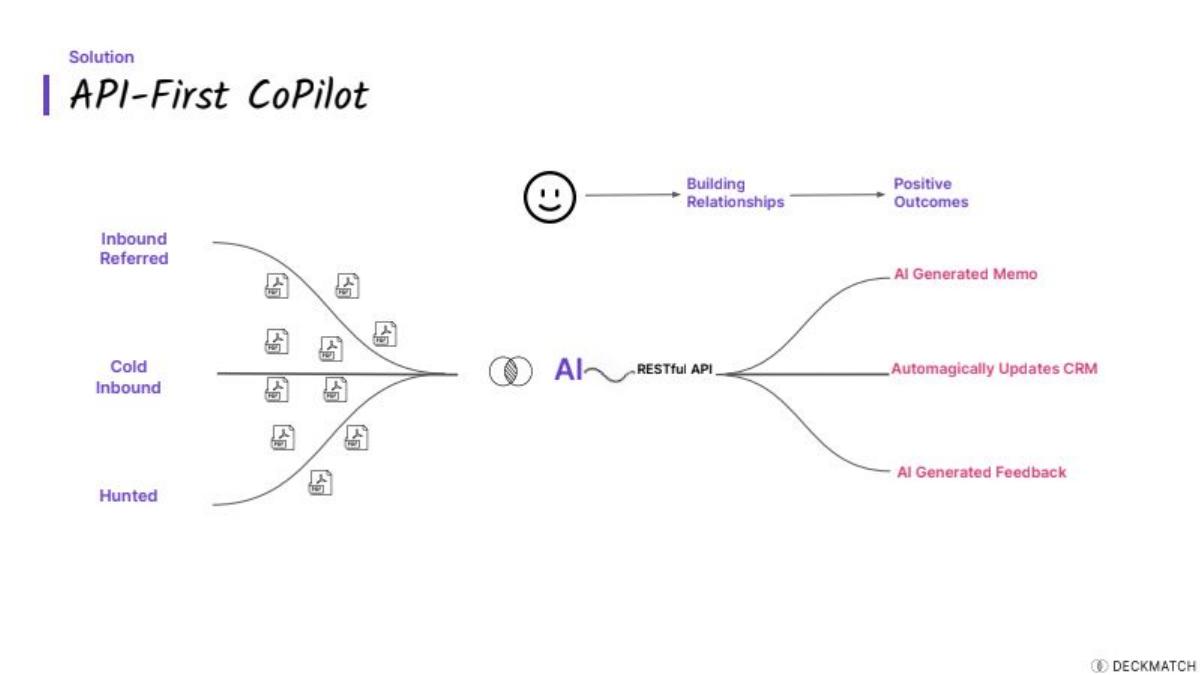
- The product is positioned as an 'API-First CoPilot' that automates memo generation and CRM updates (Slide 6).
- DeckMatch outlines a clear horizontal expansion strategy into HR, Tenders/RFPs, and Grant Making (Slide 9).
- A detailed roadmap shows a progression from V0.1 in May 2023 to V0.8, targeting a $120b total market (Slide 10).
- The growth strategy includes a goal of reaching 100 beta testers by the end of Q3 and validating a $20k+ p.a. SaaS price point (Slide 12).
- The team features a CEO with asset management expertise and a CTO with a PhD in AI and LLMs (Slide 13).
- The ask is clearly stated as a EUR 1m Pre-Seed round on the final content slide (Slide 14).
Introduction and Visual Hook
DeckMatch opens with a minimalist title slide (Slide 1) that introduces their tagline: "Co-pilot for managing opportunities." This immediately sets the stage for a B2B productivity tool. The branding is clean, using a Venn-diagram-style logo that hints at the 'matching' aspect of their name.
The Problem: The Data Firehose
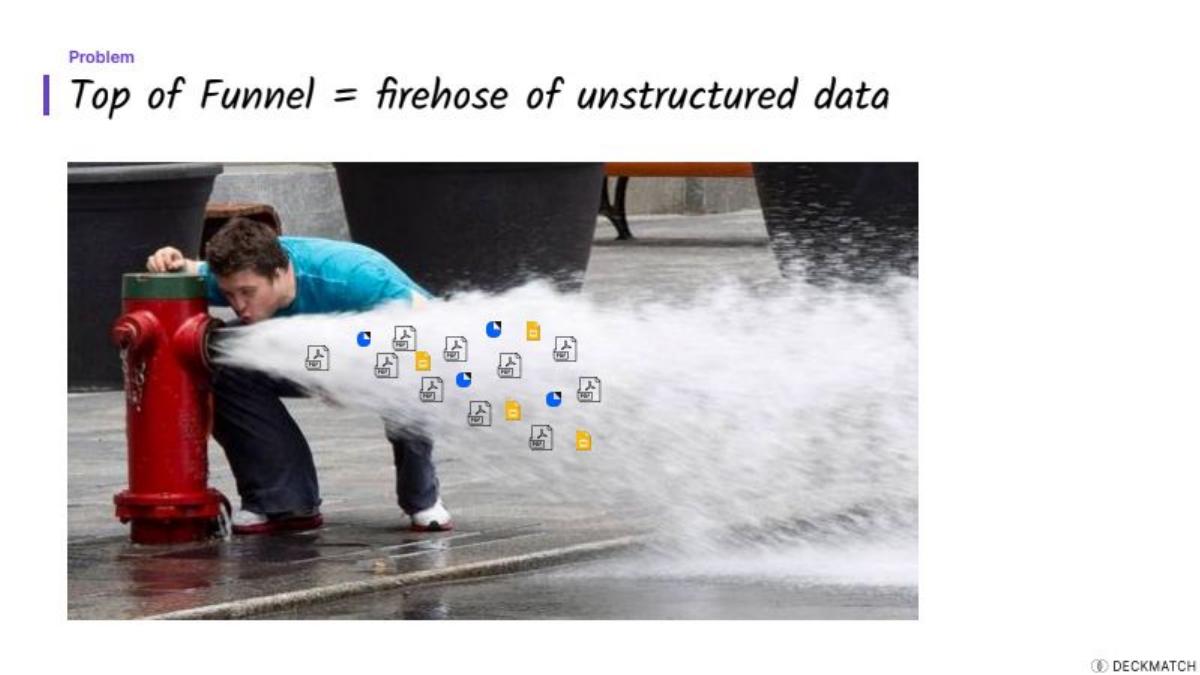
Slide 2 uses a visceral image of a man trying to drink from a firehose, with document icons (PDFs, spreadsheets) superimposed on the water. The headline, "Top of Funnel = firehose of unstructured data," is a direct hit on the pain point felt by VCs and recruiters. Slide 3 escalates this by using a 'wave' meme to show that while email and automation were large waves, "Gen AI" is a massive tsunami that will cause inbound volume to "explode 100x." This creates a sense of urgency—the current manual methods are not just inefficient; they are about to become obsolete.
Market Segmentation and Opportunity
Slide 4, titled "Where opportunities overwhelm," breaks down the Total Addressable Market (TAM). They list five key verticals: Investment Opportunities ($1b p.a. market), HR & Recruitment ($100b p.a. market), Procurement ($4b p.a. market), Public Sector ($5b p.a. market), and Industrial Application ($10b p.a. market). The slide concludes with a total estimate of "≈$120b p.a. market." This is a crucial slide because it shows that while they are starting small, the technology is horizontally applicable.
The Cost of Inaction
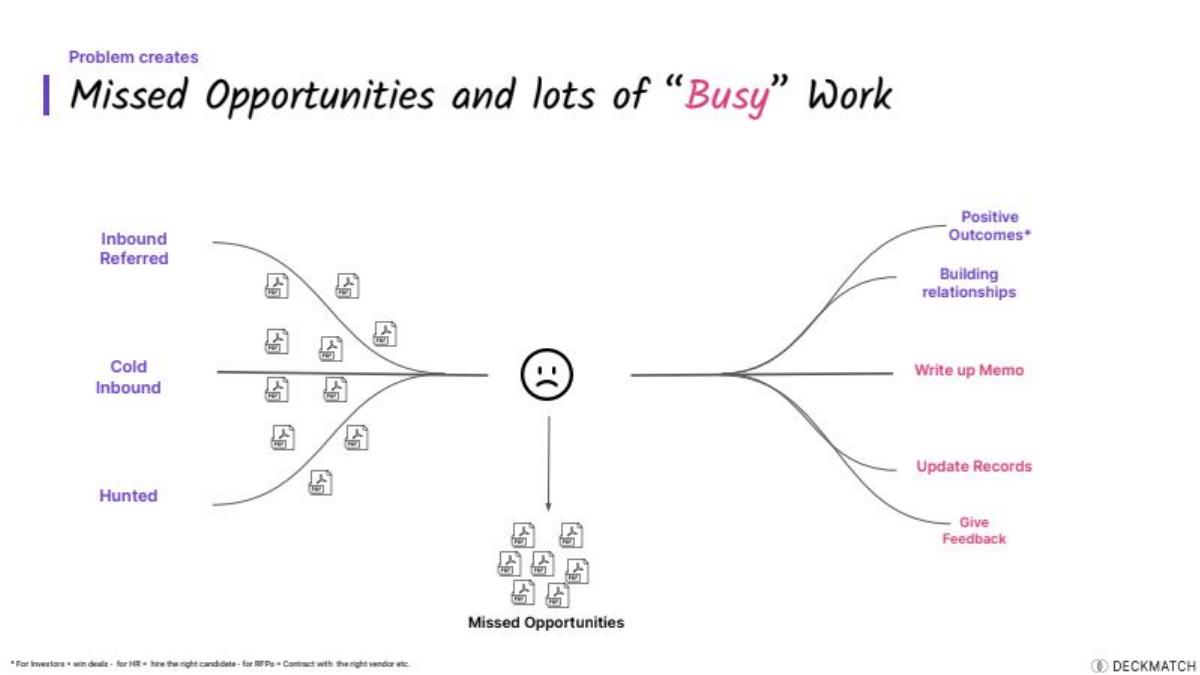
Slide 5 illustrates the current workflow failure. It shows a funnel of "Inbound Referred," "Cold Inbound," and "Hunted" leads leading to a sad face. The output is a pile of "Missed Opportunities" and low-value tasks like "Update Records" and "Write up Memo." This slide effectively quantifies the 'busy work' that DeckMatch intends to eliminate.
The Solution: API-First CoPilot
Product Mechanics
Slide 6 presents the solution. By inserting "AI" and a "RESTful API" into the center of the funnel, the user (now a happy face) is freed up for "Building Relationships" and "Positive Outcomes." The AI handles the "AI Generated Memo," "Automagically Updates CRM," and "AI Generated Feedback." This is a clear value proposition: automate the administrative burden to enable higher-value human interaction.
Demonstration and Horizontal Expansion
Slide 7 is a placeholder for a video demo focused on Private Markets. Slide 8, "Core Components for Horizontal Expansion in B2B," explains how the tech adapts to different sectors. Whether it is an investment thesis for Private Markets or a scope of work for Tenders & RFPs, the process remains the same: Input -> AI Process -> Structured Data Output -> API Integration. This slide is vital for proving that the product isn't just a 'VC tool' but a data processing engine.
The Roadmap and The Wedge
Slide 9 and 10 outline the strategy. Slide 10, "Roadmap to a huge market," shows their 'Wedge' strategy. They start with Private Markets (V0.1 and V0.2) in May 2023, then move to HR/Recruitment (V0.3), Tenders/RFPs (V0.4-V0.5), and finally Grant Making (V0.6-V0.8). This sequence is logical; they are starting with the market they know best (Private Markets) to refine the tech before moving into the higher-value HR space.
Defensibility and Growth
The Data Moat
Slide 11, "Unique DataSet & Platform Play," addresses the question of defensibility. They claim a "Unique Data Advantage" through network effects and a "Curated Hunting ground for new ideas." They also highlight analytics on "missed opportunities" and "diversity metrics ESG," which are high-priority items for modern enterprises and funds. This suggests that the value of DeckMatch grows as more data passes through it.
Product Led Growth (PLG)
Slide 12 is the most metric-heavy slide in the deck. It outlines their "Product Led Growth" strategy with specific goals:
Now: Reach 100 happy beta testers by end of Q3 (50+ VCs already signed up via word of mouth). · Pricing: Validate SaaS pricing "north of $20k p.a. self service." · OpenAI: Mention of being approved to build a plugin for ChatGPT. · Revenue: Generate first $200k in ARR by Q4 (assuming 20 customers at $10k ACV).
The Team and The Ask
Founding Expertise
Slide 13, "All Hands on Deck," introduces the founders. Leo Gasteen (CEO) is noted for founding Edgefolio and having domain expertise in asset management. Walid Mustapha, PhD (CTO) is highlighted for his expertise in AI, LLMs, and mathematical optimization. The slide also includes 'Fun Facts' to humanize the founders, a common tactic to build rapport with investors.
The Pre-Seed Round
Slide 14 is the final content slide, titled "Beta Test Underway." It shows a world map with activity clusters in the US, Europe, and Southeast Asia. The bottom of the slide clearly states the funding goal: "Pre-Seed Round: EUR 1m." This is a direct and unambiguous ask, positioned after the case for the product and team has been fully made.
What Works and What is Missing
What Works
Clear Metaphors: The firehose and wave imagery (Slides 2-3) instantly communicate the problem without needing a wall of text. · The Wedge Strategy: By starting with VCs (the very people they are pitching to), they prove the product's utility in a high-stakes environment before expanding. · Specific Revenue Assumptions: Slide 12 doesn't just say "we will make money"; it breaks down the ACV and customer count needed to hit their $200k ARR goal. · API-First Focus: Emphasizing the RESTful API (Slide 6 and 8) shows they understand that modern enterprise tools must live within existing workflows (CRMs), not just act as standalone silos.
What is Missing
Unit Economics: There is no mention of Customer Acquisition Cost (CAC) or Lifetime Value (LTV), though this is common for a pre-seed/seed stage deck. · Competitive Landscape: The deck does not include a competitor matrix or a 'Why Us' slide compared to existing tools like Affinity, Dealcloud, or generic LLM wrappers. · Technical Architecture: While the CTO has a PhD, there is very little detail on how their AI differs from a standard GPT-4 prompt. They mention a "Unique Data Advantage" but don't explain how they protect that data or ensure accuracy (hallucination management). · Churn/Retention Data: While they set a goal for 30% retention (Slide 12), they don't provide current retention data from the initial 50+ beta testers.
Founder's Playbook: What to Copy
Founders should emulate the milestone-based roadmap on Slide 10. Many decks show a vague timeline of "Product Launch" and "Scale." DeckMatch shows exactly which versions (V0.1 through V0.8) correspond to which market entries. This gives investors confidence that the founders have thought through the engineering requirements for horizontal expansion.
Additionally, the problem escalation in Slides 2 and 3 is excellent. Don't just state the problem; show why the problem is getting worse. By tying their existence to the explosion of Generative AI, DeckMatch makes themselves a 'must-have' tool for the new era of information overload rather than just another 'nice-to-have' productivity app.
Finally, the explicit ACV assumptions on Slide 12 are a great way to ground a seed-stage pitch. It shows the founders have a realistic grasp of what it takes to build a $200k ARR business, which is the first major hurdle for any SaaS startup.
Frequently asked questions
- What is the primary problem DeckMatch is solving?
- DeckMatch addresses the 'firehose of unstructured data' at the top of the funnel for decision-makers. As shown on slide 2 and 3, the rise of Generative AI is expected to increase inbound volume by 100x, making it impossible for humans to manually process every deck, resume, or RFP without missing opportunities or performing excessive 'busy work'.
- How does the product actually work?
- The solution is an 'API-First CoPilot' (Slide 6). It takes unstructured inputs—like pitch decks or applications—and uses AI to generate memos, automagically update CRM records, and provide automated feedback to the sender. This allows the user to focus on building relationships rather than data entry.
- What is the long-term market potential according to the deck?
- While starting with a $1b p.a. market in private investments, the deck identifies a total opportunity of approximately $120b p.a. (Slide 4). This includes HR & Recruitment ($100b), Industrial Applications ($10b), Public Sector grants ($5b), and Procurement ($4b).
- What are the key milestones for their first year?
- According to slide 12, the company aims to reach 100 beta testers by the end of Q3, release a ChatGPT plugin, and generate its first $200k in ARR by Q4. They assume a customer base of 20 clients with an average contract value (ACV) of $10k p.a. to hit this revenue target.
- Who are the founders and what is their background?
- The team consists of CEO Leo Gasteen, who previously founded Edgefolio and has domain expertise in asset management, and CTO Walid Mustapha, PhD, who founded Homefair and specializes in AI, LLMs, and mathematical optimization (Slide 13).