DeepIP's 17-slide deck is a masterclass in demonstrating rapid market pull within a highly specialized niche. The company positions itself as a 'Vertical AI' leader for IP professionals, claiming to support attorneys in 75% of their daily tasks. The narrative is built on three pillars: extreme efficiency gains (saving up to 50% of time), high-tier customer validation (3 of the top 10 US IP law firms), and a clear competitive moat through proprietary data collection. By framing the intellectual property space as a 'Blue Ocean' currently occupied by low-tech incumbents, DeepIP makes a compellin…
Key takeaways
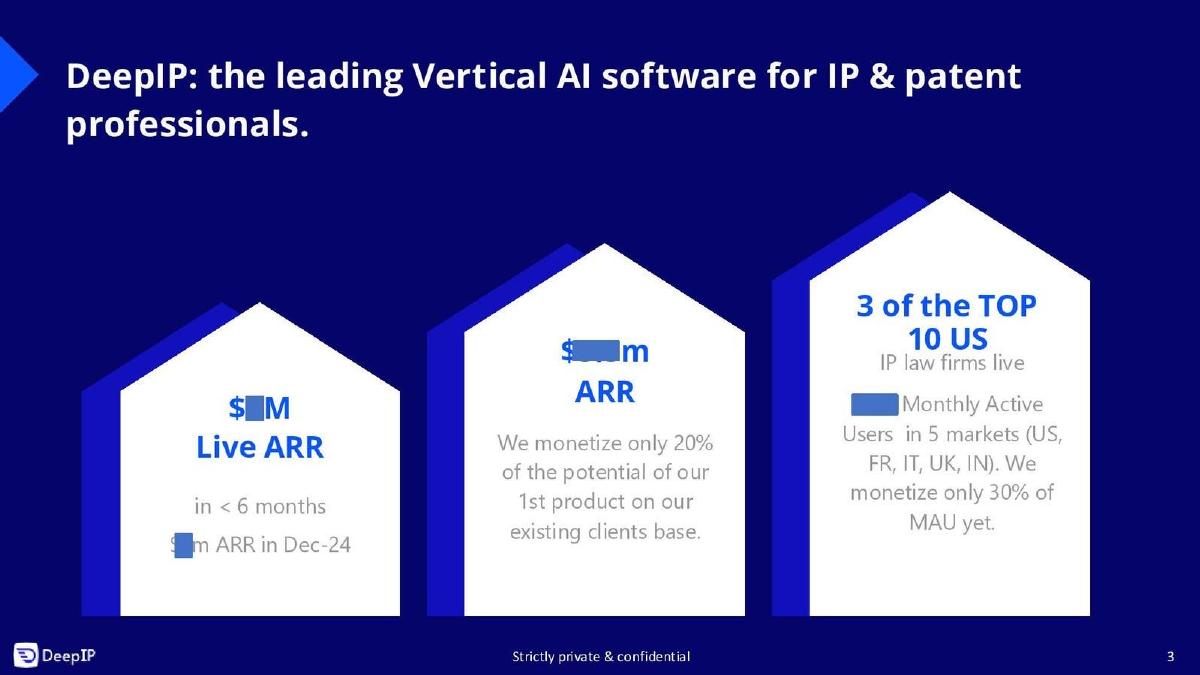
- DeepIP positions itself as the leading Vertical AI software for IP and patent professionals on slide 3.
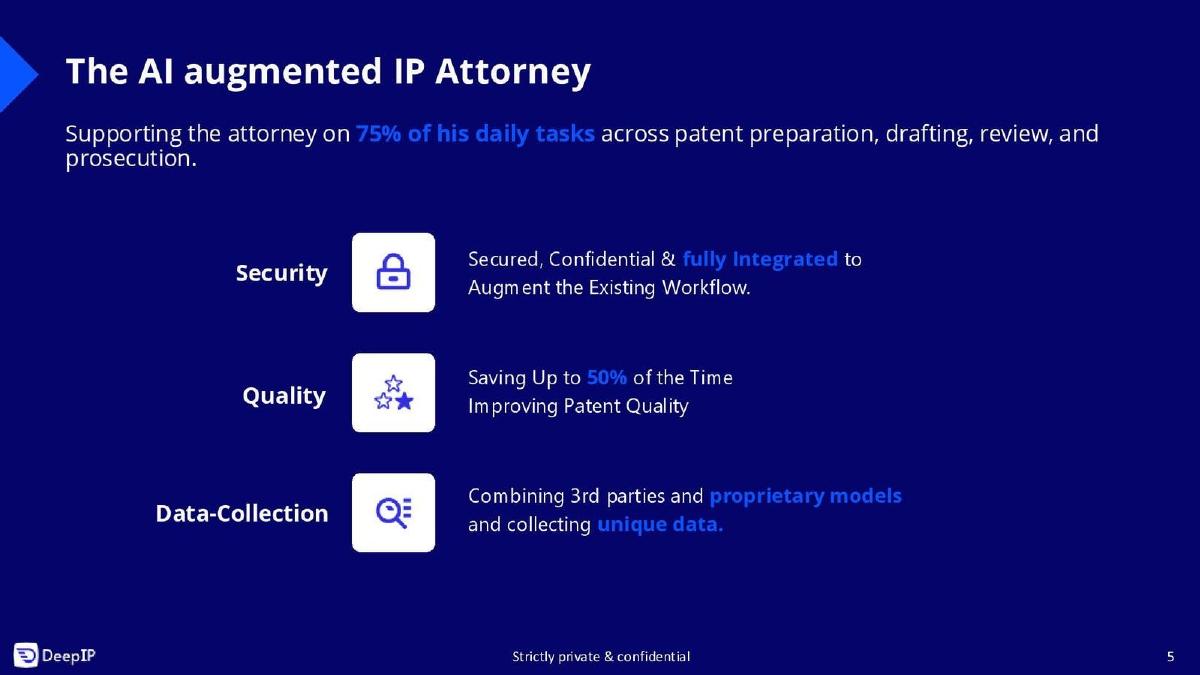
- The company claims to support attorneys on 75% of daily tasks, including preparation, drafting, and review, as stated on slide 5.
- The product delivers significant efficiency, saving up to 50% of time while improving patent quality according to slide 5.
- DeepIP has secured 3 of the top 10 US IP law firms as live clients, a major validation point on slide 3.
- The competitive landscape is categorized into three segments: old tech incumbents, pre-GenAI niche players, and GenAI entrants on slide 10.
- The team emphasizes a 'French AI excellence with a US GTM' strategy, highlighting founders with multiple exits on slide 16.
- Revenue growth is shown as consistent since the first paying client, with an ambitious growth plan through 2026 on slide 14.
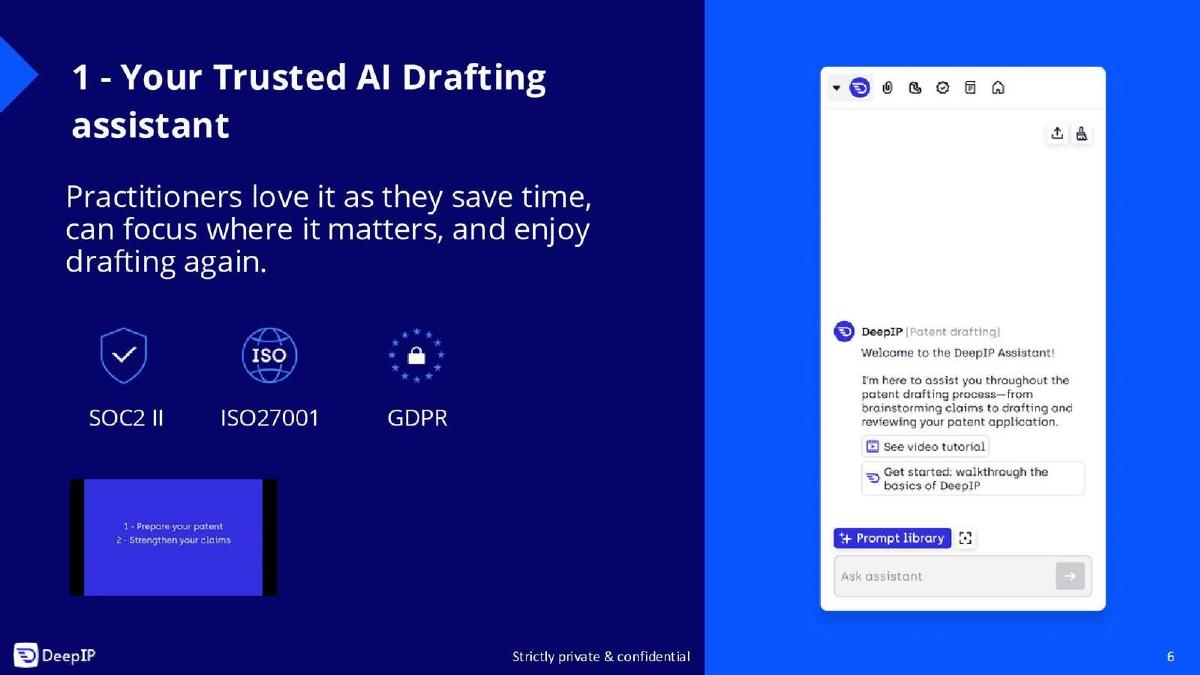
- The deck highlights enterprise-grade security with SOC2 II, ISO27001, and GDPR compliance on slide 7.
DeepIP: The Vertical AI Play for Intellectual Property
DeepIP’s Series A deck is a focused, 17-slide presentation that successfully argues for the transformation of a legacy industry through specialized artificial intelligence. The deck, dated November 2024, arrived as the company announced a $15M raise to scale its operations across Europe and North America. The narrative is not just about 'AI for lawyers,' but specifically 'Vertical AI for IP professionals,' a distinction that allows them to claim higher utility and deeper integration than general-purpose legal assistants.
Slide 1-2: Branding and Positioning
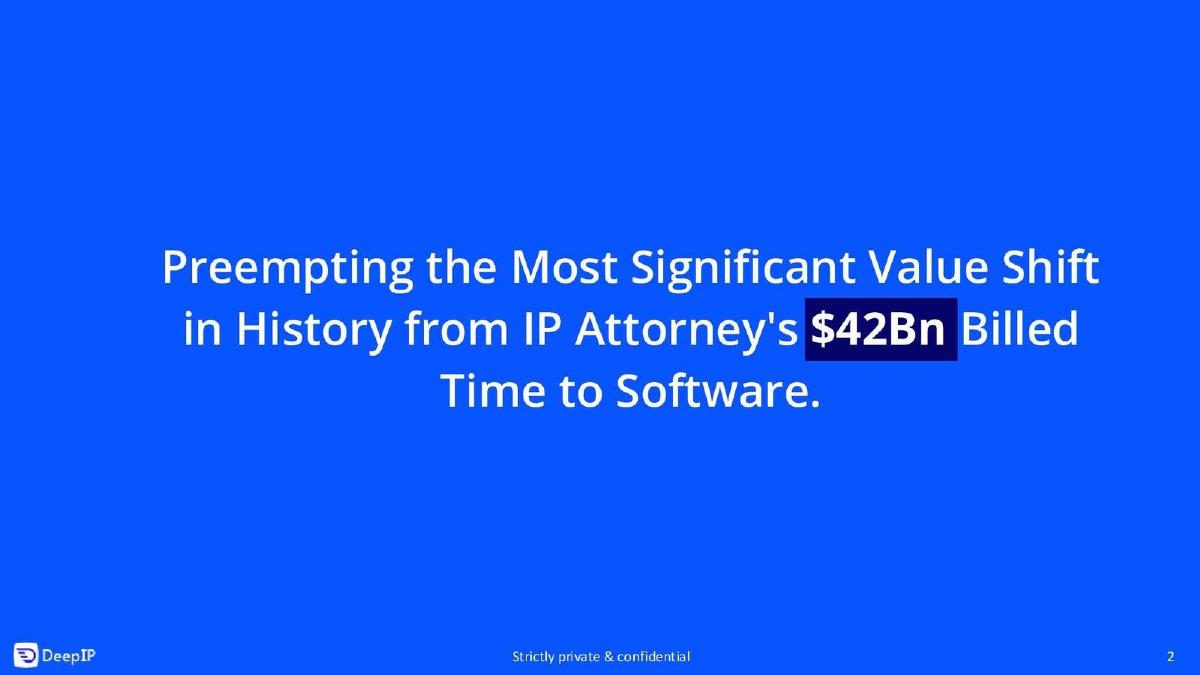
The deck opens with a clean, dark blue aesthetic. The tagline 'Better Patents Faster' on slide 1 immediately identifies the value proposition. Slide 2 is a transition or branding slide. The simplicity here suggests a company that is confident in its identity and doesn't feel the need to clutter the opening with excessive data before the narrative begins.
Slide 3: The Executive Summary of Traction
Slide 3 is the 'hook.' It defines DeepIP as the 'leading Vertical AI software for IP & patent professionals.' It uses three house-shaped graphics to present key metrics. The first shows 'Live ARR' growth in under six months. The second notes that they are only monetizing 20% of the potential of their first product on their existing client base, suggesting massive 'land and expand' potential. The third graphic provides the most impressive social proof: 3 of the TOP 10 US IP law firms are live, with monthly active users across five international markets. This slide effectively answers the 'Why now?' and 'Is it working?' questions simultaneously.
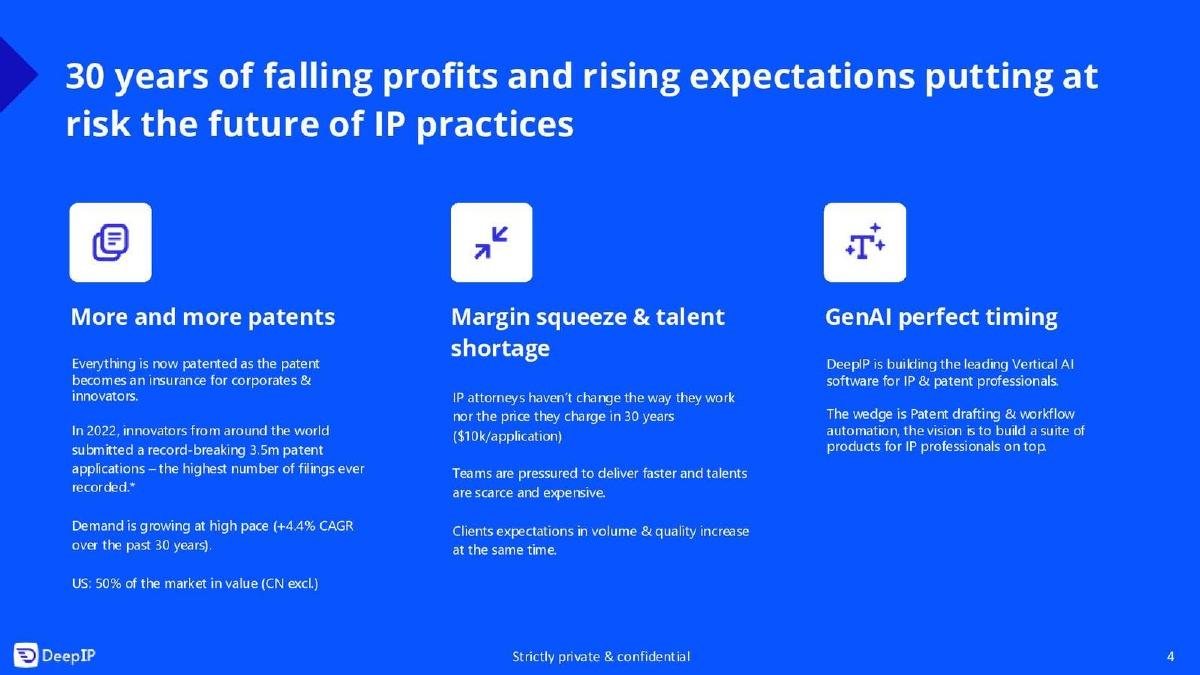
Slide 4-5: The Product and Value Proposition
Slide 5, titled 'The AI augmented IP Attorney,' breaks down the utility of the software. It claims to support attorneys on 75% of their daily tasks. The slide highlights three core pillars: Security (fully integrated and confidential), Quality (saving up to 50% of time), and Data-Collection (combining 3rd party and proprietary models). By mentioning 'unique data,' DeepIP is signaling to investors that they have a data moat that general LLMs cannot easily replicate.
Slide 6-7: Product Interface and Trust
Slide 7 introduces 'Your Trusted AI Prosecution Assistant.' It features a mobile/sidebar UI mockup showing a 'Prompt library' with specific IP tasks like 'Summarize the invention' and 'Suggest arguments.' This makes the abstract concept of 'AI' concrete. Importantly, the slide prominently displays SOC2 II, ISO27001, and GDPR icons. In the legal tech world, security is not a feature; it is a prerequisite. By placing these front and center, DeepIP removes a major hurdle for conservative law firm buyers.
Slide 8-10: Market Opportunity and Competition
Slide 10 is a sophisticated competitive landscape analysis. Instead of a standard 2x2 grid, it uses three buckets: '$bn old tech incumbents' (Clarivate, Questel, LexisNexis), 'Pre GenAI niche players' (ClaimMaster, Juristat), and 'GenAI entrants' (Solve Intelligence, Patlytics). DeepIP positions itself as the leader of the third category. The headline 'Blue Ocean Space Filled with Niche & Low Tech Incumbents' suggests that the market is ripe for disruption because the current leaders are slow to adapt to generative AI.
Slide 11-12: Customer Validation
Slide 12 reinforces the traction mentioned earlier. It shows three columns representing the US Top 10, US Top 100, and EU Top 1 firms. While specific names are redacted in this version, the use of national flags (US, France, Italy) and the 'Top' rankings provide a clear picture of their market penetration. This slide is designed to prove that DeepIP can sell into the most prestigious and demanding firms in the world.
Slide 13-14: Financial Growth and Projections
Slide 14 presents two bar charts. The left chart shows 'Consistent growth since 1st paying client' on a monthly basis from April 2024 to December 2024. The right chart shows an 'ambitious growth plan' for 2024, 2025, and 2026. While the Y-axis values are redacted, the steep upward trajectory of the bars indicates a high-growth SaaS model. The focus here is on the velocity of growth rather than just the absolute numbers.
Slide 15-16: The Team and 'Unfair Advantage'
Slide 16, 'French AI excellence with a US GTM,' is a strong team slide. It features the CEO and CTO, both serial founders with exits (Doppio, Kili). The CTO’s background as Head of AI at BNP adds institutional weight. The slide also highlights leads for Product, ML, Software, and Growth, mostly coming from Kili. A standout hire is the 'Sales lead' who was the former head of US Sales at Questel—a direct incumbent competitor. This 'poaching' of talent from the market leader is a strong signal of DeepIP's competitive intent. The bottom of the slide credits French engineering schools (CentraleSupélec, UPMC), framing their talent pipeline as an 'unfair access to excellence.'
Slide 17: Conclusion
The deck ends as it began, with a simple 'Thank you' and the DeepIP logo. It maintains the 'Strictly private & confidential' footer throughout, emphasizing the sensitive nature of the legal tech space.
What Works in the DeepIP Deck
Specific Vertical Focus: By calling themselves 'Vertical AI,' they avoid the trap of being compared to general legal assistants like Harvey or Casetext. They own the 'Patent' niche, which is highly technical and lucrative.
High-Signal Traction: Naming (or implying) Top 10 US law firms as clients is the strongest possible validation in legal tech. Law firms are notoriously slow to adopt new tech; having three of the best is a massive achievement.
Strategic Hiring: Highlighting a sales lead from a major incumbent (Questel) shows that they aren't just building cool tech—they are building a sales machine that knows exactly how to take market share from the old guard.
Security as a Pillar: The explicit mention of SOC2 and ISO standards on the product slide addresses the #1 objection in legal sales before the investor even asks it.
What is Missing from the DeepIP Deck
Unit Economics: While the deck shows ARR growth, it lacks details on CAC (Customer Acquisition Cost), LTV (Lifetime Value), or Churn. For a Series A, investors usually want to see the underlying efficiency of the revenue growth.
Pricing Model: The deck mentions they are 'only monetizing 20% of the potential,' but it doesn't explain how they price (per seat, per patent, or enterprise license). Understanding the pricing mechanics would clarify how they plan to reach their 2026 goals.
Product Depth: The deck shows a sidebar assistant, but patent drafting is a complex, multi-step process involving drawings, claims, and specifications. More detail on how the AI handles these specific, high-stakes components would be beneficial.
The 'Ask': The public version of this deck does not include a slide detailing how much they are raising or how they intend to spend the capital. While this is often removed for public distribution, it is a critical component of a fundraising deck.
Founder Takeaways: What to Copy
The 'Three Buckets' Competition Slide: Slide 10 is a great way to frame a market. Instead of saying 'we are better than X,' they say 'the market is moving from Old Tech to Niche to GenAI, and we are the GenAI leader.' It creates a sense of inevitability.
The 'Unfair Advantage' Framing: If you have a team from a specific region or background, frame it as an 'unfair advantage.' DeepIP’s use of 'French AI excellence' turns a geographic location into a competitive moat for talent.
Land and Expand Narrative: Slide 3’s mention of only monetizing 20% of current potential is a brilliant way to show that even without new customers, the company has a path to 5x revenue. Founders should always highlight the 'untapped' value within their existing footprint.
Clean, High-Contrast Design: The use of a consistent dark blue background with white and light blue accents makes the deck feel professional, modern, and authoritative. It looks like 'Enterprise Software,' not a consumer app.
Frequently asked questions
- What is DeepIP's core value proposition?
- DeepIP provides an AI-augmented assistant for patent attorneys that automates up to 75% of daily tasks. The software focuses on patent preparation, drafting, review, and prosecution. According to slide 5, the primary benefits are saving up to 50% of the attorney's time and improving the overall quality of the patents produced.
- How does DeepIP differentiate itself from competitors?
- On slide 10, DeepIP categorizes the market into 'old tech' incumbents like Clarivate and LexisNexis, and 'pre-GenAI' players like ClaimMaster. DeepIP positions itself as a GenAI-native entrant that combines third-party models with proprietary models and unique data collection to create a superior vertical AI solution.
- What kind of traction has DeepIP achieved?
- As of November 2024, DeepIP has live clients in 5 markets (US, FR, IT, UK, IN). Crucially, they have onboarded 3 of the top 10 US IP law firms. Slide 14 shows a bar chart of consistent monthly ARR growth since their first paying client, though the specific dollar amounts are redacted in the public version of the deck.
- Who are the founders and what is their background?
- The team slide (16) highlights a mix of serial entrepreneurs and AI experts. The CEO and CTO are former co-founders of Doppio, Tripndrive, and Kili. The CTO also served as the Head of AI at BNP. They explicitly leverage their 'unfair access to French engineering excellence' while hiring US-based sales leadership from industry incumbents like Questel.
- What is the company's geographic strategy?
- DeepIP employs a 'French AI excellence with a US GTM' strategy. While the engineering and product development appear to be rooted in France (citing institutions like CentraleSupélec), the primary sales focus is the US market. Slide 12 shows they have already captured 'Top 1' firms in France and Italy alongside 'Top 10' and 'Top 100' firms in the US.