How legal tech startups present the problem in a pitch deck: say whether the buyer is a lawyer or a client, show where legal work breaks down.
Legal Tech Problem Slide: Real Pitch Deck Examples
Eight problem slides from legal tech startups, shown in full, compare whether each slide makes clear who has the problem (lawyers, in-house legal teams or the people who need a lawyer), where the work breaks down, and a number for the cost.
TL;DR
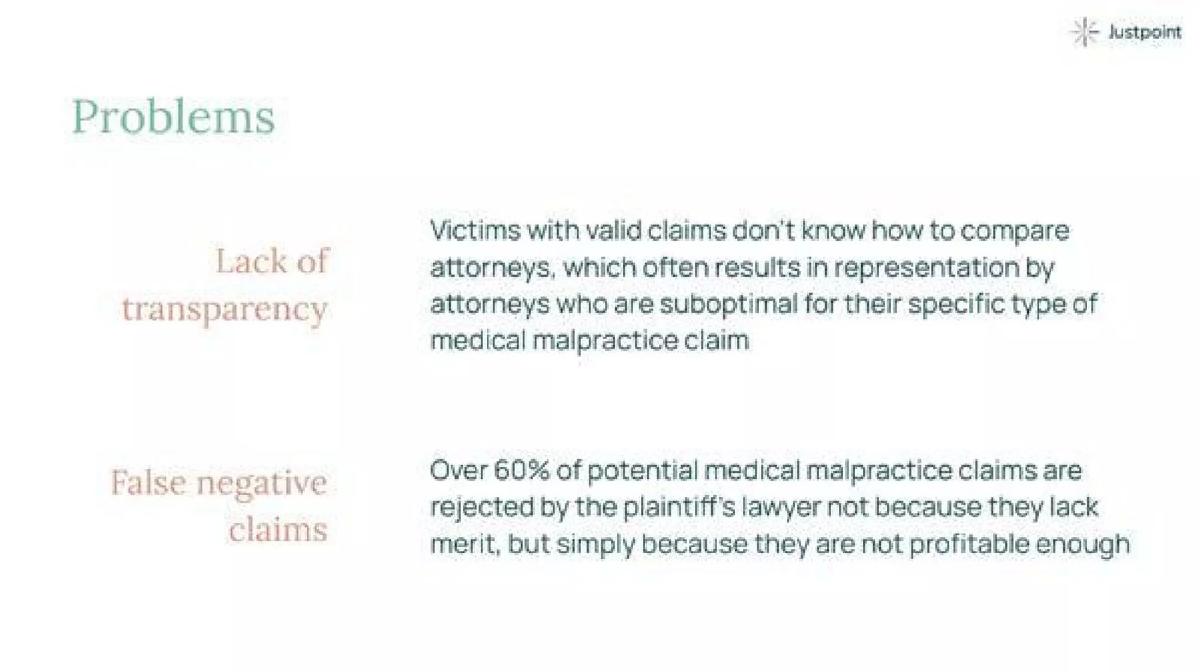
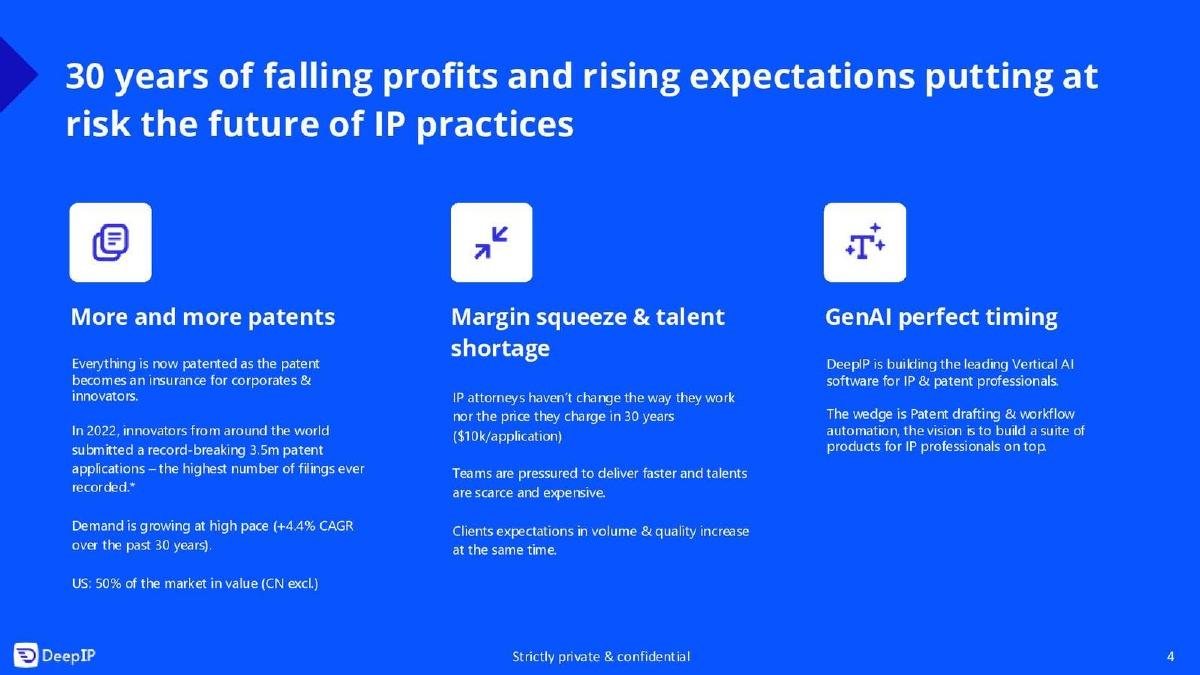
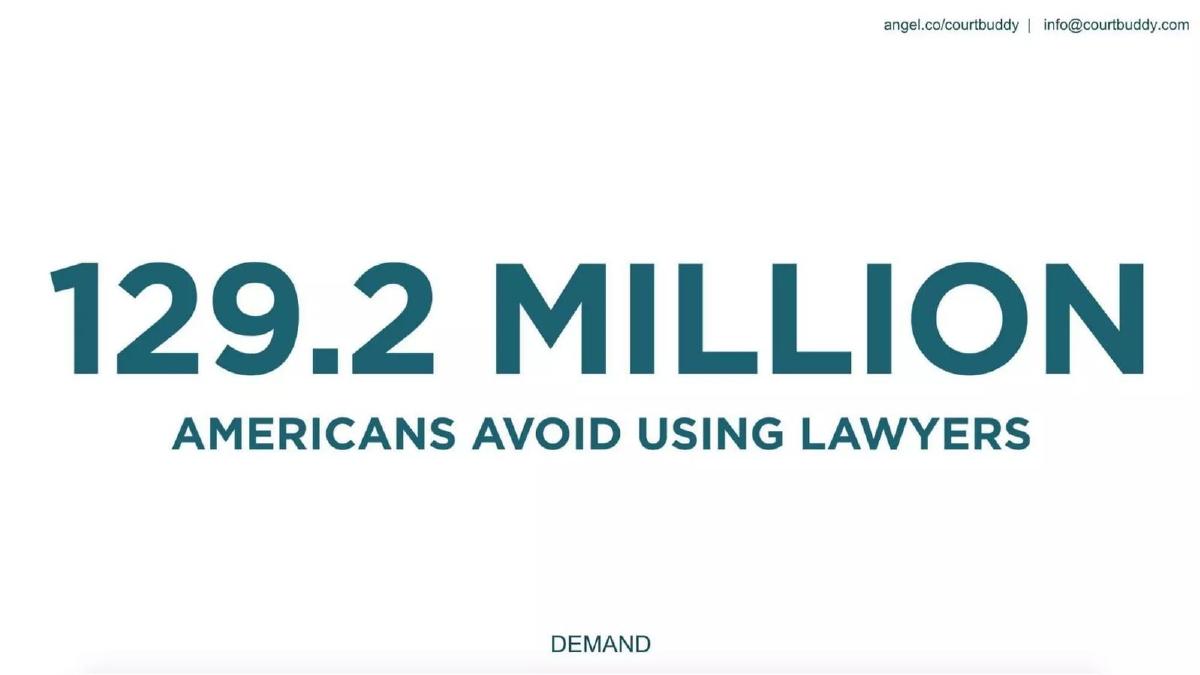
A legal tech problem slide first has to settle one question: is the customer the lawyer, the legal department, or the person who needs legal help? Those buyers have opposite problems. Justpoint picks the client side and backs it with one figure: "Over 60% of potential medical malpractice claims are rejected by the plaintiff's lawyer not because they lack merit, but simply because they are not profitable enough." DeepIP picks the lawyer side: patent attorneys "haven't changed the way they work nor the price they charge in 30 years ($10k/application)" while filings hit "a record-breaking 3.5m". CourtBuddy shows one giant number, "129.2 million Americans avoid using lawyers". Athennian's slide spends half its space on the product, which is the weaker pattern.
Legal tech problem slides from real pitch decks
Each example shows the exact stored slide above its analysis and links to the full teardown. Claims are as shown on the slides; we have not verified them.
Justpoint problem slide — slide 4
Matching medical malpractice claims with law firms. Two labelled problems on a plain slide.
Justpoint deck, slide 4. Exact stored slide matched to this analysis.
Our analysis: The strongest slide here: one kind of person, one kind of claim, and a number that explains why the market fails them.
Evidence and limitation: "Over 60%"; no source on the slide.
What a founder can adapt: Narrow to one type of case and give one number for how often it goes wrong.
Supporting analysis
What the deck claims: "Problems." "Lack of transparency": "Victims with valid claims don't know how to compare attorneys, which often results in representation by attorneys who are suboptimal for their specific type of medical malpractice claim." "False negative claims": "Over 60% of potential medical malpractice claims are rejected by the plaintiff's lawyer not because they lack merit, but simply because they are not profitable enough."
Presentation choice: The 60% figure shows the problem is how lawyers get paid, not a lack of lawyers.
When it does not fit: Source the 60%; an investor will ask where it comes from.
AI software for patent attorneys. Three columns on blue.
DeepIP deck, slide 4. Exact stored slide matched to this analysis.
Our analysis: More work at a fixed price with fewer people: the squeeze is clear and specific to one kind of lawyer.
Evidence and limitation: Filing volume (footnoted), growth rate, a price per application.
What a founder can adapt: Show volume rising while price or headcount stays flat.
Supporting analysis
What the deck claims: "30 years of falling profits and rising expectations putting at risk the future of IP practices." "More and more patents": "In 2022, innovators from around the world submitted a record-breaking 3.5m patent applications." "Margin squeeze & talent shortage": "IP attorneys haven't changed the way they work nor the price they charge in 30 years ($10k/application)." "GenAI perfect timing."
Presentation choice: It uses the numbers patent attorneys think in (filings, price per application).
When it does not fit: The third column is a "why now" point; it deserves its own slide.
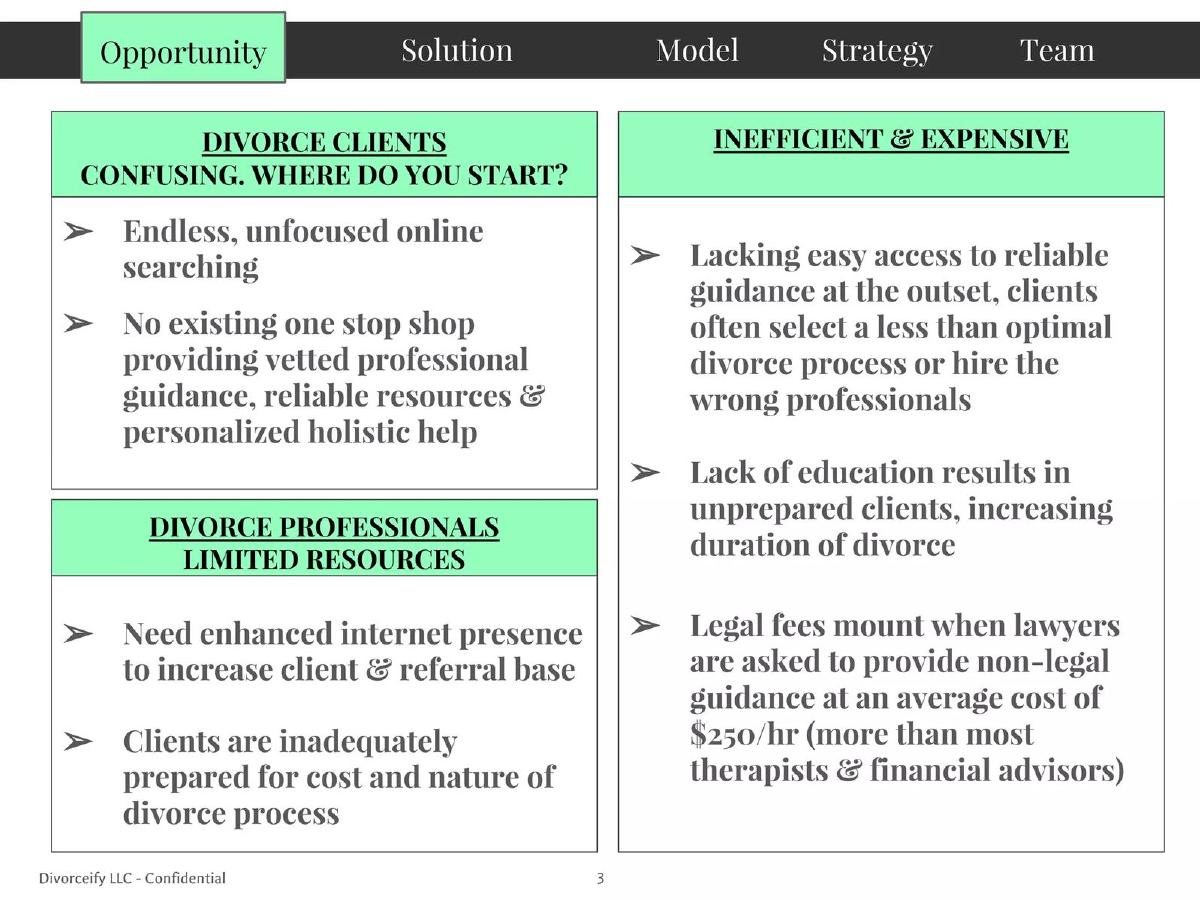
Divorce guidance platform. Three text boxes covering clients, professionals and cost.
Divorceify deck, slide 3. Exact stored slide matched to this analysis.
Our analysis: It names both sides and gives a concrete cost: paying a lawyer's rate for help that isn't legal.
Evidence and limitation: "$250/hr"; no source.
What a founder can adapt: Find the work your buyer pays a lawyer's rate for that doesn't need a lawyer.
Supporting analysis
What the deck claims: "Divorce clients confusing. Where do you start?" "No existing one stop shop." "Divorce professionals limited resources." "Inefficient & expensive": "Legal fees mount when lawyers are asked to provide non-legal guidance at an average cost of $250/hr (more than most therapists & financial advisors)."
Presentation choice: The $250-an-hour comparison with therapists makes the waste easy to grasp.
When it does not fit: Dense text in three boxes; lead with the $250 line.
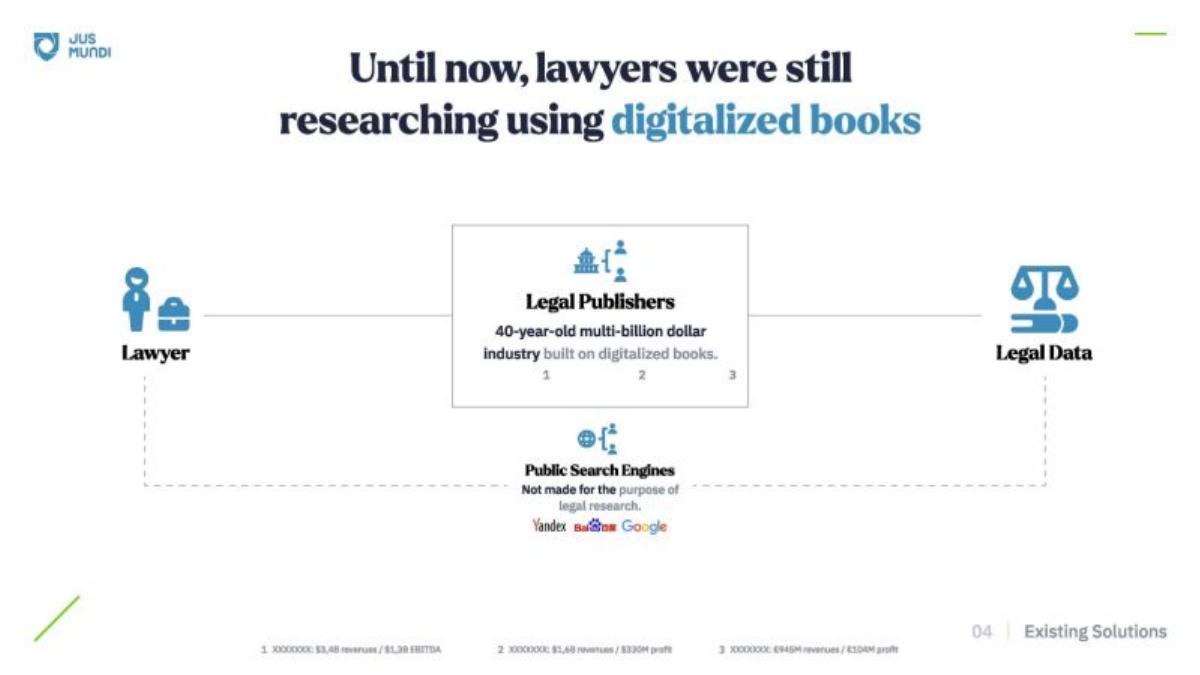
Legal research search engine. A diagram of how lawyers reach legal data today.
Jus Mundi deck, slide 4. Exact stored slide matched to this analysis.
Our analysis: It shows both current routes to legal information and why each falls short.
Evidence and limitation: Publisher revenue footnotes (names blanked in the stored copy).
What a founder can adapt: Draw how your buyer gets the job done today, and mark where it fails.
Supporting analysis
What the deck claims: "Until now, lawyers were still researching using digitalized books." Lawyer → "Legal Publishers: 40-year-old multi-billion dollar industry built on digitalized books" → Legal Data. "Public Search Engines: Not made for the purpose of legal research." "Existing Solutions."
Presentation choice: A simple diagram of today's options makes the gap visible.
When it does not fit: Add what the old way costs a lawyer: hours per search, subscription price.
Software for in-house legal teams. Five paired boxes: the lawyer's situation and its impact on the business.
Kea deck, slide 3. Exact stored slide matched to this analysis.
Our analysis: It names one buyer (in-house lawyers) and ties each weakness to a business cost.
Evidence and limitation: Survey sources listed in small print along the edge.
What a founder can adapt: For each buyer problem, write the cost to the company that pays.
Supporting analysis
What the deck claims: "Things are not working well for lawyers; they weren't trained to be digital, to work in remote teams and show value to the business." "Traditional in-house lawyer": "They feel like a firefighter", "Usually over budget", "Best decision-making tool is 'a hunch'". "Most in-house lawyers run their work on disconnected solutions with no real visibility or insight."
Presentation choice: Linking the lawyer's pain to the company's pain is how in-house tools get budget.
When it does not fit: Ten small boxes; pick the two strongest and give each a number.
Legal services marketplace for small businesses and consumers. Four labelled circles. Partial.
Lawkick deck, slide 2. Exact stored slide matched to this analysis.
Our analysis: "Rising costs" from client acquisition is a real problem, but market size and fragmentation are market facts, not a customer's pain.
Evidence and limitation: Two figures; no sources; two unlabelled trend lines.
What a founder can adapt: Lead with the acquisition-cost point and say what it adds to a client's bill.
Supporting analysis
What the deck claims: "Problem. A massive, fragmented market that operates inefficiently." "Size: $100B industry for small biz and consumer legal services." "Fragmentation: 49% of lawyers are solo practitioners." "Inefficiency: Legal services are inaccessible to many consumers." "Rising Costs: Inflated prices due to high client acquisition costs."
Presentation choice: It shows the common mix-up between the problem and the market slide.
When it does not fit: Move the $100B to the market slide; drop charts with no numbers.
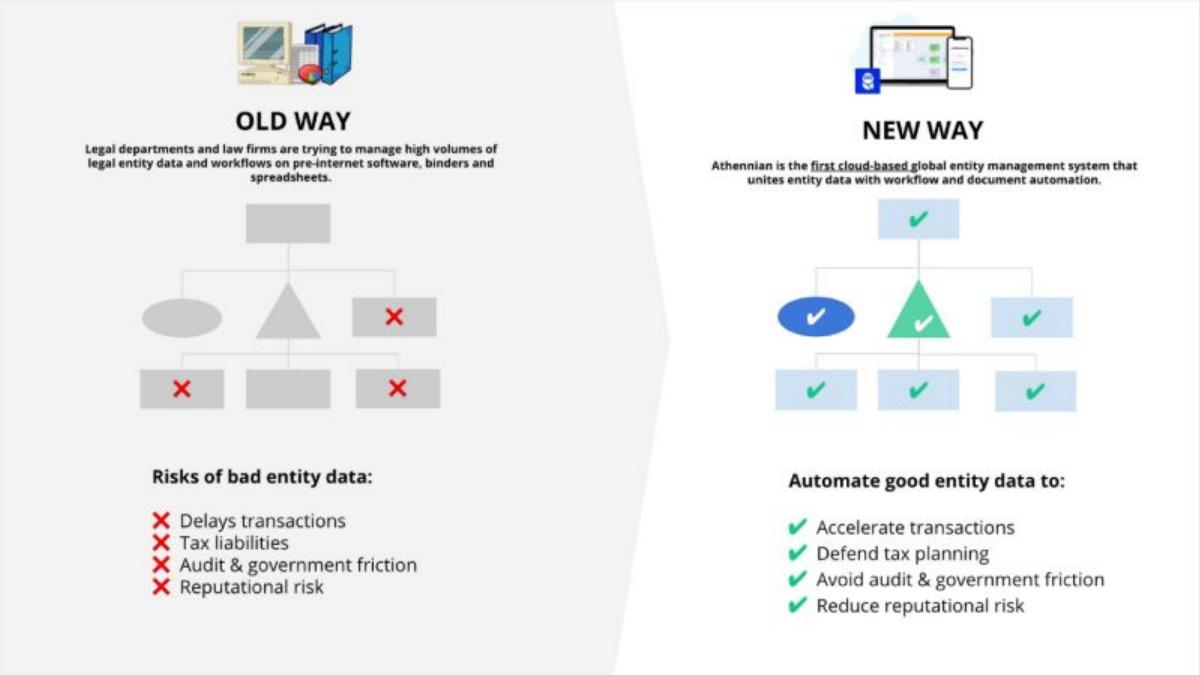
Entity management software for legal teams. An "old way" and "new way" split. Weak on purpose.
Athennian deck, slide 2. Exact stored slide matched to this analysis.
Our analysis: The four risks are real, but none is sized, and half the slide is the product.
Evidence and limitation: No figures.
What a founder can adapt: Keep the old way, put a number on one risk (a delayed deal, a tax penalty).
Supporting analysis
What the deck claims: "Old way": "Legal departments and law firms are trying to manage high volumes of legal entity data and workflows on pre-internet software, binders and spreadsheets." "Risks of bad entity data: Delays transactions, Tax liabilities, Audit & government friction, Reputational risk." "New way": "Athennian is the first cloud-based global entity management system..."
Presentation choice: It shows what the stronger slides avoid: problem and solution sharing the space.
When it does not fit: Move "new way" to the solution slide.
Whether each slide names who suffers, where the work breaks down, and a number.
Example
Who suffers
Where it breaks
Number
Justpoint
Clients (malpractice victims)
Yes (claims rejected, wrong lawyer)
Yes (over 60%, unsourced)
DeepIP
Lawyers (patent attorneys)
Yes (volume up, price flat)
Yes (3.5m filings, $10k)
Divorceify
Both (clients, professionals)
Yes (lawyers doing non-legal work)
Yes ($250/hr, unsourced)
CourtBuddy
Clients
No
Yes (129.2m, unsourced)
Jus Mundi
Lawyers
Yes (research tools)
Partly (footnotes)
Kea
In-house lawyers
Yes (disconnected tools)
Sources, no figure on slide
Lawkick
Clients
Partly (acquisition costs)
Market figures only
Athennian
Legal teams
Partly (spreadsheets)
No
Key Takeaways
Say which side you serve: lawyers, in-house teams, or clients. Divorceify names both and splits them.
Show where the work breaks down: research in "digitalized books" (Jus Mundi), claims rejected as unprofitable (Justpoint).
Use the numbers lawyers use: hourly rates, fees per matter, cases turned away ("$250/hr", "$10k/application").
"The legal industry is inefficient" is not a problem; say for whom and what it costs them.
Keep the product off the problem slide; Athennian's "new way" half belongs on the next slide.
Build your legal tech problem slide
One side, one breakdown, one number.
Side. Lawyers, in-house teams, or people needing legal help? Pick one.
Breakdown. Where exactly does the work or the case go wrong?
Cost. Hours, fees per matter, cases lost or turned away, with a source.
Today. What do they use now, and why doesn't it work?
Copyable framework: [Who] lose [hours/money/cases] because [breakdown]. Today they rely on [current tool], which [why it fails]. (Source: [source].)
Illustrative example 1 — written by us
Before: The legal industry is huge, outdated and inefficient.
After: Small landlords spend an average of 6 weeks and $3,100 in legal fees on a routine eviction; 4 of those weeks are paperwork a lawyer bills at $300 an hour. (Source: our survey of 250 landlords.)
What improved: Our illustrative rewrite; the figures are invented for the example. It picks one side, one breakdown and a measured cost.
What this guide adds
The SaaS problem guide covers software sold to businesses in general. Legal tech is a special case: the same product idea can be sold to lawyers (to do more work) or to clients (to need lawyers less), and investors want to know which.
Four slides here speak for clients (Justpoint, CourtBuddy, Divorceify, Lawkick), three for lawyers or legal teams (DeepIP, Jus Mundi, Kea), and Athennian for both at once.
Three things a legal tech problem slide proves
Who suffers: "Victims with valid claims" (Justpoint), "IP attorneys" (DeepIP), "Traditional in-house lawyer" (Kea), divorce clients and divorce professionals (Divorceify).
Where the work breaks down: choosing the wrong lawyer, research in old tools, disconnected software, rejected claims.
What it costs: "$250/hr" for non-legal advice (Divorceify), "$10k/application" (DeepIP), "Over 60%" of claims rejected (Justpoint).
Common mistakes
Not choosing a side. Selling to lawyers and selling around them are different businesses.
Market size as the problem. "$100B industry" belongs on the market slide.
"Inefficient" with no number. Give hours, fees or cases lost.
Too many boxes. Two strong points beat ten small ones.
Old way / new way on one slide. Keep the new way for the solution slide.
Diagnostic checklist
It says whether the buyer is a lawyer, a legal team or a client.
It shows where the work or case breaks down.
It gives one number in terms lawyers use (hours, fees, cases), with a source.
Market size is on another slide.
The product is on the next slide.
Frequently asked questions
How we chose these examples
Corpus: published pitch deck teardowns on StartupFundraising.com. Founder-uploaded private decks are excluded.
Selection (2026-09-25): we searched slides 2–6 for slides mentioning lawyers, law firms, legal departments, attorneys, contract management or legal tech, excluding securities disclaimers. Twelve stored images were inspected. CourtCorrect and Filevine were excluded because those decks already appear in other guides; Contractbook and Della were left out because their slides are general contract software or a critique of competitors. Lawkick is marked partial; Athennian is kept as a weaker contrast.
Overlap check: none of these eight slides appears in another guide.
Review: all eight stored slide images were inspected on 2026-09-25 and matched to company, deck and slide number (editorial model review). No person has yet completed an editorial review of this page.
Claims are as shown on the slides; we have not verified them. We make no claim that any slide caused a fundraising outcome.