Justpoint’s pitch deck presents a compelling case for the modernization of the medical malpractice industry, a sector traditionally reliant on billboards and manual record review. By positioning themselves as an AI-driven matching platform, Justpoint addresses two critical pain points: the lack of transparency for victims and the high cost of claim analysis for law firms. The deck highlights a significant market opportunity, with a $1.1 billion beachhead in medical malpractice and a $106 billion total addressable market in negligence torts. With a strong founding team featuring expertise in m…
Key takeaways
- The deck identifies medical errors as the third leading cause of death in the US to establish high stakes (Slide 2).
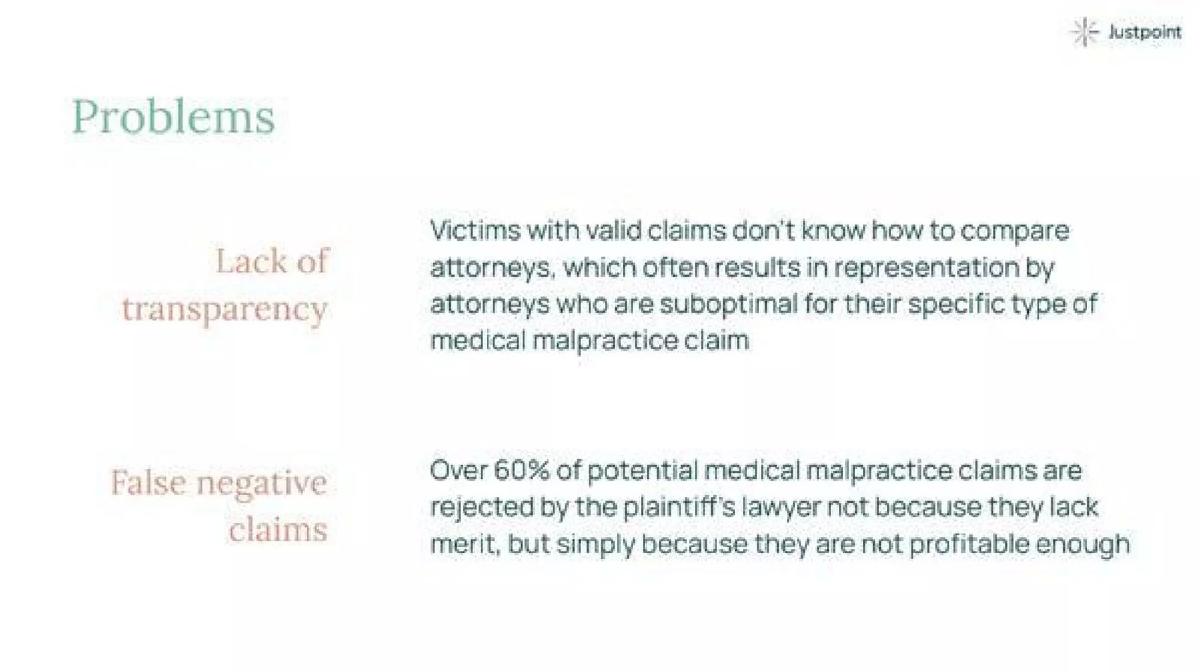
- Over 60% of valid medical malpractice claims are rejected by lawyers because they are deemed not profitable enough (Slide 4).
- Justpoint claims its AI platform can estimate settlement values 100x faster than traditional methods (Slide 8).
- The company demonstrated over 30% month-over-month growth in plaintiffs matched between November 2019 and May 2020 (Slide 9).
- The beachhead market for law firm costs in medical malpractice is valued at $1.1 billion (Slide 10).
- The total addressable market for litigation finance in negligence tort cases is cited as $106 billion (Slide 10).
- Justpoint’s strategy relies on a data flywheel where more claim submissions improve AI models, attracting more partnerships (Slide 11).
- The founding team includes a Google Developer Expert in Machine Learning and a medical malpractice defense attorney (Slide 12).
Introduction: A Data-Driven Approach to Litigation
Justpoint’s pitch deck is a masterclass in identifying a massive, antiquated industry and applying a modern technological solution to its most glaring inefficiencies. The medical malpractice sector is notorious for its high barriers to entry, complex data requirements, and reliance on manual labor. Justpoint positions itself not just as a tool, but as the central infrastructure for the future of this space. By leveraging AI to automate the discovery and valuation process, they aim to democratize access to justice for plaintiffs while significantly increasing the margins for law firms. This teardown explores how the 13-slide deck builds a narrative of inevitable market dominance through data accumulation.
The Problem and the Human Cost
Slide 1: Title Slide The deck opens with a clean, minimalist title slide. It features the Justpoint logo and identifies Victor Bornstein, Ph.D., as the CEO and Co-founder. The inclusion of his academic credentials and the company's New York address sets a professional, serious tone from the outset.
Slide 2: The medical malpractice system is broken This slide establishes the gravity of the problem. It states that medical errors are the third leading cause of death in the US. The narrative focus is on the lack of credibility in the industry, where "frivolous cases often receive awards while many meritorious cases receive nothing." This sets the stage for a solution that brings objective analysis to a subjective process.
Slide 3: Most medical malpractice claims are never heard Justpoint uses a persona, Maria González, to humanize the data. Maria suffered a surgical mistake resulting in a $150,000 claim—a significant sum for an individual but, as the slide notes, "no law firm was willing to take on the claim because its value was not significant enough." This slide effectively illustrates the "profitability gap" that Justpoint intends to close.
Slide 4: Problems The deck categorizes the systemic issues into two buckets: "Lack of transparency" (victims don't know how to compare attorneys) and "False negative claims." A critical metric is introduced here: Over 60% of potential medical malpractice claims are rejected by lawyers not for lack of merit, but because they aren't profitable enough to investigate manually.
The Solution and Market Timing
Slide 5: Justpoint's solution The solution is defined as an AI platform that matches valid claims with law firms by (1) decreasing the cost and time of analyzing merits and (2) analyzing law firm performance. This is a two-sided value proposition: efficiency for the firm and better outcomes for the plaintiff.
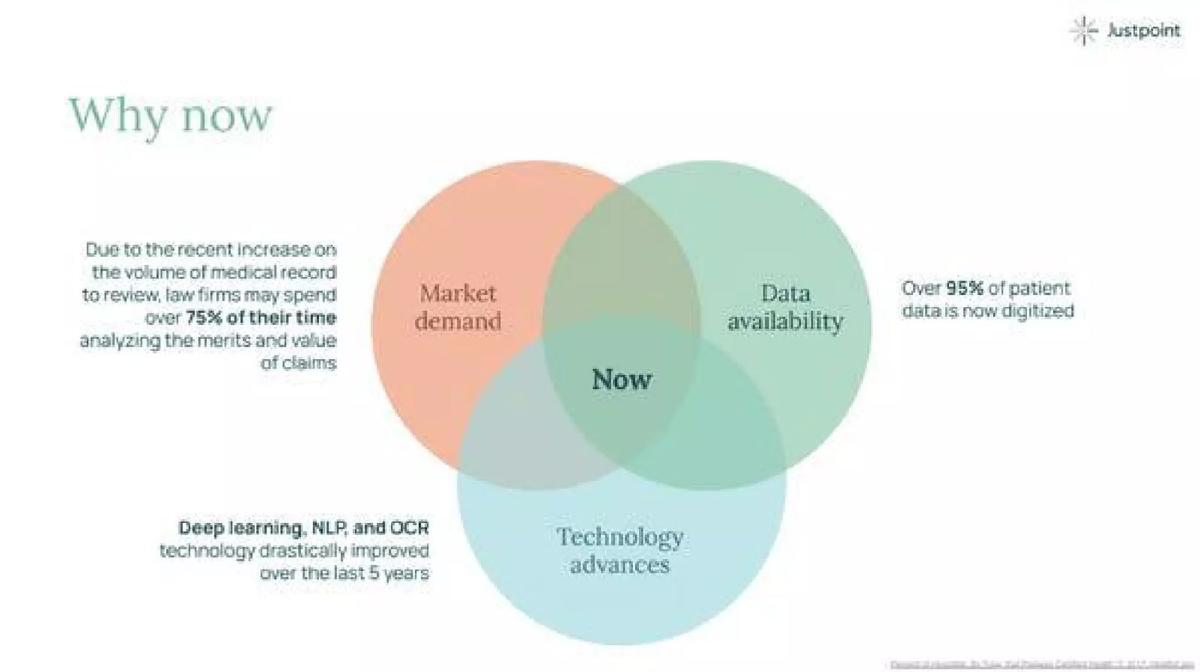
Slide 6: Why now A Venn diagram illustrates the convergence of Market demand, Data availability, and Technology advances. Key stats include: law firms spend over 75% of their time analyzing claim merits, and over 95% of patient data is now digitized. The slide also mentions that Deep Learning, NLP, and OCR technology have drastically improved in the last 5 years, providing the technical foundation for the product.
Slide 7: Thesis This is the "big picture" slide. It posits that AI will eventually make the most important decisions in medical malpractice. The core strategic claim is that "the AI company which accumulates the most data will become the market-defining company in this space." This frames Justpoint as a data-moat business rather than just a software provider.
Product, Traction, and Market Size
Slide 8: Our first product This slide breaks down the user journey. A plaintiff provides details on the website; a "Matching Attorney" (Justpoint's client) uses the platform to estimate settlement value 100x faster ; and the claimant is connected to a "Retaining Attorney." Justpoint earns a percentage of attorney fees as co-counsel, clarifying the revenue model.
Slide 9: Over 30% MoM growth on plaintiffs matched Traction is shown through a line graph spanning November 2019 to May 2020. While the absolute numbers on the Y-axis are relatively small (peaking at just under 40 total claims signed), the exponential curve and the 30% month-over-month growth rate demonstrate early product-market fit and scalability.
Slide 10: Market size Justpoint presents three nested circles to define their opportunity. The beachhead is $1.1 billion (law firm costs in medical malpractice). This grows to a $24 billion market for negligence torts overall, and a $106 billion TAM for litigation finance in negligence tort cases. This suggests a clear path from a niche specialist to a broad legal-tech giant.
The Flywheel and the Team
Slide 11: Building the largest medical malpractice database This slide visualizes the data flywheel. Website claim submissions and law firm partnerships provide data, which improves AI models, which then attracts more users and partners. This reinforces the "Thesis" from Slide 7 and explains how they will maintain a competitive lead.
Slide 12: Founding team The team slide is strong, showing a balance of technical and domain expertise. Victor Bornstein (CEO) has a Ph.D. and healthcare accelerator experience. Sashko Zakharchuk (CTO) is a Google Developer Expert in Machine Learning. Serge Zenin (COO) is an attorney with experience in both defense and plaintiff law. Logos for Google, Mount Sinai, and various law firms add institutional credibility.
Slide 13: Advisors The deck concludes with two high-profile advisors: Vivek Garipalli (Founder & CEO of Clover Health) and Harry Langenberg (Co-founder of Optima Tax Relief). Their involvement suggests that Justpoint has the backing of seasoned entrepreneurs who have successfully scaled complex, regulated businesses.
What Works in This Deck
The strength of the Justpoint deck lies in its logical progression . It starts with a visceral human problem, backs it up with a staggering industry statistic (the 60% rejection rate), and then introduces a technology that specifically solves the bottleneck (the 100x speed increase). The "Thesis" slide is particularly effective because it doesn't just describe what the company does; it describes why the company will win the entire category. By focusing on data accumulation as the ultimate competitive advantage, they move the conversation away from features and toward a long-term moat. The use of a specific persona (Maria) effectively bridges the gap between abstract AI technology and real-world impact.
What is Missing
Despite its strengths, the deck has several notable omissions. First, there is no explicit 'Ask' slide . While we know from external records that they raised $58.6M, the deck itself does not state how much they are looking for or how they plan to spend the capital. Second, the unit economics are absent. While they mention taking a percentage of attorney fees as co-counsel, there is no detail on the average contract value, customer acquisition cost (CAC), or lifetime value (LTV). Finally, the competitive landscape is ignored. The deck assumes a vacuum, failing to mention other legal-tech players or how they differ from traditional lead-generation services for lawyers.
What a Founder Should Copy
Founders should emulate Justpoint’s 'Why Now' slide . It doesn't just list trends; it explains how specific technological shifts (NLP/OCR) and market conditions (digitization of records) have finally made their solution possible. This is crucial for convincing investors that the problem wasn't solved before because it couldn't be, not because no one thought of it. Additionally, the data flywheel visualization on Slide 11 is a great way to demonstrate how a company becomes more valuable with every transaction. If your startup relies on machine learning, showing exactly how your data loop functions is more persuasive than simply saying you use AI.
Frequently asked questions
- What is the primary problem Justpoint is solving?
- Justpoint addresses the 'broken' medical malpractice system where victims lack transparency in choosing attorneys and many valid claims are rejected because they are not profitable enough for law firms to manually vet. According to Slide 4, over 60% of potential claims are rejected for profitability reasons rather than lack of merit. Justpoint uses AI to lower the cost of this analysis, making smaller but valid claims viable.
- How does Justpoint's technology create a competitive advantage?
- The core advantage is speed and data accumulation. Slide 8 states that their platform allows attorneys to analyze merits and estimate settlement values 100x faster. Furthermore, Slide 11 outlines a 'data flywheel' where website submissions and law firm partnerships build the largest medical malpractice database, which in turn improves their AI models, creating a barrier to entry for competitors.
- What is the size of the market Justpoint is targeting?
- Justpoint uses a tiered market size approach on Slide 10. They identify a $1.1 billion beachhead in medical malpractice law firm costs. This expands to a $24 billion market for plaintiff acquisition in negligence torts overall, and a $106 billion total addressable market (TAM) for litigation finance in negligence tort cases.
- What does the 'Why Now' slide emphasize?
- Slide 6 attributes the timing to three factors: Market demand (law firms spend 75% of their time analyzing claims), Data availability (over 95% of patient data is now digitized), and Technology advances (significant improvements in Deep Learning, NLP, and OCR over the last five years). This combination allows for automated analysis that was previously impossible.
- Who are the key members of the Justpoint founding team?
- As shown on Slide 12, the team includes CEO Victor Bornstein, Ph.D. (former Assistant Professor at Mount Sinai), CTO Sashko Zakharchuk (a Google Developer Expert in Machine Learning), and COO Serge Zenin, Esq. (an attorney with experience in both medical malpractice defense and plaintiff disability law). This mix covers the medical, technical, and legal pillars of the business.