How legal tech startups present the solution in a pitch deck: answer the problem slide point by point, say whose work changes, and give one measured result.
Legal Tech Solution Slide: Real Pitch Deck Examples
Eight solution slides from legal tech startups, shown in full, compare whether each slide answers the problem it follows, makes clear whose work changes (the lawyer's or the client's), and gives a measured result.
TL;DR
A legal tech solution slide should answer the problem slide point by point and say whether it helps the lawyer do more or helps the client need the lawyer less. Justpoint does this in one sentence: its platform matches claims with law firms "by (1) decreasing the cost and time of analyzing the merits and likely payout of a claim, and (2) analyzing law firms based on their performance regarding each type of claim", one answer for each of its two problems. DeepIP gives numbers: support on "75% of his daily tasks" and "Saving Up to 50% of the Time". Jus Mundi says clients "save up to 30% in search time". Athennian's slide is mostly a timeline of other companies, which is the weaker pattern.
Legal tech solution slides from real pitch decks
Each example shows the exact stored slide above its analysis and links to the full teardown. Claims are as shown on the slides; we have not verified them.
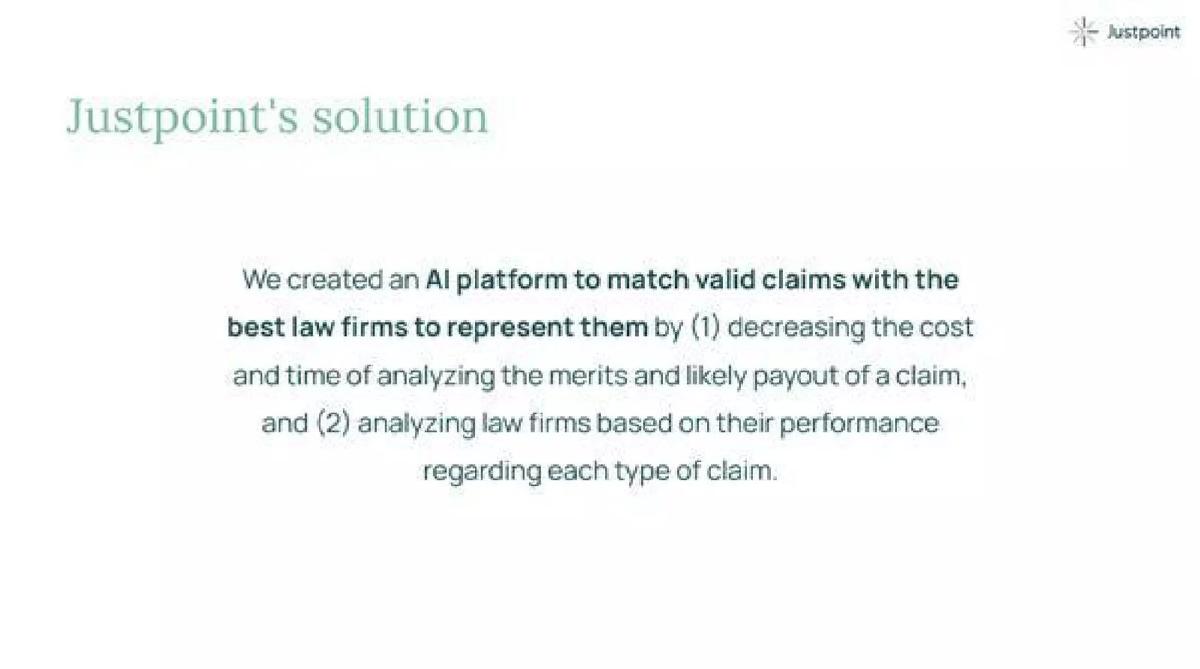
Justpoint solution slide — slide 5
Matching medical malpractice claims with law firms. One sentence on a plain slide, right after the two-problem slide.
Justpoint deck, slide 5. Exact stored slide matched to this analysis.
Our analysis: The strongest slide here: step (1) answers the claims rejected as unprofitable, step (2) answers clients who can't compare lawyers.
Evidence and limitation: No figures; the claim is how it works.
What a founder can adapt: Number your solution steps to match your numbered problems.
Supporting analysis
What the deck claims: "Justpoint's solution." "We created an AI platform to match valid claims with the best law firms to represent them by (1) decreasing the cost and time of analyzing the merits and likely payout of a claim, and (2) analyzing law firms based on their performance regarding each type of claim."
Presentation choice: Each half of the sentence closes one problem from the slide before, so the logic is easy to follow.
When it does not fit: Add one result, such as how much cheaper a claim review becomes.
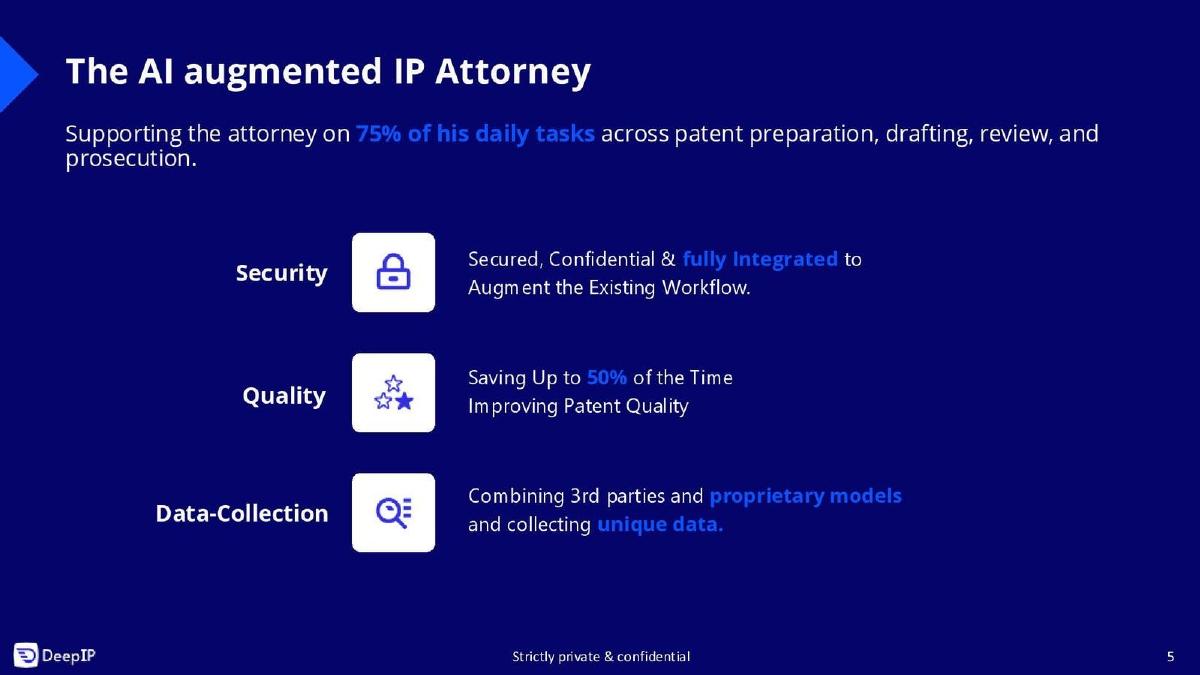
AI software for patent attorneys. Three labelled benefits on blue.
DeepIP deck, slide 5. Exact stored slide matched to this analysis.
Our analysis: It helps the lawyer rather than replacing them, which fits a problem about flat prices and rising volume.
Evidence and limitation: Two percentages; no source on the slide.
What a founder can adapt: Say which share of the lawyer's work you cover and how much time it saves.
Supporting analysis
What the deck claims: "The AI augmented IP Attorney." "Supporting the attorney on 75% of his daily tasks across patent preparation, drafting, review, and prosecution." "Security: Secured, Confidential & fully Integrated to Augment the Existing Workflow." "Quality: Saving Up to 50% of the Time, Improving Patent Quality." "Data-Collection: Combining 3rd parties and proprietary models and collecting unique data."
Presentation choice: Time saved per application answers the margin squeeze directly.
When it does not fit: Source the 75% and 50%; "up to" invites the question of the typical result.
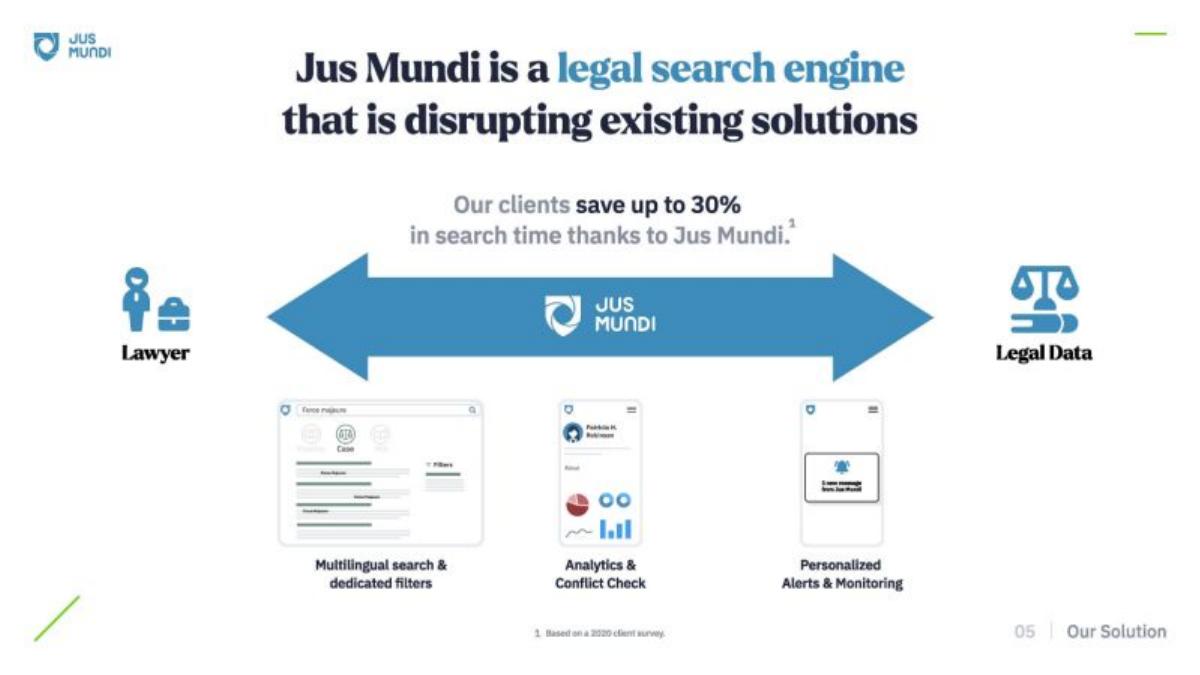
Legal research search engine. The same lawyer-to-legal-data diagram as the problem slide, now with Jus Mundi in the middle.
Jus Mundi deck, slide 5. Exact stored slide matched to this analysis.
Our analysis: Reusing the problem diagram makes the change obvious: the old routes are replaced by one arrow.
Evidence and limitation: "Up to 30%" with a survey footnote.
What a founder can adapt: Redraw your problem diagram with your product in it.
Supporting analysis
What the deck claims: "Jus Mundi is a legal search engine that is disrupting existing solutions." "Our clients save up to 30% in search time thanks to Jus Mundi." (footnote: "Based on a 2020 client survey"). Features: "Multilingual search & dedicated filters", "Analytics & Conflict Check", "Personalized Alerts & Monitoring".
Presentation choice: The time saving has a stated source, which is rare in this set.
When it does not fit: "Disrupting existing solutions" adds nothing; the diagram already shows it.
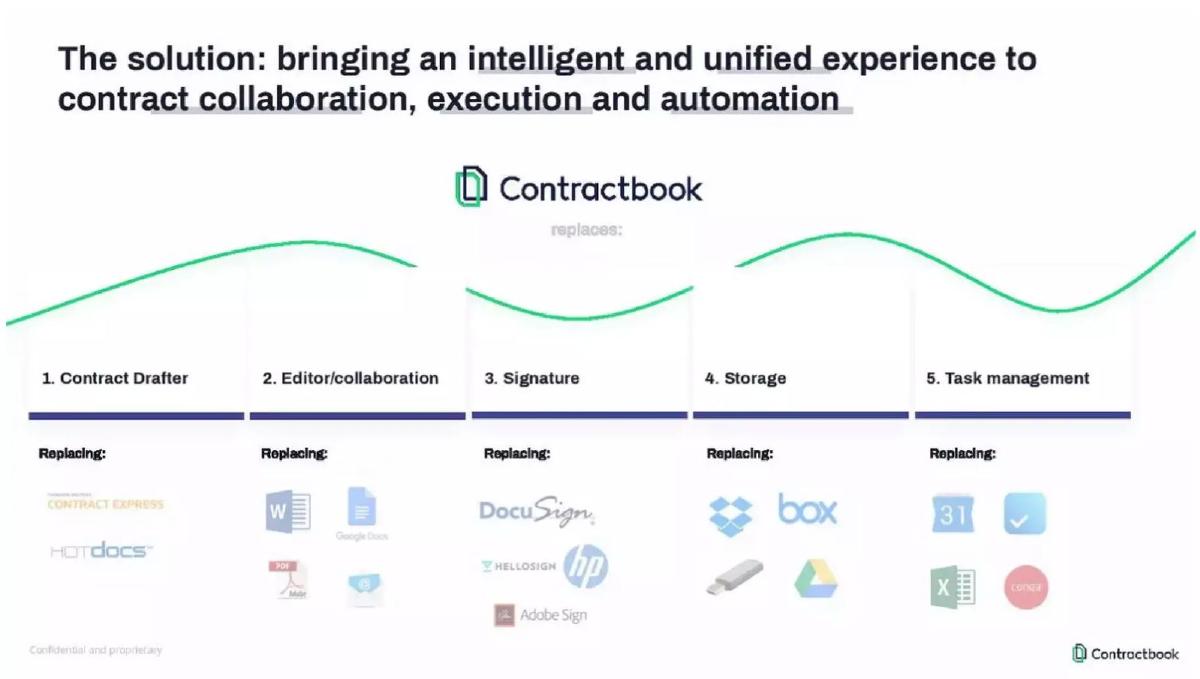
Contract management software. Five steps of a contract, with the tools each step replaces.
Contractbook deck, slide 3. Exact stored slide matched to this analysis.
Our analysis: Showing the tools it replaces tells an investor both what the product does and what budget it takes.
Evidence and limitation: No figures; the logos are the evidence.
What a founder can adapt: List the tools your product replaces under each step of the job.
Supporting analysis
What the deck claims: "The solution: bringing an intelligent and unified experience to contract collaboration, execution and automation." "Contractbook replaces:" "1. Contract Drafter", "2. Editor/collaboration", "3. Signature", "4. Storage", "5. Task management", each with a row of "Replacing:" logos (for example DocuSign under Signature, Box and Dropbox under Storage).
Presentation choice: A buyer can see which subscriptions they could cancel.
When it does not fit: Say what consolidating saves: hours, licence fees or errors.
Legal services marketplace for small businesses and consumers. Four bullet points.
Lawkick deck, slide 3. Exact stored slide matched to this analysis.
Our analysis: Each bullet answers one circle from the problem slide (fragmentation, inaccessibility, acquisition costs), and both sides of the marketplace are named.
Evidence and limitation: No figures.
What a founder can adapt: Write one solution line for each problem line, in the same order.
Supporting analysis
What the deck claims: "Solution. Bring the market online to create efficiency." "Aggregate small legal service providers onto a single platform." "Make it easy for consumers to connect with them and solicit legal services." "Decrease client acquisition costs for solo practitioners and small law firms." "Enable greater accessibility to legal services at competitive prices."
Presentation choice: It shows how cleanly a solution slide can mirror its problem slide.
When it does not fit: Say by how much acquisition costs fall; that is the claim investors will test.
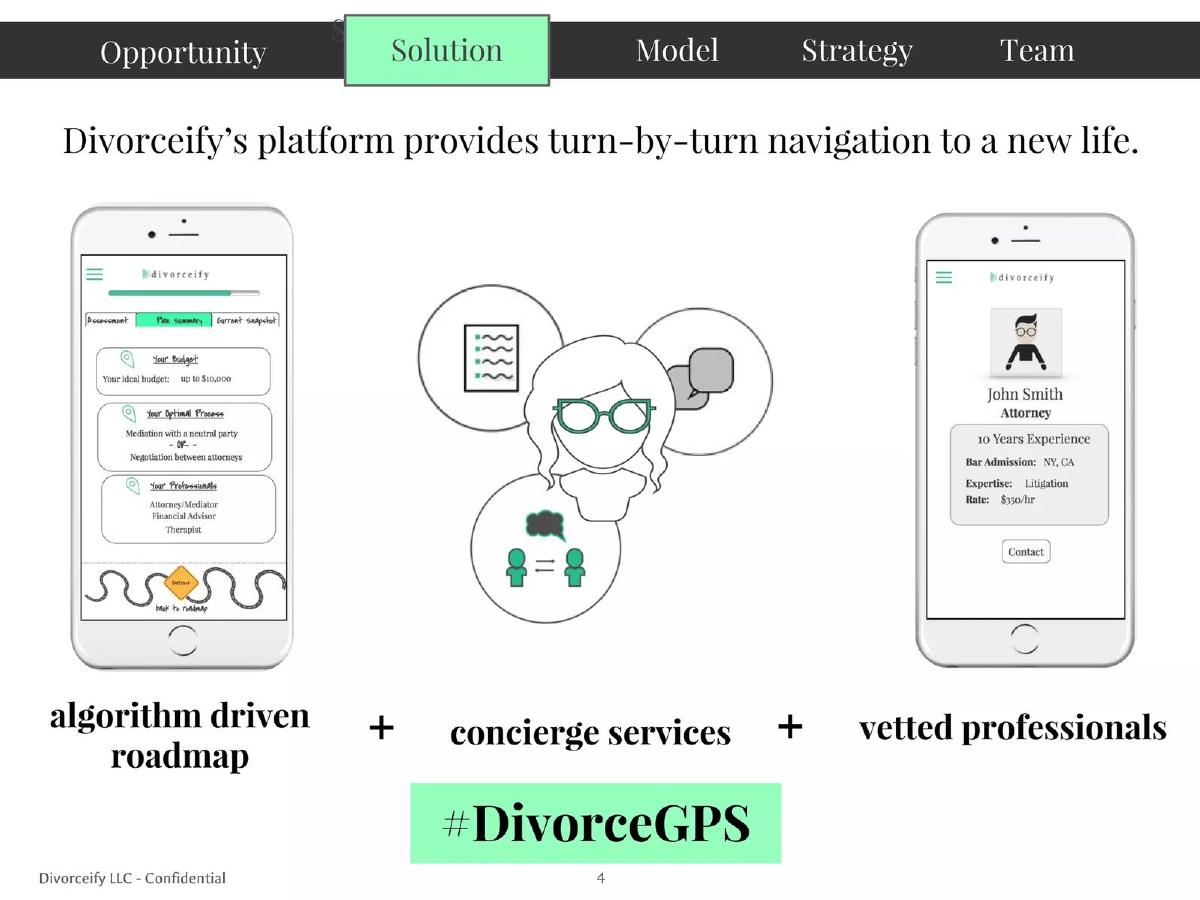
Divorce guidance platform. Two phone screens and an illustration joined by plus signs.
Divorceify deck, slide 4. Exact stored slide matched to this analysis.
Our analysis: The three parts answer its problems (confusion, no one-stop shop, lawyers doing non-legal work), and the GPS image is memorable.
Evidence and limitation: No figures; product screens.
What a founder can adapt: Show the parts of the product as a simple sum, each tied to one problem.
Supporting analysis
What the deck claims: "Divorceify's platform provides turn-by-turn navigation to a new life." "algorithm driven roadmap" + "concierge services" + "vetted professionals". "#DivorceGPS."
Presentation choice: A familiar image explains a new kind of service quickly.
When it does not fit: Say what the client saves against "$250/hr" on the problem slide.
Software for in-house legal teams. Kea placed among the tools other departments use. Partial.
Kea deck, slide 4. Exact stored slide matched to this analysis.
Our analysis: Placing Kea next to Jira and SAP frames it as the missing system for one department, but the slide never says what Kea does.
Evidence and limitation: No figures.
What a founder can adapt: Keep the comparison, and add three things the product does for a legal team.
Supporting analysis
What the deck claims: "Lawyers have options, but just a few are really meant for them." "With Kea there is no need for legal teams to remain in darkness while other business units already have solutions to increase their productivity." IT: Jira; Sales: HubSpot; Legal: Kea; Finance: SAP; People: Workday. "The platform that enable lawyers to provide the service their clients deserve." "A data-driven legal outcome."
Presentation choice: It shows a positioning slide standing in for a solution slide.
When it does not fit: Other companies' logos can't be the main content of your solution slide.
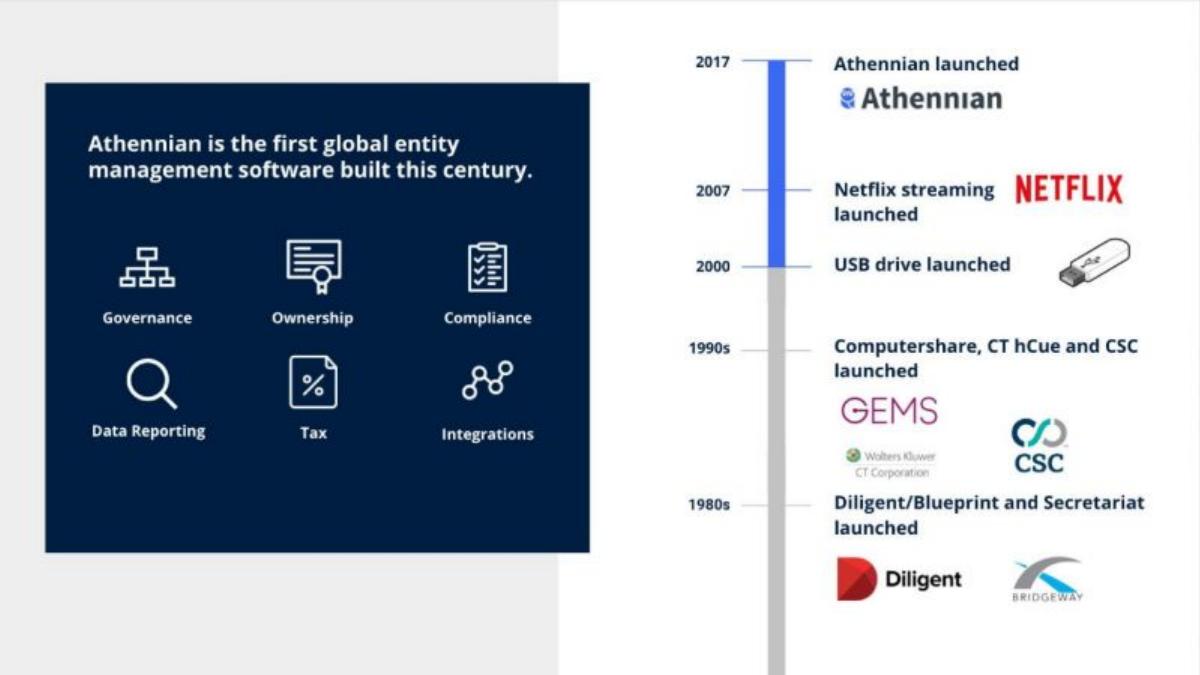
Entity management software for legal teams. Six feature icons beside a timeline. Weak on purpose.
Athennian deck, slide 3. Exact stored slide matched to this analysis.
Our analysis: Half the slide is a timeline of competitors and unrelated products; the other half is a list of feature names.
Evidence and limitation: No figures.
What a founder can adapt: Take one risk from the problem slide (a delayed deal) and show how the product prevents it.
Supporting analysis
What the deck claims: "Athennian is the first global entity management software built this century." Icons: "Governance", "Ownership", "Compliance", "Data Reporting", "Tax", "Integrations". Timeline: "1980s Diligent/Blueprint and Secretariat launched", "1990s Computershare, CT hCue and CSC launched", "2000 USB drive launched", "2007 Netflix streaming launched", "2017 Athennian launched".
Presentation choice: It shows what the stronger slides avoid: a newness claim with nothing on what changes for the user.
When it does not fit: Move the competitor timeline to the competition slide.
Whether each slide answers its problem slide, says whose work changes, and gives a measured result.
Example
Answers the problem
Whose work changes
Result
Justpoint
Yes (two steps for two problems)
Clients and firms
No
DeepIP
Yes (margin squeeze)
Lawyers
Yes (75%, 50%, unsourced)
Jus Mundi
Yes (same diagram)
Lawyers
Yes (30%, client survey)
Contractbook
Partly (tools replaced)
Legal and business teams
No
Lawkick
Yes (line by line)
Clients and small firms
No
Divorceify
Yes (three parts)
Clients
No
Kea
Partly (positioning)
In-house lawyers
No
Athennian
No
Legal teams
No
Key Takeaways
Answer the problem slide point by point; Justpoint and Lawkick mirror their problem slides line for line.
Say whose work changes: the lawyer's (DeepIP, Jus Mundi, Kea) or the client's (Justpoint, Divorceify).
Give one measured result in lawyer terms: time saved per search or per task ("up to 30%", "up to 50%").
Name what you replace; Contractbook lists the tools under each step of the contract.
"First this century" is a claim, not a solution; show what changes for the user.
Build your legal tech solution slide
One answer per problem, one side, one measured result.
Problems. Copy the problems from your problem slide, in order.
Answers. Write one line for how the product fixes each one.
Side. Does the lawyer do more, or does the client need the lawyer less?
Result. Hours saved per matter, fees saved per case, or cases accepted, with a source.
Copyable framework: [Product] lets [who] [do what] by (1) [answer to problem 1] and (2) [answer to problem 2]. Customers [measured result]. (Source: [source].)
After: Small landlords file routine evictions in 1 week instead of 6 by (1) generating court-ready notices and (2) booking a local attorney only for the hearing, saving $2,400 per case on average. (Source: 40 pilot cases.)
What improved: Our illustrative rewrite; the figures are invented for the example. Each step answers a problem, and the result is measured.
What this guide adds
The legal tech problem guide showed that legal startups must pick a side: lawyers, in-house teams, or the people who need legal help. This guide follows the same decks to the next slide and checks whether the solution keeps that promise.
Seven of the eight companies also appear in the problem guide, so you can read the two slides together: Justpoint, DeepIP, Jus Mundi, Kea, Divorceify, Lawkick and Athennian. Contractbook is new here.
Three things a legal tech solution slide proves
It answers the problem: Justpoint's two numbered steps match its two problems; Lawkick's "Decrease client acquisition costs" answers its "Rising Costs" point.
Whose work changes: "Supporting the attorney" (DeepIP), "Lawyer" to "Legal Data" (Jus Mundi), "vetted professionals" for divorcing clients (Divorceify).
A measured result: "up to 30% in search time" (Jus Mundi, from a client survey), "up to 50% of the Time" (DeepIP).
Common mistakes
Not answering the problem slide. Each problem you raised needs a matching answer.
Changing sides. A problem about clients followed by a tool for lawyers confuses investors.
Features with no result. Six feature icons tell investors less than one measured saving.
"Up to" with no source. Give the typical result and where it comes from.
Competitor timelines. They belong on the competition slide.
Diagnostic checklist
Each problem from the previous slide has a matching answer.
It says whether the lawyer or the client benefits.
It gives one measured result, with a source.
It shows or names what the product replaces.
Competitors and market size are on other slides.
Frequently asked questions
How we chose these examples
Corpus: published pitch deck teardowns on StartupFundraising.com. Founder-uploaded private decks are excluded.
Selection (2026-09-25): we took the solution slide that follows each problem slide in the legal tech problem guide, then searched slides 3–7 of other legal tech decks. Eleven candidate slides were read and eight stored images inspected. CourtBuddy was left out because slides 4–6 of its deck cover traction, demand and supply rather than a solution; Genie AI's slide 5 is a single feature; Della's slide 7 is a mission statement. Kea is marked partial; Athennian is kept as a weaker contrast.
Overlap check: none of these eight slides appears in another guide. Seven of the decks appear in the legal tech problem guide with different slides.
Review: all eight stored slide images were inspected on 2026-09-25 and matched to company, deck and slide number (editorial model review). No person has yet completed an editorial review of this page.
Claims are as shown on the slides; we have not verified them. We make no claim that any slide caused a fundraising outcome.