Divorceify is a legal technology platform designed to reduce the friction and cost of divorce by connecting consumers with a vetted network of professionals. The deck outlines a two-sided marketplace where consumers pay for concierge services and detailed roadmaps, while professionals pay a monthly subscription for directory visibility. With a seed funding goal of $500,000, the company plans to transition part-time staff to full-time roles and develop a mobile MVP. While the deck clearly defines the pain points of high legal fees and client lack of preparation, it lacks specific traction metr…
Key takeaways
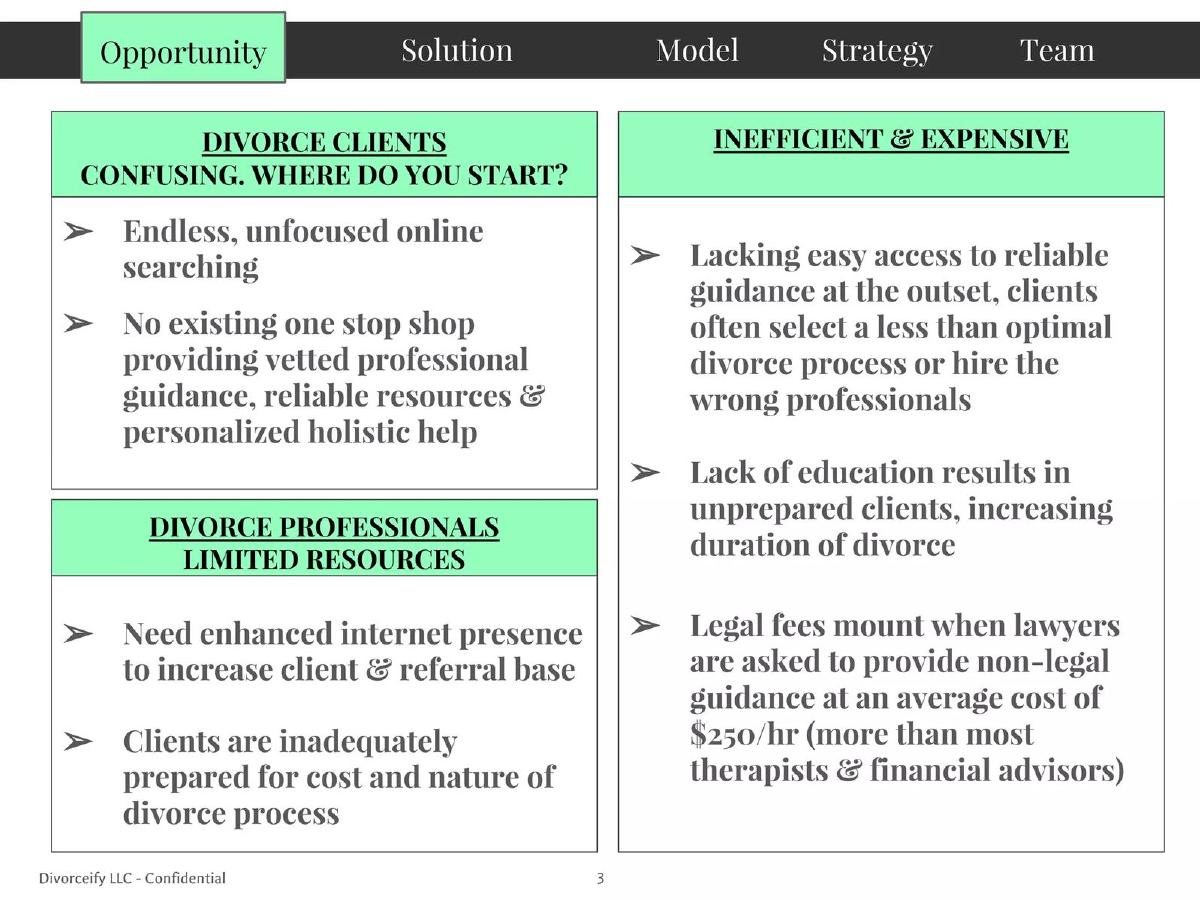
- The company identifies a specific cost inefficiency where lawyers charge an average of $250/hr for non-legal guidance (Slide 3).
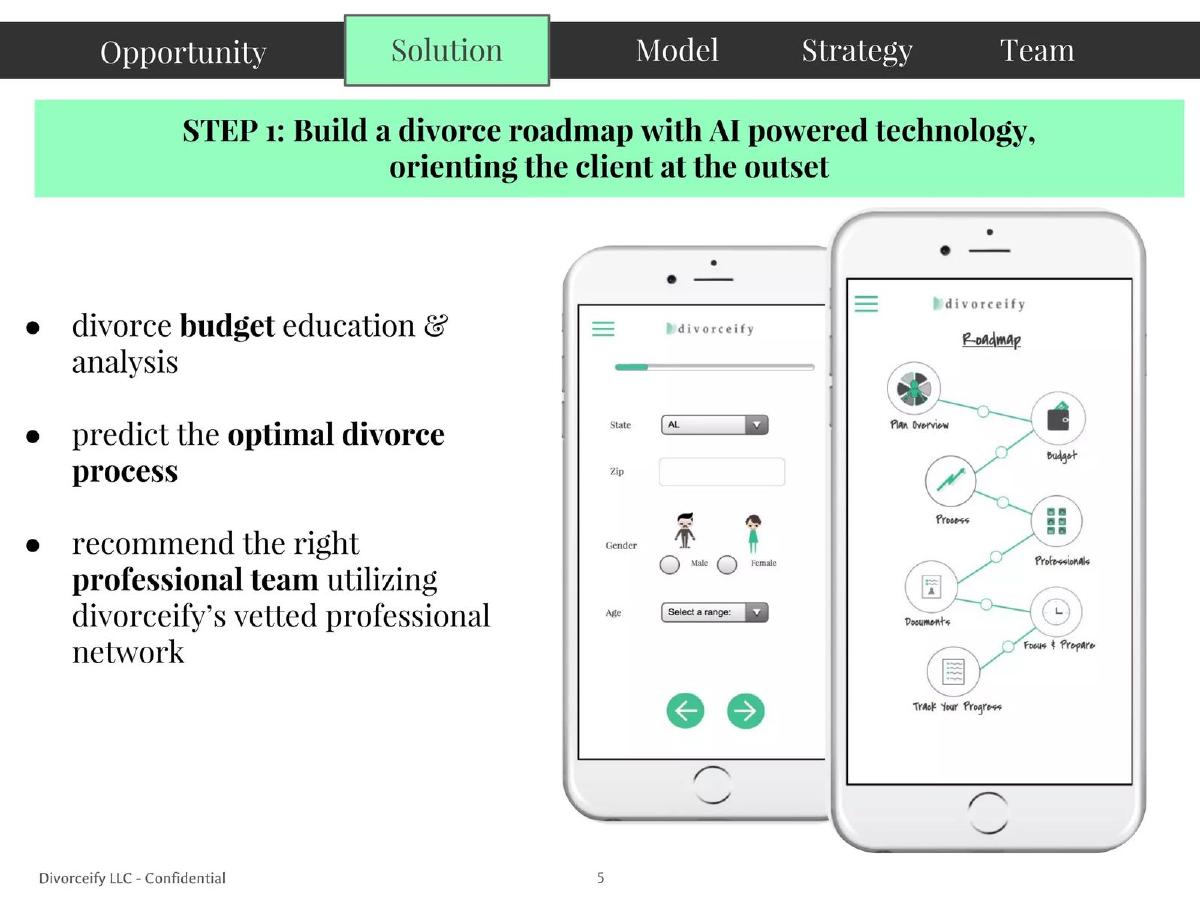
- The solution utilizes AI-powered technology to predict optimal divorce processes and provide budget analysis (Slide 5).
- Revenue is diversified between one-time transactional fees ($99), consumer subscriptions ($49-$149/mo), and professional subscriptions ($35/mo) (Slide 9).
- The total funding goal is $500,000, primarily for technology development and moving two part-time staff to full-time (Slide 13).
- Acquisition strategy targets a 'potential market size' of millions for clients and hundreds of thousands for professionals (Slide 11).
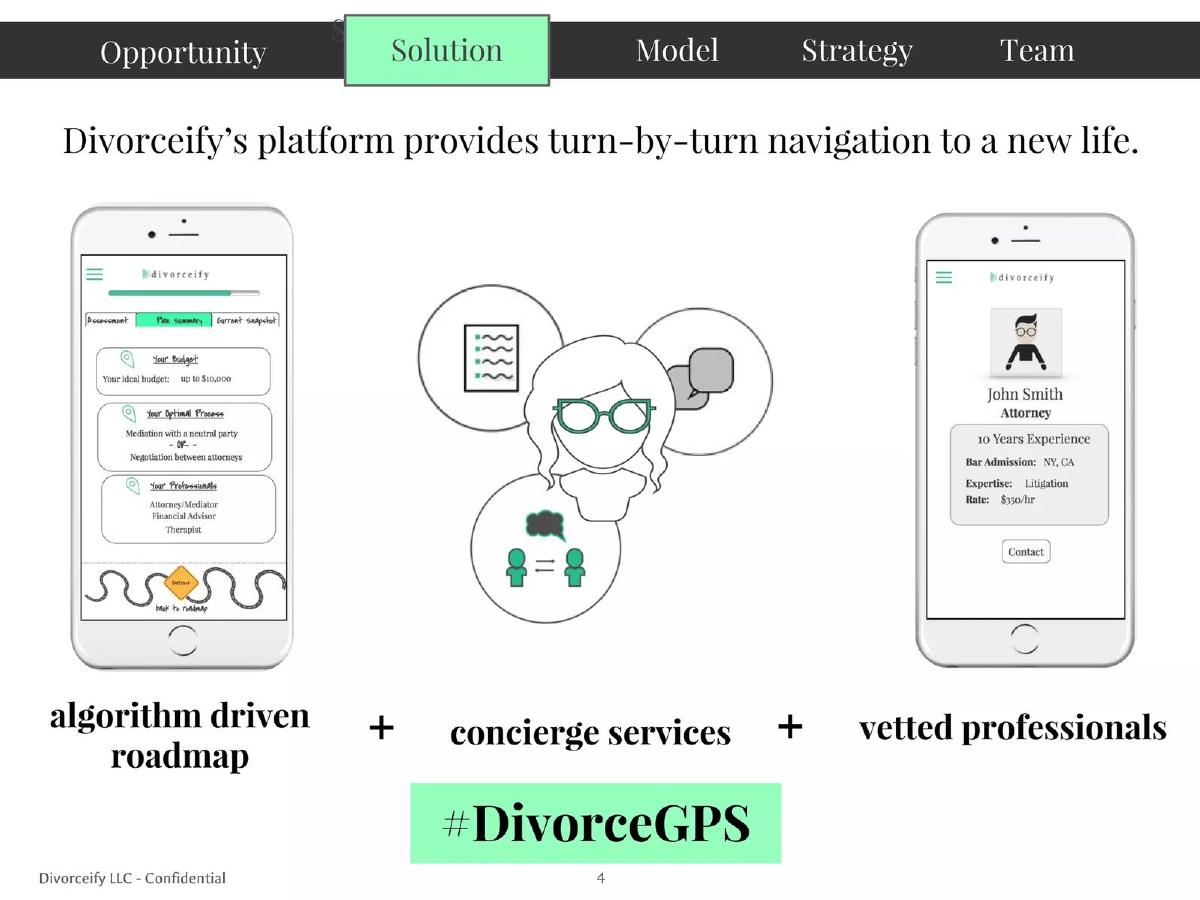
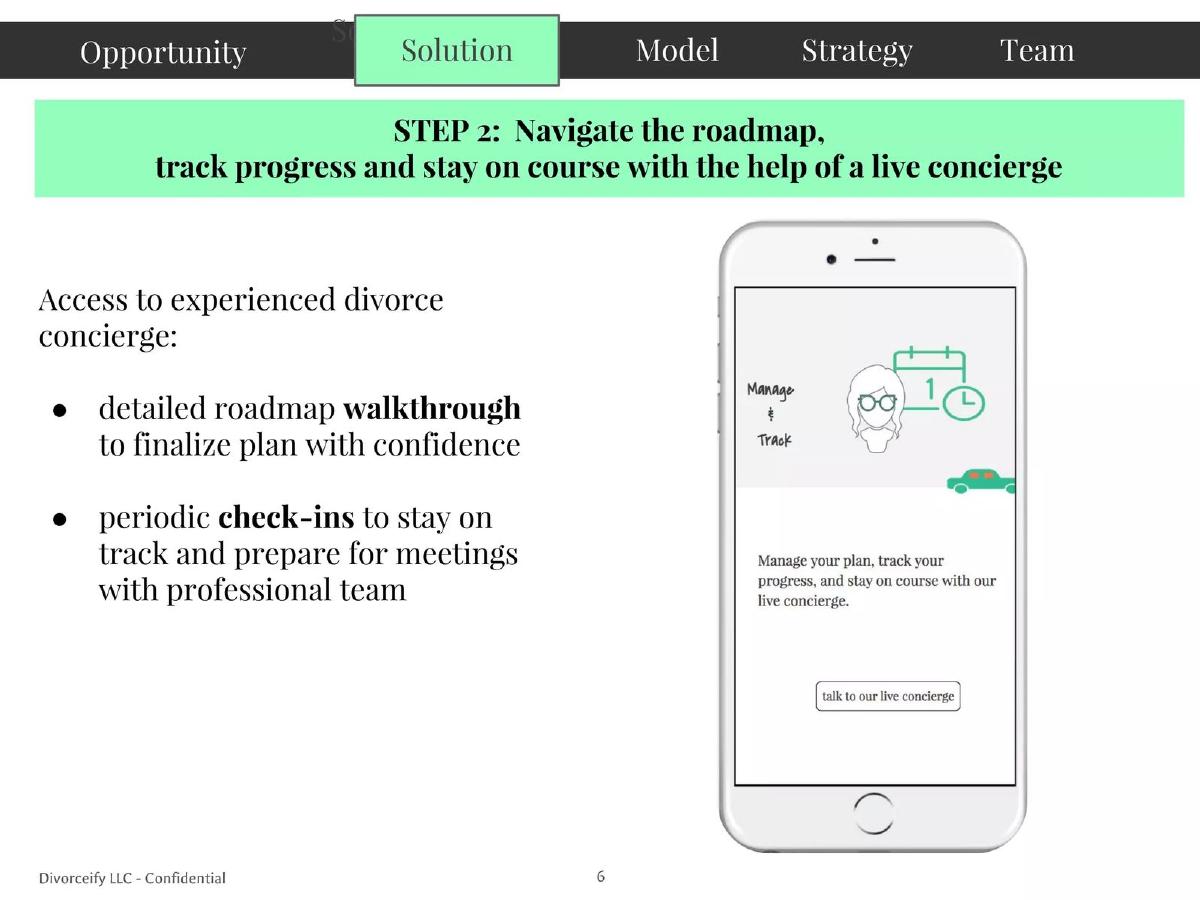
- The product includes a 'Live Concierge' component to manage and track client progress (Slide 9).
- The deck omits a dedicated team slide, competitive landscape, and historical traction data in the provided 8-slide sequence.
- Marketing plans include a mix of outsourced PR, social media ads, and sponsoring professional events (Slide 11, 13).
Introduction
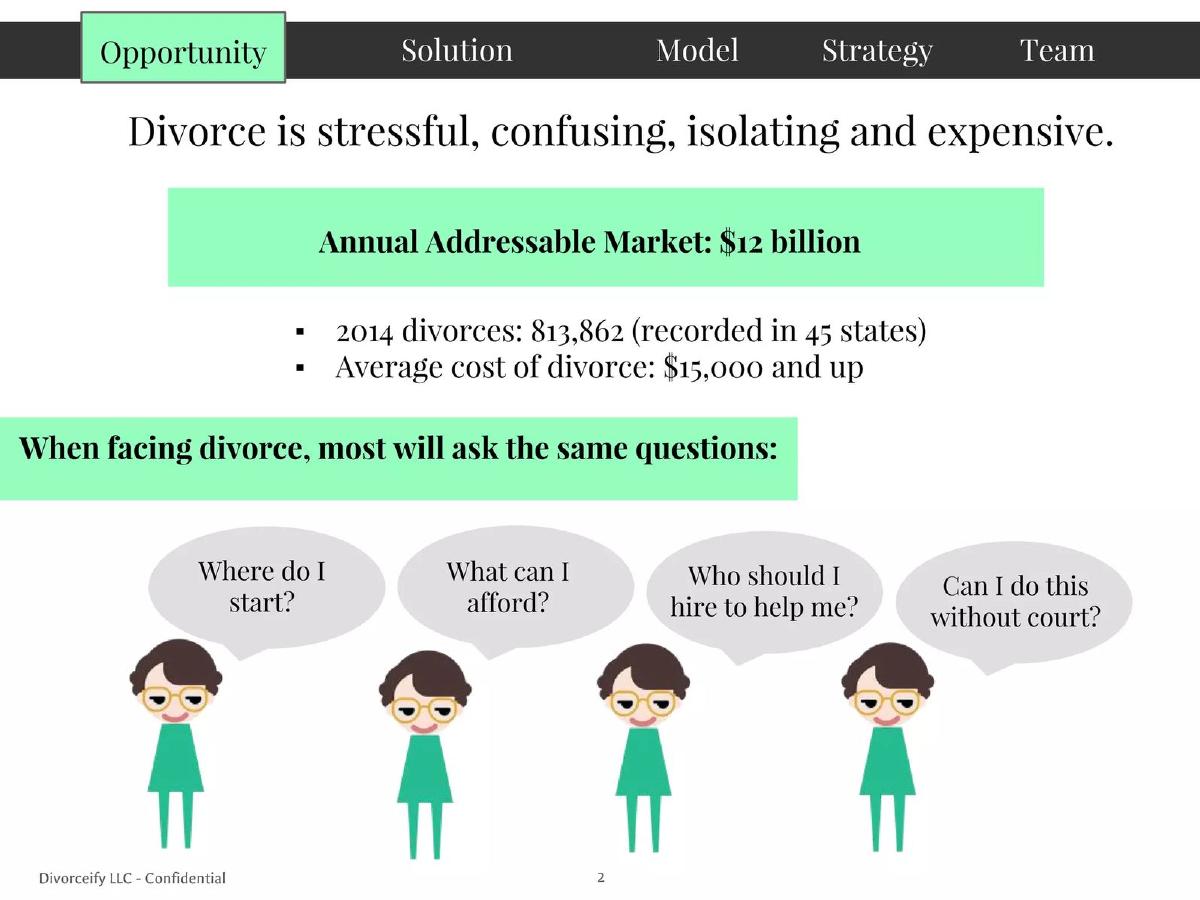
Divorceify presents itself as a holistic solution to the fragmented and expensive divorce market. The deck focuses on the 'intelligent' navigation of a life event that is traditionally characterized by high emotional and financial stress. By positioning themselves as a concierge and roadmap provider, they aim to sit at the top of the funnel, directing users to the appropriate legal and financial professionals while capturing value through both lead generation and direct service fees.
Slide 1: Title Slide
The cover slide features the company logo—a stylized teal leaf or petal—and the tagline "divorce intelligently." The aesthetic is clean and professional, avoiding the aggressive or overly legalistic imagery often associated with the sector. The footer notes the entity as "Divorceify LLC - Confidential."
Slide 3: The Opportunity
This slide breaks down the pain points for two distinct groups. For Divorce Clients , the process is described as "confusing" with "endless, unfocused online searching." A key insight provided is that there is no "one stop shop" for vetted guidance. For Divorce Professionals , the deck notes a need for an enhanced internet presence to increase their referral base. The right-hand column highlights the financial inefficiency: lawyers charging an average of $250/hr for non-legal guidance, which is noted as being more expensive than most therapists or financial advisors. This sets up the value proposition: saving the client money by diverting non-legal tasks away from high-priced attorneys.
Slide 5: Solution - Step 1
The solution is presented as a multi-step process. Step 1 involves building a "divorce roadmap with AI powered technology." The slide features mobile mockups showing a user interface where clients input data such as State, Zip, Gender, and Age. The platform promises to provide budget education & analysis , predict the optimal divorce process , and recommend a vetted professional team . The visual roadmap shown on the phone screen includes nodes for Budget, Process, Professionals, Documents, and Progress Tracking.
Slide 7: Solution - Step 3
Skipping to Step 3, the deck emphasizes education and the marketplace. Features include a "reliable resource library" and free advice via blogs and webinars. The mobile mockup shows "The Library" with categories like Divorce 101, Parenting, Finance, and Holidays. The goal here is to keep the user engaged within the ecosystem through content, eventually leading them to the "searchable network of vetted professionals for personalized help."
Slide 9: Revenue Model
Divorceify outlines a clear, multi-tiered monetization strategy. Consumer Pays:
Mobile App Basic Roadmap: FREE · Detailed Roadmap + Live Concierge Consultation: $99 (One-time fee) · Live Concierge Manage & Stay on Track: $49/mo (Basic) or $149/mo (Premium)
This model suggests a strategy to capture low-intent users for free, convert high-intent users into transactional customers, and create recurring revenue from both professionals and high-need consumers.
Slide 11: Acquisition Strategies
The acquisition strategy is split between the two sides of the marketplace. For Professionals (market size: hundreds of thousands), the tactics include targeting professional associations, sponsoring events, and advertising in trade publications. For Clients (market size: millions), the strategy relies on targeting support groups, parenting meetups, and therapists, alongside SEO-driven content and social media advertising. The mention of "Referrals from current network members" for both sides suggests an attempt to build a viral loop or at least a strong word-of-mouth component.
Slide 13: Use of Funds
The company is seeking a $500,000 Goal . The allocation is divided into:
Technology: Developing the Web & Mobile (iOS) MVP. · Marketing/Branding/PR: Specifically noted as "outsourced." · Professional Engagement: Sponsoring and hosting events. · Personnel & Admin: Moving 2 part-time staff to full-time, hiring additional part-time staff, and scaling the concierge services by training coaches in the network. · Legal fees: General administrative legal costs.
A footnote indicates that a more detailed breakdown is available upon request.
Slide 15: Contact Information
The final slide provides the standard contact channels: email, Twitter, LinkedIn, Facebook, and the company website. It maintains the same minimalist branding as the title slide.
What Divorceify Does Well
The deck excels at identifying a specific, quantifiable inefficiency in the market: the $250/hr "lawyer tax" for non-legal advice. By framing the problem as a financial drain on the consumer, they create an immediate "why now" for the product. The two-sided revenue model is also well-structured, showing that the founders have considered how to extract value from both the supply and demand sides of their marketplace. The inclusion of a "Live Concierge" suggests they understand that divorce is a high-touch emotional event that technology alone might not fully solve, providing a human element that can justify higher subscription tiers.
What is Missing from the Deck
The most glaring omission in the provided slides is the Team Slide . While Slide 13 mentions moving two part-time staff to full-time, there is no information regarding the founders' backgrounds, legal expertise, or technical capabilities. In a legal-tech startup, the credibility of the team (e.g., former divorce attorneys or experienced marketplace operators) is paramount. Additionally, there is no Traction Slide . There are no mentions of current user numbers, the number of professionals currently in the network, or any pilot program results. Finally, a Competitive Landscape slide is missing; the deck assumes a vacuum, ignoring existing players in the legal-tech and divorce-mediation space.
Founder Takeaways
Quantify the Pain: Divorceify’s use of the $250/hr figure is a great example of how to make a vague problem (divorce is expensive) concrete. Founders should always look for the "hidden cost" in their industry to anchor their value proposition. Tiered Monetization: The mix of free, transactional, and subscription revenue shows a sophisticated approach to user lifecycle. It allows for a wide top-of-funnel while ensuring there are pathways to high-margin revenue. Clear Use of Funds: Rather than just saying "Hiring," the deck specifies moving part-time staff to full-time. This gives investors a clear picture of the current organizational state and how the capital will immediately change the company's operational capacity.
Frequently asked questions
- What is the primary problem Divorceify is solving?
- Divorceify addresses the inefficiency and high cost of divorce. According to Slide 3, clients often lack access to reliable guidance at the start, leading them to hire the wrong professionals. Furthermore, lawyers are frequently asked to provide non-legal guidance at an average cost of $250/hr, which is significantly higher than the rates of therapists or financial advisors.
- How does Divorceify plan to make money?
- The company uses a hybrid revenue model detailed on Slide 9. Consumers can access a basic roadmap for free, pay a $99 one-time fee for a detailed roadmap and consultation, or subscribe to a 'Live Concierge' service for $49 to $149 per month. On the supply side, professionals pay a $35 monthly subscription to be listed in the searchable directory.
- What is the technological core of the product?
- As stated on Slide 5, the platform uses 'AI powered technology' to build a divorce roadmap. This includes budget education, predicting the optimal divorce process for a specific user's situation, and recommending a professional team from their vetted network based on user inputs like location, age, and gender.
- How will the $500,000 seed investment be spent?
- Slide 13 breaks down the use of funds into three main buckets: Technology (Web and Mobile iOS MVP), Marketing/PR (including professional event sponsorship), and Personnel. A key goal for the personnel budget is to move two existing part-time team members to full-time status and hire additional part-time staff to scale concierge services.
- What is the target market size according to the deck?
- Slide 11 defines the potential market size in two segments. For professionals (lawyers, therapists, financial advisors), they estimate the market at 'hundreds of thousands.' For clients (individuals going through divorce), they estimate the potential market size at 'millions.'