Rootine's Series A deck is a masterclass in positioning a physical product company as a high-margin data platform. By anchoring their value proposition in 'cellular nutrition,' the company moves beyond the crowded vitamin market into the high-growth 'connected health' sector. The deck successfully demonstrates traction through a 4x year-over-year revenue growth projection for 2022 and an 18x increase in at-home lab tests sold. While the deck leans heavily on future projections—claiming a path to a $1B business within six years—it backs these claims with a multi-pronged data strategy involving…
Key takeaways
- The company projects 4x year-over-year revenue growth for the 2022 period following a 2019 launch (Slide 2).
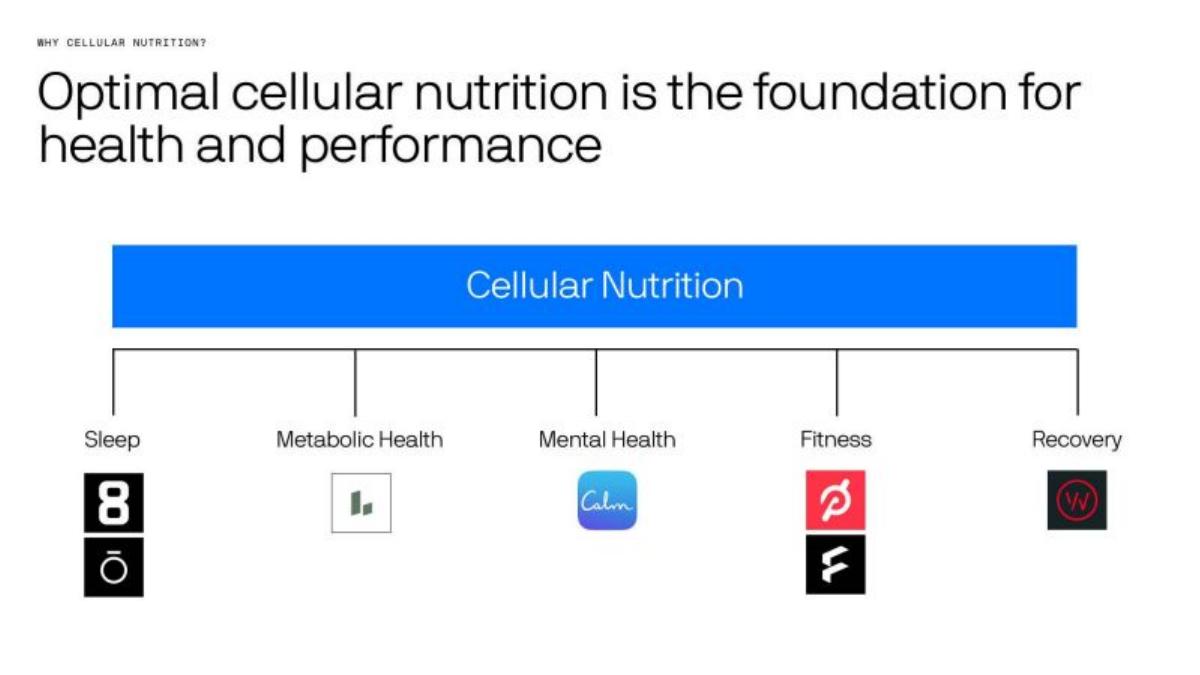
- Rootine positions cellular nutrition as the foundational layer for sleep, metabolic health, mental health, fitness, and recovery (Slide 3).
- The total global market for cellular nutrition and connected health is projected to grow by over $320B by 2030 (Slide 4).
- Product offerings include at-home tests starting at $95 for vitamins, $98 for DNA, and $112 for minerals (Slide 7).
- The technology stack utilizes AI to analyze over 100 data points per member, including clinical studies and digital biomarkers (Slide 8).
- Traction is evidenced by an 18x increase in at-home lab tests sold and an 8x increase in the test-to-new-member ratio (Slide 10).
- The company utilizes a multi-pronged tracking approach combining self-reported data, blood levels, and wearable device data (Slide 9).
- Future revenue projections through 2027 rely on four pillars: nutrients, testing, new products, and premium services (Slide 13).
Rootine Series A Teardown: The Shift to Precision Health
Rootine’s 2022 Series A deck arrived at a pivotal moment for the direct-to-consumer (DTC) health space. As the market moved away from generic 'one-size-fits-all' supplements, Rootine leaned heavily into the 'Precision Nutrition' narrative. The deck is designed to convince investors that Rootine is not just a vitamin company, but a data company that happens to sell physical products. With a $10M raise led by Relevance Ventures, this deck serves as a blueprint for how to pitch a hardware/software/biotech hybrid.
Slide 1: Title and Positioning
The cover slide is minimalist, featuring the logo and the tagline: 'Optimizing health with precision nutrition.' It explicitly identifies the deck as an 'Investment Overview - Series A.' The branding is clean and clinical, signaling a departure from the bright, lifestyle-heavy aesthetics of earlier DTC supplement brands.
Slide 2: The Snapshot
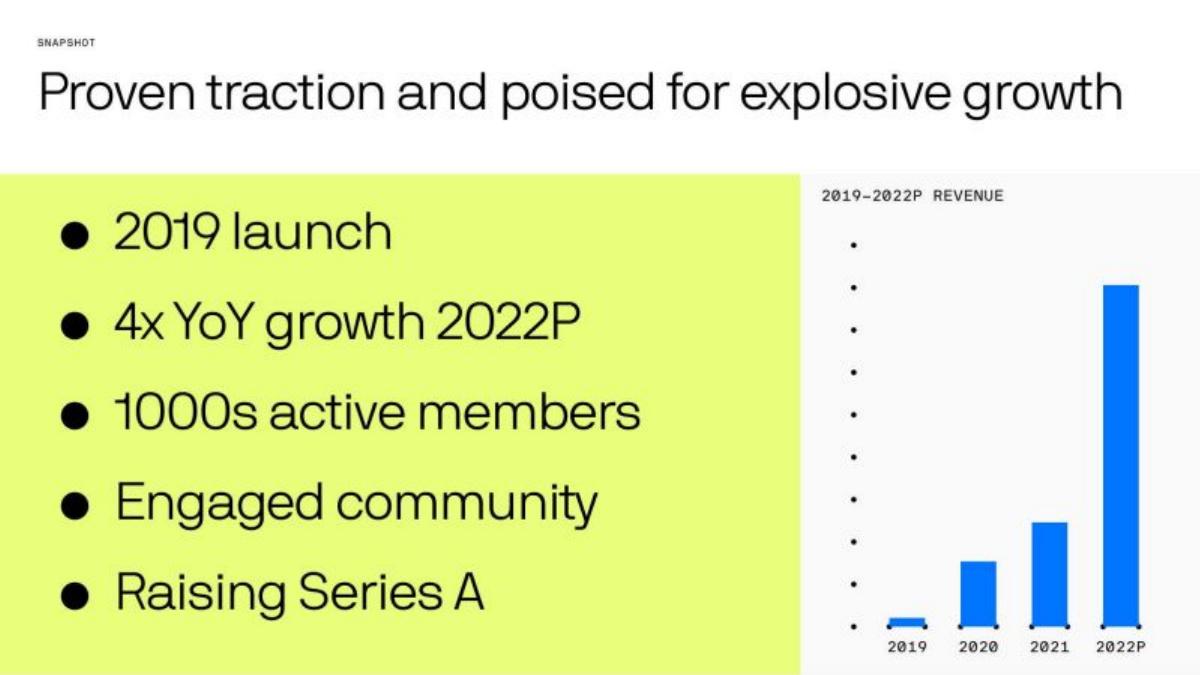
Slide 2 serves as the 'hook.' It lists five key bullet points: a 2019 launch, 4x YoY growth 2022P , 1000s of active members, an engaged community, and the fact that they are raising a Series A. The bar chart on the right shows a steep upward trajectory in revenue from 2019 to 2022P. Note the 'P' for projected; at the time of this deck, the 2022 figures were not yet finalized, but the trend line from 2020 to 2021 shows consistent doubling before the projected quadruple jump.
Slide 3: Why Cellular Nutrition?
This is a category-creation slide. Rootine places 'Cellular Nutrition' at the top of a hierarchy, claiming it is the foundation for Sleep, Metabolic Health, Mental Health, Fitness, and Recovery. By placing logos like Eight Sleep, Oura, Calm, and Peloton underneath their category, Rootine is attempting to position themselves as the 'Intel Inside' for the entire wellness economy. If you care about any of these other verticals, the slide argues, you must first solve your cellular nutrition.
Slide 4: Market Size and Growth
The market slide uses a bar chart to show the 'Total Global Market Size' growing from $460B in 2022 to $780B in 2030. They break this down into two segments: the 'Cellular nutrition supplement market' and 'Connected health + at-home diagnostics.' The arrow highlights a +$320B growth opportunity, grounding the company's potential in massive, macro-economic shifts toward personalized health data.
Slide 5: The Solution
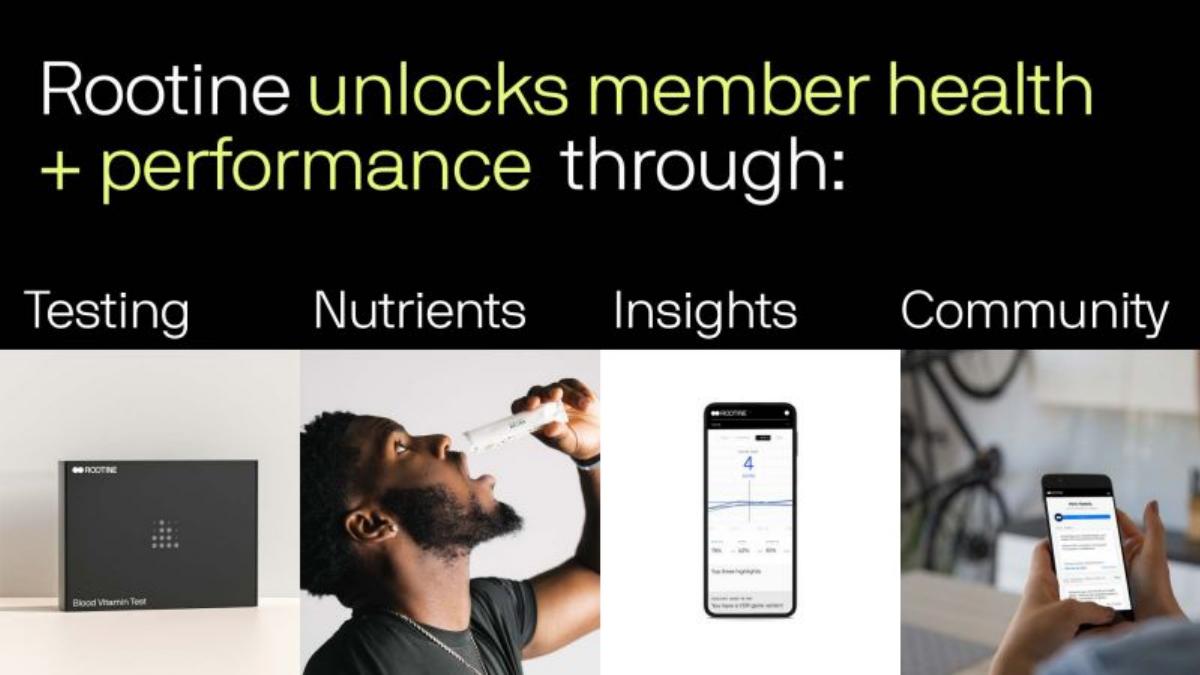
Slide 5 introduces the product ecosystem. It is divided into three pillars: 'science-backed insights,' 'supplements to optimize health,' and 'tracking + at-home lab testing.' The imagery shows a sleek black 'Blood Vitamin Test' box, individual supplement sachets, and a mobile app. This confirms the business is a three-part loop: test, treat, and track.
Slide 6 & 7: The Business Model and Lab Tests
Slide 6 simplifies the revenue streams into 'Nutrients' and 'Tests.' Slide 7 provides the specific pricing and metrics for those tests. The Blood Vitamin Test starts at $95 , the DNA for nutrition Test starts at $98 , and the Blood Mineral Test starts at $112 . This slide is critical for understanding the unit economics; these are high-ticket entry points that likely serve as lead generation for the recurring nutrient subscription.
Slide 8: The Technology Stack
To justify the 'Precision' label, Slide 8 explains their AI. It claims to analyze 100+ data points per member . The inputs include clinical studies, DNA, blood levels, lifestyle, digital biomarkers, and health outcomes. The output is a personalized formula shown on a smartphone screen, listing specific dosages like 'Vitamin C: 162.0 mg' and 'Zinc: 20.3 mg.' This level of granularity is the core differentiator against competitors who offer broad 'packs' of pills.
Slide 9: Multi-Pronged Tracking
This slide addresses the 'Track' part of the loop. It shows three methods: Self-reported (via app), Blood levels (via lab tests), and Wearable data (showing an Apple Watch). This suggests Rootine is building a data moat by aggregating disparate health data sources into a single dashboard.
Slide 10: Traction and LTV
Slide 10 is one of the strongest in the deck. It moves away from top-line revenue to focus on engagement. It claims an 18x increase in at-home lab tests sold and an 8x increase in the test/new member ratio . This is a powerful signal to investors that customers aren't just buying vitamins once; they are buying into the testing ecosystem repeatedly, which significantly improves Lifetime Value (LTV) and provides 'usable longitudinal data.'
Slide 11: Partnerships
Social proof is provided via 'Partnerships across content + community.' They list 3 winter 2022 Olympians and pros from the NFL, MMA, and Golf. On the brand side, they show logos for Eight Sleep, Levels, Bioloop, Wellory, and Aloha . These partnerships reinforce the 'foundational layer' argument made on Slide 3.
Slide 12 & 13: The Future and The Vision
Slide 12 outlines the vision: a 'data-first, comprehensive platform that supports common and chronic conditions.' Slide 13 makes a bold claim: 'Rootine will be a $1B+ business within 6 years.' The accompanying chart shows revenue diversifying from just nutrients and testing into 'New Products' and 'Premium Services' by 2027. This is a classic 'venture scale' slide, intended to show the path to a massive exit.
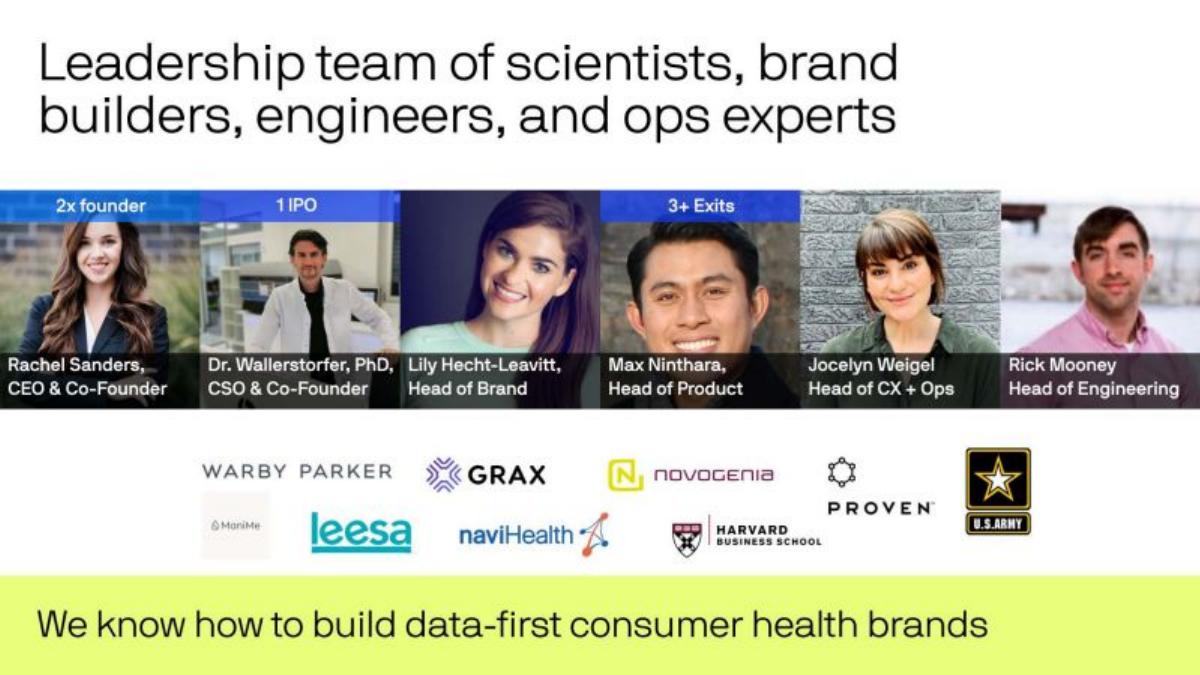
Slide 14: The Team and Advisors
The deck concludes with the people. It highlights clinical advisors like Dr. Richard Harris and Jordan Mazur , as well as business advisors like Yan Wu (ex-SoFi) and Libby Leffler . The bottom of the slide displays logos for Techstars, Cleo Capital, and DSM , along with a mention of '25+ operator angels.' This illustrates a strong support network of both scientific and institutional capital.
Slide 15: Contact Information
The final slide provides the website and social handles, along with direct contact info for Rachel Sanders, CEO and Co-founder . It mirrors the cover slide’s clean, black-and-white aesthetic.
What Works in the Rootine Deck
1. The Data Loop: The deck successfully argues that Rootine is a technology platform, not a supplement brand. By focusing on the '100+ data points' and the '18x increase in tests sold,' they prove that their customers value the data as much as the product.
2. Category Positioning: Placing themselves at the top of the wellness stack (Slide 3) is a smart way to justify their valuation. They aren't competing with Vitamin Shoppe; they are competing for the same 'health-conscious' dollar as Peloton and Oura.
3. Clear Unit Economics: Slide 7 doesn't hide the price. By showing the $95-$112 price points for tests, they signal that they are a premium brand with significant margins, which is essential for a Series A healthcare company.
What is Missing from the Rootine Deck
1. The 'Ask' Slide: The 15 slides provided do not include a specific breakdown of how the $10M will be spent. While we know the outcome from the catalogue facts, a standard pitch deck usually includes a slide detailing the allocation of funds (e.g., 40% R&D, 30% Marketing, etc.).
2. Competitive Landscape: There is no slide comparing Rootine to direct competitors like Care/of, Ritual, or InsideTracker. Investors usually want to see a 2x2 matrix or a feature comparison list to understand why Rootine’s AI or testing is superior.
3. Churn and Retention Metrics: While they show growth in tests sold, they don't explicitly state their churn rate for the nutrient subscriptions. In a B2C subscription model, retention is the most scrutinized metric at Series A.
Founder's Playbook: What to Copy
Use 'P' for Projections Wisely: If you are raising mid-year, follow Rootine’s lead on Slide 2. Show your actuals for previous years and use a 'Projected' bar for the current year to show the momentum you are currently building.
Anchor Your Product in a Larger Ecosystem: If you sell a niche product, create a slide like Slide 3. Show how your product is the 'foundation' for other popular, high-value activities. It makes your addressable market feel much larger than it might appear on the surface.
Highlight the 'Ratio' of Engagement: Instead of just showing total users, show the 'test/new member ratio' (Slide 10). This proves that your users are deepening their relationship with your product over time, which is a much stronger signal of product-market fit than simple acquisition numbers.
Frequently asked questions
- What is Rootine's core business model?
- Rootine operates a B2C e-commerce model focused on precision nutrition. According to Slide 6 and Slide 7, they generate revenue through the sale of personalized nutrient subscriptions and one-time at-home lab tests (Blood Vitamin, DNA, and Blood Mineral tests). Their long-term strategy, as shown on Slide 13, involves expanding into 'Premium Services' and additional 'New Products' to build a comprehensive health platform.
- How does Rootine differentiate itself from standard vitamin companies?
- The deck emphasizes a 'data-first' approach. Slide 8 explains that their AI analyzes 100+ data points per member, including DNA and blood levels, rather than relying on generic surveys. Slide 9 highlights the integration of wearable data and longitudinal tracking, positioning the product as a scientific tool for health optimization rather than just a daily supplement.
- What kind of traction did Rootine show for its Series A?
- Rootine showcased significant growth metrics on Slide 2 and Slide 10. They reported 4x YoY revenue growth for 2022P and '1000s of active members.' Most notably, they demonstrated an 18x increase in at-home lab tests sold, suggesting that their existing customer base is deeply engaged with the data-tracking aspect of the service, which improves Lifetime Value (LTV).
- Who are the key investors and advisors behind the company?
- According to the catalogue facts, the $10M Series A was led by Relevance Ventures, with participation from Techstars and DSM Venturing. Slide 14 lists a diverse advisory board including Dr. Richard Harris (MD/PharmD), Jordan Mazur (RD for the SF 49ers), and Libby Leffler (former VP at SoFi), providing expertise across clinical health and consumer tech scaling.
- What are the primary risks associated with this business model?
- The deck highlights a heavy reliance on future projections, specifically on Slide 13, which predicts a $1B valuation within six years based on the successful launch of 'Premium Services' and 'New Products' that are not yet fully defined. Additionally, the high cost of at-home tests ($95-$112) may limit the addressable market to affluent consumers, a challenge common in the 'biohacking' and precision health space.