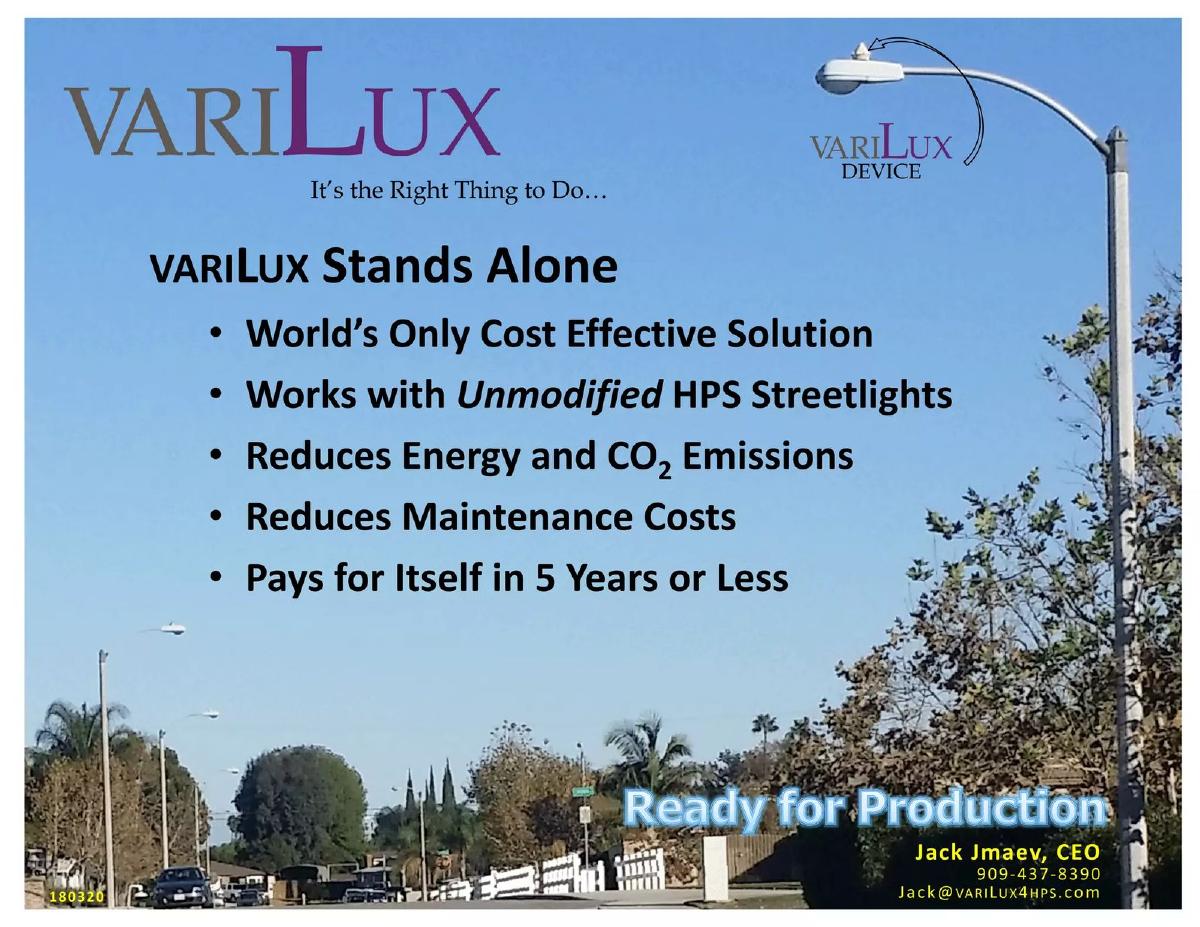
VariLux is positioning itself as a cost-effective alternative to the global push for LED streetlights. Their core product is an intelligent dimmer that retrofits onto existing High-Pressure Sodium (HPS) lamps in under five minutes. The deck makes a bold, contrarian claim: that LEDs are not economically viable due to high acquisition costs and 'lumen depletion' over 12 years. VariLux promises a 40% reduction in electricity and carbon emissions with a payback period of three to five years. The fundraising strategy is highly structured, seeking a seed round at a $15 million pre-money valuation,…
Key takeaways
- The product is a patented 3-terminal intelligent dimmer designed for unmodified HPS streetlights, allowing for a 5-minute 'plug and play' installation (Slide 4).
- VariLux claims that streetlights account for 35% to 50% of a city's electricity budget, creating a massive cost-saving opportunity (Slide 2).
- The company explicitly positions its solution against LED streetlights, which it labels as 'harmful to the environment' and 'not economically viable' (Slide 2).
- Economic projections suggest the device pays for itself in 5 years or less, compared to LEDs which the deck claims never pay for themselves due to component failure (Slide 6).
- The current seed round is seeking capital at a $15 million pre-money valuation for a 3% stake, including warrants (Slide 15).
- Use of proceeds is heavily weighted toward cost reduction ($1.52M) and certification/production ramp-up ($1.29M) (Slide 16).
- The product roadmap includes the development of a 'Low Cost Version' by month 24, aimed at a 30% COGS reduction (Slide 9).
- Management includes a patent attorney turned entrepreneur (CEO Jack Jmaev) and a former LED lighting sales executive (Fady Abushahla) (Slide 19).
VariLux Pitch Deck Teardown
Slide 1: Title and Value Proposition
The cover slide introduces VariLux with the tagline 'It’s the Right Thing to Do...' and identifies the product as the 'VariLux Device.' It lists five key value drivers: it is the 'World’s Only Cost Effective Solution,' works with 'Unmodified HPS Streetlights,' reduces energy and CO2 emissions, lowers maintenance costs, and 'Pays for Itself in 5 Years or Less.' The slide also notes the product is 'Ready for Production' and provides contact information for CEO Jack Jmaev.
Slide 2: The Opportunity and LED Critique
Slide 2 frames the market opportunity around the high cost of municipal lighting, stating that streetlights consume 35% to 50% of a city's electricity budget. It identifies bulb failures as the primary driver of maintenance costs. Crucially, this slide begins a sustained critique of LED technology, labeling LED streetlights as 'Not Economically Viable' due to high acquisition costs, a 'Dangerous Lighting Spectrum,' and being 'Harmful to the Environment.'
Slide 3: Product Capabilities
This slide defines the VariLux device as an 'Intelligent Streetlight Dimmer.' Features include IoT readiness, power metering, and environmental sensors. The slide claims the device pays for itself in as little as 3 years, maintains safe lighting levels, and reduces electricity and carbon emissions by 40%. It also emphasizes a 'Dark-Sky' and environmentally friendly profile.
Slide 4: Installation Process
Slide 4 illustrates the 'Plug & Play 5 Minute Installation.' Through a three-step photo series, it shows a technician removing a standard photocell and installing the VariLux device. The slide highlights a 'Patented 3-Terminal Design' as the essential component for this quick installation, emphasizing the lack of need for fixture modification.
Slide 5: Energy and Maintenance Logic
This slide uses two graphs to explain how the device saves money. The top graph shows 'Selective Dimming,' where light levels are adjusted between dusk and dawn to save power. The bottom graph, 'Lumen Maintenance,' compares HPS bulbs with and without VariLux. It claims the device maintains a constant luminance and safe light level while extending bulb life to 35,000 hours, compared to roughly 24,000 hours without it.
Slide 6: The Economic Case Against LEDs
Slide 6 presents a 12-year cost comparison. It argues that LEDs never pay for themselves because the entire fixture must be replaced after 12 years due to 'Lumen Depletion,' and power supplies fail every 5 to 6 years. The chart shows VariLux achieving 'Cost Recovery' by year 5, while LED acquisition costs remain a significant barrier.
Slide 7: Net Savings Projections
Focusing purely on the VariLux ROI, slide 7 shows a bar chart where the initial acquisition cost is recovered by year 5. From year 6 through year 12, the device is projected to deliver increasing 'Net Savings.' The calculations are based on a 150W HPS fixture and an electricity cost of $0.07 per Kilowatt-Hour.
Slide 8: Technical Architecture
This slide breaks down the product into 'Parent Nodes' and 'Child Nodes.' A Parent Node is dual-redundant, features a solar calculator and cellular modem, and can control 1,000 Child Nodes. Child Nodes report to the Parent, offer controllable dimming, and provide power metering. The physical device is shown as a green, cone-shaped unit.
Slide 9: Product Roadmap
The roadmap spans 24 months after funding. Key milestones include safety certifications for the current HPS product in months 1-6, development of an LED version (months 4-12), and the design and fabrication of custom Silicon (ASICs) for control and power monitoring. A 'Low Cost Version' with a 30% COGS reduction is slated for month 24.
Slide 10: Market Inflection Points
Slide 10 discusses the 'Inflection In Market Trajectory,' citing the American Medical Association (AMA) warnings about blue light hazards from LEDs. It suggests that local governments have been 'misled by LED manufacturers' and that awareness of LED 'broken promises' (12-year lifespan, 5-year power supply) is rising.
Slide 11: Total Available Market (TAM)
This slide provides a chart of the TAM from 2016 to 2027. It projects a 'Potential Correction' where the increase in LED adoption slows down due to economic and hazard concerns, while the HPS TAM remains higher than previously expected after an 'Inflection Point' in 2018-2019.
Slide 12: Business Development Plan
The sales strategy targets three tiers: 'Low Hanging Fruit' (cities with metered strings), 'Utility Companies' (for company-owned lighting), and 'Unmetered Lamps' (which requires Utilities Commission support for per-pole metering). The slide uses a simple graphic to represent these three channels.
Slide 13: Pro Forma Tabular
The financial table projects five years of operations. Sales are expected to grow from $1,003,500 in Year 1 to $311,400,000 in Year 5. The company projects net losses for the first three years (-$4.6M, -$4.9M, and -$225k) before reaching a net profit of $10.8M in Year 4 and $40.9M in Year 5. The 'Investment' row shows $5.35M in Year 1 and $5M in Year 2.
Slide 14: Operational Projection Chart
This slide visualizes the data from the pro forma. A bar chart shows the dramatic scaling of sales (total height) in Years 4 and 5, broken down by G&A, COGS, and EBIT. The Year 5 bar shows EBIT (Earnings Before Interest and Taxes) as a significant portion of the total revenue.
Slide 15: Funding Strategy
Slide 15 outlines the capital structure. It lists an initial $350k seed round and two planned $5 million rounds. The 'Current Round' is identified as a Seed Round at a $15 million pre-money valuation for a 3% stake with warrants. A pie chart shows the equity distribution: Founders (36.7%), First Round (14.0%), First Round Warrants (10.7%), and Second Round (10.0%), among others.
Slide 16: Use of Proceeds
The first-year use of proceeds ($5.35M total) is visualized in a pie chart. The largest allocations are for 'Cost Reduction' ($1,521,000) and 'Certification & Production Ramp Up' ($1,294,000). Other categories include G&A ($570k), Business Development ($464k), Management ($284k), and Political Efforts ($264k).
Slide 17: COGS Reduction Strategy
This slide details how the company plans to reduce COGS by 38% ($40 per unit). It shows photos of the internal circuit boards and points to two 'Special Chips' (ASICs) that will replace multiple components: one for i-Sense and Power Metering, and another for Programmable Logic and 'Glue' logic.
Slide 18: Exit Strategy & Valuation
VariLux targets a strategic acquisition, noting 'Two Inquiries from Existing Lighting Companies.' It also mentions 'LED Industry Vexation' as a driver, suggesting they could be a target for 'Buy and Bury' to protect LED roll-outs. The projected 5-year valuation is $700 million (based on 10x EBIT) or $800 million (based on NPV-EBIT).
Slide 19: Management Team
The final slide introduces the three-person leadership team. Jack Jmaev (CEO) is a patent attorney and former engineer at JPL and Hughes Aircraft. Min Kim (CFO) has experience in university administration and programming. Fady Abushahla (EVP Sales) has 20 years of experience, including a background in selling LED streetlights.
What VariLux Does Well
The VariLux deck is exceptionally strong in its economic argumentation . By focusing on the 'total cost of ownership' rather than just the initial energy savings, the founders create a compelling reason for municipal buyers to hesitate on LED transitions. The use of specific figures, such as the 35,000-hour bulb life extension (Slide 5) and the $40 per unit COGS reduction (Slide 17), provides a level of granular detail that suggests a deep understanding of their manufacturing and operational hurdles.
Furthermore, the technical differentiation is clear. The '5-minute installation' (Slide 4) is a powerful value proposition for cash-strapped cities. By showing the physical product and its internal components, the deck moves beyond abstract software promises into the realm of tangible hardware solutions. The inclusion of a specific roadmap for custom silicon (Slide 9) demonstrates a long-term vision for maintaining margins as the company scales.
What is Missing from the VariLux Deck
The most glaring omission is a detailed competitive landscape . While the deck spends significant time attacking 'LEDs' as a category, it does not mention specific competitors in the smart lighting or HPS dimming space. Investors would likely want to know who else is providing IoT nodes for streetlights and how VariLux's patented 3-terminal design compares to other retrofit solutions.
Additionally, the sales pipeline is vague. Slide 12 mentions 'Low Hanging Fruit' and 'Utility Companies,' but there are no mentions of specific pilot programs, letters of intent (LOIs), or existing municipal partnerships. For a company claiming to be 'Ready for Production,' the absence of a concrete list of early adopters or trial results is a significant gap. The 'Political Efforts' line item in the use of proceeds (Slide 16) hints at the regulatory hurdles involved, but the deck does not explicitly detail the lobbying or certification strategy required to change utility commission rules for 'per-pole metering.'
What a Founder Should Copy
Founders in the hardware or infrastructure space should emulate VariLux's transparency regarding capital structure . Slide 15 is a masterclass in showing how different rounds of funding and warrants impact the cap table. This level of detail builds trust with sophisticated investors who want to see how their stake will be diluted or protected over time.
The roadmap integration (Slide 9) is also worth copying. Instead of just listing milestones, VariLux ties their roadmap directly to the 'Months After Funding,' making it clear exactly what the investor's capital is buying and when the next value-inflection point (like the 'Low Cost Version') will occur. Finally, the clear exit strategy (Slide 18) that acknowledges the possibility of a 'Buy and Bury' acquisition shows a pragmatic understanding of industry dynamics that many founders overlook in favor of 'changing the world' narratives.
Frequently asked questions
- What is the core technology behind VariLux?
- VariLux produces an intelligent streetlight dimmer that utilizes a patented 3-terminal design. This allows the device to be installed on existing High-Pressure Sodium (HPS) streetlights in approximately five minutes by replacing the standard photocell. The device enables selective dimming, power metering, and is IoT-ready for smart city integration, as detailed on slides 3 and 4.
- Why does VariLux argue against LED streetlights?
- The deck presents a contrarian view on LEDs, claiming they have untenable acquisition costs and hidden operating expenses. Slide 6 argues that LEDs suffer from 'lumen depletion,' requiring full fixture replacement every 12 years, and that their power supplies fail every 5 to 6 years. VariLux also cites American Medical Association warnings regarding hazardous blue light from LEDs on slide 10.
- What are the financial projections for the company?
- VariLux projects significant growth, starting from $1 million in sales in Year 1 and reaching $311.4 million by Year 5. The pro forma on slide 13 shows the company reaching profitability in Year 4 with a net income after tax of $10.89 million, scaling to $40.97 million in Year 5.
- What is the current fundraising ask?
- According to slide 15, the company is currently in its Seed Round. They are seeking investment at a $15 million pre-money valuation for a 3% stake. The slide also outlines a history of funding, including an initial $350,000 seed round and plans for two subsequent $5 million rounds.
- Who is leading the VariLux team?
- The leadership team consists of CEO Jack Jmaev, a patent attorney and former JPL/Hughes Aircraft engineer; CFO Min Kim, who has a background in administration and programming; and EVP Fady Abushahla, who brings 20 years of experience in consultative sales, specifically in the LED lighting sector (Slide 19).