The Rovilus pitch deck is a 17-slide presentation that prioritizes visual impact over dense data, a bold choice for a deep-tech hardware company. By focusing on the massive $201B Total Addressable Market (Slide 5) and the critical safety failures of current battery tech (Slide 10), Rovilus positions its fire-suppressing thermal management system as a necessary industrial evolution. The deck successfully bridges the gap between a modest $20K in current revenue and a massive $102M in MOUs (Slide 15), providing a clear path to scale. While it lacks a formal 'Ask' slide or detailed financial proj…
Key takeaways
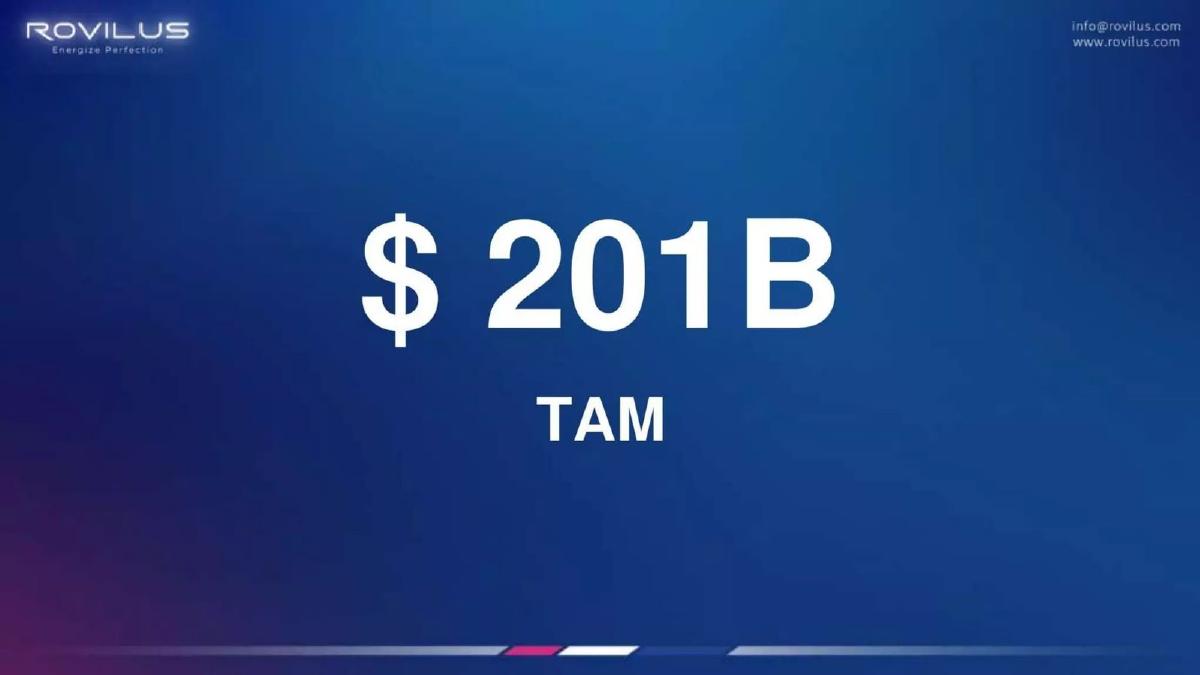
- The deck identifies a Total Addressable Market (TAM) of $201B on Slide 5.
- Rovilus claims its thermal management system provides a 3x increase in battery lifetime and 16x faster charging (Slide 13).
- The technology operates across a wide temperature range from -40 degrees Fahrenheit to 140 degrees Fahrenheit (Slide 13).
- The company highlights a sales cycle that is 3x shorter than competitors like GM and A123 Systems (Slide 14).
- Traction is demonstrated by a jump from $20K in gross revenue to $102M in signed MOUs following successful POCs (Slide 15).
- The team includes two co-founders and two sales advisors with backgrounds in A123 Systems and Delta-Q Technologies (Slide 16).
- The deck utilizes a modularized design strategy to maintain vehicle integrity while providing high power output (Slide 12).
- Safety is a primary value proposition, using imagery of vehicle fires to highlight the 'Safety Issues' of current solutions (Slide 10).
The Rovilus Pitch Deck: Visual Storytelling in Industrial Tech
Rovilus entered the pre-seed market in 2018 with a 17-slide deck that challenges the traditional text-heavy approach of hardware startups. Operating in the industrial battery space, the company focuses on thermal management—a critical component for safety and longevity in electric vehicles. This teardown examines how they used visual cues and massive pipeline figures to secure $150,000 in early-stage funding.
Slides 1-4: The Context and the Vision
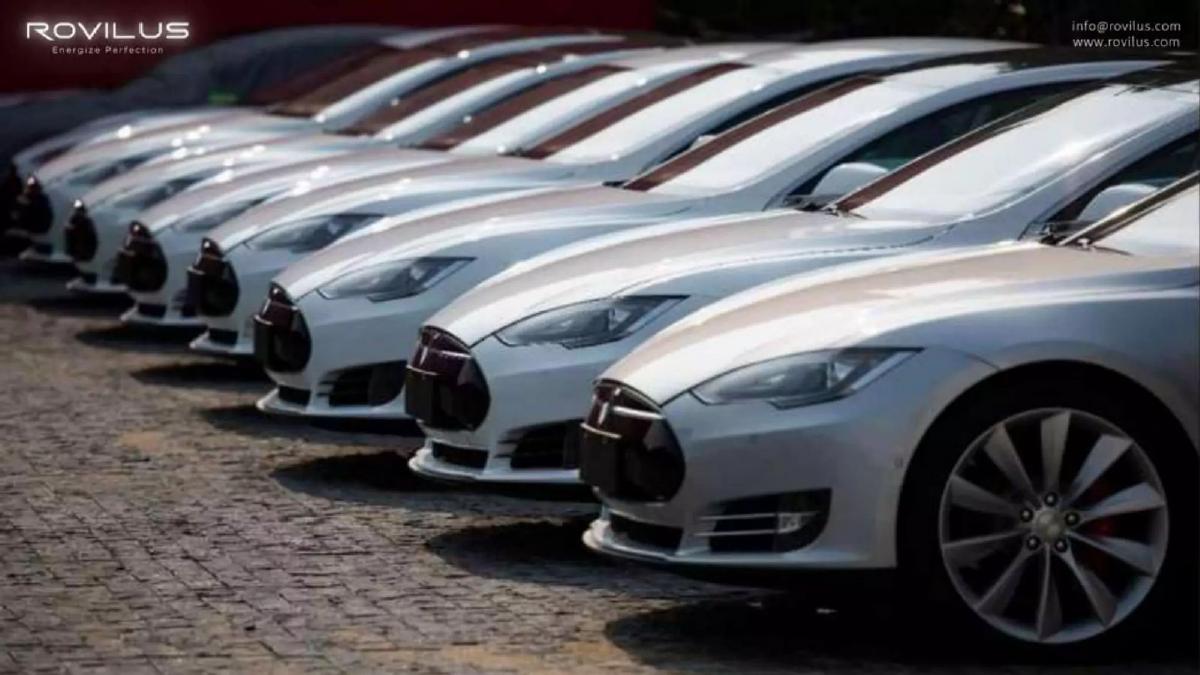
Slide 1 is a standard title slide featuring the logo and the tagline "Energize Perfection." The aesthetic is dark, sleek, and modern, setting a high-tech tone. Slide 2 and Slide 3 are unconventional; they feature a large portrait of Elon Musk and a row of Teslas. While the deck does not explicitly state the connection, the implication is clear: Rovilus is positioning itself within the broader EV revolution sparked by industry leaders, though their specific focus is industrial rather than consumer.
Slide 4 transitions the focus to the industrial sector. It uses a three-paneled image showing a semi-truck, a combine harvester, and a forklift. This is the first indication of the company's target market—heavy-duty machinery that requires more robust power solutions than a standard passenger car.
Slides 5-7: Market Size and Complexity
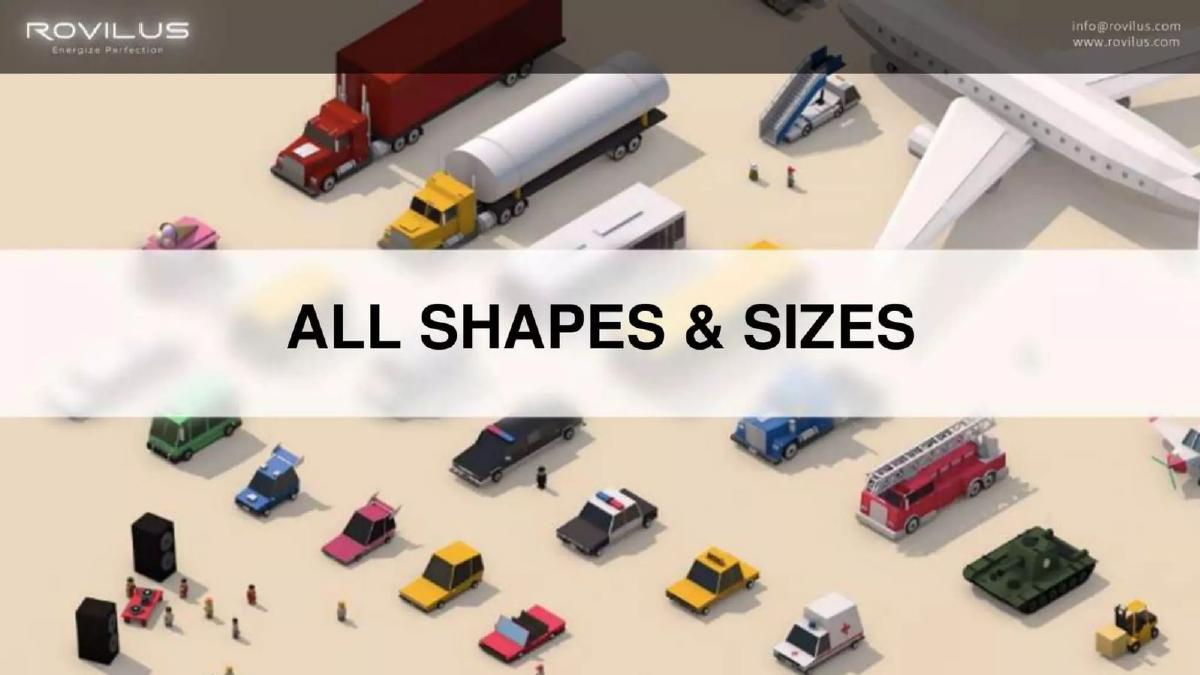
Slide 5 presents a single, bold metric: $201B TAM . By placing this number in isolation, Rovilus ensures the scale of the opportunity is the only takeaway. Slide 6 , titled "ALL SHAPES & SIZES," uses a low-poly isometric graphic of various vehicles—from tanks and ambulances to ice cream trucks and planes. This illustrates the versatility required in the battery market. Slide 7 follows up with "DIFFERENT PERFORMANCE NEEDS," showing a forklift, a scooter, and a jet. The narrative here is that a one-size-fits-all battery does not exist for the industrial world.
Slides 8-10: The Problem Statement
Slide 8 introduces the concept of a "CUSTOM BATTERY SOLUTION" over a ghosted image of a vehicle chassis. This sets up the transition to the pain points. Slide 9 highlights "BILLIONS IN R&D COSTS" against a background of scattered dollar bills, suggesting that current battery development is prohibitively expensive for many OEMs. Slide 10 hits the most visceral pain point: "SAFETY ISSUES." The slide features a dramatic photo of a car engulfed in flames, emphasizing the danger of thermal runaway in lithium-ion batteries—the exact problem Rovilus claims to solve.
Slides 11-13: The Solution and Technical Specs
Slide 11 introduces the "MODULARIZED DESIGN." It lists three key benefits: Most Cost-Efficient Fleet , Vehicle Integrity Maintained , and High Power Output . The visual shows a modular battery pack being assembled, reinforcing the ease of integration. Slide 12 is the technical heart of the deck, titled "FIRE-SUPPRESSING THERMAL MANAGEMENT SYSTEM." It provides three specific performance claims: 3x increase in lifetime , 16x fast charging , and an operational temperature range of -40°F to 140°F . This is the most data-dense slide in the deck and serves as the primary value proposition for engineers and industrial buyers.
Slides 14-15: Traction and Sales Efficiency
Slide 14 makes a bold claim regarding the sales process. It shows the logos of GM, A123 Systems, and Hinduja Tech above the text "3x Shorter Sales Cycle." This suggests that Rovilus's modular approach bypasses the lengthy custom engineering phases typically required by major automotive and battery players. Slide 15 provides the "wow" factor for investors. It shows a progression from $20K Gross Revenue to $102M MOUs , linked by the phrase "Successful POCs." This indicates that while the company is currently in the early revenue stage, their pilot programs have successfully converted into a massive potential backlog.
Slides 16-17: The Team and Contact
Slide 16 introduces the team. Co-founders Gigi Huang and Katherine Kan are listed alongside Sales Advisors Evan Sanders and William Chang. The inclusion of Sanders is particularly notable, as his background as the Former VP of Global Sales at A123 Systems lends significant credibility to the "3x Shorter Sales Cycle" claim on the previous slide. The slide also features logos from the Ministry of Science and Technology, Voltaiq, and Delta-Q Technologies. Slide 17 concludes the deck with contact information, including a phone number, email, and website.
What Works in the Rovilus Deck
Visual Impact: The deck uses high-quality imagery and minimal text to maintain a fast pace. This is effective for a first-look deck intended to secure a meeting. · Clear Value Prop: The performance metrics on Slide 12 (3x lifetime, 16x charging) are specific and highly desirable in the industrial sector. · Pipeline vs. Revenue: By highlighting the $102M in MOUs, the founders successfully frame the company as a high-growth opportunity despite having very little current revenue. · Industry Credibility: The advisors listed on Slide 16 have direct experience in the sectors Rovilus is targeting, which mitigates the risk associated with a pre-seed team.
What is Missing from the Rovilus Deck
The Ask: There is no slide indicating how much money the company is raising, what the terms are, or what the milestones for the next 18 months look like. · Competition: The deck mentions GM and A123 Systems in the context of sales cycles but does not provide a competitive matrix or a "Why Us" comparison against other thermal management startups. · Unit Economics: While they mention being "cost-efficient," there is no data on the cost of goods sold (COGS) or the expected margins on their battery packs. · Intellectual Property: The catalogue listing mentions "patented thermal management technology," but the deck itself does not detail the patent status or what specifically is protected.
What a Founder Should Copy
The "MOU Bridge": If you are a hardware founder with low revenue but high interest from big players, use the Slide 15 format. Showing that a $20K pilot turned into a $100M+ potential contract is the best way to prove market fit. · Modular Visualization: Use 3D renders (like Slide 11) to show how your product fits into a customer's existing workflow. It makes a complex hardware solution feel tangible and easy to adopt. · Isolated Big Numbers: Don't bury your TAM or your key performance indicators in a sea of bullet points. Putting "$201B TAM" or "16x Fast Charging" in large font on its own slide ensures it sticks in the investor's memory.
Frequently asked questions
- What is the core technology Rovilus is pitching?
- Rovilus is pitching a patented fire-suppressing thermal management system for industrial battery packs. According to Slide 13, this system enables a 3x increase in battery lifetime and 16x faster charging speeds. The technology is designed to be modular, allowing it to fit various vehicle shapes and sizes while maintaining structural integrity and high power output.
- How does Rovilus demonstrate market traction with such low revenue?
- While Slide 15 shows only $20K in gross revenue, the company uses this as a springboard to highlight $102M in Memorandums of Understanding (MOUs). They attribute this massive pipeline to 'Successful POCs' (Proof of Concepts). This strategy shifts the investor's focus from current cash flow to future contract potential and market validation.
- Who are the key people behind Rovilus?
- The team consists of Co-Founders Gigi Huang and Katherine Kan. They are supported by Sales Advisors Evan Sanders (former VP of Global Sales at A123 Systems) and William Chang (Ministry of Science & Technology and CEO of iCAN Program). The slide also lists logos for Voltaiq, Delta-Q Technologies, and Microtek, implying past experience or partnerships.
- What specific problem is Rovilus solving in the battery market?
- Rovilus targets the industrial sector where standard batteries face 'Billions in R&D costs' (Slide 9) and significant 'Safety Issues' (Slide 10), specifically fires. They aim to provide a 'Custom Battery Solution' (Slide 8) that addresses the 'Different Performance Needs' (Slide 7) of heavy machinery, scooters, and aircraft that consumer-grade batteries cannot meet.
- What is missing from the Rovilus pitch deck?
- The deck is notably missing a 'The Ask' slide, which usually details how much capital is being raised and at what valuation. It also lacks a roadmap, detailed financial projections, and a competitive landscape matrix. The presentation relies heavily on high-level claims and visual metaphors rather than granular technical or financial data.