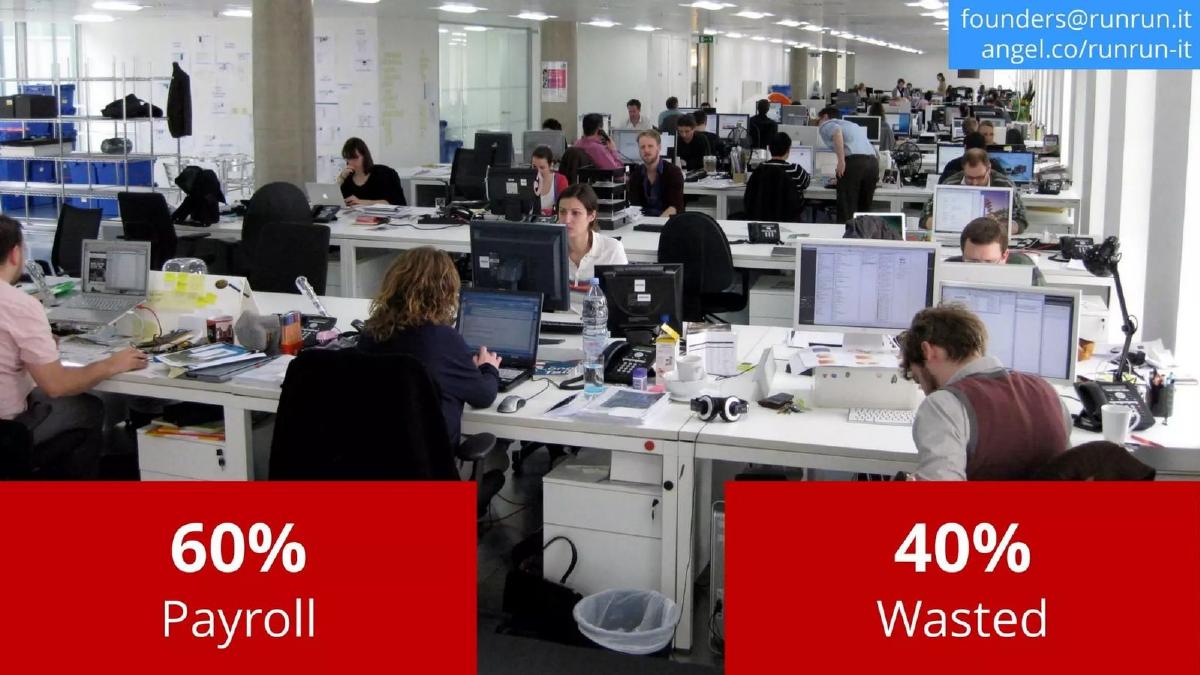
Runrun.it’s Series A deck is a masterclass in Demo Day efficiency. Spanning 13 slides, it eschews dense paragraphs for bold, singular metrics and high-quality photography. The narrative centers on a core problem: 40% of corporate payroll is wasted on inefficient task management. By the time the deck reaches the traction slide, the company reveals a robust $2M ARR and a customer base of over 1,000 paying companies. The founders leverage their previous successful exit of Aorta Mobile to establish immediate credibility. While the deck lacks detailed unit economics and a specific 'ask' for the ro…
Key takeaways
- The deck identifies a specific pain point: 40% of payroll is 'wasted' due to inefficient management (Slide 4).
- The global market for team management solutions is valued at $21 billion (Slide 5).
- The founding team has a proven track record, having successfully exited Aorta Mobile to Grupo RBS (Slide 7).
- Runrun.it was recognized as a G2 Crowd Leader in Summer 2018 (Slide 8).
- The product uses AI to 'Learn & Predict' workflow outcomes (Slide 9).
- Customer testimonials claim significant efficiency gains, such as reducing processes from 4 days to 6 hours (Slide 10).
- Traction is significant, with $2M in ARR and 1000+ paying companies at the time of the presentation (Slide 12).
- The Serviceable Addressable Market (SAM) is estimated at $2 billion (Slide 12).
The Demo Day Format: Impact Over Information
The Runrun.it pitch deck, presented at the 500 Startups Demo Day in Miami on November 01, 2018, is a textbook example of a presentation designed for a live audience. With only 13 slides and minimal text, it relies on the speaker to provide the nuance while the visuals drive home emotional and statistical anchors. The deck focuses on the massive scale of corporate waste and the proven capability of the team to solve it.
Slides 1-4: The Hook and the Problem
Slide 1 is a standard title slide featuring the Runrun.it logo and the event details. It establishes the brand immediately with its signature red background.
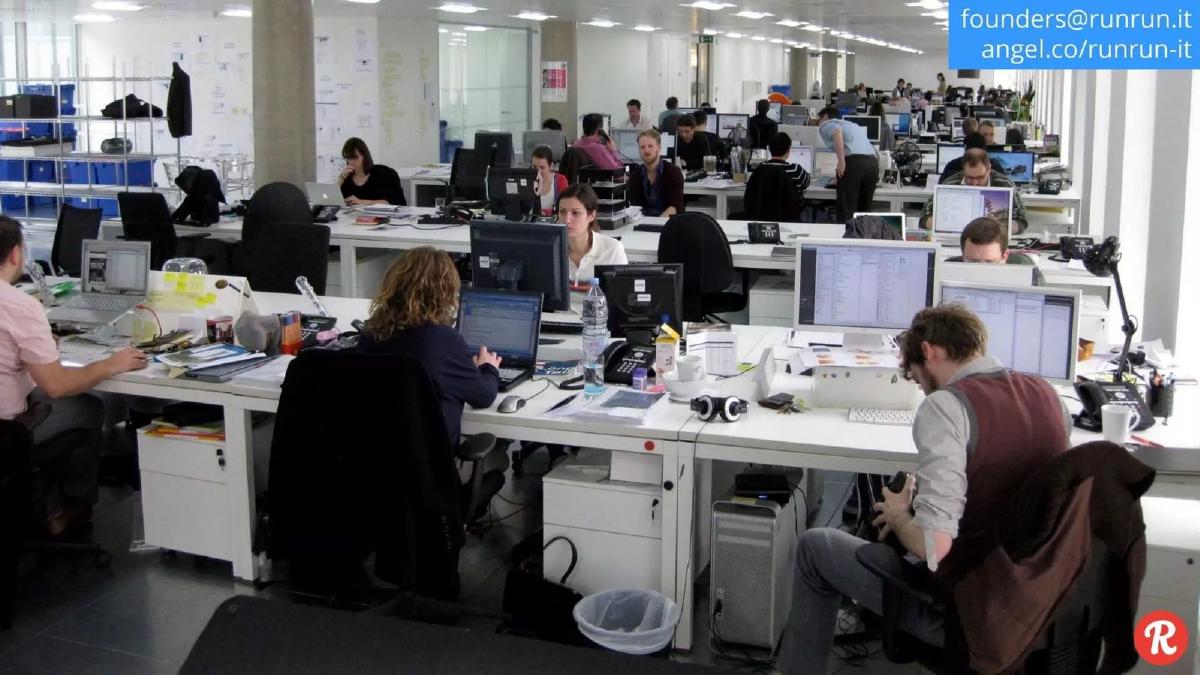
Slide 2 shows a busy, open-plan office. There is no text on this slide, serving as a visual backdrop for the founder to describe the chaos of modern work. Notably, the top right corner of this and subsequent slides contains contact information: founders@runrun.it and an AngelList link.
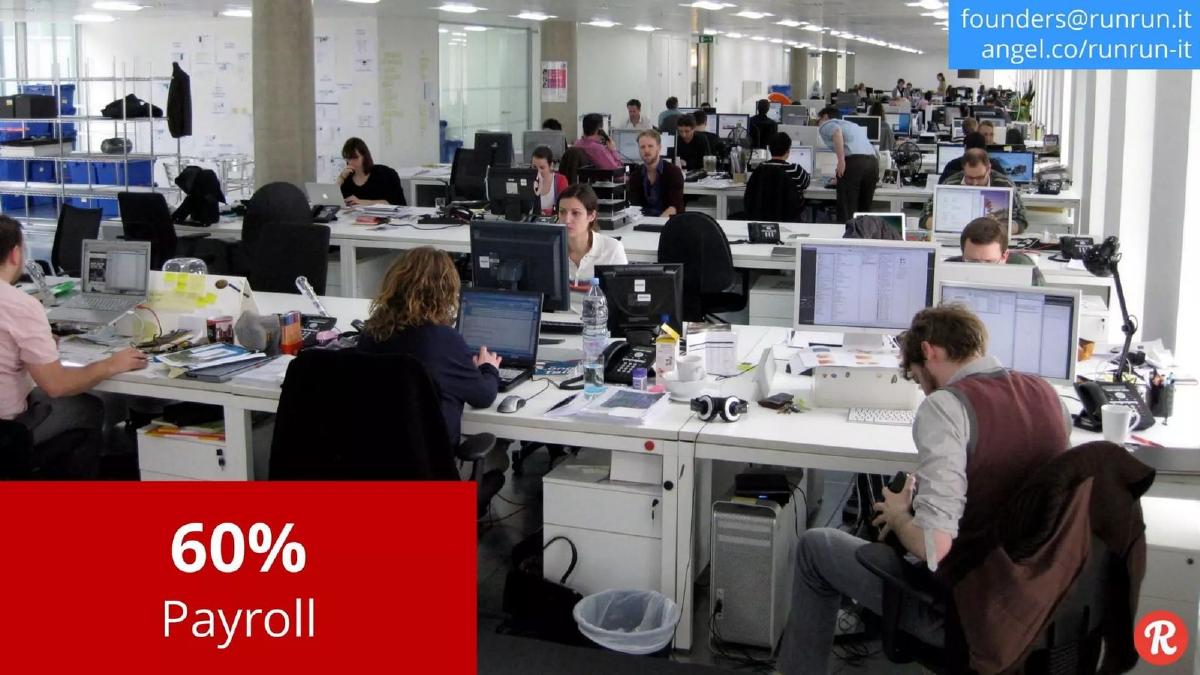
Slide 3 and 4 introduce the core 'villain' of the pitch. Slide 3 highlights that 60% of company costs are 'Payroll.' Slide 4 adds a second box stating that 40% of that is 'Wasted.' This is a powerful framing technique; it doesn't just say 'work is hard,' it attaches a specific, massive dollar value to the inefficiency Runrun.it intends to fix.
Slides 5-6: Market Size and Emotional Pain
Slide 5 defines the opportunity. Against a backdrop of a confused man and a chalkboard of tangled arrows, the deck claims a '$21 Billion Global Market.' This positions the startup as a player in a high-ceiling industry, essential for a Series A pitch.
Slide 6 shifts to the emotional toll on managers. A photo of a frustrated man screaming is paired with three words: 'Clumsy, Costly, Unreliable.' This slide validates the daily experience of the target customer, moving the pitch from abstract market data to relatable human frustration.
Slide 7: The 'Proven Team' Credibility
Slide 7 is one of the most important slides in the deck. It introduces the three founders: Franklin Valadares (CTO), Patrick Lisbona (CFO), and Antonio Carlos Soares (CEO). Rather than just listing titles, the slide features a prominent banner: 'Successfully founded, scaled and exited Aorta Mobile to Grupo RBS.' For investors, this significantly de-risks the investment, proving the founders know how to build a company to an exit. Their backgrounds at Deloitte Consulting and various Brazilian universities (USP, FGV, IBMEC) further bolster their professional standing.
Slides 8-9: The Solution and the Tech
Slide 8 showcases the product across multiple devices: a laptop, tablet, smartphone, and smartwatch. This demonstrates a mature, cross-platform ecosystem. A 'G2 Crowd Leader Summer 2018' badge is included, providing third-party validation that the product is already well-regarded in the market.
Slide 9 introduces the technological edge: 'AI Learns & Predicts.' In 2018, this was a significant differentiator. It moves the product from a passive recording tool (like a basic timesheet) to an active management assistant that can forecast delays before they happen.
Slides 10-11: Social Proof and Case Studies
Slide 10 and 11 use LinkedIn-style profiles to present testimonials. Slide 10 features Bruno Baldo, who claims the tool moved his processes 'From 4 days to 6 hours.' Slide 11 features Renato Oliveira, who states the tool 'Slashed costs by 40%.' By using real names and photos, the deck makes these efficiency gains feel concrete and achievable rather than theoretical.
Slide 12: The Traction Slide
Slide 12 delivers the 'knockout' metrics. It lists three key figures: a '$2B SAM' (Serviceable Addressable Market), '$2M ARR' (Annual Recurring Revenue), and '1000+ Paying Companies.' For a startup in an accelerator program, $2M in ARR is exceptionally strong traction. This slide confirms that the product-market fit has been found and the company is ready to scale.
Slide 13: The Summary
Slide 13 concludes the deck by reiterating the three pillars of the investment thesis: 'Product Leader,' '$2B Market Opportunity,' and 'Proven Team.' It leaves the G2 Crowd Leader badge on the screen, ensuring the final impression is one of established success.
What Works in the Runrun.it Deck
Extreme Clarity: The deck follows the 'one idea per slide' rule perfectly. There are no crowded charts or small fonts. This ensures the audience stays focused on the speaker while the slide reinforces the message.
Focus on Waste: By quantifying inefficiency as '40% Wasted Payroll,' the founders create a compelling financial reason for a CEO to buy their software. It transforms the product from a 'nice-to-have' organizational tool into a 'must-have' cost-saving engine.
Team Pedigree: Highlighting a previous successful exit is the strongest possible signal for a Series A founder. It tells investors that this team knows the full lifecycle of a startup.
What is Missing from the Runrun.it Deck
Unit Economics: While $2M ARR is impressive, the deck does not explain how much it costs to acquire those customers (CAC) or what their lifetime value (LTV) is. For a Series A, investors usually want to see the 'money in, money out' engine of the business.
Competitive Landscape: The project management space is notoriously crowded (Asana, Monday.com, Trello, Jira). The deck does not explicitly state how Runrun.it wins against these incumbents, other than a brief mention of AI predictions.
The Ask: The deck never mentions how much money they are looking to raise or what the milestones for the next 18 months will be. This is common in Demo Day decks where the goal is to start conversations rather than close a deal on the spot, but it leaves the narrative incomplete for a standalone read.
What Founders Should Copy
The 'Villain' Slide: Founders should copy the way Runrun.it identifies a specific, quantifiable enemy (40% wasted payroll). It makes the problem feel urgent and expensive.
Visual Testimonials: Instead of anonymous quotes, using real photos and professional titles (as seen on slides 10 and 11) adds a layer of authenticity that text-only testimonials lack.
Minimalism for Live Pitches: If you are pitching on a stage, your slides should look like this. They are designed to be seen from the back of a room and understood in three seconds. Save the spreadsheets and dense text for the follow-up data room.
Final Analysis
Runrun.it’s deck is a high-signal, low-noise presentation. It relies heavily on the company's existing momentum—specifically its $2M ARR and the founders' track record—to do the heavy lifting. While it leaves many operational questions unanswered, it succeeds in its primary goal: proving that the company is a serious, professional outfit tackling a massive market with a product that users already love.
Frequently asked questions
- What is the primary problem Runrun.it aims to solve?
- Runrun.it targets the inefficiency of corporate work environments. According to slides 3 and 4, while 60% of a company's budget goes to payroll, 40% of that effort is wasted. The deck characterizes current management methods as 'Clumsy, Costly, and Unreliable' (Slide 6), positioning their software as the solution to reclaim that lost productivity through better tracking and AI-driven predictions.
- How much traction did Runrun.it have when this deck was used?
- At the time of the 500 Startups Demo Day in November 2018, Runrun.it reported $2 million in Annual Recurring Revenue (ARR). Additionally, the company stated it had over 1,000 paying companies using the platform (Slide 12). This level of traction is high for a typical accelerator graduate, reflecting their Series A stage and established presence in the Brazilian market.
- Who are the founders and what is their background?
- The company was founded by Franklin Valadares (CTO), Patrick Lisbona (CFO), and Antonio Carlos Soares (CEO). Their pedigree includes experience at Deloitte Consulting and mobile carriers, with education from institutions like PUC-MG, IBMEC, USP, and FGV. Crucially, slide 7 highlights that they 'Successfully founded, scaled and exited Aorta Mobile to Grupo RBS,' establishing them as serial entrepreneurs.
- What role does AI play in the Runrun.it platform?
- Slide 9 explicitly states 'AI Learns & Predicts.' The deck suggests that the software goes beyond simple task tracking by using machine learning to forecast project timelines and delivery dates. This is reinforced by the product screenshot on slide 8, which shows a dashboard with metrics for 'Tasks behind schedule' and 'Projects with delay,' presumably powered by these predictive algorithms.
- What is missing from this pitch deck?
- As a Demo Day deck, it is intentionally light on detail. It lacks a slide on unit economics (LTV/CAC), a detailed competitor matrix, a roadmap of future features, and a specific financial 'ask' (how much they are raising and the terms). It also omits a breakdown of their go-to-market strategy or how they plan to expand beyond their initial 1,000+ customers.